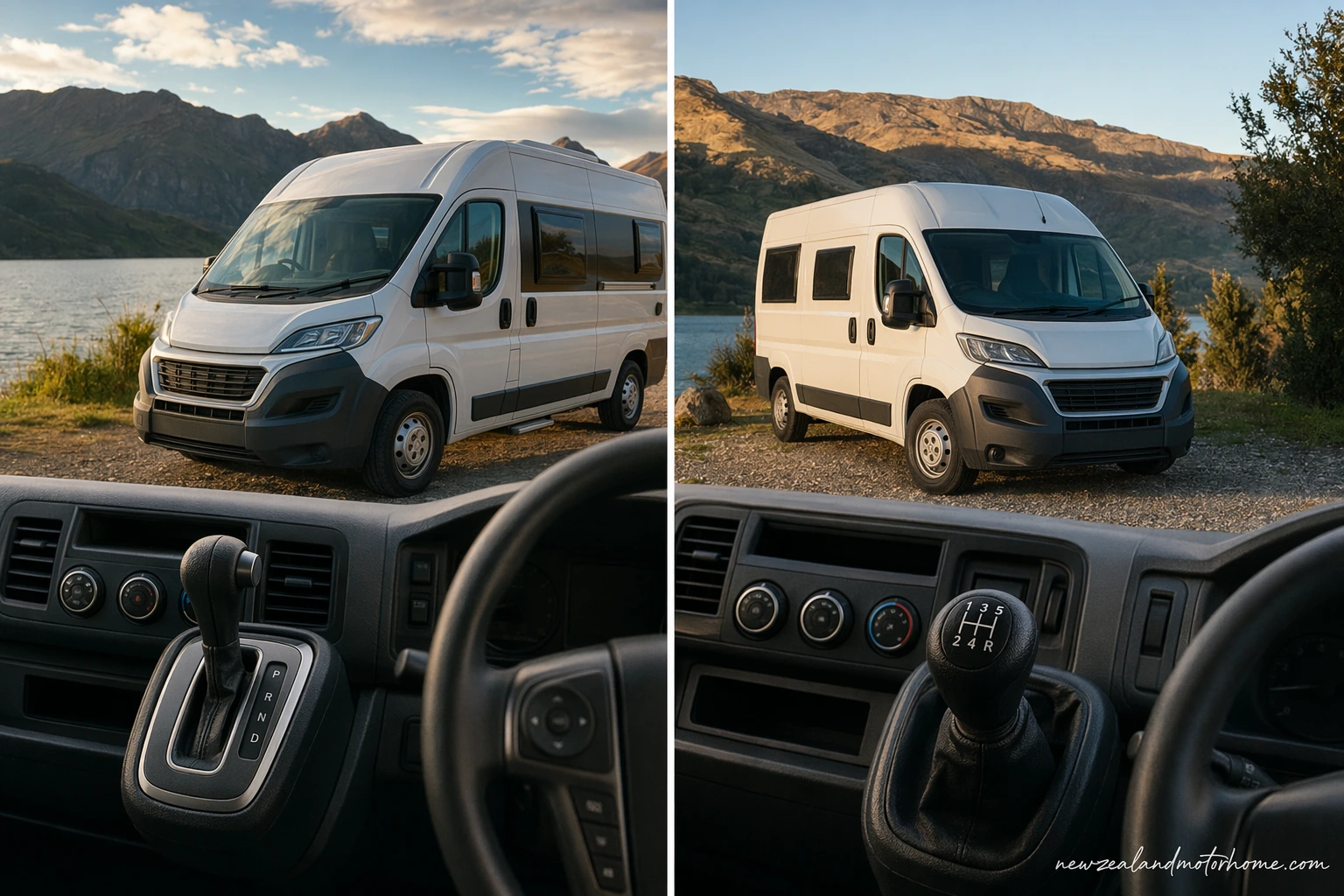
- Automatic best for first-timers
- Manual suits confident gear drivers
- Freedom camping depends on certification
- Van length matters for parking
- Powered sites work with either
Choosing between an automatic and manual campervan in New Zealand is less about being a “better” driver and more about how you want the trip to feel. You will be driving on the left, easing a high-roof van through supermarket car parks, pulling into holiday park sites, and sometimes crawling up steep, bendy roads with a queue behind you.
This comparison is written for self-drive travellers who will be sleeping in the van, not just using it for day trips. We will look at the real trade-offs: comfort on alpine roads, parking and reversing, powered and unpowered campsites, freedom camping eligibility, fuel and hire cost, and who each transmission suits best.
The short answer: transmission matters, but not as much as van size
If you are nervous about driving a campervan in New Zealand, an automatic is usually the calmer choice. It lets you focus on lane position, mirrors, road signs, one-lane bridges and where the rear of the van is tracking, rather than clutch control.
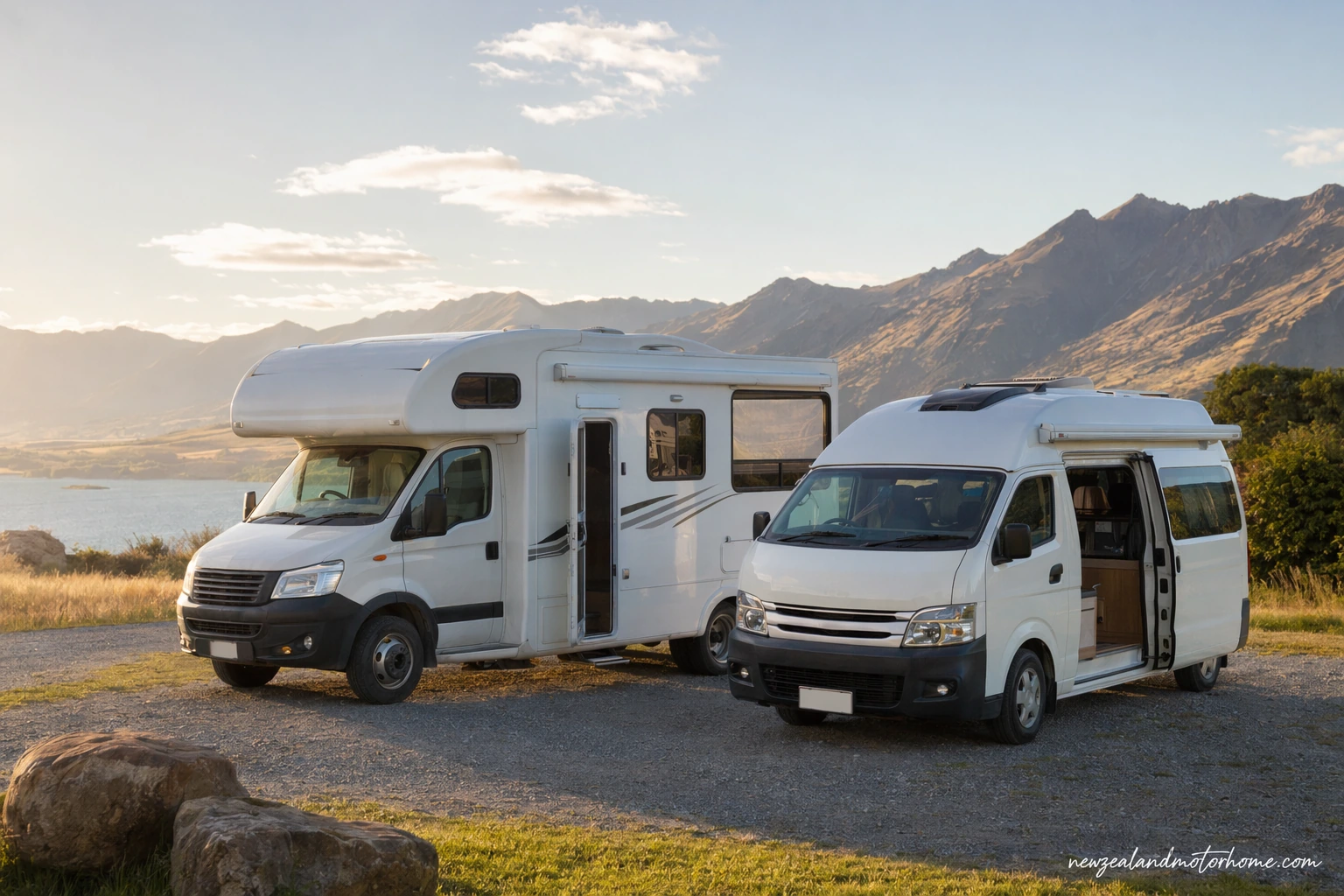
A manual can still be a good option if you are confident with gears and want more control on long descents. The bigger decision, though, is often vehicle size: a compact two-berth van is easier to park and turn than a six-berth motorhome, whether it is automatic or manual.
- Automatic: easier in traffic, tight holiday park lanes and stop-start town driving.
- Manual: familiar for drivers who like gear control on hills and gravel access roads.
- Both: can use powered sites, unpowered sites, dump stations and fresh-water fills if the van is set up for them.
- More important than transmission: height, length, rear overhang, turning circle and whether the van is certified self-contained.
Road feel on New Zealand hills, passes and coastal bends
New Zealand roads can be slow even when the distance looks short on a map. Expect winding coast roads, narrow shoulders, steep climbs, stock trucks, cyclists and single-lane bridges. In places like the Crown Range, Arthur’s Pass, the West Coast, the Coromandel and the roads into Aoraki Mount Cook, you will be working the vehicle more than you might on a motorway at home.
An automatic is comfortable because it removes the constant gear-changing through bends and small towns. In a heavier motorhome, it also makes hill starts less stressful when you pull out from a lookout, fuel stop or roadside lay-by.
A manual can be satisfying on descents because you can select a lower gear early and avoid riding the brakes. If you choose manual, be honest about your hill-start confidence with a loaded van, especially after a long day when you are arriving at camp tired.
- Use slow vehicle bays when traffic builds behind you.
- Allow more braking distance than you would in a car, especially after rain.
- Check your van height before entering covered car parks or low service station canopies.
- On gravel access roads to some basic camps, drive slowly and avoid sudden braking, whichever transmission you hire.
Parking the van: supermarkets, lookouts and campsites
Parking is where many first-time campervan drivers feel the difference most. An automatic makes creeping into a bay, reversing onto a powered site and edging around a tight holiday park corner simpler because you can move slowly without balancing the clutch.
With a manual, low-speed manoeuvring takes more concentration, especially on sloped grass or gravel. It is not a problem for confident manual drivers, but it can add stress when someone is waiting behind you at a dump station or the campsite office has given you a narrow site between two larger motorhomes.
- Choose drive-through or wider sites where available if you are new to larger vans.
- Park away from the busiest supermarket entrance and walk the extra minute.
- Use a spotter when reversing near picnic tables, power bollards, trees or water taps.
- Arrive at your overnight stop before dark until you are used to the van’s mirrors and rear swing.
Transmission will not decide whether you fit in a town car park; dimensions will. Always check the hire vehicle’s length and height, and remember that roof vents, solar panels and bike racks can change how much space you need.
Powered sites, freedom camping and overnight eligibility
An automatic vs manual choice does not change which campsites you are legally allowed to use. Powered sites, unpowered sites, Department of Conservation-style basic camps and holiday park pitches are generally about vehicle setup, booking rules, ground conditions and space, not the gearbox.
Freedom camping is different again: what matters is whether the campervan is certified self-contained and whether the local bylaw allows overnight stays in that exact place. A manual van without certification will not become eligible just because it is smaller, and an automatic motorhome still needs to follow signs, time limits and any designated parking lines.
- Powered site: good for topping up house batteries, using mains appliances and staying warm in cooler months.
- Unpowered site: works best when you manage lights, fridge use, water and charging carefully.
- Freedom camping: check self-containment certification and local signage before you settle in.
- Basic camps: check access notes; some have gravel roads, tight turns or limited space for long vehicles.
Whichever transmission you choose, plan regular dump station stops, fresh-water fills and LPG refills if your van uses gas for cooking, hot water or heating. These service stops are part of the route, not an afterthought.
Cost, availability and fuel: the practical trade-offs
Manual campervans can sometimes be cheaper to hire, but availability varies by season, van size and depot. Automatics are popular with international travellers and people who want a more relaxed drive, so the best layouts can book out early for summer, school holidays and long weekends.
Fuel use is not determined by transmission alone. A tall, heavy motorhome driven into a headwind will use more fuel than a lighter van, regardless of gearbox. Your speed, tyre pressure, roof load, road gradient and how often you stop-start through towns all matter.
- Compare actual van layouts, not just transmission labels.
- Check whether the daily driving comfort is worth any difference in hire cost.
- Look at bed setup, internal standing room, toilet/shower, water capacity and battery capacity.
- Ask about roadside support, tyre rules and whether gravel road restrictions apply.
If you are unsure which trade-off suits your route, use our talk to us step and tell us where you want to overnight, how confident you are driving manual, and whether you are aiming for holiday parks, freedom camping or a mix.
Who should choose automatic, and who should choose manual?
Choose an automatic if this is your first time driving on the left, your first time in a high-roof campervan, or you want the simplest experience in towns and campgrounds. It is also the better fit if you will be sharing driving with someone who rarely drives manual.
Choose a manual if you drive manual regularly, enjoy controlling gears on hills, and are comfortable reversing and doing hill starts in a larger vehicle. It can suit travellers who are watching the budget and do not mind a more involved driving style.
- First-time NZ campervan travellers: automatic is usually the safer, calmer pick.
- Confident manual drivers: manual is fine if the layout and size suit your route.
- Long South Island loop: comfort matters because mountain roads and weather changes can be tiring.
- Mostly holiday parks: either works, but automatic helps with tight powered-site manoeuvres.
- Freedom camping focus: prioritise certified self-contained status, water capacity and battery setup over transmission.
Common questions
Is an automatic campervan better for driving in New Zealand?
For many visitors, yes. An automatic lets you focus on driving on the left, judging the van’s width and handling winding roads without worrying about clutch control. It is especially helpful in towns, traffic and tight campground lanes.
Can a manual campervan use the same campsites as an automatic?
Yes. Transmission does not decide campsite access. Powered sites, unpowered sites and many basic camps depend on vehicle size, booking rules, ground conditions and whether your van has the right facilities.
Does automatic or manual affect freedom camping eligibility?
No. Freedom camping eligibility is about self-containment certification and local rules, not the gearbox. Always check the signs at the specific overnight spot and make sure your van meets current self-contained requirements.
Is a manual campervan hard to drive on New Zealand hills?
It depends on your confidence. If you drive manual often, you may like the control on climbs and descents. If you are rusty, steep roads, hill starts and reversing onto sloped sites can make a manual feel tiring.
Should I choose transmission or layout first?
Choose a van you can drive confidently, then check the layout carefully. Bed setup, toilet, water capacity, heating, storage, vehicle length and self-containment status will shape your overnight options more than the transmission alone.
Have a planner shape this for your dates
Send a short outline — your dates, party size, and the kind of trip you want. A planner replies with a vehicle recommendation, a paced route, and the realistic budget.