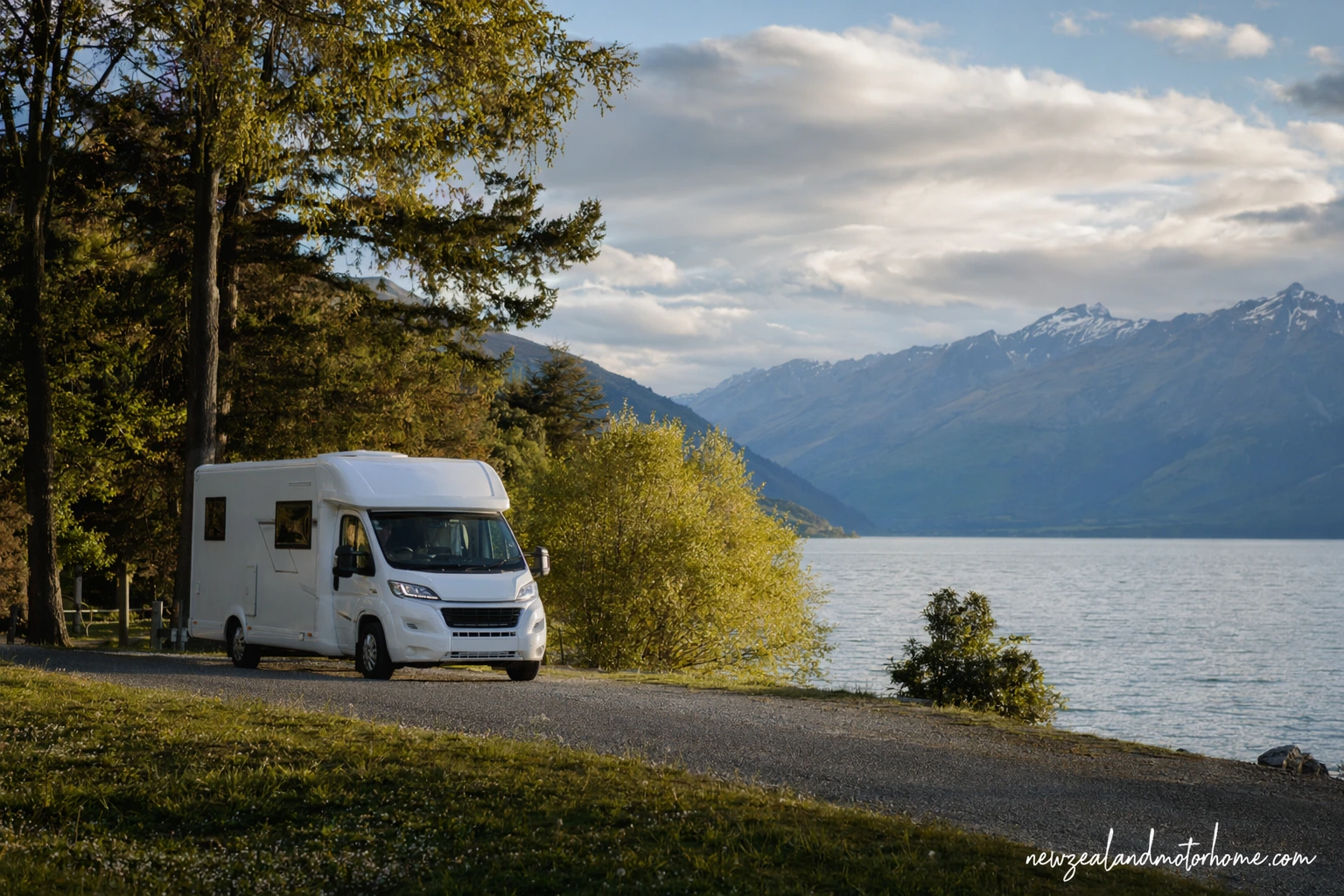
- Best as a 1–2 night side trip
- Sealed road from Queenstown
- Limited services beyond Queenstown
- Use approved overnight sites only
- Check gravel road access for large vans
Glenorchy feels like the place where the sealed road finally exhales: lake on one side, beech forest and braided rivers ahead, and the mountains closing in around the van. For self-drive travellers, it is one of the easiest ways to make Queenstown feel quieter — but it still needs a little campervan planning.
This Glenorchy campervan guide covers the drive from Queenstown, where to park without annoying locals, what to know about camping near Glenorchy, and how to use the township as a base for short walks, the Routeburn road-end and slower lakefront time in your motorhome.
Driving the Queenstown to Glenorchy road in a campervan
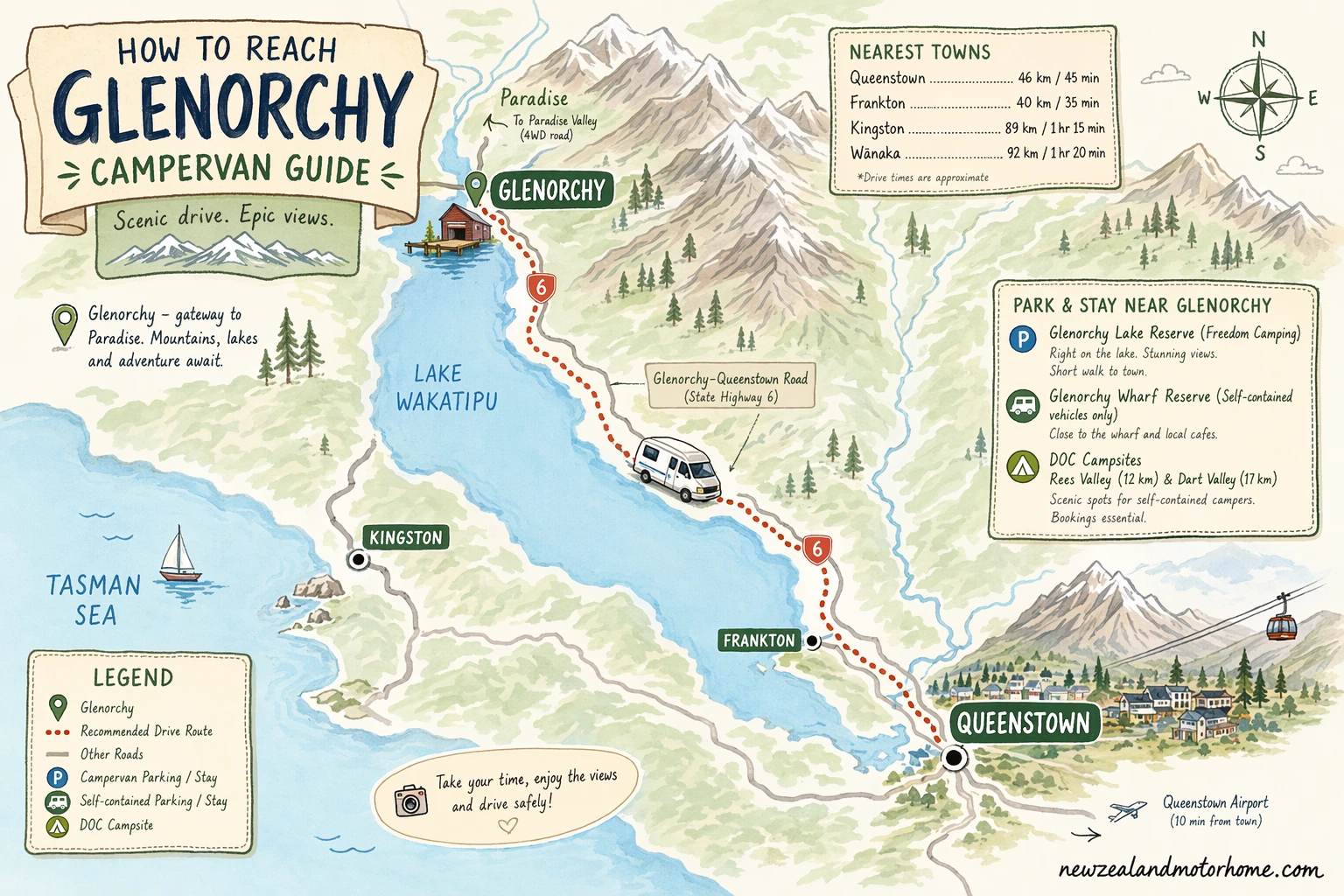
The Queenstown–Glenorchy Road is about 45 kilometres of sealed lakeside driving, and it is every bit as scenic as people say. In a campervan, the trick is to take it slowly rather than trying to keep pace with cars behind you; there are signed pull-offs where you can let traffic pass and enjoy the view without stopping on the lane edge.
The road is generally fine for standard hire campervans and motorhomes, but it has bends, occasional rockfall areas, lake winds and shaded winter patches that can stay icy. If you are driving a longer vehicle, use lower gears on descents and avoid squeezing into tiny informal lay-bys where you cannot turn around cleanly.
- Top up fuel, LPG and groceries in Queenstown or Frankton before you go; services become more limited beyond the lake road.
- Use formed viewpoints for photo stops, not private driveways or narrow road shoulders.
- In winter, check road conditions before an early start, especially after frost or snow.
- Allow extra time in high season, as traffic can bunch up behind larger vans.
Parking the van in Glenorchy township
Glenorchy is small, flat and easy to explore on foot once you have parked the van. Look for marked public parking around the township and lakefront area, then walk to the wharf, lagoon boardwalk and cafés rather than moving the vehicle for every short stop.
Do not treat day parking as an overnight option. Queenstown Lakes District is strict about freedom camping, and Glenorchy has plenty of signs because the lakefront and nearby reserves are sensitive, busy places. If you are in a campervan Glenorchy works best as a day base or as a night stop at an approved campground, not as a place to quietly tuck in beside the water.
- Park within marked bays and avoid blocking boat ramps, toilets, access gates or residential entrances.
- Large motorhomes may find the easiest parking a short walk back from the wharf rather than right on the busiest lakefront edge.
- Use public toilets during the day, but keep your own grey water and toilet waste for proper dump stations.
Where to stay overnight near Glenorchy
For most motorhome Glenorchy trips, the simplest overnight choice is a local holiday park or an established DOC-style campsite nearby. A holiday park suits travellers wanting powered sites, showers, fresh water and an easier reset after a few days on the road. Unpowered sites are better if you are self-contained and happy to keep things simple.
Camping near Glenorchy also includes more rustic options towards Kinloch, Sylvan and the Routeburn side, where you are closer to beech forest, river flats and trailheads. These sites can be beautiful but more basic, and access roads may be gravel, narrow or affected by weather. If you are in a large motorhome, check access suitability before committing to a remote road-end.
Before leaving Queenstown, plan your waste and water. Public dump station options and LPG refills are much easier to organise around Queenstown and Frankton than at the end of the lake road, so arrive in Glenorchy with empty waste tanks, full fresh water and enough gas for cooking and heating.
- Choose powered sites if you need battery recovery, heating support or a reliable charge for devices.
- Choose unpowered sites only if your house battery, water and toilet capacity match your stay.
- Only freedom camp where it is clearly permitted and only if your vehicle meets current self-containment requirements.
- Book ahead in summer, school holidays and around Great Walk season, as small campgrounds fill quickly.
Walks and road-end exploring from the van
The beauty of Glenorchy in a campervan is that you can park once and keep your plans flexible. The lagoon boardwalk is the easy local wander, with big mountain views for very little effort. The lakefront and wharf are ideal for a slow morning coffee from the van before you head towards a trailhead.
For a bigger day, many travellers drive towards the Routeburn Shelter for short forest walks or the start of the Routeburn Track. The approach is manageable in settled weather, but always check the latest road status and parking situation before taking a long or high-sided motorhome in. Road-end parking can be tight when trampers, shuttle vehicles and day walkers are all arriving at once.
Paradise, Rees and Dart valley roads are where you need to be more cautious. They are scenic but can involve gravel, corrugations, stock, dust, washouts and weather-dependent access. In a hire campervan, respect your rental agreement and do not push beyond signed limits or onto soft verges just to reach a photo spot.
How Glenorchy fits into a wider motorhome route
Glenorchy is usually a side trip from Queenstown rather than a through-route. There is no onward sealed highway over the mountains from here, so plan it as an out-and-back: Queenstown to Glenorchy, one or two nights if you want the slower version, then back to connect with Wanaka, Te Anau, Central Otago or the West Coast.
One night works if you mainly want the lake road, township and a short walk. Two nights gives you time to sit out a weather change, explore the Routeburn side, and avoid driving both ways in the same rushed afternoon. If you are building Glenorchy into a longer South Island campervan itinerary, our talk-to-us step is a useful way to sanity-check drive times, dump-station gaps and where powered nights make sense.
- From Queenstown: make it an overnight side trip when you want quiet scenery without a long relocation day.
- Before Te Anau or Milford Sound: use Glenorchy as a slower reset, then return to Queenstown for supplies.
- Before Wanaka: leave time for the Crown Range or Cromwell route after you come back from Glenorchy.
- With larger vans: avoid making Glenorchy a late-day add-on in winter darkness or poor weather.
Keep planning
Common questions
Can I freedom camp in Glenorchy in a self-contained campervan?
Only camp where freedom camping is clearly permitted and your vehicle meets current self-containment requirements. Glenorchy township and the lakefront are closely managed, so do not assume a scenic car park is an overnight spot.
Is the road to Glenorchy suitable for a motorhome?
Yes, the main road from Queenstown to Glenorchy is sealed and commonly driven by campervans and motorhomes. Take care with bends, wind, winter ice and viewpoint pull-offs, especially in a longer or wider vehicle.
Where should I empty waste and fill fresh water before Glenorchy?
It is safest to handle dump-station use, fresh-water fills, fuel and LPG around Queenstown or Frankton before heading up the lake. Facilities at the Glenorchy end are more limited, and some services may be for campground guests only.
How many nights should I allow for Glenorchy in a campervan?
One night is enough for the lake road, wharf, lagoon walk and a relaxed morning. Two nights are better if you want to explore the Routeburn side or have flexibility for rain, wind or road-end parking.
Can large motorhomes drive to Paradise or the Rees and Dart valleys?
Be cautious. Those roads can be gravel, narrow and weather-affected, and they may not suit larger motorhomes or some hire agreements. Check conditions locally and avoid unsealed or soft roadside areas if you are unsure.
Have a planner shape this for your dates
Send a short outline — your dates, party size, and the kind of trip you want. A planner replies with a vehicle recommendation, a paced route, and the realistic budget.