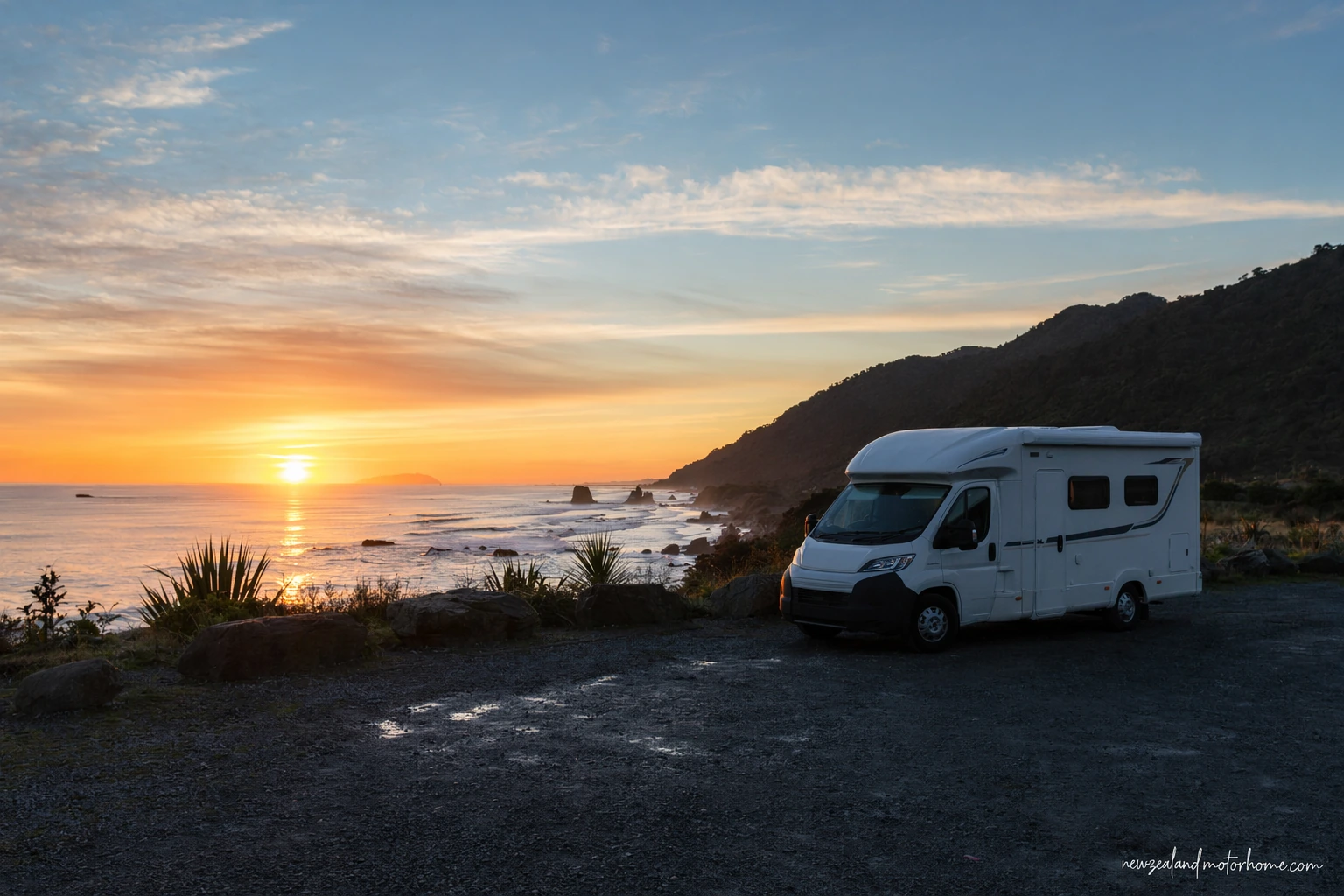
- Best for 1–2 nights
- Powered sites in town
- Unpowered lake camping nearby
- Check freedom camping signs
- Easy SH6 access
Hokitika is one of those West Coast towns that suits a campervan: flat streets, a proper service stop, beach sunsets close to town, and enough nearby lakes and rainforest walks to make a one-night stay turn into two. It is compact, but it is not just a fuel-and-groceries pause between Greymouth and the glaciers.
This hokitika campervan guide is written for travellers driving and sleeping in their own hired van. You will find practical notes on where to park the van, how to choose between powered and unpowered nights, what to know about freedom camping, and how Hokitika fits into a wider West Coast motorhome route.
Getting to Hokitika by campervan
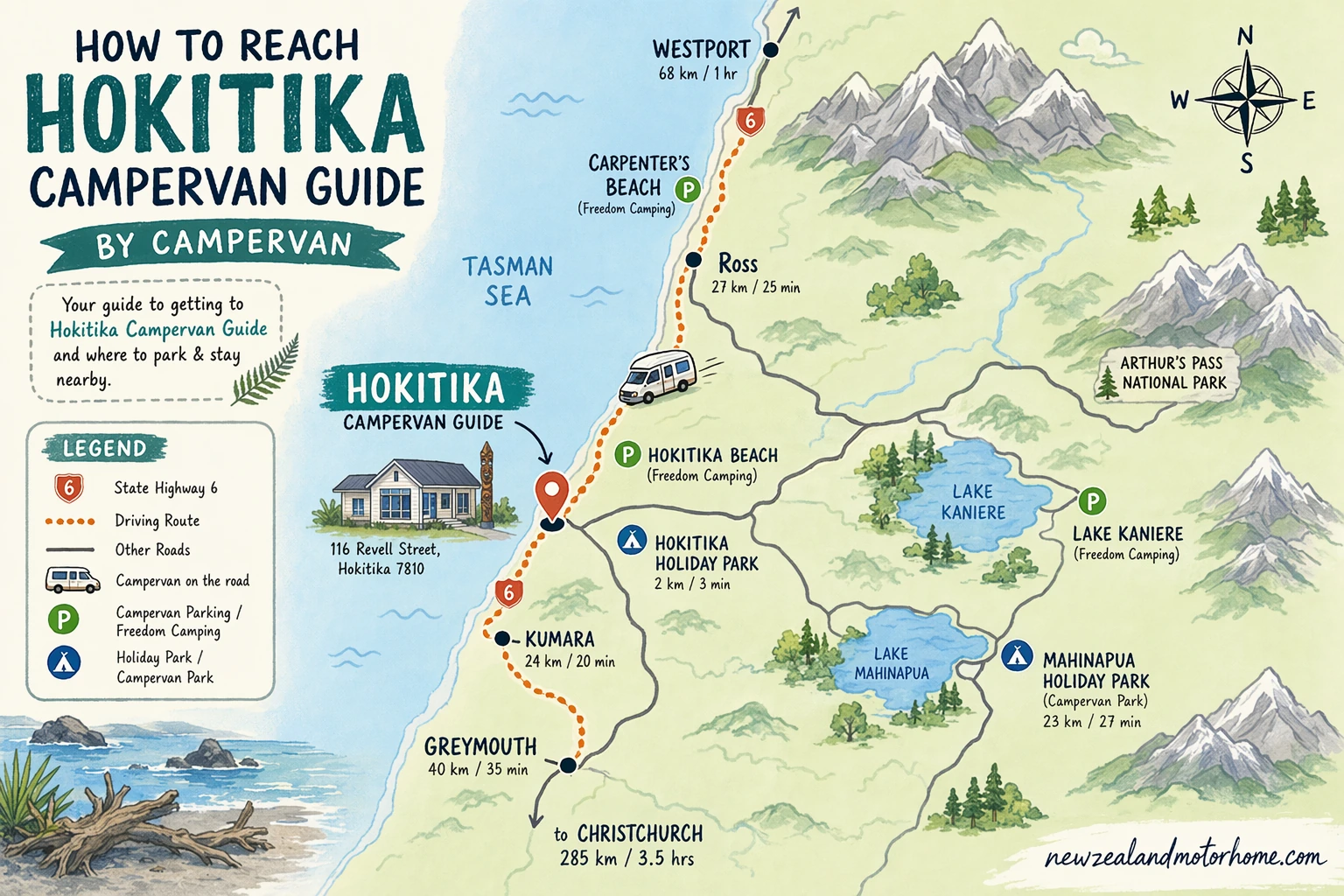
Hokitika sits on State Highway 6, about 40 kilometres south of Greymouth and a natural stop before the longer push towards Franz Josef and Fox Glacier. If you are coming from Christchurch, the usual campervan route is over Arthur’s Pass on State Highway 73, then down through Kumara Junction to the coast. It is a beautiful drive, but take it steadily: weather changes quickly, and the pass has steep grades, tight bends, and busy pull-offs.
Most standard 2-berth to 6-berth motorhomes handle the main approaches well, but build in time rather than trying to “make up” kilometres. On the West Coast, rain, roadworks, slips, and one-lane bridges can slow the day more than the map suggests.
- From Greymouth: easy SH6 driving, with coastal and river flats, but watch for local traffic and wet-road spray.
- From Arthur’s Pass: use lower gears on descents and pull over only where the van is fully clear of the lane.
- From the glaciers: allow extra time for one-lane bridges, winding forest sections, and photo stops that are safe for a longer vehicle.
Parking the van around town and the beach
Central Hokitika is generally manageable in a campervan, especially compared with hillier New Zealand towns. The main streets are flat, and many sights are close enough to park once and walk: the beach sign, river mouth, pounamu shops, cafés, and the town centre are all nearby.
For a campervan Hokitika stop, look for wider kerbside spaces or off-street public parking rather than squeezing into short angled parks. If your motorhome is over about 7 metres, avoid nosing into tight town parks where the rear overhang blocks traffic or footpaths. Beachfront parking can be handy for a daytime wander, but check signs carefully; a nice sunset spot is not automatically an overnight spot.
- Park early in the day if you want an easy walk to the beach and town centre.
- Keep clear of shop driveways, bus stops, and mobility parks.
- Use public toilets during the day, but do not treat town parking as a campsite unless signage allows it.
Where to stay overnight in and near Hokitika
Hokitika works well for both serviced nights and quieter unpowered stops. In town, holiday parks are the simplest choice if you want powered sites, showers, laundry, fresh water, and a legal place to plug in after a damp West Coast day. This is often the easiest first night after crossing Arthur’s Pass, especially if you need to dry gear or recharge devices.
Camping near Hokitika also includes conservation-style options around lakes such as Mahinapua and Kaniere, where facilities are usually more basic and sites are unpowered. Expect toilets rather than full service blocks, and check current access, booking rules, and seasonal conditions before you drive out, particularly after heavy rain.
Freedom camping is controlled by local bylaws. In the Westland District, you should only use places where overnight camping is permitted, and certified self-contained vans need to display the correct certification. Do not assume that a quiet beach car park, lake edge, or reserve allows overnighting.
- Choose powered in town if you need heating, laundry, charging, and a dump/fresh-water reset.
- Choose unpowered near the lakes if you are self-sufficient and happy with basic facilities.
- Check signs on arrival because rules can change between seasons and after local issues.
Dump stations, water, fuel and LPG
Hokitika is a practical motorhome Hokitika service stop before the distances open out again to the south. Fuel and groceries are available in town, and it is sensible to top up here if you are heading towards the glaciers, Haast, or a lake campsite for the night.
Use an approved dump station for grey water and toilet cassettes; holiday parks can usually advise guests on the correct facilities, and public dump points are signposted where available. Fresh-water fills should come from marked potable taps only, not from random hoses at beaches, reserves, or public toilets. For LPG, check fuel or hardware outlets in town before relying on a later stop, especially if your bottle is getting low.
- Empty the toilet cassette before heading into more remote camping near Hokitika.
- Refill drinking water before unpowered lake stays.
- Keep a small rubbish bag inside the van; bins at scenic stops are not for campsite waste.
- After heavy rain, allow extra drying time before packing wet awnings, mats, and outdoor chairs.
What to do from a Hokitika campsite
The beach is the easy first wander: park the van legally, walk down to the driftwood-strewn shore, and time it for sunset if the weather is behaving. The famous Hokitika beach sign is close to town, and the river mouth is a good leg-stretch after a long driving day.
For a short evening outing, the glow worm dell north of town is simple but best done with care: take a torch for the path, switch it off once you are viewing, and keep noise low. During the day, the pounamu carvers and local galleries give Hokitika a sense of place that is worth more than a quick photo stop.
The Hokitika Gorge is the bigger side trip. The drive inland is suitable for many campervans, but the rural roads are narrower than SH6, with farm traffic, bridges, and limited room to turn around in places. If your van is large, go slowly, park considerately at the gorge car park, and avoid arriving late when spaces are tight.
How Hokitika fits a wider West Coast route
Hokitika sits neatly between the wild limestone coast around Punakaiki and the glacier country to the south. Northbound, it is a good reset after Franz Josef or Fox Glacier before continuing to Greymouth, Punakaiki, or over Arthur’s Pass. Southbound, it is the last larger-feeling town before longer, wetter, more remote driving days.
A simple rhythm is to spend one night in Hokitika itself, then add a second night near Lake Kaniere or Lake Mahinapua if the weather is settled and your van is well stocked. That gives you time for the gorge, beach, and town without rushing the SH6 miles. If you are not sure how to balance powered nights with quieter unpowered stops, you can sketch your route and send it through the talk-to-us step for a second set of eyes.
- 1 night: town stay, beach walk, supplies, dump and water reset.
- 2 nights: add Hokitika Gorge or a lake campsite.
- 3 nights: slow West Coast pace with wet-weather flexibility and shorter driving days.
Keep planning
Common questions
Can I freedom camp in Hokitika in a campervan?
Only where local signage and Westland District rules allow it. Your van should be certified self-contained, and you still need to follow any time limits or prohibited-area notices. If in doubt, use a holiday park or an approved campsite rather than guessing.
Is Hokitika worth stopping at in a motorhome?
Yes, especially if you want a practical West Coast reset with fuel, groceries, beach walks, and easy access to Hokitika Gorge. It is also a useful powered-site stop after Arthur’s Pass or before heading into more remote glacier country.
Where can I camp near Hokitika without power?
Look at recognised conservation or lake campsites near places such as Lake Mahinapua or Lake Kaniere, checking current rules before you go. Facilities are usually basic, so arrive with water, empty waste tanks, and enough battery for the night.
Is the road to Hokitika Gorge suitable for campervans?
Many standard campervans can drive to the gorge, but the inland roads are narrower than the state highway and need slower driving. Larger motorhomes should take extra care with bridges, pull-offs, and turning space at the car park.
How many nights should I allow for Hokitika?
One night is enough for the town, beach, and a service reset. Two nights feels better if you want Hokitika Gorge, lake time, or a buffer for wet West Coast weather.
Have a planner shape this for your dates
Send a short outline — your dates, party size, and the kind of trip you want. A planner replies with a vehicle recommendation, a paced route, and the realistic budget.