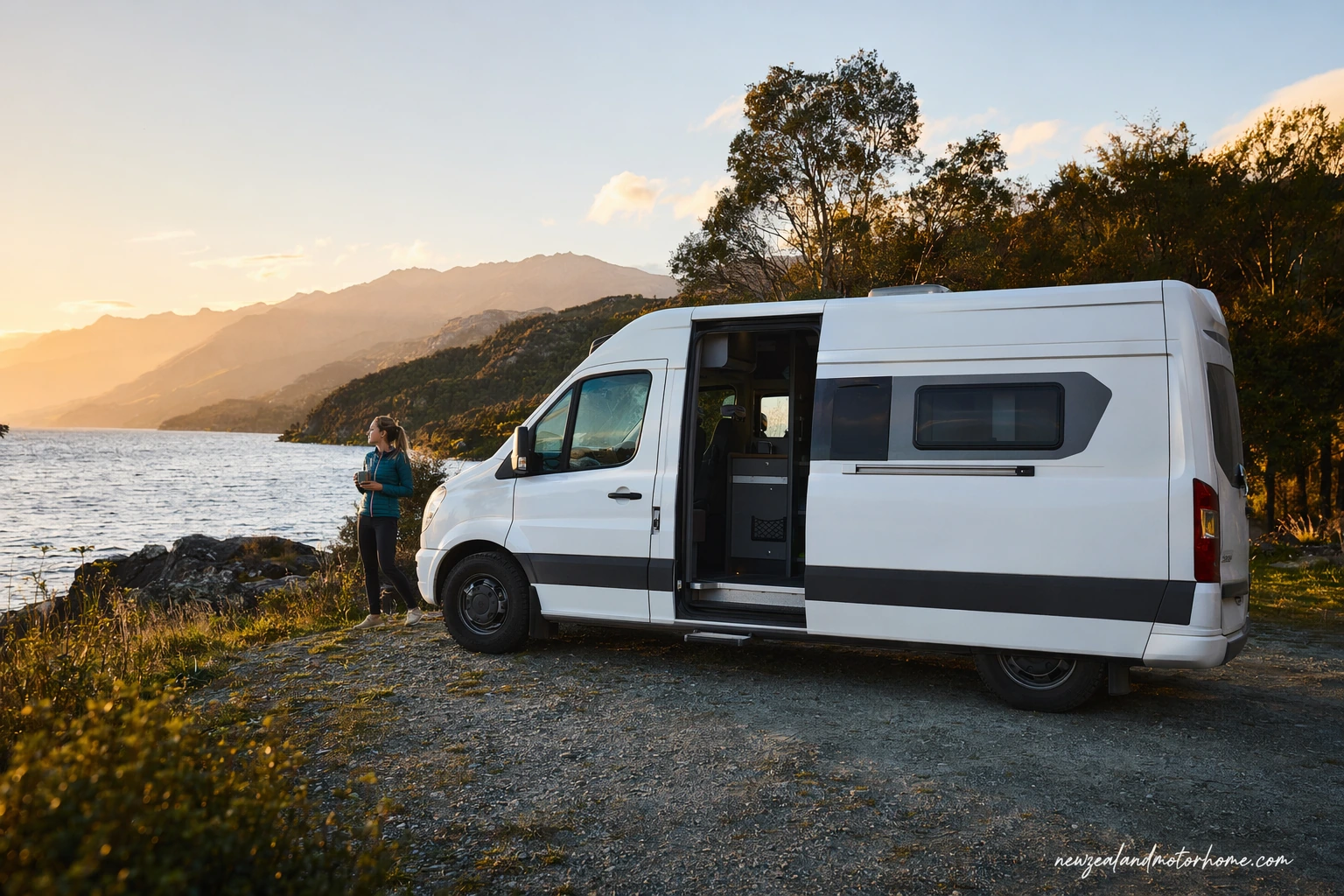
First time campervan hire New Zealand: what to know before you drive
- Best first night: booked powered site
- Allow slower driving days
- Check van height before parking
- Certified self-contained helps flexibility
- Plan dump and water stops
Your first New Zealand campervan trip is exciting, but it is also a small moving household on narrow roads, in changeable weather, with a few routines to learn. The good news is that once you know how powered sites, dump stations, fresh-water fills and freedom camping rules work, the van side of the holiday becomes part of the rhythm rather than a worry.
This first time campervan hire New Zealand guide is written for travellers who will be driving and sleeping in their own hired campervan or motorhome. We will cover choosing a sensible van, planning realistic driving days, booking overnight stops, managing water, waste, LPG and batteries, and arriving at each campsite with enough daylight to park the van calmly.
Choose a van you will enjoy driving, not just sleeping in
For a first trip, bigger is not always easier. A large motorhome gives you more indoor space, but it also needs more care in supermarket car parks, holiday park lanes, fuel stations and tight scenic pull-offs. If you are nervous about width and reversing, a compact certified self-contained campervan can be a better first drive, especially for two travellers.
Look beyond the number of berths. Think about how you will use the van on wet evenings, where luggage will go, whether the bed stays made up, and whether you want an onboard toilet and shower. A fixed toilet is increasingly important for self-containment certification and for accessing some freedom camping areas where permitted.
- Check height and length: know your vehicle height before entering covered car parks, service station canopies or low tree-lined campground loops.
- Ask about power: understand what runs from the house battery and what needs a powered site, such as 240V sockets.
- Think about heating: South Island spring and autumn nights can be cold, even when the daytime drive is sunny.
- Keep the layout simple: first timers usually appreciate clear storage, easy bed setup and a fridge that is accessible without unpacking half the van.
Plan shorter driving days than the map suggests
New Zealand distances can look modest, but campervan days are slower than they appear on a screen. Roads often wind around harbours, lakes and ranges, and you will stop for photos, food, toilets, fuel, short walks and the odd one-lane bridge. A 250 kilometre day can feel full in a motorhome if it includes alpine roads or coastal bends.
For a first time campervan hire New Zealand itinerary, build in two-night stays early in the trip. They give you time to learn the van, do laundry, top up water, empty grey water, and explore without packing up every morning. It also means you are not trying to reverse into an unfamiliar campsite after dark.
- Drive on the left: take extra care when leaving lookouts and quiet side roads, where habits can slip.
- Watch your mirrors: pull over safely if traffic builds behind you on winding roads.
- Treat gravel carefully: some hire agreements restrict unsealed roads, beaches and remote tracks.
- Arrive before dusk: it is much easier to level the van, connect power and find the amenities block in daylight.
Know the difference between powered sites, unpowered sites and freedom camping
Holiday parks are the easiest first-night option because they usually have marked sites, toilets, showers, laundry, kitchens, rubbish facilities, fresh-water taps and dump stations or nearby dump points. A powered site lets you plug into mains power with the correct lead, recharge the house battery more fully and run appliances that need 240V.
Unpowered sites are common at simpler campgrounds and can be lovely when your van has enough battery, gas and water for the night. You will need to be more aware of fridge use, lights, charging devices and how full the grey-water tank is. If you are staying off-grid for more than a night, plan where the next dump station and water fill will be before you park up.
Freedom camping is not a free-for-all. Rules change by district and by individual reserve, and many areas require a certified self-contained vehicle. Always read local signs, use official council information, keep clear of no-camping zones, and leave early if the area is day-use only.
Learn the daily van routine: water, waste, LPG and rubbish
A campervan is easiest when you treat servicing it as a normal part of the day, not an emergency at bedtime. Fresh water, grey water, toilet cassette capacity, rubbish space and LPG all have limits. The more remote the route, the more you should top up and empty out when facilities appear.
Dump stations are where you empty grey water and toilet waste into the correct points. Take your time the first time you use one, wear the supplied gloves if provided or your own, rinse only where allowed, and never empty waste into stormwater drains, toilets or the bush. Many holiday parks, some service stations and council areas have dump facilities, but you should check ahead rather than assume.
- Fresh water: fill from potable water taps only, using your own hose if supplied with the hire van.
- Grey water: empty before it is full, especially before climbing long roads where weight matters.
- LPG: learn whether your bottle is swap, refill or fixed, and ask at handover how to turn it off for ferry travel if needed.
- Rubbish and recycling: keep it contained in the van and use proper bins at campsites or town facilities.
Build your first itinerary around easy arrivals
The best first campervan routes are not the ones that tick off the most places; they are the ones where each day finishes somewhere practical. Look for overnight stops with clear access, space to manoeuvre, nearby food supplies and a dump or water option within the next day or two. On your first and last nights, staying within a comfortable drive of the depot or airport reduces stress around handover times and packing.
If you are landing after a long-haul flight, consider a short first drive and a booked powered site. Use that evening to learn the control panel, test the heater, find the torch, work out the bed, and decide where shoes and wet jackets will live. A calm first night makes the rest of the trip smoother.
When you are ready to shape the route around your dates, van size and confidence level, you can use the talk-to-us step and we will help turn the idea into a campervan-friendly plan rather than a rushed list of dots on a map.
Common questions
Is New Zealand a good place for a first campervan trip?
Yes, as long as you plan at a sensible pace and respect camping rules. New Zealand has a strong network of holiday parks, scenic campgrounds, dump stations and small towns where you can restock the van. The main adjustment is slower driving on winding roads.
Do I need a self-contained campervan for my first hire?
A certified self-contained vehicle gives you more flexibility, especially where freedom camping is allowed only for certified vans. It does not mean you can stay anywhere, and you still need to follow local signs and council rules. For many first timers, the onboard toilet and contained tanks are worth having.
Should I book campsites before I arrive?
Book at least the first night, the last night, and busy holiday periods. In summer, school holidays and popular national park gateways, powered sites can fill quickly. Outside peak times, you can often keep more flexibility, but still check availability before driving late in the day.
How often will I need a powered site?
It depends on the van, weather and how much power you use. Many travellers mix powered holiday park nights with unpowered campground nights, using powered stays to recharge, shower, do laundry and reset the van. Ask at handover what the battery can realistically support off-grid.
Can I drive a motorhome in New Zealand on my normal licence?
Most standard campervans and motorhomes can be driven on a valid car licence, but you should confirm the licence class and vehicle weight with the hire operator. If your licence is not in English, you may need an approved translation or an international driving permit.
Have a planner shape this for your dates
Send a short outline — your dates, party size, and the kind of trip you want. A planner replies with a vehicle recommendation, a paced route, and the realistic budget.