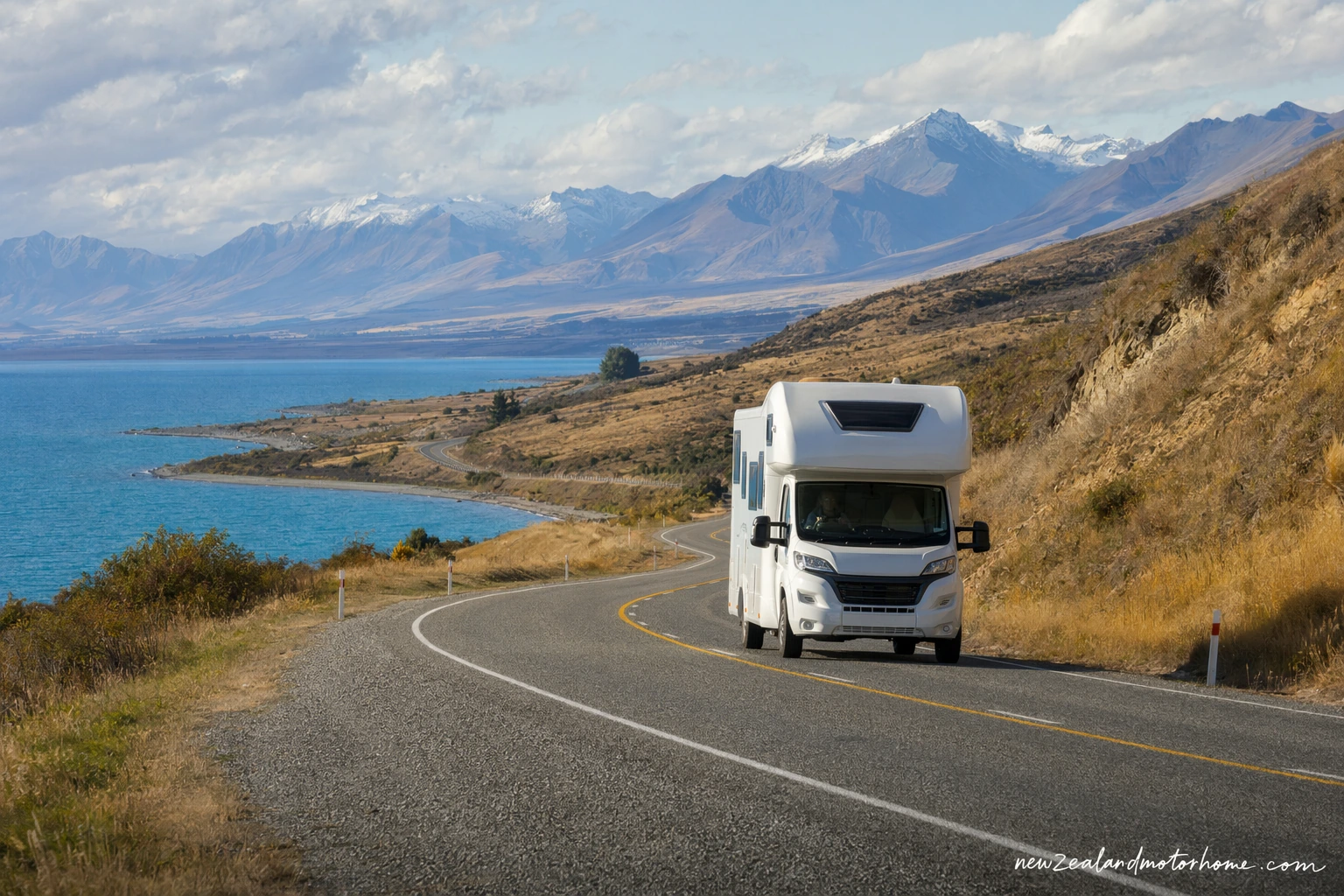
Hamilton to Timaru campervan route: ferry, stops and van notes
- Allow 4 to 6 days
- Approx. 1,050 to 1,100 km plus ferry
- Best in settled spring to autumn weather
- Major highways, but exposed wind sections
- Powered sites useful before and after ferry
The Hamilton to Timaru campervan route is a proper two-island relocation drive: Waikato farmland, the Central Plateau, a Cook Strait ferry, Marlborough vines, the Kaikōura coast and the wide Canterbury Plains before you roll into South Canterbury. It is not a route to rush in a large van, especially if you are timing a ferry and want decent overnight stops rather than late arrivals in the dark.
This guide breaks the Hamilton to Timaru drive into campervan-friendly legs, with practical notes on powered sites, freedom camping, dump stations, fresh-water fills, LPG, ferry preparation and roads that can feel different in a high-sided motorhome. Use it as a base plan for a Hamilton to Timaru motorhome road trip, then adjust the pace around weather, ferry space and how long you want to linger at Taupō, Wellington, Kaikōura or Geraldine.
How many days to allow for the Hamilton to Timaru drive
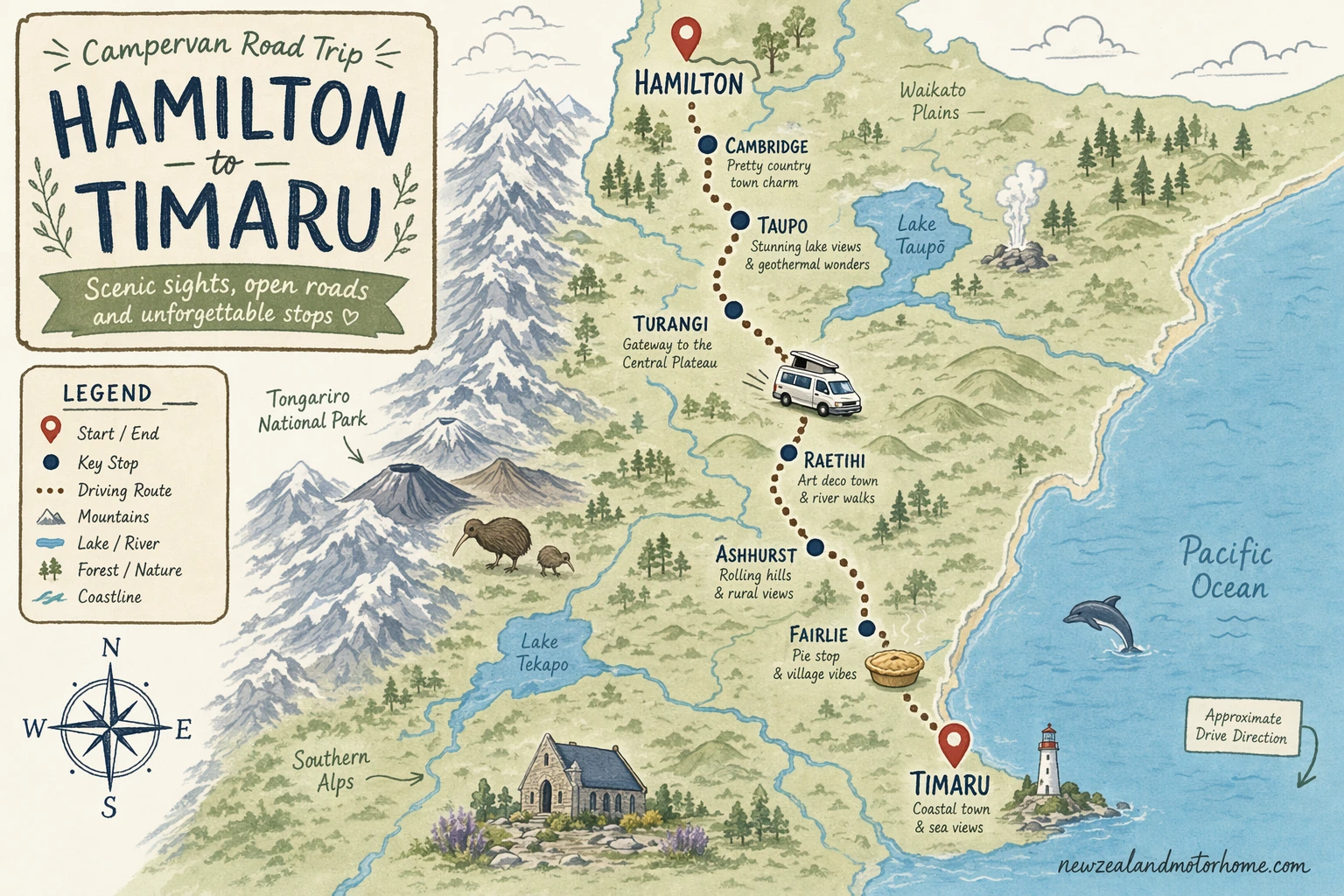
Allow at least four days for a comfortable Hamilton to Timaru campervan trip, and five or six if you prefer shorter driving days or want a buffer around the Cook Strait ferry. The sealed-road distance is roughly 1,050 to 1,100 kilometres, not counting the ferry crossing, and the road time is spread across very different driving conditions.
In a campervan, the easy-looking map time can stretch. You will stop for fuel, fresh water, groceries, dump stations, ferry check-in and slower hill or wind sections. Planning your overnights before you drive makes this route feel settled rather than like a delivery run.
- Fast but tiring: 3 days, only if ferry timing lines up and drivers are fresh.
- Balanced: 4 days, with one North Island night, one ferry/Wellington or Picton night, and one Canterbury or Kaikōura night.
- Comfortable: 5 to 6 days, adding time at Taupō, Wellington, Kaikōura, Christchurch or Geraldine.
- Best arrival habit: aim to reach each overnight stop by late afternoon so you can level the van, plug in if needed and sort dinner before dark.
Leg 1: Hamilton to Taupō, Tūrangi or the Central Plateau
From Hamilton, most vans take SH1 through the Waikato and south towards Taupō. The early part is straightforward highway driving, but give yourself time through busier town approaches and do not rely on being able to stop anywhere in a long motorhome. Taupō is the easiest first reset point, with supermarkets, fuel, LPG swaps, public toilets, lakefront parking in signed areas and holiday parks where you can choose powered or unpowered sites.
If you are heading further on the first day, Tūrangi is a practical overnight before the Desert Road. It is quieter than Taupō, still has essential services, and puts you close to the next morning’s climb. In winter or rough weather, check road conditions for the Desert Road before committing; snow, ice, fog and high winds are more important in a high-sided van than they are in a small car.
- Good first-night choices: Taupō for services and lake time, or Tūrangi for a calmer start to the next leg.
- Campervan services: look for public dump stations and potable water points in Taupō or Tūrangi before crossing more exposed country.
- Driving note: keep speed modest on downhill approaches and let faster traffic pass where it is safe and legal.
- Freedom camping: only use signed, permitted areas and make sure your van is certified self-contained if required.
Leg 2: Central Plateau to Wellington and the ferry
The run from the Central Plateau to Wellington is one of the longest-feeling parts of the route. The Desert Road can be magnificent on a clear day, with big views of Tongariro National Park, but it is exposed. After that, the drive continues through the lower North Island, with wind, traffic and urban approaches increasing as you get closer to the harbour.
If your ferry is early, consider staying the previous night in the Wellington, Porirua or Kāpiti area rather than trying to drive from Taupō at dawn. For larger motorhomes, this makes check-in much less stressful. Book the ferry with your exact vehicle length and height, include bike racks or rear boxes if fitted, and follow operator instructions for LPG bottles and fridge power during the crossing.
- Before boarding: empty grey water and toilet cassette where possible, fill fresh water only if you need it, and secure cupboards for the ship movement.
- Overnight strategy: use a holiday park or council-approved campervan area near Wellington rather than assuming you can sleep close to the terminal.
- Urban driving: allow extra time for motorway traffic, narrow parking options and one-way systems near the waterfront.
- Wind note: Cook Strait and Wellington gusts can move a tall van, so keep both hands on the wheel and slow down.
Leg 3: Picton to Kaikōura, or onward to Christchurch
After the ferry, Picton is a sensible place to pause, restock and decide whether to keep driving. There are powered-site options around Picton and Blenheim, and public dump stations and water points are usually easier to manage here than when you are tired on the coastal road. Blenheim is also a good fuel and grocery stop before heading down SH1.
The Picton to Kaikōura section is beautiful but needs attention in a campervan. SH1 has coastal curves, rail crossings, areas with limited shoulder and occasional roadworks or closures after heavy weather. Park only in formed pull-offs that suit your vehicle length; some scenic stops are tight, sloping or awkward for a motorhome with a rear overhang.
- Overnight options: Picton or Blenheim for an easy post-ferry stop, Kaikōura for coast and wildlife, Christchurch if you want a longer driving day.
- Van parking: in Kaikōura, use signed large-vehicle parking and avoid blocking beach access or residential streets.
- Services: dump, water and fuel are available in the larger service towns, but do not leave the cassette until it is urgent.
- Road note: expect slower average speeds along the Kaikōura coast, especially in wind, rain or summer traffic.
Leg 4: Christchurch, Ashburton and Geraldine to Timaru
South of Christchurch the road opens onto the Canterbury Plains. It looks easy, but it can be tiring in a campervan because the driving is steady, exposed and often windy. Keep an eye on following traffic, use passing lanes courteously and take breaks at larger towns where there is room to park the van without squeezing into small roadside bays.
You can go directly through Ashburton to Timaru on SH1, or make a gentler final day by turning inland through Geraldine before reaching the coast. Geraldine is a pleasant campervan stop with food, fuel and a slower pace, while Timaru gives you Caroline Bay, coastal walks and practical end-of-route services.
- Best final overnight before Timaru: Christchurch for city services, Ashburton for a simple midway stop, or Geraldine for a softer South Canterbury finish.
- Arrival in Timaru: look for signed campervan or large-vehicle parking rather than taking small town-centre spaces.
- End-of-route tasks: use a dump station, top up fresh water if continuing south, and check LPG before heading into more rural areas.
- Driving note: watch for crosswinds on open plains and take extra care on bridges and when large trucks pass.
Camping, services and road readiness for the whole route
This is a route where the basics matter: a certified self-contained van if you plan to use freedom camping areas, a working toilet and grey-water system, enough fresh water between service towns, and a ferry booking that matches the actual size of your motorhome. Powered sites are useful on colder nights around the Central Plateau or if you are running heaters, charging devices and drying gear.
Freedom camping rules change by district, so check local council signs on the day rather than relying on an old memory or a pin someone shared online. If in doubt, choose a holiday park or approved camping area; it is usually easier than being moved on late at night. If you want help turning this into a day-by-day plan around your van size and ferry date, you can talk to us before locking it in.
- Dump stations: plan around Taupō or Tūrangi, Wellington area, Picton or Blenheim, Kaikōura, Christchurch, Ashburton and Timaru.
- LPG and fuel: refill or swap in larger towns; do not assume every small settlement can handle your bottle type.
- Fresh water: fill from signed potable taps only, and avoid travelling with a full tank if you do not need the weight.
- Van size: disclose full length, height and rear fittings for the ferry and be realistic about parking in compact coastal lay-bys.
Common questions
Can I drive from Hamilton to Timaru in two days in a campervan?
It is technically possible only with very long driving days and perfect ferry timing, but it is not a relaxed campervan plan. Four days is a much safer minimum for most self-drive travellers, especially if you want to arrive in Timaru rested and still keep up with dumping, water and food stops.
Where should I stay the night before the Cook Strait ferry?
If your sailing is early, stay in the Wellington, Porirua or Kāpiti area at a holiday park or approved campervan site. Avoid assuming you can freedom camp near the terminal, as central Wellington parking and overnight rules are tight and can be unsuitable for larger motorhomes.
Is the Hamilton to Timaru motorhome road trip suitable for a large van?
Yes, the main route uses major state highways and ferry services that take motorhomes, but you need to drive to conditions. The exposed Desert Road, Wellington wind, coastal SH1 near Kaikōura and open Canterbury Plains all deserve extra space, lower speeds and careful parking choices.
Do I need a self-contained campervan for this route?
You can complete the route using holiday parks without freedom camping, but certified self-containment gives you more flexibility where council rules allow it. Always check local signage, because each district can set its own overnight parking rules and some areas are restricted even for self-contained vans.
What should I know about taking LPG on the ferry?
Book the ferry with accurate vehicle details and follow the operator’s LPG instructions at check-in. Usually that means turning bottles off and making sure gas appliances are not running, but always follow the current ferry guidance on the day.
Where can I empty the toilet cassette before arriving in Timaru?
Plan dump stops in the larger service towns rather than waiting until the cassette is full. Taupō or Tūrangi, the Wellington area, Picton or Blenheim, Kaikōura, Christchurch, Ashburton and Timaru are the natural places to check for public dump stations and potable water.
Have a planner shape this for your dates
Send a short outline — your dates, party size, and the kind of trip you want. A planner replies with a vehicle recommendation, a paced route, and the realistic budget.