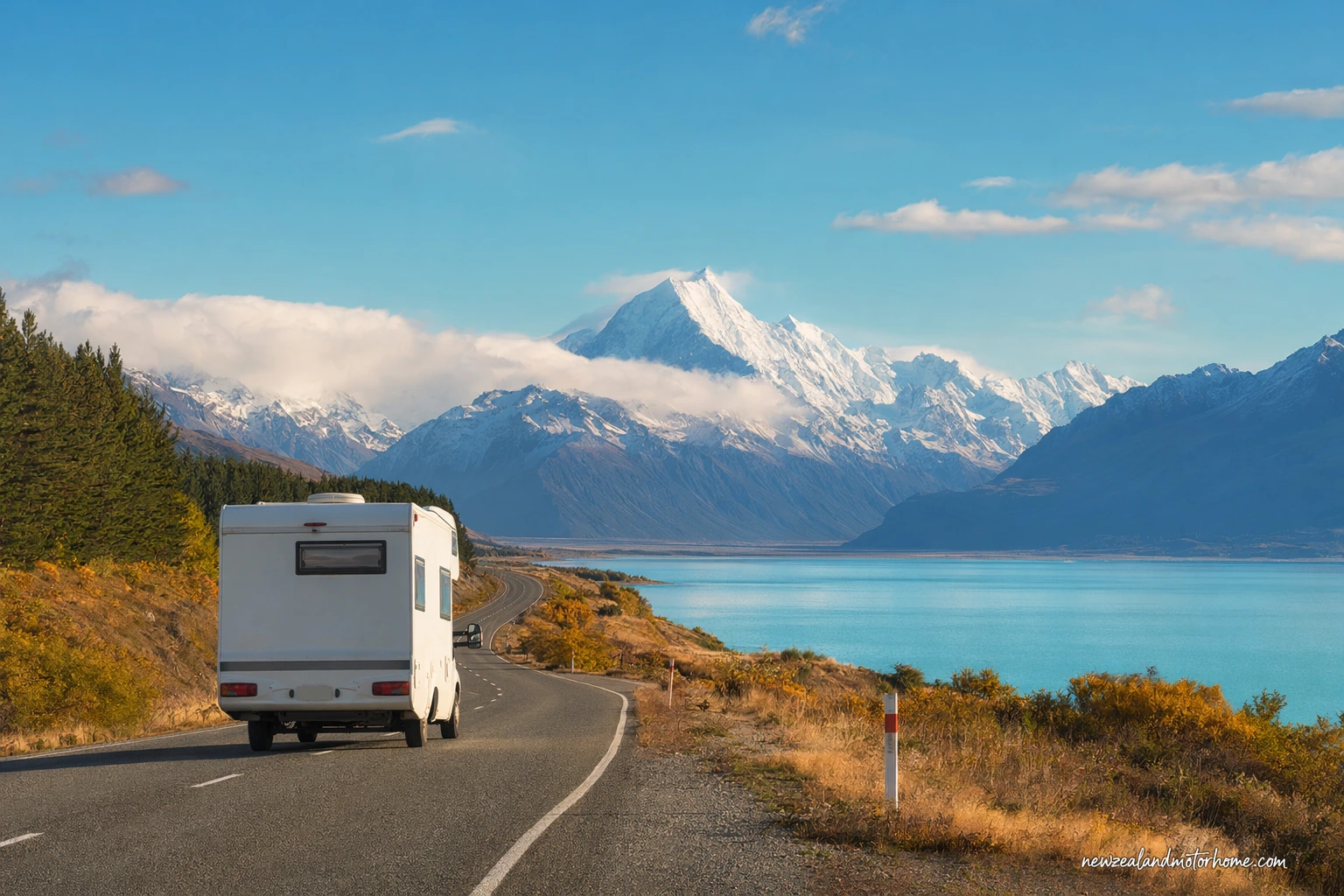
Auckland to Queenstown campervan route: a practical island-to-island plan
- Best with 10-14 days
- Cook Strait ferry required
- Powered sites every few nights
- Check winter pass conditions
- Certified self-contained for freedom camping
An Auckland to Queenstown campervan trip is not one drive so much as a proper New Zealand crossing: volcanic plateau, Cook Strait ferry, dry high-country basins, alpine passes and finally Lake Wakatipu. It suits travellers who want to sleep in their own hired van each night, choose between powered and unpowered sites, and avoid pushing too many kilometres after dark.
This guide sets out a van-friendly route rather than a race. You will find sensible daily legs, where to look for overnight stops, what to know about dump stations and fresh-water fills, and the road sections where vehicle length, wind or winter conditions matter.
If your dates, ferry timing or van size make the plan a bit awkward, send us the outline through /talk-to-us/ and we can help shape a route that feels workable before you book campsites.
How long to allow for the Auckland to Queenstown drive
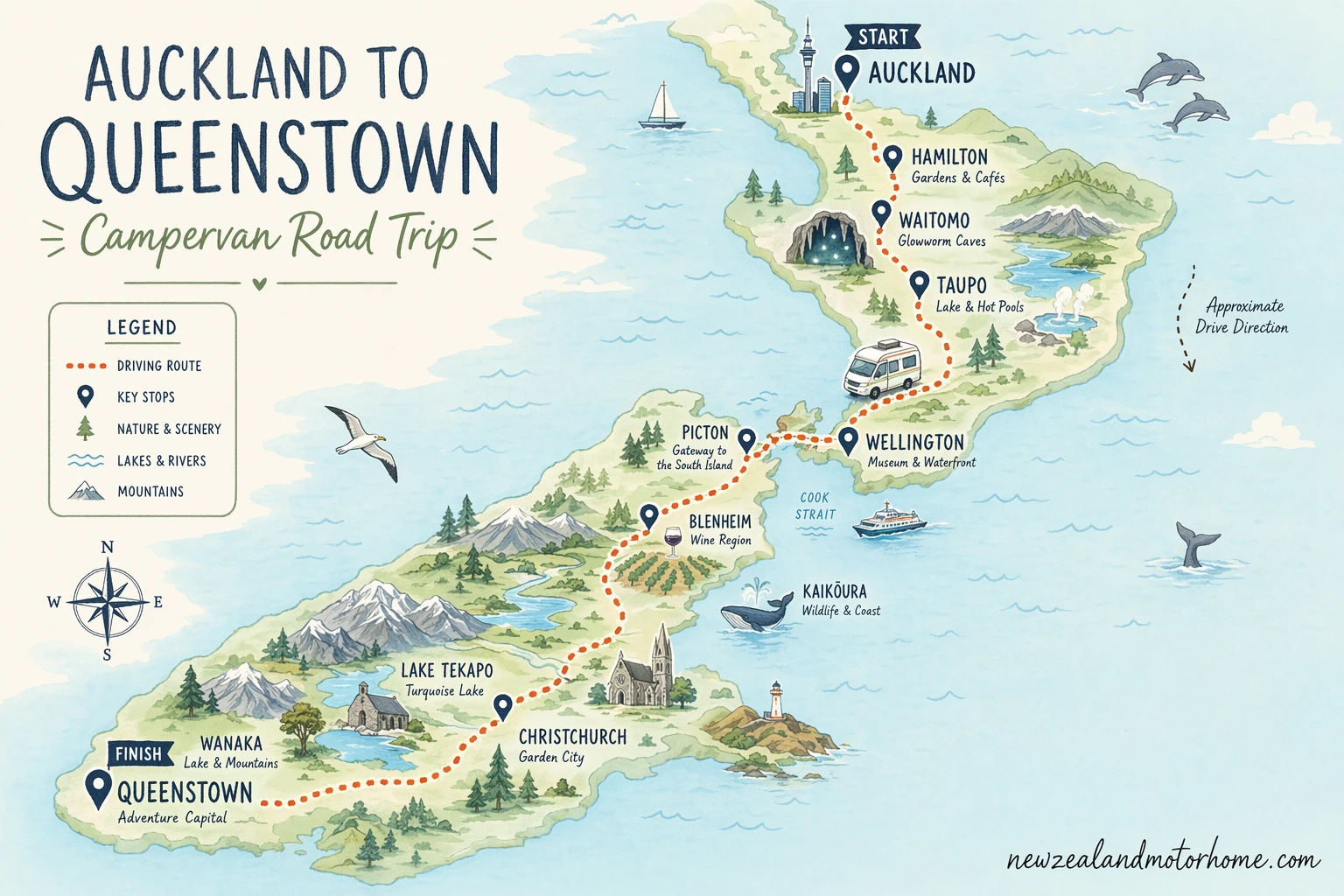
The direct Auckland to Queenstown drive is too long to treat as a simple point-to-point dash in a campervan. You have the Cook Strait ferry in the middle, plus slower scenic roads where a motorhome needs more space to pull in, turn around and settle for the night.
For most self-drive travellers, 10 to 14 days is a comfortable window. Seven or eight days can work if you keep the stops practical and pre-book key nights, but you will be driving most days and skipping side trips.
- Fast but workable: 7-8 days, using main highways and booked holiday parks.
- Balanced: 10-12 days, with time in Taupō, Wellington, Kaikōura or Tekapo.
- Unhurried: 14+ days, with room for Marlborough, Christchurch, Wānaka or extra weather days.
- Van note: longer motorhomes should plan daylight arrivals, especially at small lakeside or DOC-style camps.
Think of this Auckland to Queenstown motorhome road trip as a chain of overnight decisions. A powered site every few nights makes life easier for charging, heating and laundry, while unpowered or DOC-style stays suit certified self-contained vans that are carrying enough water.
Leg 1: Auckland to Taupō or Tongariro
Leave Auckland with a full fresh-water tank, empty grey water and toilet cassette, and enough LPG for cooking and heating. The first stretch usually follows SH1 through the Waikato, with options to pause near Hamilton, Waitomo or Cambridge before continuing towards Lake Taupō.
Taupō is a useful first or second night because it has holiday parks, supermarkets, fuel, LPG swap options and public dump station facilities in the wider town area. If you prefer a quieter mountain feel, push on to Tūrangi or the southern Lake Taupō area, but avoid arriving late in winter when temperatures drop quickly.
- Suggested distance: Auckland to Taupō is a full but manageable campervan day if you start early.
- Overnight style: powered holiday park in Taupō for an easy reset, or a certified self-contained-friendly site where permitted.
- Service rhythm: dump and refill before heading into the central plateau if you plan an unpowered night.
- Road note: SH1 can be busy near Auckland and Hamilton; give yourself longer braking distances in a high-sided van.
If you detour to Waitomo, check parking before committing to tight side roads. Some rural roads are narrow, and it is better to use signed visitor parking than squeeze a motorhome into a small roadside pull-off.
Leg 2: Central Plateau to Wellington and the ferry
The drive from Taupō or Tongariro to Wellington crosses exposed country and then follows the lower North Island towards the capital. The Desert Road section can be beautiful, but it is also one of the parts of the route where snow, ice, fog and wind can affect a campervan more than a car.
Plan to overnight near Wellington before your ferry rather than driving down on the same morning from the plateau. It takes the pressure off traffic, fuel, dump station timing and ferry check-in, especially if you are travelling with children or in a larger berth motorhome.
- Good staging points: Tūrangi, Whanganui, Kāpiti Coast or the Hutt Valley, depending on your pace.
- Wellington night: choose a proper holiday park or designated campervan site so you can arrive with confidence.
- Ferry booking: book by vehicle length and height, including bike racks or rear boxes.
- On board: turn LPG off as instructed and secure loose items before boarding.
Wellington streets can be steep and tight, so do not rely on central city parking unless you have checked height restrictions and access. For a relaxed night, park the van where overnighting is allowed and use public transport or a taxi into the city.
Leg 3: Picton to Kaikōura, Christchurch or the Mackenzie Country
Rolling off the ferry in Picton feels like the second half of the journey beginning. Do not rush straight out of town if you need groceries, fuel, a dump station or fresh water; Picton and nearby Blenheim are easier service stops than trying to sort everything on a narrow coastal road.
The common van-friendly route heads south on SH1 through Marlborough towards Kaikōura and Christchurch. The Kaikōura coast is superb, but parts of the road are squeezed between sea, rail and cliffs, so use marked pull-offs rather than stopping on shoulders for photos.
- Picton/Blenheim: handy for ferry recovery, food shopping, fuel and van servicing tasks.
- Kaikōura: good overnight option if you want a shorter ferry-day drive; book powered sites in busy periods.
- Christchurch: useful reset point with larger supermarkets, LPG, repairs and multiple campground options.
- Alternative: the West Coast route is spectacular but longer, wetter and more demanding on time.
If your ferry arrives late, stay near Picton rather than driving tired. Night driving in a campervan on unfamiliar South Island roads is not worth the small gain, particularly when you still have several big landscapes ahead.
Leg 4: Christchurch, Tekapo, Twizel and the run into Queenstown
From Christchurch, the classic inland line to Queenstown runs through Geraldine, Lake Tekapo, Twizel, Ōmarama, the Lindis Pass and Cromwell. This is one of the most memorable sections of the Auckland to Queenstown campervan route, with wide skies and high-country roads that still deserve respect in wind or winter weather.
Lake Tekapo and Twizel are strong overnight choices because they break the journey neatly and have campervan services nearby. In peak summer, school holidays and ski season, book ahead for powered sites; lakeside freedom camping rules are localised and can change, so only stay where signage and your certification allow it.
- Christchurch to Tekapo: a comfortable day with stops, but watch fatigue after flat Canterbury driving.
- Tekapo/Twizel to Queenstown: allow most of a day if you want to stop at Lake Pukaki, Ōmarama or Cromwell.
- Lindis Pass: no major problem in fine weather, but check winter road conditions before leaving.
- Wānaka option: scenic, but larger motorhomes should be cautious about continuing via the Crown Range.
For many hired campervans, the easiest final approach is SH6 through Cromwell and the Kawarau Gorge. The Crown Range between Wānaka and Queenstown is steep, winding and weather-prone; if your rental agreement restricts it, or if you are not confident in a longer vehicle, take the lower route.
Where to sleep, service the van and park in Queenstown
On a long island-to-island route, a good camping rhythm matters as much as sightseeing. Aim to empty grey water and the toilet cassette before they are urgent, refill fresh water before remote sections, and plug into power every few nights if you are using heating, devices or an electric fridge heavily.
Freedom camping is not a blanket right in New Zealand. You need a certified self-contained vehicle where required, and you must follow local council signs and site-specific rules. A quiet roadside lay-by is not an overnight stop unless it is clearly permitted.
- Powered sites: best before ferry day, after long wet-weather drives, and in colder alpine areas.
- Unpowered sites: fine for self-contained vans when you are carrying enough water and battery capacity.
- Dump stations: plan around major towns such as Taupō, Wellington, Picton/Blenheim, Christchurch, Tekapo/Twizel, Cromwell and Queenstown.
- LPG and water: top up in larger towns; do not assume small settlements have every campervan service.
Queenstown itself has limited easy parking for large vans, and central streets can feel tight when busy. Choose an overnight base where campervans are accepted, then use buses, walking tracks or campground shuttles where available rather than trying to park a motorhome in the centre all day.
Keep planning
Visiting skyline queenstown gondola by campervan
Read onVisiting sky tower auckland by campervan
Read onVisiting rainbows end auckland by campervan
Read onHoliday parks queenstown skyline
Read onHoliday parks queenstown lakes
Read onHoliday parks queenstown
Read onCommon questions
How many days do I need for an Auckland to Queenstown campervan trip?
Allow 10 to 14 days if you want the route to feel enjoyable rather than rushed. It can be done in about a week, but you will have less time for weather delays, ferry timing and proper overnight stops.
Can I freedom camp all the way from Auckland to Queenstown?
No, not everywhere. You need a certified self-contained campervan where required, and each council area has its own rules and signs. Mix legal freedom camping with holiday parks so you can dump waste, refill water and recharge.
Is the Cook Strait ferry easy with a motorhome?
Yes, but book using the correct vehicle length and height, including racks or accessories. Arrive in plenty of time, follow crew directions, turn LPG off if instructed and secure loose gear inside the van.
Should I drive the Crown Range into Queenstown?
Only if your rental agreement allows it, the weather is good and you are comfortable with steep, winding roads. Larger motorhomes often have an easier final run via Cromwell and the Kawarau Gorge on SH6.
Where should I plan dump station stops?
Use larger towns as your service anchors: Taupō or Tūrangi, Wellington, Picton or Blenheim, Christchurch, Tekapo or Twizel, Cromwell and Queenstown. Check current facility access before relying on a specific stop.
Is winter suitable for this route in a campervan?
Winter is possible, but you need more flexibility. The Desert Road, Lindis Pass and alpine areas near Queenstown can see snow, ice and strong winds, so check road conditions daily and book powered sites for cold nights.
Have a planner shape this for your dates
Send a short outline — your dates, party size, and the kind of trip you want. A planner replies with a vehicle recommendation, a paced route, and the realistic budget.