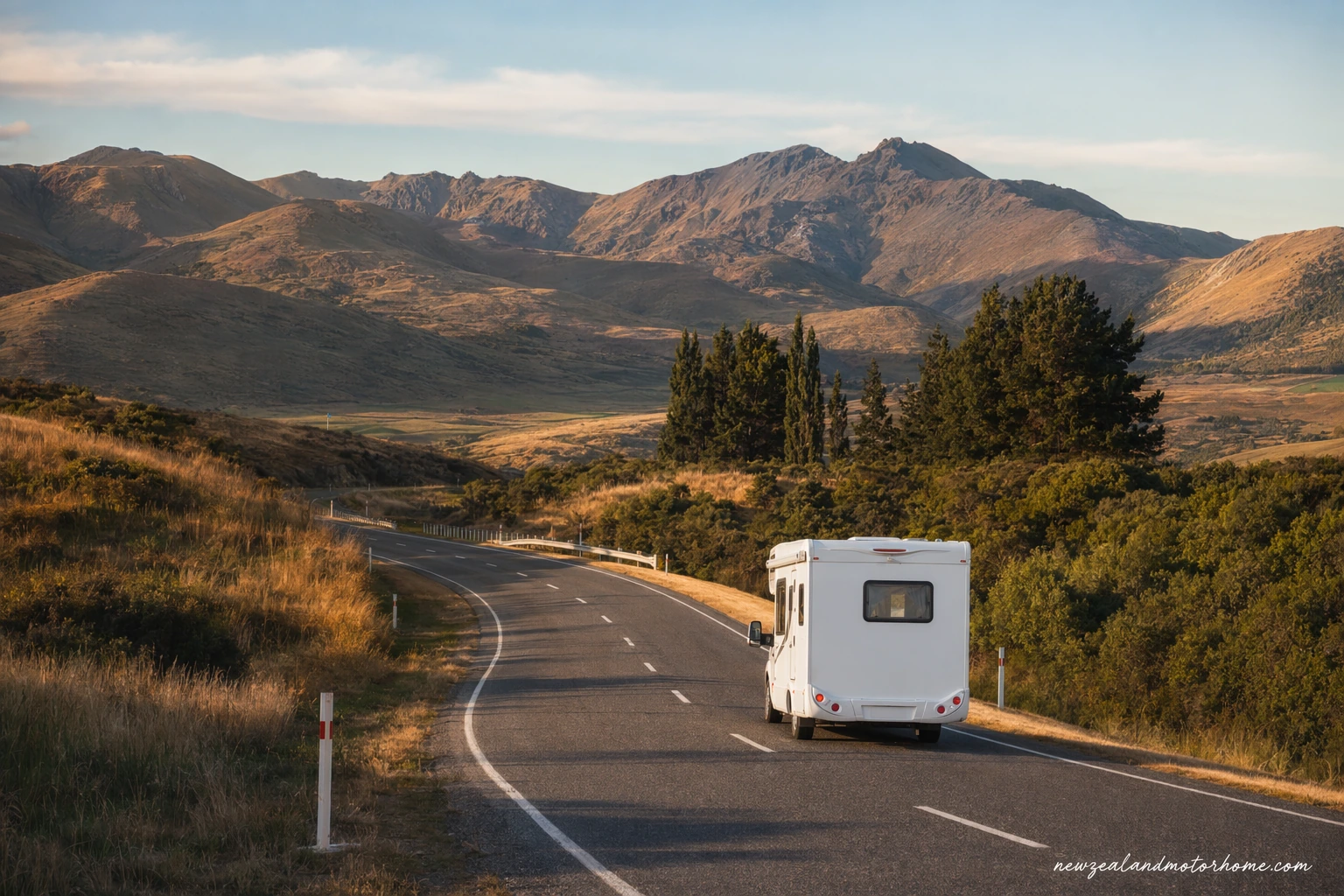
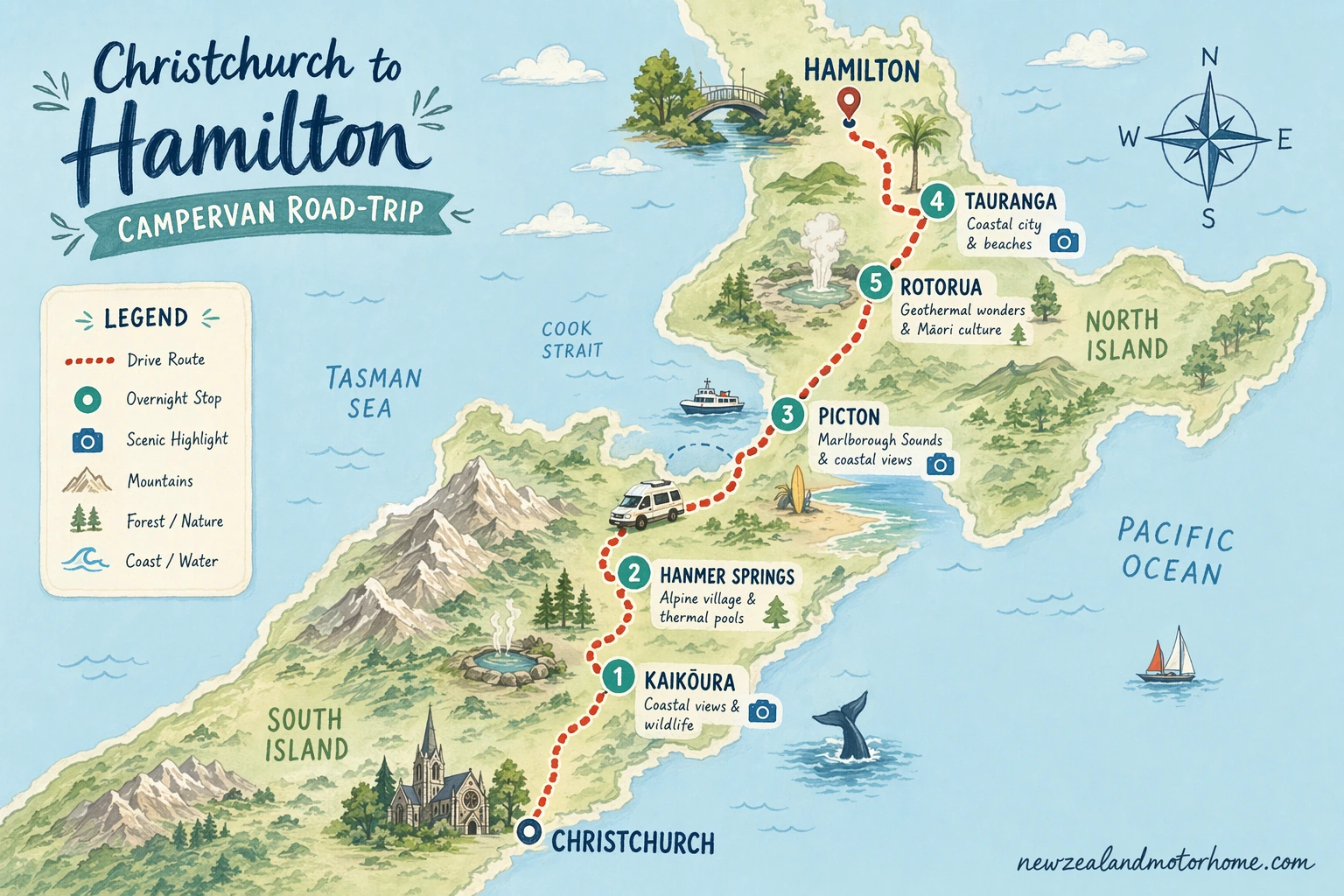
Your Christchurch to Hamilton campervan route, ferry included
- Allow 5–7 days
- Cook Strait ferry required
- Best for self-contained vans
- Mix powered and unpowered sites
- Check winter road conditions
A Christchurch to Hamilton campervan trip is a proper two-island journey: Canterbury plains, the Kaikōura coast, a Cook Strait ferry crossing, then the long roll up through the lower North Island and into the Waikato. It is not a route to rush in a big van, especially if you want time for dump stations, supermarket runs, fresh-water fills and a few unhurried nights beside the sea or lake.
This guide is written for travellers driving and sleeping in their own hired campervan or motorhome. You will find sensible driving legs, where to base the van overnight, what to watch for on SH1, how to handle the ferry with LPG and vehicle height, and how to shape the Christchurch to Hamilton drive into a relaxed motorhome road trip rather than a chain of fuel stops.
How many days to allow from Christchurch to Hamilton
The fastest version of this Christchurch to Hamilton campervan route is three very full travel days: Christchurch to Picton, ferry to Wellington, then Wellington to Hamilton. That works only if your ferry timing is kind, the weather behaves, and everyone in the van is happy with long hours in the cab.
For most self-drive campervan travellers, five to seven days feels better. It gives you room for Kaikōura, a quieter night near Picton before the ferry, and at least one proper North Island stop such as Kāpiti, Whanganui, Tongariro/Taupō or Cambridge before rolling into Hamilton.
- Minimum: 3 days, with long driving legs and little sightseeing.
- Comfortable: 5 days, with two South Island nights, the ferry, and two North Island nights.
- Unhurried: 7+ days, adding Kaikōura walks, Marlborough, Taupō, Waitomo or Raglan.
- Total driving: roughly 870 kilometres, not including ferry time or detours.
If you are picking up the van in Christchurch, allow your first day for groceries, checking the self-containment certificate, learning the grey-water and toilet cassette setup, and confirming what LPG bottle system your vehicle uses. It is much easier to learn the van before you are trying to park in a ferry queue.
Leg 1: Christchurch to Kaikōura and Marlborough
Leave Christchurch on SH1 and give yourself time to settle into the van before the road tightens north of Cheviot. The Kaikōura coast is one of the highlights of the Christchurch to Hamilton motorhome road trip, with sea on one side and steep hills on the other, but it asks for patient driving in a high-sided vehicle.
Kaikōura is a good first overnight if you do not want to push straight through to Picton. Choose a proper campground or clearly signed self-contained area rather than assuming waterfront parking means overnight camping is allowed. In town, use larger public parking areas for day stops and avoid squeezing a long motorhome into small kerbside parks near cafés.
- Road note: SH1 north of Kaikōura has tunnels, coastal corners, rail crossings nearby and wind exposure. Keep left, use slow-vehicle bays and let faster traffic pass.
- Overnight style: powered sites are useful on night one if you are still testing the fridge, heater and charging system.
- Services: Kaikōura and Blenheim are sensible places to check fuel, groceries, potable water and dump-station options before the ferry.
- Van size: if you are over 7 metres, pre-plan parking rather than relying on small scenic pull-outs.
From Kaikōura, continue through Blenheim to Picton. Blenheim is easier than Picton for a big supermarket stock-up, while Picton is the practical base for ferry day. If your sailing is early, staying close to the terminal removes a lot of stress.
Cook Strait ferry planning with a campervan
The ferry is the hinge point of this route. Book with your campervan’s correct length and height, including bike racks, roof vents, solar panels and any rear storage. Understating dimensions can create problems at check-in, and turning up late with a large vehicle is not fun.
Before boarding, ferry staff will direct you into lanes with trucks, utes and other motorhomes. Turn LPG off as required, secure loose gear inside the van, close roof vents, and make sure the fridge is set up for the crossing according to your hire instructions. You will not usually be able to access the vehicle deck during the sailing.
- Picton side: arrive with enough fuel and water so you are not rushing between dump station, fuel stop and check-in.
- Wellington side: traffic ramps up quickly after disembarking, so know whether you are heading north immediately or staying the night.
- Bad weather: Cook Strait can delay sailings; keep one flexible night in the plan if you have a fixed drop-off date in Hamilton.
- Pets and gas: follow the ferry operator’s current rules for animals, LPG bottles and vehicle access.
If your ferry lands late, do not plan to free-camp casually around Wellington. Use a booked campground or a council-permitted self-contained spot, and check the exact rules for the night you are there.
Leg 2: Wellington to the central North Island
From Wellington, the direct Christchurch to Hamilton drive follows SH1 north through the Kāpiti Coast, Levin, Bulls, Taihape and onto the central plateau. It is a long section in a campervan, with urban traffic at the start and exposed, higher country later, so it is better split with at least one overnight.
Good van-friendly stopping patterns include Wellington to Kāpiti or Whanganui for a gentler post-ferry day, or Wellington to Taupō if you are well rested and the weather is settled. The Desert Road section of SH1 can be affected by snow, ice, wind and closures in winter, so always check road conditions before committing a large motorhome to it.
- Kāpiti/Levin: useful for a shorter day, supermarket top-ups and easier parking than central Wellington.
- Whanganui: a pleasant overnight detour if you prefer a riverside town to highway services.
- Taihape/Tūrangi: practical fuel and rest stops before or after the hillier central plateau.
- Taupō: excellent two-night pause, with holiday parks, lake walks and plenty of services for motorhomes.
For dump stations and fresh water, use campgrounds when staying on powered or unpowered sites, and confirm public dump stations through council listings or a current camping app before you arrive. Public taps are not always potable, and not every dump station has rinse water suitable for filling a tank.
Leg 3: Taupō, Cambridge and into Hamilton
From Taupō, the route north runs through forestry, farmland and Waikato towns before joining the wider Hamilton approach. The road is generally straightforward for a campervan, but keep an eye on speed changes through small towns and roadworks, and do not let the final day become sloppy just because the distance looks manageable.
Cambridge is a handy last overnight if you want to arrive in Hamilton fresh, especially if you need time to empty the toilet cassette, refill diesel, clean the van and sort luggage before drop-off. Hamilton itself has urban roads, roundabouts and busier parking areas, so it pays to choose a campground or motorhome-suitable stop on the edge of the city rather than trying to park a long vehicle in the central retail blocks.
- Best final pause: Taupō for a lake night, or Cambridge for an easy Waikato finish.
- Dump before town: empty grey water and the cassette at a confirmed dump station before returning or parking up in Hamilton.
- LPG and water: plan final refills in larger towns rather than leaving them to a rushed city arrival.
- Parking: use large supermarket or visitor car parks only where permitted, and avoid taking multiple small parks in tight town centres.
If you want this route adjusted around ferry times, van length, powered-site preferences or a slower family pace, you can send your rough dates through /talk-to-us/ and shape the overnight pattern before you book campsites.
Freedom camping, powered sites and practical van services
Freedom camping rules vary between districts on this route, and they are enforced differently around popular coastal and lake areas. A self-containment certificate helps, but it does not give permission to sleep anywhere. Always check local signage, council maps and current camping apps before putting the handbrake on for the night.
Mixing powered and unpowered nights works well on this trip. Use powered sites after long driving days, wet weather, or when you need laundry, showers and a full battery reset. Unpowered campground sites can be good value in mild weather if your solar, house battery and gas setup are working well.
- Fresh water: fill from potable taps only; campgrounds are the most reliable places.
- Grey water: never drain roadside or into stormwater; use a legal dump station.
- Toilet cassette: empty before it is full, especially before the ferry and before remote plateau driving.
- Rubbish: keep a sealed bag in the van and use town refuse facilities or campground bins.
- Battery: if you run laptops, heaters or CPAP gear, book powered sites more often.
In a larger motorhome, the best trips come from doing small chores early: fuel at half a tank, water before it is urgent, and dump stations when they are convenient rather than when the cassette light is already on.
Keep planning
Common questions
Can I drive from Christchurch to Hamilton in a campervan without taking the ferry?
No. Christchurch is in the South Island and Hamilton is in the North Island, so you need a Cook Strait ferry between Picton and Wellington. Book the crossing using your campervan’s full length and height.
Is the Christchurch to Hamilton campervan route suitable for a large motorhome?
Yes, but plan it like a large-vehicle trip. SH1 is the main route, with good services, but the Kaikōura coast, Wellington traffic and the central plateau need patient driving, wide turning, and proper overnight stops rather than roadside improvising.
Where should I stop overnight between Christchurch and Hamilton?
Common campervan stops are Kaikōura, Blenheim or Picton, Wellington or Kāpiti, then Taupō or Cambridge before Hamilton. Choose campgrounds or legally permitted self-contained areas, and book powered sites around the ferry if your timings are tight.
Do I need a self-containment certificate for this trip?
You need one if you want to use many freedom camping areas, but it does not override local restrictions. If your hire van is not certified, plan to stay in holiday parks, campgrounds or other paid overnight sites with toilets and waste facilities.
When is the best season for a Christchurch to Hamilton motorhome road trip?
Spring, summer and early autumn give the easiest driving and more daylight. Winter is still possible, but check Kaikōura coast conditions, ferry weather and Desert Road updates before setting off in a high-sided van.
Should I go via Taupō or the west coast of the North Island?
Via Taupō is the most direct and service-friendly route to Hamilton. The west coast option through Whanganui, Taranaki and Waitomo is scenic but longer, so it suits travellers with extra days and a relaxed itinerary.
Have a planner shape this for your dates
Send a short outline — your dates, party size, and the kind of trip you want. A planner replies with a vehicle recommendation, a paced route, and the realistic budget.