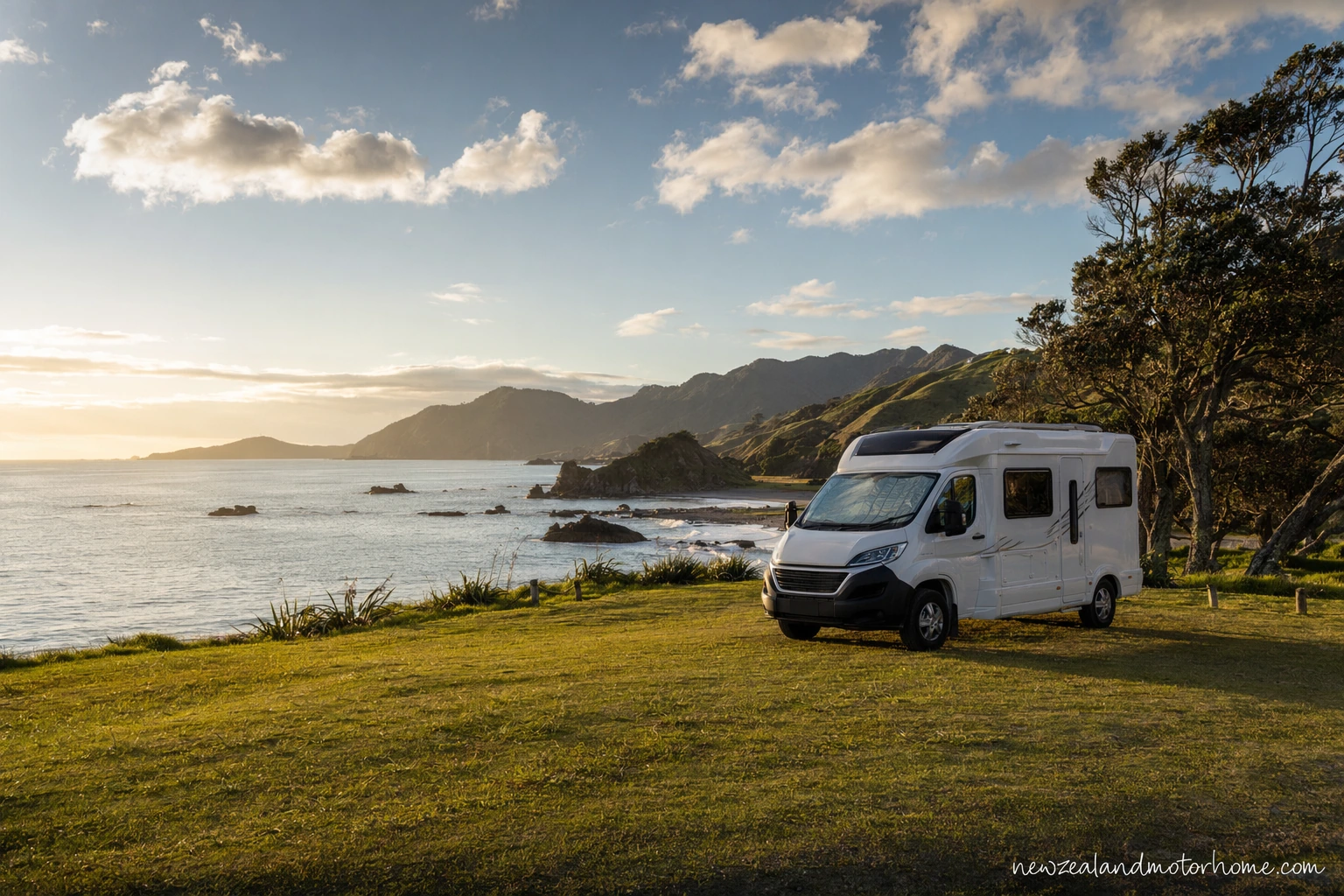
Freedom camping rules New Zealand campervan travellers should know
- Certified self-contained usually required
- Council bylaws vary by district
- Mix freedom nights with powered sites
- Plan dump stations and water fills
- Arrive before dark to read signs
Freedom camping in New Zealand can be brilliant: a quiet harbour edge, a legal riverside bay, the kettle on while the weather moves through. It is also one of the easiest parts of a campervan trip to get wrong if you assume every scenic pull-off is an overnight stop.
This guide explains the freedom camping rules New Zealand motorhome travellers need to understand before choosing where to park the van for the night. We will cover self-containment, council signs, DOC land, services such as dump stations and fresh-water fills, and how to plan legal overnight stops without turning the trip into a nightly guessing game.
What freedom camping actually means when you are sleeping in the van
Freedom camping means staying overnight on public land outside a formal campground or holiday park, usually in your campervan or motorhome. It does not mean you can pull up anywhere that has a view, and it does not override local council bylaws, Department of Conservation rules, road safety restrictions, private land, or signs at reserves and beaches.
For self-drive travellers, the key question is simple: is this specific spot legal for your specific vehicle tonight? A car park may allow daytime parking but ban overnight stays. Another reserve may allow only certified self-contained vehicles in marked bays. A DOC area may have basic toilets and a small fee, but still not be freedom camping in the council sense.
- Legal overnight spot: signed for camping, listed by the council or DOC, or clearly permitted under the local bylaw.
- Not a campsite: scenic lookouts, boat ramps, beach access tracks, residential streets, road shoulders and supermarket car parks unless overnight camping is clearly allowed.
- Still your responsibility: keeping within marked bays, controlling noise, taking rubbish, and leaving before any stated time limit.
Self-containment is the first filter for most freedom camping
Many legal freedom camping areas in New Zealand are restricted to certified self-contained campervans and motorhomes. In practice, that means your van must be set up to contain toilet waste, grey water and rubbish without relying on public toilets, drains or the bush. Before you leave the depot, check the certificate, warrant/card and expiry date, and ask what the rules are for your travel dates.
Rules around self-containment have been tightened in recent years, especially for hired vehicles. A portable toilet hidden under the bed may not be enough at many sites. If freedom camping is important to your route, choose a van with the right current certification, enough fresh-water and grey-water capacity for your crew, and a toilet you are actually comfortable using at night.
- Check that the self-containment label or warrant matches the vehicle you are driving.
- Make sure everyone knows how to use the onboard toilet and where the waste cassette or black-water point is accessed.
- Plan dump station stops before tanks are full; small towns do not all have 24-hour services.
- Do not use public toilets as your plan A if the site requires self-containment.
Council signs and local bylaws change from town to town
One of the traps with freedom camping is that New Zealand does not operate as one single rulebook. Councils set local bylaws, and those bylaws can change between neighbouring districts. You might legally stay in a marked foreshore bay one night, then cross a bridge into the next district where overnight camping beside the same coast is prohibited.
Read the sign where you park, not just the general listing you saw earlier in the day. Look for wording such as certified self-contained only, maximum stay, number of nights in a calendar month, parking between marked lines, no tents or awnings, and departure times. If the sign and an app disagree, trust the sign or the council website.
- Arrive with daylight left so you can read signs and see bay markings.
- Keep the whole van inside the permitted parking space, including bike racks and tow bars.
- Avoid putting chairs, tables or awnings out unless the site clearly allows camping behaviour beyond parking overnight.
- If a site is full, move on rather than squeezing onto grass or blocking access for locals and emergency vehicles.
How to build freedom camping into a realistic motorhome route
The most relaxed trips do not try to freedom camp every night. A good New Zealand campervan rhythm is to mix legal free or low-cost overnight stops with holiday parks or campgrounds where you can plug into power, shower properly, do laundry, fill fresh water, dump grey water and reset the van. This is especially useful after two wet days, a dusty gravel-road section, or a run of short winter daylight.
When planning a route, mark your likely overnight stops first, then check the services between them. A scenic freedom camping area is not much use if your grey tank is already full, your LPG bottle is low, or your fridge battery has been hammered by cloudy weather. If you would like help shaping the order of nights around legal stops and van services, you can talk to us before you lock in the route.
- Alternate unpowered nights with powered sites if you are running laptops, heaters, medical devices or a compressor fridge hard.
- Plan dump stations and fresh-water fills every couple of days, sooner for larger groups.
- Check LPG early in smaller regions, especially before a long holiday weekend.
- Keep a backup campground in mind for bad weather or if a popular freedom spot is full.
Parking the van well: the small habits that keep access open
Freedom camping works best when visitors look after the places locals use every day. That starts with parking the van neatly and behaving as though you are a guest, not taking over a reserve. In a longer motorhome, avoid narrow dead-end beach roads unless you know there is space to turn around. In a high-roof camper, watch for low branches, old timber gateways and sloping grass verges that get soft after rain.
Leave no trace is more than taking rubbish. It means no grey water on the ground, no food scraps in fire pits, no brushing teeth into stormwater drains, no late-night sliding doors in residential streets, and no generator beside another van. If you need space to spread out, cook outside and run power, book a campground or holiday park instead of trying to make a small freedom camping bay do too much.
- Use dump stations for grey water and toilet waste only as signed; do not empty into public toilets or roadside drains.
- Carry rubbish until you find a proper bin or transfer station that accepts visitor waste.
- Keep noise down after dark, including van doors, music and diesel heaters cycling near other sleepers.
- Leave early if the site has a morning departure rule, even if others overstay.
DOC campsites, holiday parks and freedom spots all have a place
Not every unpowered night needs to be freedom camping. Department of Conservation campsites often suit campervans well, with basic facilities, defined camping areas and access to walking tracks, lakes or bush. Some are first-come, some need booking, and facilities vary widely, so check whether your van length, toilet setup and road clearance are appropriate.
Holiday parks are still worth building into a self-drive trip, even if you love quiet overnight stops. A powered site helps charge house batteries, dry wet gear, run a fan heater where permitted, and give everyone a proper shower. In busy summer areas, school holidays and around events, having a booked powered or unpowered site can save an evening of driving from one full freedom camping area to the next.
- Use DOC or council information to check access roads, especially gravel, ford crossings and tight turns.
- Book holiday parks ahead in peak coastal regions if you need power or a larger motorhome bay.
- Do not assume a DOC toilet means your non-self-contained van can stay; read the site conditions.
- Match the stop to the night: freedom spot for simple parking, campground for services, holiday park for a full reset.
Common questions
Can I freedom camp anywhere if my campervan is self-contained?
No. Self-containment often makes you eligible for certain sites, but it does not give permission to camp anywhere. You still need to follow council bylaws, DOC rules, signs, time limits and parking bay restrictions.
What should I check on the van before planning freedom camping nights?
Check the current self-containment certificate or warrant, fresh-water and grey-water capacity, toilet setup, house battery health, LPG level and whether the van fits typical marked bays. Ask the hire operator to show you how to empty the toilet cassette and grey water before you leave.
Are non-self-contained campervans allowed to freedom camp in New Zealand?
In many places, no. Some areas may allow camping only in formal campgrounds or specific sites with facilities, but most freedom camping areas used by campervans require certified self-containment. If your van is not certified, plan on holiday parks, campgrounds and suitable DOC sites instead.
How do I know if a freedom camping spot is legal tonight?
Check the sign at the site, the local council information and any current restrictions before you settle in. If there is a conflict between an app listing and the sign on the ground, follow the sign or move to a confirmed campground.
Can I put out chairs, an awning or a barbecue at a freedom camping area?
Only if the site rules allow it and there is room without blocking anyone. Many urban or foreshore freedom camping areas are effectively overnight parking bays for self-contained vans, not full campsites. If you want to spread out, choose a campground or holiday park.
What happens if the legal freedom camping area is full?
Do not park outside the marked area or on nearby grass. Move to your backup stop, a DOC campsite or a holiday park. Arriving before dark and carrying a short list of alternatives makes this much less stressful.
Have a planner shape this for your dates
Send a short outline — your dates, party size, and the kind of trip you want. A planner replies with a vehicle recommendation, a paced route, and the realistic budget.