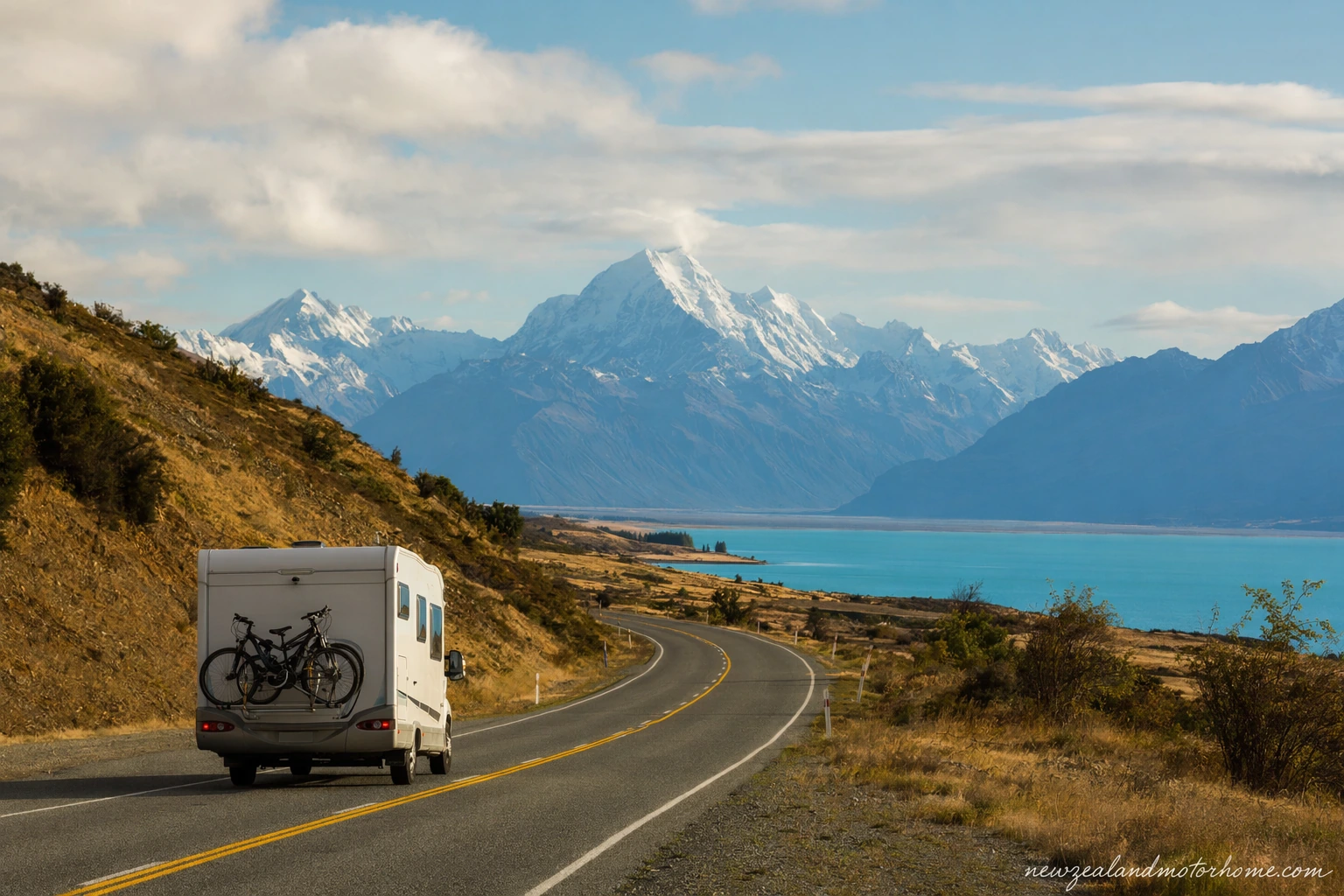
- Allow 7–12 days
- Cook Strait ferry required
- Best on state highways
- Powered nights recommended
- Check freedom camping rules
A Hamilton to Invercargill campervan trip is a proper top-to-bottom run: green Waikato roads, the Desert Road or central North Island alternatives, a Cook Strait ferry crossing, then a long South Island roll past Marlborough, Canterbury, Otago and Southland. It is not a route to rush if you are sleeping in the van each night and managing water, power, LPG and waste as you go.
This guide is written for self-drive motorhome travellers, not people hopping between motels. You will find practical legs, overnight stop ideas, road notes for longer vehicles, ferry considerations, and where to think about powered sites, dump stations and fresh-water fills on the Hamilton to Invercargill drive.
How many days to allow and the best overall route
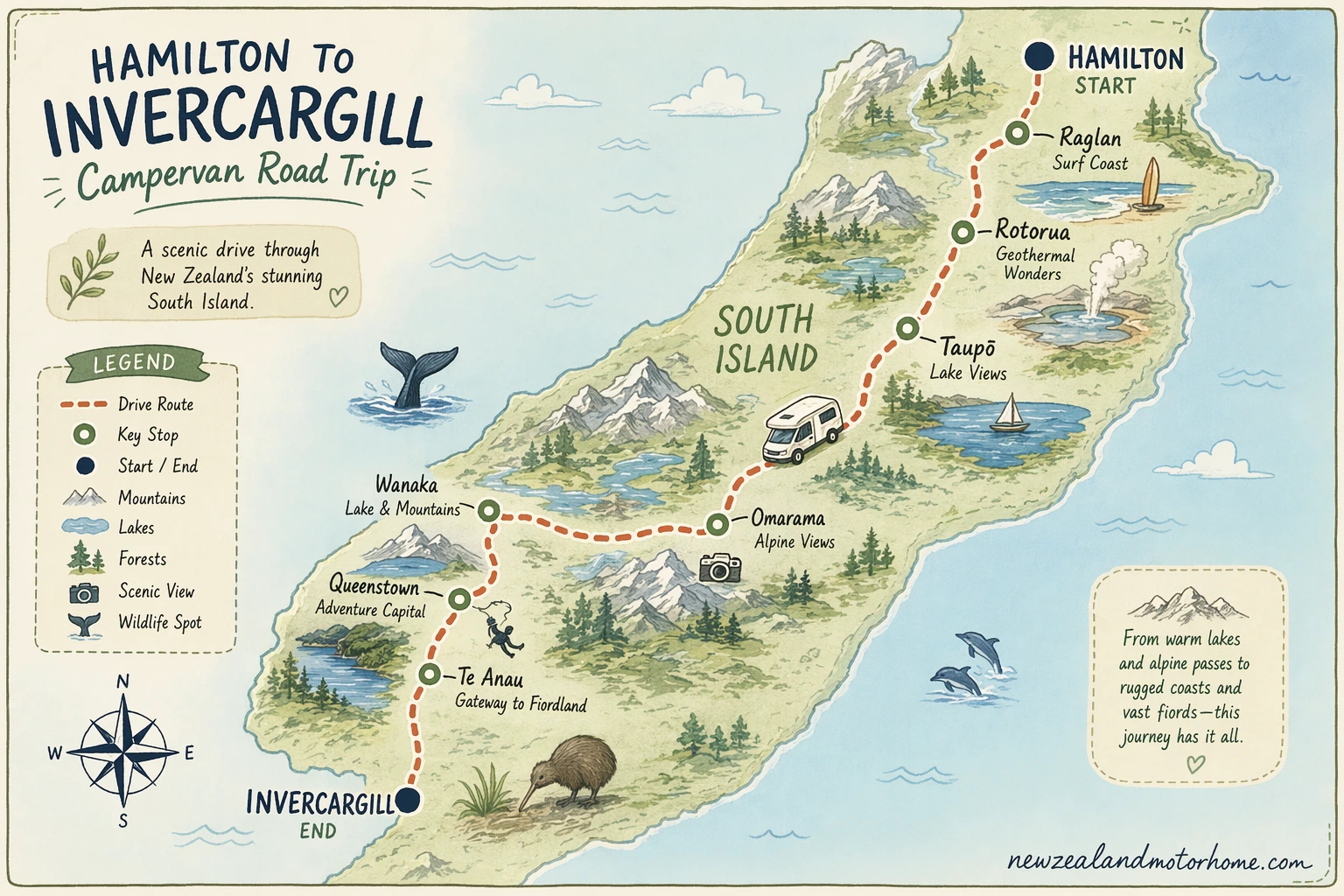
The direct Hamilton to Invercargill motorhome road trip is roughly 1,600 kilometres once you include the Picton-to-Southland drive after the ferry. In a campervan, a comfortable minimum is 7 days, but 9 to 12 days gives you time to arrive before dark, use dump stations without rushing, and sit out a rough-weather day if the ferry or alpine roads are affected.
The simplest van-friendly line is Hamilton to Taupō or the central plateau, then Wellington for the ferry, Picton, Kaikōura or Christchurch, Ōamaru or Dunedin, and Invercargill. It keeps you mostly on state highways, with plenty of holiday parks, service towns, supermarkets and fuel stops. A scenic inland South Island variation via Lake Tekapo, Wānaka or Queenstown is beautiful, but it adds distance, hillier driving and more weather exposure.
- Fast but still realistic: 7 days, using mainly powered holiday park nights and early ferry booking.
- Balanced: 9 to 10 days, with time for Wellington, Kaikōura, Dunedin and the Catlins edge of Southland.
- Slow touring pace: 12+ days, allowing rest days, short driving legs and a few freedom camping nights where permitted.
North Island legs: Hamilton to Wellington without wearing yourself out
From Hamilton, most vans head south via SH1 through Cambridge and the central North Island. The road is generally suitable for motorhomes, but do not underestimate the time taken by roadworks, passing-lane traffic, wind on open sections, and slower climbs around the plateau. If your hire van is tall or heavy, leave bigger following gaps and plan your stops before you are tired.
A sensible first night is around Taupō, Turangi or National Park if you want to break the drive early. These towns usually offer a mix of powered holiday park sites, basic unpowered camping and nearby public dump station options. If the weather is poor on the Desert Road, check conditions before committing; snow, ice and strong wind can make this stretch unpleasant in a high-sided van.
For the second North Island leg, aim for a Wellington or Kāpiti overnight rather than arriving at the ferry frazzled. Parking a campervan in central Wellington takes patience, so many travellers prefer a holiday park or designated motorhome-friendly site on the city edge, then drive to the ferry terminal with fresh water topped up and grey water emptied.
- Keep LPG and fuel topped up before remote or late-day sections.
- Use dump stations in larger towns rather than assuming every small settlement has one.
- Book a powered night before the ferry if you need to recharge batteries, devices and fridge confidence.
Cook Strait ferry notes for campervans and motorhomes
The ferry is the hinge point of the Hamilton to Invercargill campervan route. Book early, enter your van’s length and height accurately, and allow generous check-in time. Roof pods, bike racks and rear storage boxes can change your vehicle dimensions, so measure the whole set-up rather than relying only on the base model.
Before boarding, secure cupboards, turn off gas as instructed by the ferry operator, and make sure loose items will not slide around if the crossing is bumpy. You will not be able to stay in the vehicle deck during the sailing, so take warm layers, medication, snacks and chargers with you upstairs.
On arrival in Picton, resist the urge to drive too far if the crossing has been delayed or rough. Picton, Blenheim and nearby coastal settlements all make useful reset points, with holiday parks, fuel, groceries and dump station options. If your itinerary needs tightening, this is a good place to review the next few days; you can also use our talk-to-us step if you want help shaping the route around ferry times, van size and overnight preferences.
South Island legs: Picton to Dunedin in a van
The coastal run from Picton towards Kaikōura and Christchurch is one of the memorable parts of the journey, but it asks for attention in a campervan. There are tight bends, seaside pull-offs that are not all suitable for long vehicles, and busy tourist traffic in season. Use proper lay-bys, avoid soft shoulders, and let faster traffic pass when safe.
Kaikōura is a good overnight for the first South Island night if your ferry lands early enough. Powered sites are useful here after a sea crossing, especially if you have been using the fridge and heating. Freedom camping rules in coastal districts can be strict and change by area, so only stay where signage and your self-containment certification clearly allow it.
From Christchurch, the route south on SH1 is straightforward by New Zealand standards, with broad farmland, service towns and regular places to stop. Ōamaru makes a pleasant break before Dunedin, particularly if you want a shorter next-day drive. Dunedin itself has steep streets and narrow older suburbs, so choose an overnight site with easy van access and avoid taking a large motorhome into tight city parking unless you have checked height, length and turning space.
- Picton to Kaikōura: scenic coast, allow extra time for photo stops and wind.
- Kaikōura to Christchurch: manageable half-day drive with urban traffic at the end.
- Christchurch to Ōamaru or Dunedin: practical service-town corridor with good resupply options.
Dunedin to Invercargill: Southland approach and optional Catlins detour
The most direct Dunedin to Invercargill leg follows SH1 through Balclutha, Gore and into Southland. It is a solid drive rather than a dramatic one, with enough town stops for fuel, coffee, groceries, water and dump station planning. Watch for crosswinds on open farmland and give yourself time on rural bridges and narrower stretches.
If you have an extra day or two, the Catlins route via Kaka Point, Owaka, Papatowai and Curio Bay is a slower, more coastal way to approach Invercargill. It rewards patient van travellers with forest, beaches and wildlife, but it is not the place for late-night driving in a big motorhome. Roads can be winding, parking areas may be uneven, and some scenic car parks are better suited to smaller campervans than long vehicles.
Invercargill is a practical finish point because you can reset the van properly: fuel up, empty waste, refill fresh water where permitted, restock food and choose a powered site if the batteries have had a hard run. If you are continuing to Bluff or Stewart Island ferry parking, check where overnight parking is allowed and do not assume a self-contained vehicle can stay anywhere near the waterfront.
Overnight style: powered sites, freedom camping and van services
For this route, mix your nights rather than trying to freedom camp the whole way. A powered site every second or third night keeps batteries healthy, gives you laundry and shower access, and makes cold or wet evenings easier. Unpowered holiday park sites can be a good middle ground when you want facilities but do not need to plug in.
Freedom camping is only suitable where it is clearly permitted and your vehicle meets the current self-containment requirements. Council rules vary between Waikato, Wellington, Marlborough, Canterbury, Otago and Southland, and local signage always matters. Arrive early, park within marked areas, keep awnings and furniture packed away if the site is for parking only, and leave no trace.
Plan dump stations as part of the day’s route, not as an afterthought at dusk. Larger towns such as Taupō, Wellington, Picton, Blenheim, Christchurch, Ōamaru, Dunedin, Gore and Invercargill are the logical places to look for public or holiday-park dump points, fresh-water taps and LPG swap or refill options. Always confirm access locally before relying on a facility, especially outside business hours or after council rule changes.
Keep planning
Common questions
Can I drive from Hamilton to Invercargill in a campervan in less than a week?
You can, but it will feel like a delivery drive rather than a holiday. With the ferry, weather risk and long South Island distances, 7 days is a practical minimum and 9 to 12 days is much better for a self-drive motorhome trip.
Is the Hamilton to Invercargill drive suitable for a large motorhome?
Yes, if you stay mainly on state highways and choose overnight stops with suitable access. Be cautious in central Wellington, Dunedin’s steep suburbs, coastal pull-offs near Kaikōura, and the Catlins, where tight parking and winding roads can be awkward for longer vans.
Do I need to book the Cook Strait ferry for my campervan?
Booking ahead is strongly recommended, especially in summer, school holidays and around long weekends. Enter the full length and height of the campervan, including racks or rear storage, and follow the operator’s instructions for LPG and vehicle deck access.
Where should I plan powered nights on this route?
Good places for powered nights are before or after the ferry, after cold central North Island driving, and before the final Southland leg. Taupō, Wellington or Kāpiti, Picton, Kaikōura, Christchurch, Dunedin and Invercargill all work well for resetting batteries, laundry, showers and waste.
Can I freedom camp all the way from Hamilton to Invercargill?
Not realistically without careful checking every night. Rules change by council area, and you must use only permitted sites with a compliant self-contained vehicle. It is safer to combine legal freedom camping with holiday parks and designated low-cost campgrounds.
Which season is best for a Hamilton to Invercargill motorhome road trip?
Late spring to early autumn gives the easiest driving and longer daylight, though it is also busier. Winter is possible in a well-equipped van, but you need to watch for Desert Road snow, ferry disruptions, shorter days and colder nights in the south.
Have a planner shape this for your dates
Send a short outline — your dates, party size, and the kind of trip you want. A planner replies with a vehicle recommendation, a paced route, and the realistic budget.