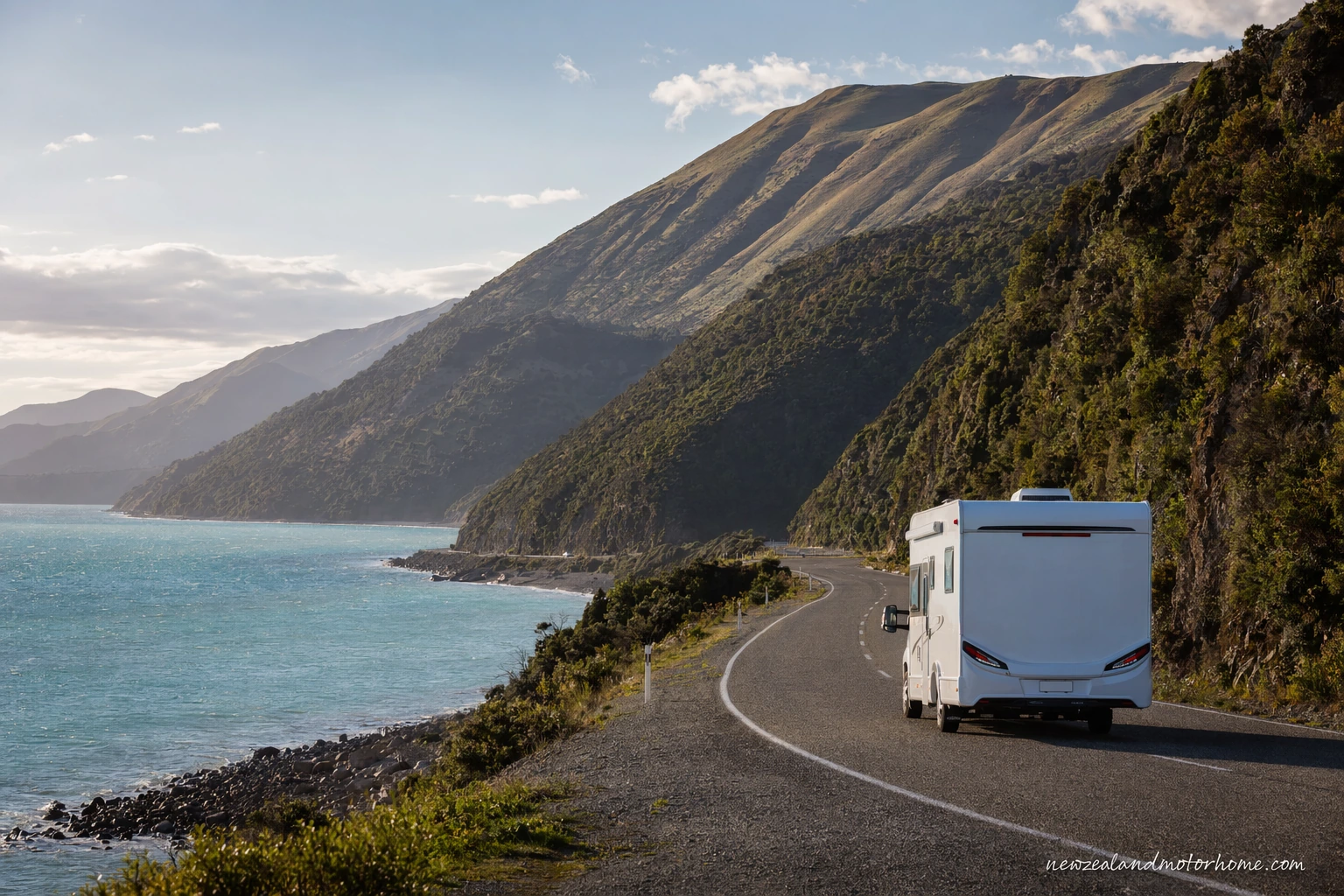
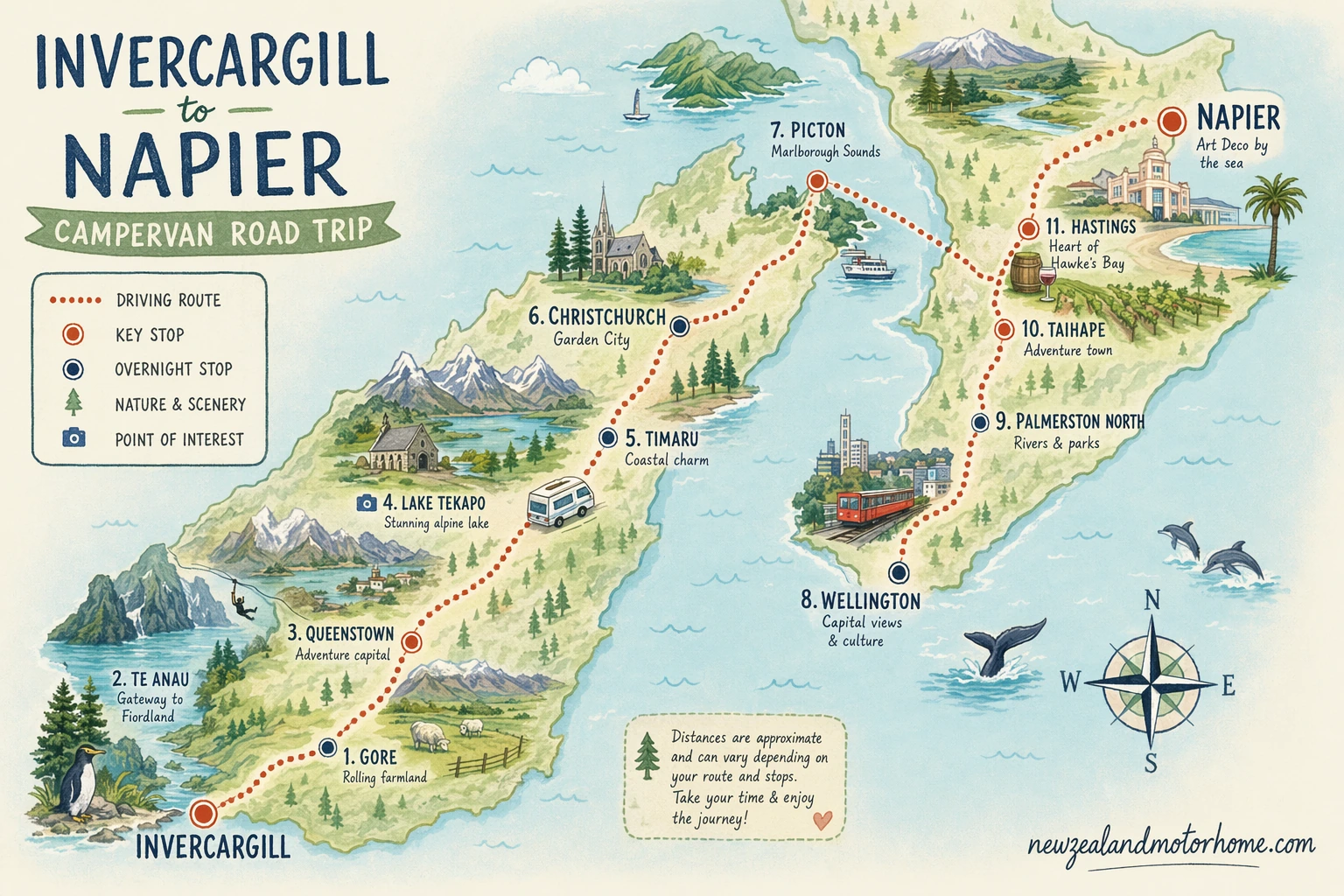
Invercargill to Napier campervan route: Southland to Hawke’s Bay
- Best allowed over 8–10 days
- Includes Cook Strait ferry
- Powered sites advised in peak season
- Remutaka Hill needs care in wind
- Self-contained rules vary by district
An Invercargill to Napier campervan trip is a proper cross-country New Zealand drive: Southland plains, the Otago coast, Canterbury’s long straight roads, the Kaikōura coast, a Cook Strait ferry crossing, then the Wairarapa and Hawke’s Bay. It is not a route to rush in a hired motorhome, especially if you want easy arrivals at campgrounds and time to service the van properly.
This guide breaks the Invercargill to Napier drive into sensible self-drive legs, with overnight stop ideas, ferry and road notes, dump-station planning, and where powered sites are worth booking ahead. It is written for travellers sleeping in their own campervan or motorhome each night, not hopping between hotels.
How many days to allow in a campervan
Allow at least 6 days for the direct Invercargill to Napier motorhome road trip, but 8 to 10 days feels much better. The road distance is long, the Cook Strait ferry needs a booked sailing, and several sections are slow in a larger van even when the map looks simple.
A comfortable rhythm is to keep most driving days under 300 kilometres, arrive before dusk, plug into power every few nights, and use bigger towns for laundry, groceries, LPG, fresh water and waste. If you are travelling in school holidays or summer, book powered sites at the popular coastal stops rather than assuming a late arrival will be fine.
- Fast but tiring: 5 to 6 days, with longer motorway-style days and minimal sightseeing.
- Balanced: 8 days, with nights around Dunedin or Oamaru, Christchurch, Kaikōura, Picton, Wellington/Wairarapa and Napier.
- Relaxed: 10 days or more, giving time for coastal walks, wine country, and weather delays around the ferry.
If you want help matching daily kilometres to your van size, ferry timing and campground style, you can talk to us before locking in the route.
Leg 1: Invercargill to Dunedin or Oamaru
From Invercargill, most campervan travellers head north-east via State Highway 1 through Southland and Otago. The roads are generally van-friendly, with open farmland, small towns and enough fuel stops that you do not need to carry the tank low. Take it steady through the rolling sections north of Balclutha and give yourself room for agricultural traffic.
Dunedin makes a practical first overnight if you are easing into the trip. Choose a holiday park or campground with powered sites if you want to recharge house batteries, run the heater, and reset after picking up supplies. Street parking in central Dunedin can be tight for longer motorhomes, so use larger public car parks only where signs allow your vehicle size and avoid trying to squeeze into steep residential streets.
- Good first-night options: Dunedin holiday parks, coastal campgrounds around the wider harbour area, or continuing to Oamaru if you have made an early start.
- Van services: Invercargill, Gore, Balclutha and Dunedin are useful places to look for fuel, groceries, public dump stations, LPG swaps/fills and fresh water.
- Road note: Dunedin’s hills can be sharp and narrow; check your route before following a navigation app into suburban shortcuts.
If you push on to Oamaru, aim to arrive in daylight. The historic precinct is lovely for a wander, but park the van in signed larger spaces rather than tight angle parks near heritage streets.
Leg 2: Oamaru to Christchurch and Kaikōura
The run from North Otago across South Canterbury to Christchurch is one of the easier parts of the Invercargill to Napier drive, but it is still a long, exposed section in wind. SH1 has plenty of straight stretches, passing lanes and service towns, yet a high-sided motorhome can move around in nor’west gusts, so slow down and keep both hands on the wheel.
Timaru and Ashburton are useful service breaks with supermarkets and fuel. Christchurch is the best major reset point on the South Island side: book a powered site, empty the toilet cassette and grey water, refill fresh water, do laundry, and top up groceries before the more scenic coastal run north.
- Overnight idea: Oamaru to Christchurch is manageable in one day; Christchurch to Kaikōura is a good next leg if you want a shorter drive.
- Parking the van: In Christchurch, use campgrounds or designated large-vehicle parking rather than central-city kerbside spots.
- Freedom camping: Bylaws vary by district. Use only permitted sites, and only if your van has current self-containment certification displayed.
North of Christchurch, the Kaikōura coast is spectacular but slower than it looks. There are tunnels, rail crossings, pull-outs and tourist traffic, so do not plan this section as a late-evening sprint. Kaikōura is a strong overnight stop, with powered sites worth booking in peak season.
Leg 3: Kaikōura to Picton, then the Cook Strait ferry
From Kaikōura to Blenheim and Picton, stay patient and let faster traffic pass when safe. The coast and wine-country roads are suitable for campervans, but watch for roadworks, narrow shoulders and changing speed limits. Check current highway conditions before leaving, especially after heavy rain or coastal slips.
Picton is where your route changes from road trip to ferry logistics. Book the ferry for your full vehicle length and height, including bike racks, roof boxes, solar panels and anything mounted on the rear. Arrive early enough to queue calmly, turn off LPG as required by ferry instructions, and secure loose items inside the van before boarding.
- Before the ferry: Fill fuel if needed, empty waste, top up fresh water, and do a fridge check before parking in the ferry lane.
- Overnight choice: Picton or Blenheim works well if your sailing is early; a late sailing may make Wellington-side campground arrival awkward.
- Van size note: Long rear overhangs and low clearance can scrape on steep driveways, so use proper service stations and avoid improvised turnarounds.
The ferry crossing is part of the adventure, but it can be delayed by weather. Keep your first North Island night flexible if possible, and avoid scheduling a long Wellington-to-Hawke’s Bay drive immediately after an afternoon crossing.
Leg 4: Wellington to Napier via the Wairarapa
From Wellington, the most direct campervan route to Napier is usually via SH2 over the Remutaka Hill, through Featherston, Greytown, Carterton, Masterton, Dannevirke and on towards Hawke’s Bay. The Remutaka section is sealed and used by motorhomes, but it is steep, winding and exposed, so use a low gear downhill and pull over only in formed, safe areas.
If you are in a larger motorhome, new to driving on the left, or travelling in rough weather, consider taking the longer way north first before linking across to Hawke’s Bay. It adds kilometres but can feel less intense than the hill road. Either way, do not rely on a navigation app alone; check the state highway route and weather before you leave Wellington.
- Good break towns: Greytown for a leg stretch, Masterton for groceries and services, and Dannevirke or Waipukurau for a practical fuel stop.
- Overnight idea: Martinborough, Masterton or the wider Wairarapa make a calmer stop than driving all the way to Napier after the ferry.
- Arrival in Napier: Choose a campground or holiday park with easy access rather than trying to overnight near the waterfront without checking signs.
As you approach Napier, roads become busier around Hastings, orchards and industrial areas. Watch for trucks, seasonal workers’ vehicles, cyclists and roundabouts. Park the van before exploring Art Deco streets on foot; central Napier is much easier without a long vehicle to manoeuvre.
Overnight stops, dump stations and freedom camping
This route works best when you mix powered campground nights with occasional unpowered or freedom-camping stops where permitted. Powered sites are especially useful before and after the ferry, in colder months, and after several days of fridge, lights and device charging. Unpowered sites can be lovely on the coast, but only if your battery, water and toilet capacity suit the stay.
Plan dump stations around bigger centres rather than waiting until the cassette is full. Invercargill, Dunedin, Oamaru, Timaru, Christchurch, Kaikōura, Blenheim, Picton, Wellington/Lower Hutt, Masterton, Dannevirke, Waipukurau and Napier are all logical service points to check on council or camping apps before you travel. Always use designated dump points only, and never drain grey water roadside or into stormwater.
- Freedom camping: Rules are local, signposted and actively enforced in many districts. A self-contained sticker or certificate does not give blanket permission to stay anywhere.
- Fresh water: Refill at campgrounds, approved public taps or service points; carry a drinking-water hose, not a garden hose used for waste.
- LPG: Top up before remote-feeling sections and before cold nights; check whether your hire van uses swap bottles or refillable bottles.
- Rubbish: Use campground bins or council transfer stations where available. Do not leave rubbish at small roadside pull-offs.
For Napier itself, book ahead if you want a powered site near the coast in summer or during events. Hawke’s Bay is popular with campervans, and the best-positioned sites can fill well before dark.
Keep planning
Common questions
Can I drive from Invercargill to Napier in a campervan without using the ferry?
No. Invercargill is in the South Island and Napier is in the North Island, so a Cook Strait ferry crossing between Picton and Wellington is required. Book your campervan by exact length and height, including any rear racks or roof fittings.
Is the Remutaka Hill suitable for a motorhome?
Yes, many motorhomes use the Remutaka Hill road, but it is steep, winding and exposed. Drive slowly, use a lower gear on descents, and avoid crossing in severe wind if you are in a high-sided van.
How many nights should I book powered sites for?
For this route, a powered site every second or third night is sensible for most hired campervans. Book powered nights in Christchurch, Kaikōura or Picton, and again around Wellington/Wairarapa or Napier if you want an easy service reset.
Can I freedom camp the whole Invercargill to Napier route?
It is not a good plan to rely on freedom camping every night. Local bylaws change between districts, many coastal and town areas restrict overnight stays, and you must have current self-containment certification where freedom camping is allowed.
Where should I service the campervan before arriving in Napier?
Masterton, Dannevirke and Waipukurau are useful places to check for fuel, groceries, dump stations and water before the final run into Hawke’s Bay. If your tanks are already getting full after Wellington, service the van before you leave the Wairarapa.
Have a planner shape this for your dates
Send a short outline — your dates, party size, and the kind of trip you want. A planner replies with a vehicle recommendation, a paced route, and the realistic budget.