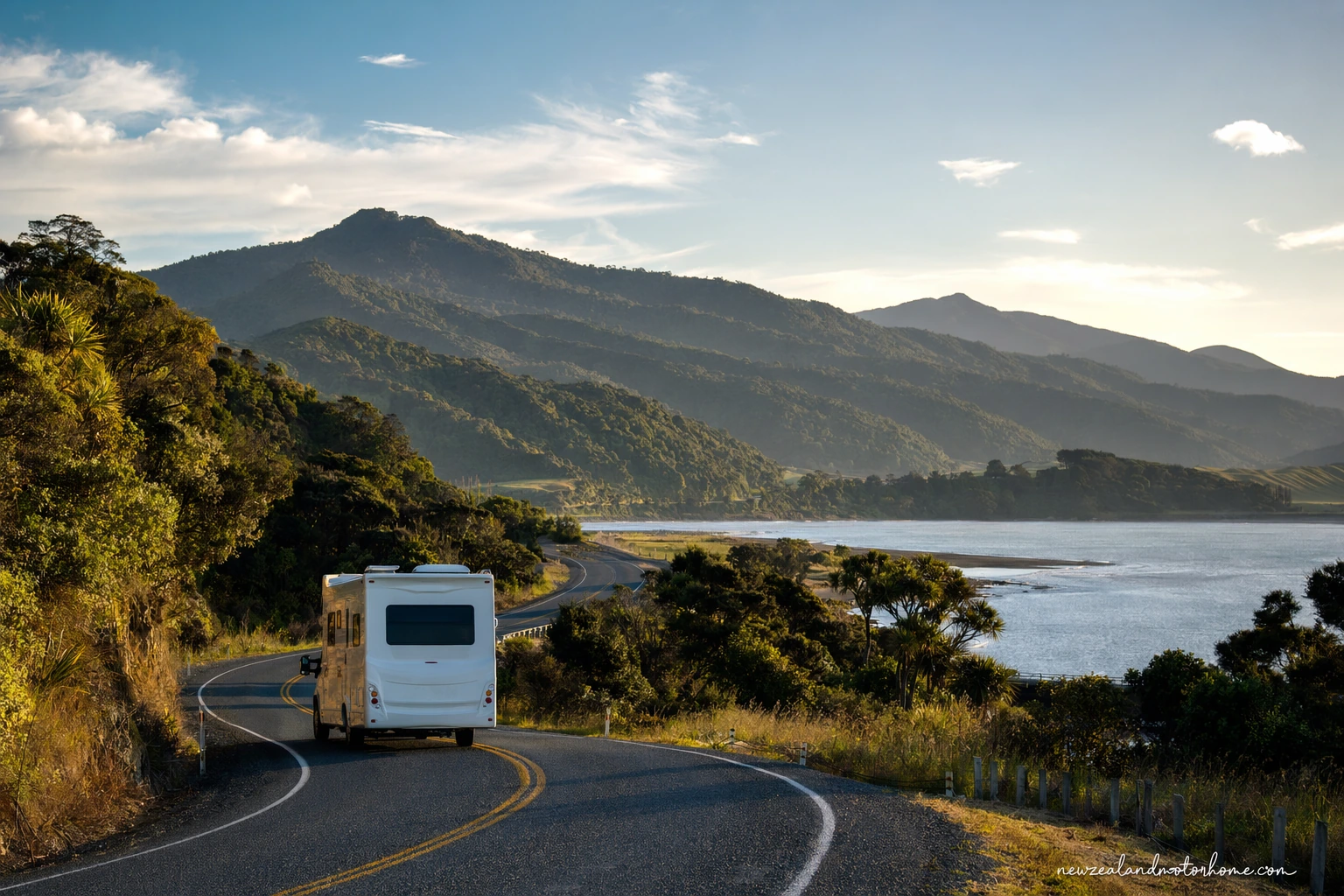
Nelson to New Plymouth campervan route: ferry, coast and Taranaki
- Allow 3-4 days
- Cook Strait ferry required
- Main roads suit motorhomes
- Book powered sites in summer
- Self-contained rules apply
The Nelson to New Plymouth campervan route is not a quick hop on the map: it is a South Island-to-North Island crossing, a Cook Strait ferry, and then a west-coast run through Kāpiti, Whanganui and Taranaki. Done well, it is a rewarding self-drive motorhome trip with harbour mornings, ferry logistics, surf beaches and a big volcanic finish under Taranaki Maunga.
This guide is written for travellers sleeping in their own hired campervan or motorhome, so the focus is practical: where to break the drive, how to handle ferry check-in with a van, which roads suit longer vehicles, and where to think about powered sites, dump stations, fresh water and LPG. If you want the legs matched to your van size and travel dates, you can also talk to us before you lock it in.
How many days to allow for the Nelson to New Plymouth drive
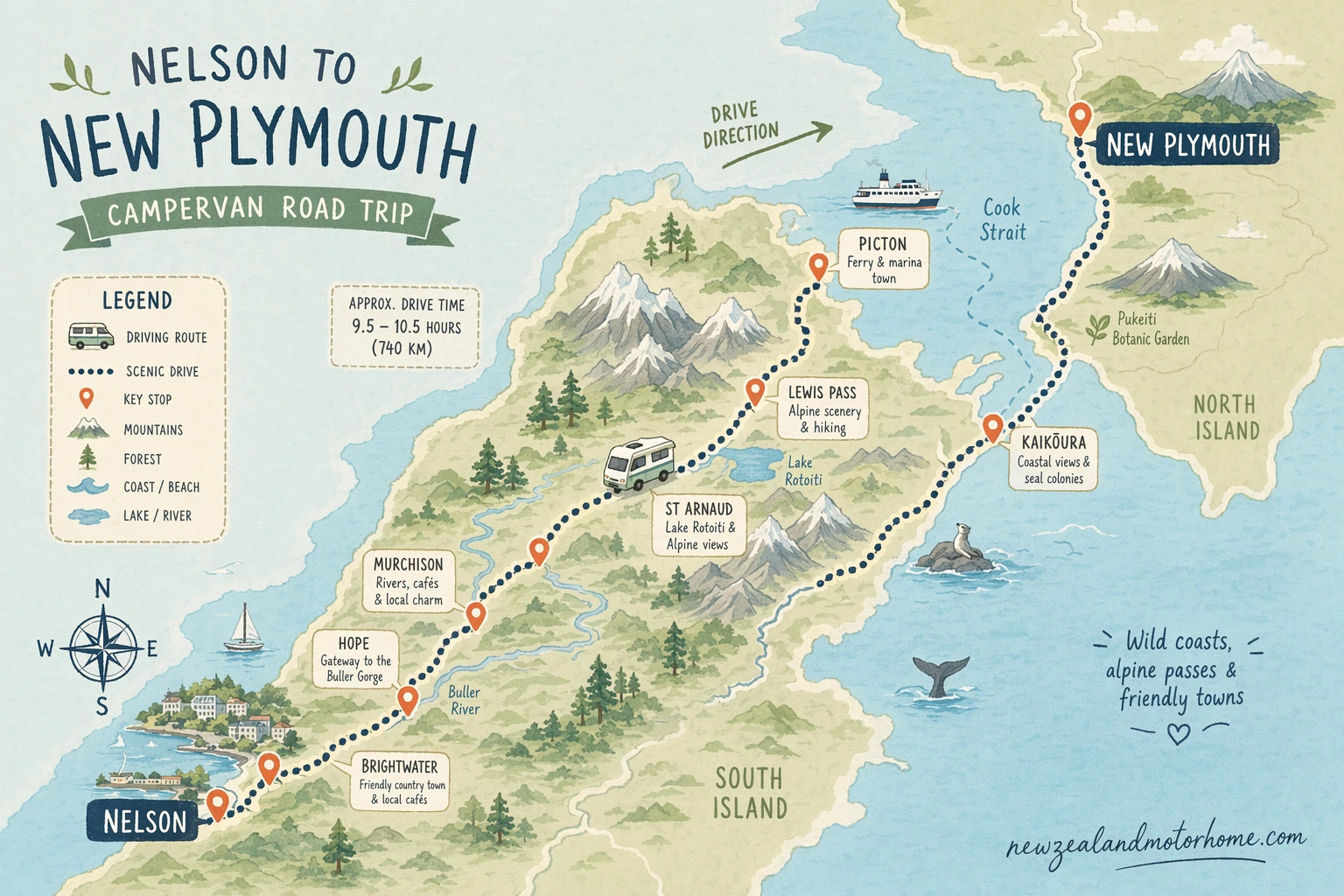
You can technically complete the Nelson to New Plymouth drive in two long days if ferry times line up, but that leaves very little margin for weather, ferry delays, dumping tanks or simply enjoying the road. For a calmer campervan rhythm, allow three to four days from Nelson to New Plymouth, or five if you want time in Marlborough Sounds, Wellington or Whanganui.
The whole route is roughly 490 kilometres of driving, plus the Cook Strait ferry. The main campervan-friendly line is Nelson to Blenheim or Picton, ferry to Wellington, then north via SH1 and SH3 through Kāpiti, Levin, Whanganui and Hāwera to New Plymouth.
- Fast but tight: Nelson to Picton, ferry, overnight near Wellington or Kāpiti, then New Plymouth next day.
- Comfortable: Nelson/Picton night, ferry day, Kāpiti or Whanganui night, then New Plymouth.
- Best for larger motorhomes: avoid rushing ferry check-in and plan shorter driving legs with powered sites booked ahead.
If you are picking up a van in Nelson, do your first supermarket shop, check your self-containment certificate, test the water pump and locate your grey-water hose before leaving town. Small fixes are easier in Nelson than in a ferry queue.
Leg 1: Nelson to Picton without stressing the van
The standard van-suitable route from Nelson to Picton is via SH6 towards Havelock, then on to Blenheim and Picton. It is a proper highway drive with winding sections, hills and regular logging and freight traffic, so keep left, use slow-vehicle bays, and do not let faster cars push you through bends.
Queen Charlotte Drive between Havelock and Picton is beautiful, but it is narrow, twisty and slow. In a compact campervan it can be a memorable scenic detour; in a long motorhome, especially if you are new to New Zealand roads, the Blenheim route is usually the easier choice.
- Good first stop: Pelorus Bridge area for a leg stretch, toilets and native bush walks; check overnight rules if you plan to stay.
- Before the ferry: top up groceries and fuel in Blenheim or Picton rather than arriving on empty.
- Overnight options: Nelson, Havelock, Blenheim and Picton all have holiday park-style stays with powered and unpowered sites.
- Van service note: use public dump stations or campground facilities in Nelson, Blenheim or Picton before crossing if your tanks are getting full.
Picton is a small ferry town and parking a larger motorhome right by the waterfront can be awkward at busy times. Arrive with time to spare, use designated long-vehicle parking where signed, and avoid squeezing into short car bays with the rear overhanging traffic.
Taking a campervan on the Cook Strait ferry
The ferry is the hinge point of this Nelson to New Plymouth motorhome road trip. Book using your campervan or motorhome length and height, including bike racks, rear boxes or anything on the roof. Turning up with the wrong dimensions can create check-in problems, especially during school holidays and summer sailings.
Before boarding, secure loose items inside the van, close roof vents, switch the fridge to an approved travel setting, and turn LPG bottles off as required by ferry instructions. You will not be able to stay in the campervan during the sailing, so take warm layers, medication, chargers and anything you need with you to the passenger decks.
- Timing: allow a buffer before check-in; roadworks or a slow hill section out of Nelson can chew up time.
- Food and waste: empty rubbish and deal with grey water before the ferry if needed, rather than carrying a full van across.
- Weather: Cook Strait can be lively; keep cupboard latches closed and do not leave breakables loose.
- Arrival in Wellington: city traffic, tight lanes and wind can be tiring after the sailing, so consider a short first North Island leg.
If your ferry arrives late in the day, it is often smarter to overnight in the Wellington, Lower Hutt, Porirua or Kāpiti area rather than driving on to Whanganui in the dark. New Zealand rural roads have limited lighting, and fatigue is a real issue in a high-sided vehicle.
Leg 2: Wellington to Whanganui or Kāpiti
From Wellington, most campervan travellers head north on SH1 through the Transmission Gully corridor, then continue via the Kāpiti Coast and Levin before joining the route towards Whanganui. This is a more relaxed drive than the old coastal bottlenecks, but wind, rain and busy merge points still require steady hands in a taller van.
Kāpiti makes an easy first North Island night if you want beaches, groceries and a shorter day after the ferry. Whanganui is a better break if you are ready for a longer run and want riverside walks, heritage streets and a clear jump-off point for Taranaki the next morning.
- Overnight style: look for holiday parks or council-approved camping areas; freedom camping rules vary between Wellington, Kāpiti, Horowhenua and Whanganui districts.
- Powered sites: useful after a ferry day if you have been running the fridge, heater or device charging hard.
- Dump and water: plan around public dump stations in larger centres such as Porirua, Paraparaumu, Levin and Whanganui, or use campground facilities.
- LPG and fuel: refill in the main towns rather than assuming small settlements will have bottle fills.
Street parking a motorhome in Wellington city is not much fun, especially with height restrictions in many car parks. If you want to visit the city, base the van at a proper campground or outer-area parking spot and use public transport or a short walk where practical.
Leg 3: Whanganui to New Plymouth via Surf Highway country
The run from Whanganui to New Plymouth follows SH3 through South Taranaki, with views opening gradually towards Taranaki Maunga on a clear day. It is a straightforward sealed highway for campervans, though you will still meet trucks, farm vehicles and exposed windy stretches.
Hāwera is a practical service stop before the final push north. From there you can continue on SH3 through Stratford and Inglewood, or, if time and confidence allow, explore parts of the coast around Ōpunake and the Surf Highway. The coastal road is scenic but slower, with narrower sections and more bends, so it suits travellers who are comfortable manoeuvring their van and not in a hurry.
- Good breaks: Whanganui riverfront, Pātea, Hāwera, Ōpunake and coastal viewpoints with room to turn around.
- Van size note: check signs before entering beach access roads; some are sandy, steep or have tight turning areas.
- Arrival in New Plymouth: choose a campground or designated overnight area before dark, especially during summer events.
- Servicing: dump stations, fresh-water fills, fuel and LPG are generally easier in Hāwera and New Plymouth than at smaller beach settlements.
New Plymouth is a great place to slow the route down. Park the van for a couple of nights if you can, walk the Coastal Walkway, visit Pukekura Park, and keep an eye on weather if you are heading up towards Egmont National Park, where roads are steeper and cloud can drop quickly.
Freedom camping, powered sites and van services on this route
This route crosses several council areas, and freedom camping rules change as you move from Nelson and Marlborough into Wellington, Kāpiti, Whanganui and Taranaki. Do not assume one district's rules apply to the next. In general, freedom camping is only for certified self-contained vehicles and only where signs or council maps allow it.
For a Nelson to New Plymouth campervan trip, mix paid campgrounds with carefully chosen free or low-cost stops rather than relying on freedom camping every night. Powered sites are especially helpful before or after the ferry, in bad weather, or when you need a proper shower, laundry, water fill and dump station in one place.
- Carry: your self-containment certificate, toilet paper suitable for campervan systems, levelling blocks and a grey-water hose.
- Dump before you must: do not wait until tanks are full; use facilities in Nelson, Blenheim, Picton, Wellington region, Whanganui, Hāwera or New Plymouth.
- Fresh water: fill from signed potable taps only, usually at campgrounds, service hubs or official dump station areas.
- Respect signs: no-camping areas are enforced, and fines can sour an otherwise brilliant trip.
The simple rule is to finish each driving day with the van sorted: enough fresh water, enough battery, grey and toilet tanks under control, and a legal place to sleep. That makes the route feel like a road trip rather than a series of chores.
Keep planning
Common questions
Can I drive from Nelson to New Plymouth in one day with a campervan?
It is not a sensible one-day campervan drive because the route includes the Cook Strait ferry plus long road legs on both islands. Treat it as at least a two-day trip, with three or four days giving much better margins for ferry timing, rest stops and overnight camping.
Is the Nelson to Picton road suitable for a large motorhome?
Yes, the main route via SH6 and Blenheim is suitable for large motorhomes when driven steadily. Queen Charlotte Drive is more scenic but narrower and windier, so larger vans or nervous drivers are usually better staying on the main highway.
Do I need to book the Cook Strait ferry for my campervan?
Yes, book ahead and enter the correct vehicle length and height, including anything mounted on the rear or roof. Summer, long weekends and school holidays can sell out for high or long vehicles before standard car spaces do.
Where should I overnight after arriving in Wellington by ferry?
If the ferry arrives late, choose a legal campground or designated overnight area in the Wellington, Lower Hutt, Porirua or Kāpiti area rather than pushing north tired. City street freedom camping is restricted, so check current council rules before parking up for the night.
Are there dump stations between Wellington and New Plymouth?
Yes, you will find dump station options in larger centres along the way, commonly around the Wellington region, Kāpiti, Levin, Whanganui, Hāwera and New Plymouth. Check current locations before you travel and use only signed facilities for toilet cassette and grey-water disposal.
Is freedom camping easy on this route?
It is possible in places if your vehicle is certified self-contained, but it is not something to rely on every night. Rules differ by district, and many coastal or urban spots are restricted, so plan a mix of powered sites, unpowered campground sites and approved freedom camping areas.
Have a planner shape this for your dates
Send a short outline — your dates, party size, and the kind of trip you want. A planner replies with a vehicle recommendation, a paced route, and the realistic budget.