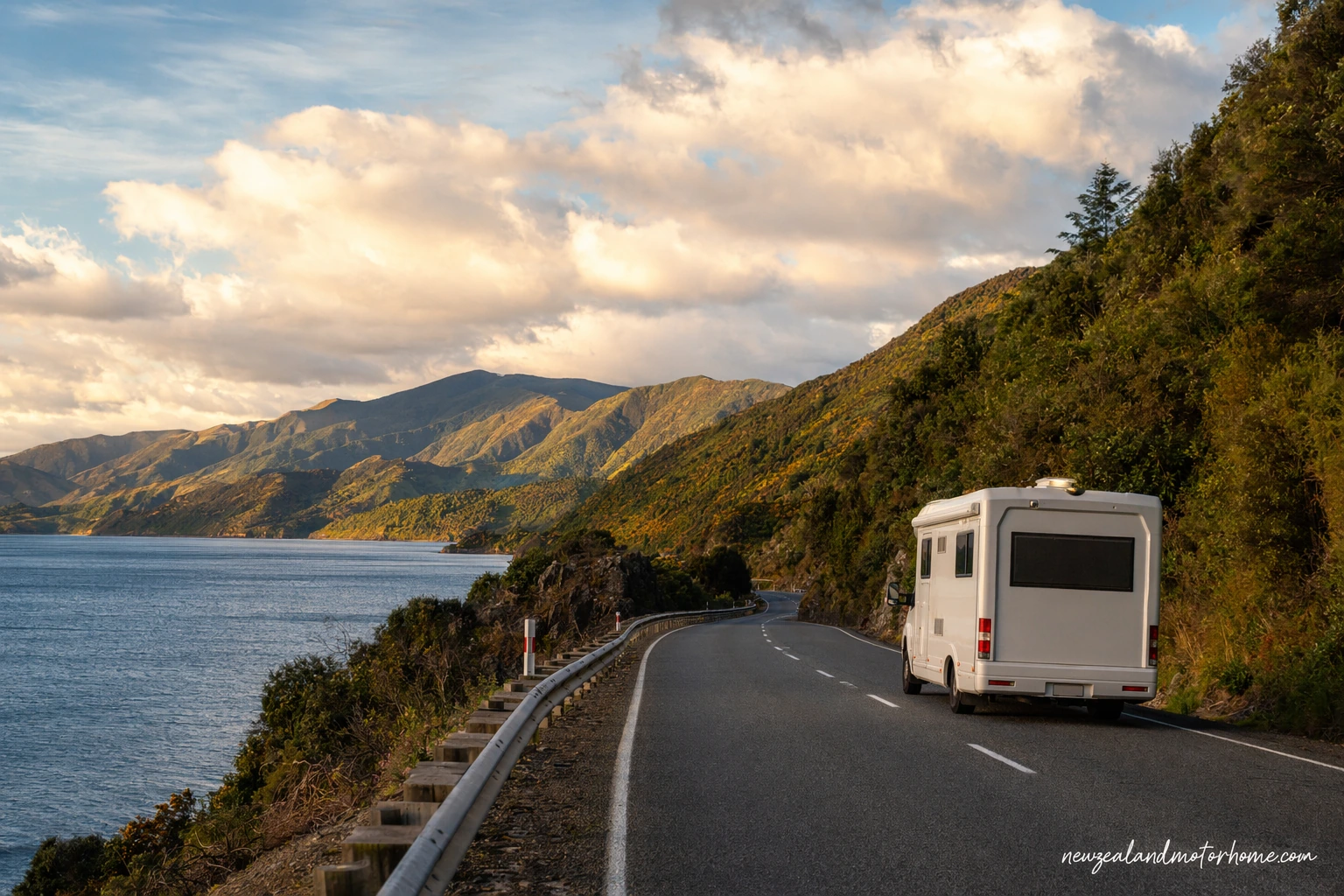
Your Nelson to Picton campervan route over the hills and Sounds
- Best with 1–3 days
- Scenic route has tight bends
- Powered sites in Nelson and Picton
- Self-contained rules apply
- Good ferry-day route
The Nelson to Picton campervan route is short on the map, but it deserves more than a dash to the ferry. Between Tasman Bay, the Whangamoa hills, Pelorus Bridge, Havelock and the Queen Charlotte Sound, this is a drive where a self-contained van gives you real flexibility: pull in for river swims, choose a powered site when batteries need a top-up, or keep the day loose if the weather turns.
This guide is written for travellers driving and sleeping in their hired campervan or motorhome. You’ll find practical road notes for the Nelson to Picton drive, overnight options, dump station and fresh-water planning, and advice on when to take the scenic but twisty Sounds road instead of the easier state highway approach.
How long to allow for the Nelson to Picton drive
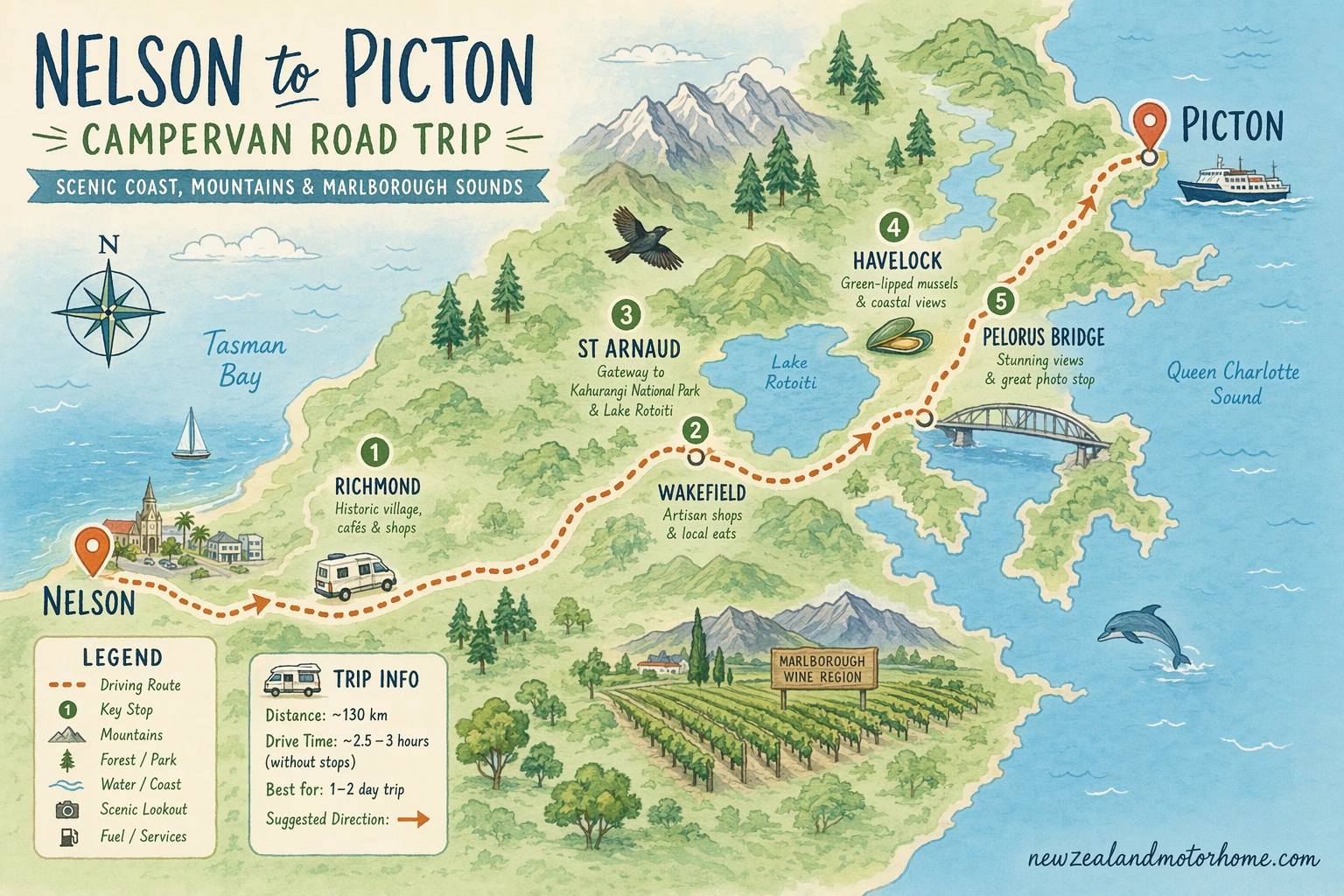
The direct Nelson to Picton drive can be done in a half day, but a better campervan rhythm is one to three days. One day works if you are connecting to an afternoon or evening ferry and only want short stops. Two days lets you sleep around Pelorus Bridge, Havelock or Queen Charlotte Sound. Three days gives you time for a harbour walk, a kayak, a long lunch stop, or a quiet morning before the ferry queue.
Road time varies depending on whether you choose the scenic Queen Charlotte Drive from Havelock to Picton or the more straightforward route via Blenheim. In a larger motorhome, allow extra time for slower climbs, narrow corners and photo stops where you can safely get right off the carriageway.
- Fast but less scenic: Nelson to Havelock, then via Renwick, Blenheim and SH1 to Picton; generally easier for longer vans.
- Scenic and slower: Nelson to Havelock, then Queen Charlotte Drive through Linkwater and the bays into Picton.
- Best pace: 2 days if you want a relaxed Nelson to Picton motorhome road trip rather than a transfer.
Nelson to Havelock: hills, river stops and van-friendly pull-ins
Leave Nelson with fuel, groceries and fresh water sorted if you can. The first section climbs through the Whangamoa and Rai Saddle area, so secure cupboards, latch the fridge, and give the van an easy pace on the bends. These roads are used by trucks as well as holiday traffic; pull over only in formed lay-bys, not on soft shoulders.
Pelorus Bridge is the natural campervan break on this leg. The river is close to the road, there are bush walks that do not require a big time commitment, and the parking is more comfortable than trying to tuck a tall van into small roadside viewpoints. If you overnight here or nearby, check whether the site is powered or unpowered before arriving, as bush settings often mean less charging opportunity.
- Before leaving Nelson: top up LPG if needed, fill fresh water, empty the toilet cassette, and buy groceries.
- Good driving habit: use lower gears on descents rather than riding the brakes in a heavy campervan.
- Parking note: choose signed parking areas around rivers and reserves; avoid blocking boat access or forestry gates.
Where to overnight between Nelson and Picton
You have a few different overnight styles on this route. Nelson and Picton both have holiday parks where powered sites are useful before or after a ferry crossing, especially if you need laundry, showers, Wi-Fi, a dump station or a reliable fresh-water fill. Around Havelock and the Sounds, expect more unpowered and low-key camping, with fewer services and more reason to arrive before dark.
Freedom camping rules are set by local councils and can change, particularly around Nelson, Tasman and Marlborough coastal areas. Do not assume a waterfront car park is available overnight just because another van is there. You’ll generally need a certified self-contained vehicle, and even then you must follow the posted signs, time limits and any restricted-area maps.
- Nelson/Tahunanui: practical powered-site base before starting the route, with easy resupply.
- Pelorus Bridge/Rai Valley area: good for a nature stop, often quieter, but check service levels.
- Havelock: useful overnight if you want an early start onto Queen Charlotte Drive.
- Picton/Waikawa: best choice if you have an early ferry and want to be close without rushing.
Queen Charlotte Drive or the Blenheim route?
From Havelock, the decision is the heart of this campervan route. Queen Charlotte Drive is the postcard option, curling above bays and through native bush before dropping towards Picton. It is also narrow, winding and slow, with limited places to turn a larger motorhome around. If your van is long, your driver is new to NZ roads, or the weather is wet and misty, give yourself plenty of margin.
The alternative via Renwick, Blenheim and SH1 is less dramatic but more relaxed for bigger vehicles. It also suits travellers who want supermarket choice, a dump station, fuel, LPG or mechanical peace of mind before reaching Picton. If you are catching a ferry the same day, this route can be the calmer option.
- Choose Queen Charlotte Drive if: you have time, good visibility, and a driver comfortable with tight corners.
- Choose via Blenheim if: you are in a large motorhome, travelling in poor weather, or need services before Picton.
- Either way: avoid stopping on blind bends for photos; wait for proper lookouts or bays where the whole van fits safely.
Dump stations, water, LPG and ferry-day planning
Service planning matters on a short route because ferry timing can make the day feel tighter than the kilometres suggest. Treat Nelson as your best pre-route service hub, with supermarkets, fuel, LPG and council-listed dump station options. Havelock and Picton can also be useful, but do not leave cassette emptying or fresh-water filling until the last half hour before ferry check-in.
If you are ending the route in Picton, plan your final night around what the van needs: a powered site for batteries, a dump point before returning the vehicle later, or a quiet unpowered night if you are already sorted. Ferry queues are not the place to discover your grey-water tank is full or the gas bottle is nearly empty.
If you want help matching your van size, ferry time and overnight stops, you can use our talk-to-us step and we’ll help shape the route around how you actually travel.
- Fresh water: fill at holiday parks or signed public points only; never use wash-down taps unless marked as potable.
- Grey and black water: use designated dump stations and rinse areas, not campground drains or public toilets.
- Ferry morning: allow time for fuel, dumping, rubbish disposal and check-in without rushing the hills into Picton.
Common questions
Can I drive from Nelson to Picton in one day in a campervan?
Yes, the drive is short enough for one day, especially if you use the easier Blenheim route. For a more relaxed campervan trip, allow at least one overnight so you can stop at Pelorus Bridge, Havelock or the Sounds without watching the clock.
Is Queen Charlotte Drive suitable for a large motorhome?
It can be suitable for confident drivers, but it is narrow, winding and slow in places. If your motorhome is long, high-sided, or you are new to NZ roads, the route via Blenheim is generally easier and less tiring.
Where should I stay before an early Picton ferry?
Stay in Picton or nearby Waikawa if you want the simplest morning. A powered site is useful before a ferry crossing because you can charge devices, use facilities, dump tanks if available, and leave with the van organised.
Can I freedom camp between Nelson and Picton?
Only where local bylaws allow it, and usually only in a certified self-contained campervan. Check current council signage and maps before settling in, because many waterfront and town-centre areas around Nelson, Marlborough and Picton are restricted.
Where can I empty my toilet cassette on this route?
Plan to use council-listed dump stations or holiday park facilities in Nelson, Havelock, Blenheim or Picton. Do not rely on finding one at the last minute near the ferry terminal, especially in busy summer periods.
Have a planner shape this for your dates
Send a short outline — your dates, party size, and the kind of trip you want. A planner replies with a vehicle recommendation, a paced route, and the realistic budget.