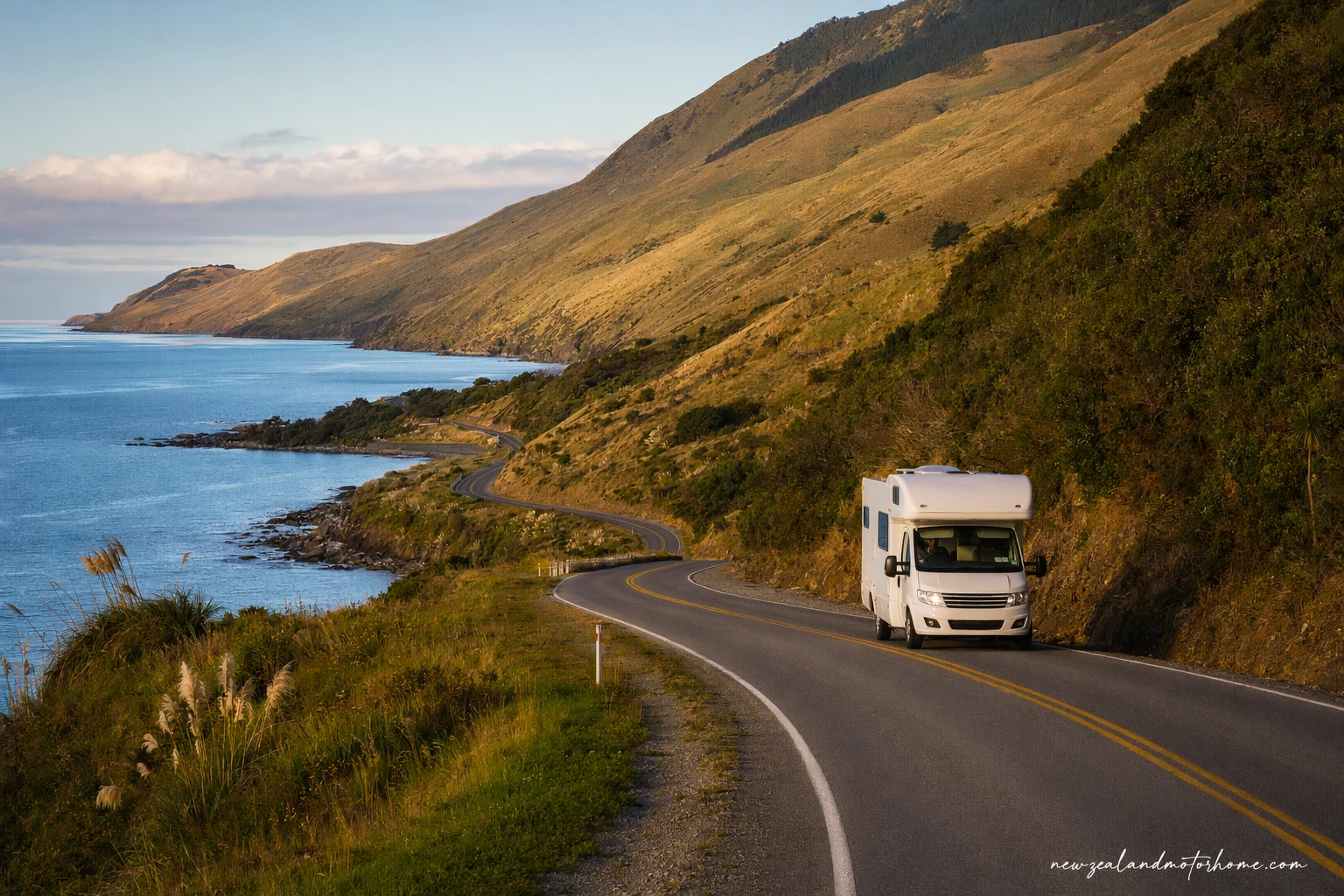
Queenstown to New Plymouth campervan route for self-drive vans
- Allow 6–10+ days
- Includes Cook Strait ferry
- Best in spring to autumn
- Powered and unpowered stops
- Check self-containment rules
The queenstown to new plymouth campervan route is a proper cross-country journey: alpine roads out of Otago, the wild West Coast, a Cook Strait ferry crossing, then the surf coast and volcanic cone of Taranaki. It is not a route to rush in a big van, especially if you want relaxed overnight stops, time for dump stations, and a little weather margin around the ferry.
This guide is written for travellers driving and sleeping in a hired campervan or motorhome. You will find a practical leg-by-leg shape for the queenstown to new plymouth drive, where to think about powered and unpowered nights, what roads need extra care, and how to arrive in New Plymouth with fresh water, empty waste tanks and a sane parking plan.
If you would like this stitched into your own dates, van size and ferry sailing, you can use our plan-your-trip step and we will help turn the route into a workable overnight sequence.
How many days to allow in a campervan
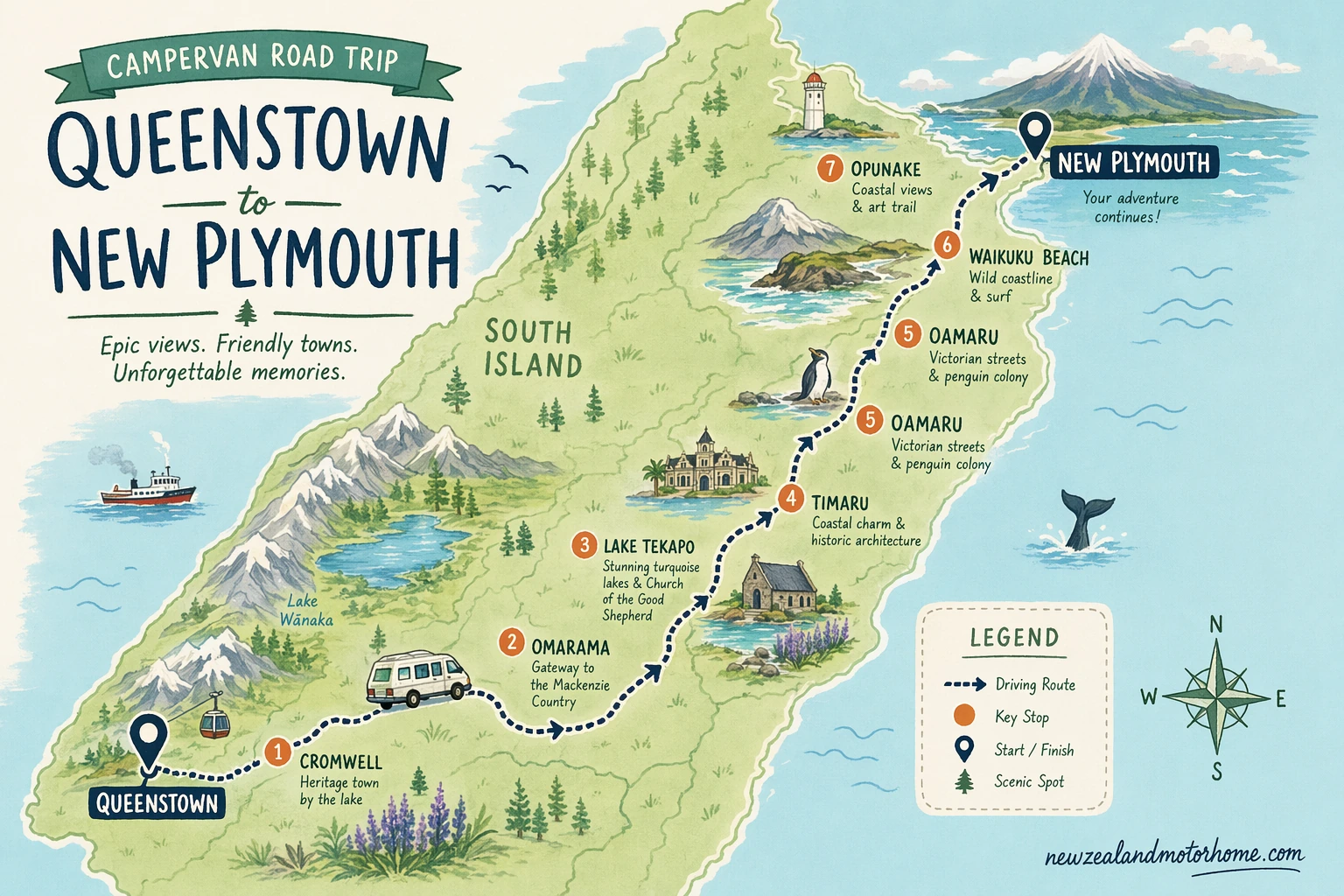
For most self-drive vans, allow at least 6 to 8 days from Queenstown to New Plymouth, with 9 to 12 days feeling much better if you want short driving days and time on the West Coast. The direct kilometres look manageable on a map, but the queenstown to new plymouth motorhome road trip includes mountain passes, winding coast road, one-way bridges, ferry timing and slower urban approaches around Wellington.
A sensible rhythm is three to five nights on the South Island, one ferry day, then one to three nights between Wellington and Taranaki. If you have a larger motorhome, build in more daylight for parking, supermarket stops, LPG checks and dump-station visits rather than trying to arrive after dark.
- Fast but still realistic: Queenstown, West Coast, Picton, ferry, Whanganui, New Plymouth over about 6 days.
- Comfortable pace: 8 to 10 days with stops around Wānaka, Franz Josef or Hokitika, Punakaiki or Westport, Picton, Kāpiti or Whanganui.
- Best for first-timers: Keep daily driving under about 250 km where possible, especially between Queenstown, Haast and the northern West Coast.
Queenstown to the West Coast: passes, fuel and first nights
From Queenstown, most campervan travellers either head through Cromwell and Wānaka, or take the Crown Range if conditions and rental rules allow. The Crown Range is steep, exposed and can be icy; in a long or high-roof van, the Cromwell route is often the calmer choice even if it adds a little distance.
Wānaka is a useful first reset point with supermarkets, fuel, LPG swap options, fresh-water fills and holiday parks if you want a powered night after collecting the van. From there the road over Haast Pass is beautiful but slow, with limited services once you leave the lakes. Fill fuel, top fresh water and check grey/black tanks before you push through to Haast, Fox Glacier, Franz Josef or Hokitika.
- Good first overnight zones: Wānaka for services, Haast for a simple road-trip stop, or Glacier Country if you have made an early start.
- Road note: Haast Pass has tight corners, rainforest shade and waterfall pull-offs that are not always long-vehicle friendly.
- Camper tip: Do not rely on freedom camping unless your van is certified self-contained and the local signs clearly allow it.
Up the West Coast to Picton without wearing out the driver
The West Coast section is one of the highlights of the queenstown to new plymouth campervan route, but it is not a motorway run. Expect single-lane bridges, changing weather, logging trucks and scenic pull-offs where a large motorhome may need to continue to the next safer bay rather than squeezing in.
Hokitika, Greymouth, Punakaiki, Westport and Murchison all work as overnight stepping stones depending on your pace. Holiday parks are the simplest option for powered sites, laundry and showers, while council or DOC-style campgrounds can suit self-contained vans that are happy with unpowered nights. Use larger towns for dump stations and fresh water rather than leaving both until the warning lights come on.
- Hokitika or Greymouth: Handy for groceries, fuel, dump-station planning and an easier powered night.
- Punakaiki: Great for coast scenery, but book ahead in busy periods and avoid arriving late in a big van.
- Westport to Murchison: The Buller Gorge is scenic and winding; take breaks and let faster traffic pass where safe.
- Picton: A practical pre-ferry night, especially if your sailing is early or the weather forecast is unsettled.
Cook Strait ferry day with a motorhome
The ferry is the hinge of this route. When booking, enter the full length and height of your campervan or motorhome, including bike racks, roof pods or rear storage boxes if fitted. Turn off LPG at the bottle before boarding, follow the crew’s vehicle-deck instructions, and keep anything you need for the crossing with you because you usually cannot return to the van during sailing.
Picton is easier than Wellington for last-minute van jobs, so arrive the day before if you need to dump waste, refill fresh water, organise groceries or simply reduce stress. On the Wellington side, give yourself time to clear the terminal and avoid planning a long night drive north unless you are experienced with city traffic in a high vehicle.
- Before boarding: Empty waste tanks if convenient, secure cupboards, close roof vents and check LPG is off.
- After arrival: Consider a powered night around Wellington, Porirua or the Kāpiti Coast instead of pushing straight to Taranaki.
- Weather buffer: Cook Strait can delay sailings, so avoid booking a tight activity or campsite arrival window in New Plymouth the same day.
Wellington to New Plymouth: coast, river towns and Taranaki roads
From Wellington, the usual campervan route follows SH1 up the Kāpiti Coast, then SH3 through or near Whanganui and on towards Taranaki. This is the North Island part of the queenstown to new plymouth drive where you can choose between a straightforward transit day or a slower coastal run with an overnight around Kāpiti, Whanganui or Hāwera.
Whanganui is a good mid-route stop for a self-contained van because it has town services, riverside walks and a less frantic feel than arriving in New Plymouth tired. North of there, keep an eye on SH3 conditions through the Awakino and Mt Messenger areas, where corners, hills, roadworks and temporary traffic controls can affect larger motorhomes.
- Useful overnight pattern: Ferry to Kāpiti or Whanganui, then Whanganui to New Plymouth the next day.
- Van services: Look for dump stations, potable water and LPG in larger towns such as Wellington/Porirua, Whanganui, Hāwera and New Plymouth.
- Driving note: Let trucks and locals pass at safe pull-offs; a high-roof campervan will feel crosswinds along exposed coastal sections.
Arriving in New Plymouth with the van
New Plymouth is compact, but the foreshore and central streets can be busy, especially in summer, at weekends and around events. Treat the city as a place to park once and explore on foot or by bike where you can. For a larger motorhome, it is usually easier to base yourself at a holiday park or permitted overnight area, then use designated car parks for short visits to the Coastal Walkway, Pukekura Park or the port area.
Freedom camping rules in Taranaki are location-specific and can change, so check current council signage before sleeping anywhere outside a campground. A certified self-contained van gives you more options, but it is not permission to overnight wherever there is a sea view. Empty grey and toilet waste only at approved dump stations, and refill with potable water before heading around the mountain or onwards north.
- Powered sites: Best after several unpowered West Coast nights, or if you need heaters, laundry and a full battery reset.
- Unpowered sites: Fine for certified self-contained vans with solar and conservative water use.
- Parking tip: Avoid tight beachfront car parks in peak times if your van is long; arrive early or choose a wider edge-of-centre parking area.
- Next move: From New Plymouth, SH45 around Surf Highway is scenic but slower; check bridge, roadwork and wind conditions before committing in a larger van.
Keep planning
Visiting skyline queenstown gondola by campervan
Read onHoliday parks queenstown skyline
Read onHoliday parks queenstown lakes
Read onHoliday parks queenstown
Read onHoliday parks new plymouth
Read onFarmers markets queenstown lakes
Read onCommon questions
Can I drive from Queenstown to New Plymouth in one or two days?
Not sensibly in a campervan. You must factor in the Cook Strait ferry, slower South Island roads, rest breaks, dump stations and overnight parking. Treat it as a multi-day self-drive route rather than a point-to-point dash.
Do I need to book the ferry for a motorhome?
Yes, booking ahead is strongly recommended, especially in summer, school holidays and around public holidays. You need to provide the correct vehicle length and height, and remember to turn LPG off at the bottle before boarding.
Is the Crown Range suitable for a campervan leaving Queenstown?
It can be suitable in good conditions for confident drivers, but it is steep, winding and exposed. Check your hire agreement, weather and winter road conditions; many van travellers choose the Cromwell route for an easier start.
Where should I plan dump-station stops on this route?
Use larger towns rather than remote scenic stops: Wānaka, the West Coast service towns, Picton, Wellington/Porirua, Whanganui, Hāwera and New Plymouth are the kinds of places to plan around. Always confirm the current dump-station location and potable-water status before relying on it.
Can I freedom camp the whole way from Queenstown to New Plymouth?
Only in places where overnight camping is allowed and only if your van meets the required self-containment rules. Many councils restrict beachfronts, town centres and popular reserves, so mix permitted freedom sites with holiday parks or DOC-style campgrounds.
What is the hardest driving section for a larger motorhome?
Haast Pass, parts of the West Coast, Buller Gorge and the SH3 approaches through northern Taranaki all deserve care. They are driveable, but expect bends, hills, narrow sections, roadworks and fewer easy turnarounds for long vehicles.
Have a planner shape this for your dates
Send a short outline — your dates, party size, and the kind of trip you want. A planner replies with a vehicle recommendation, a paced route, and the realistic budget.