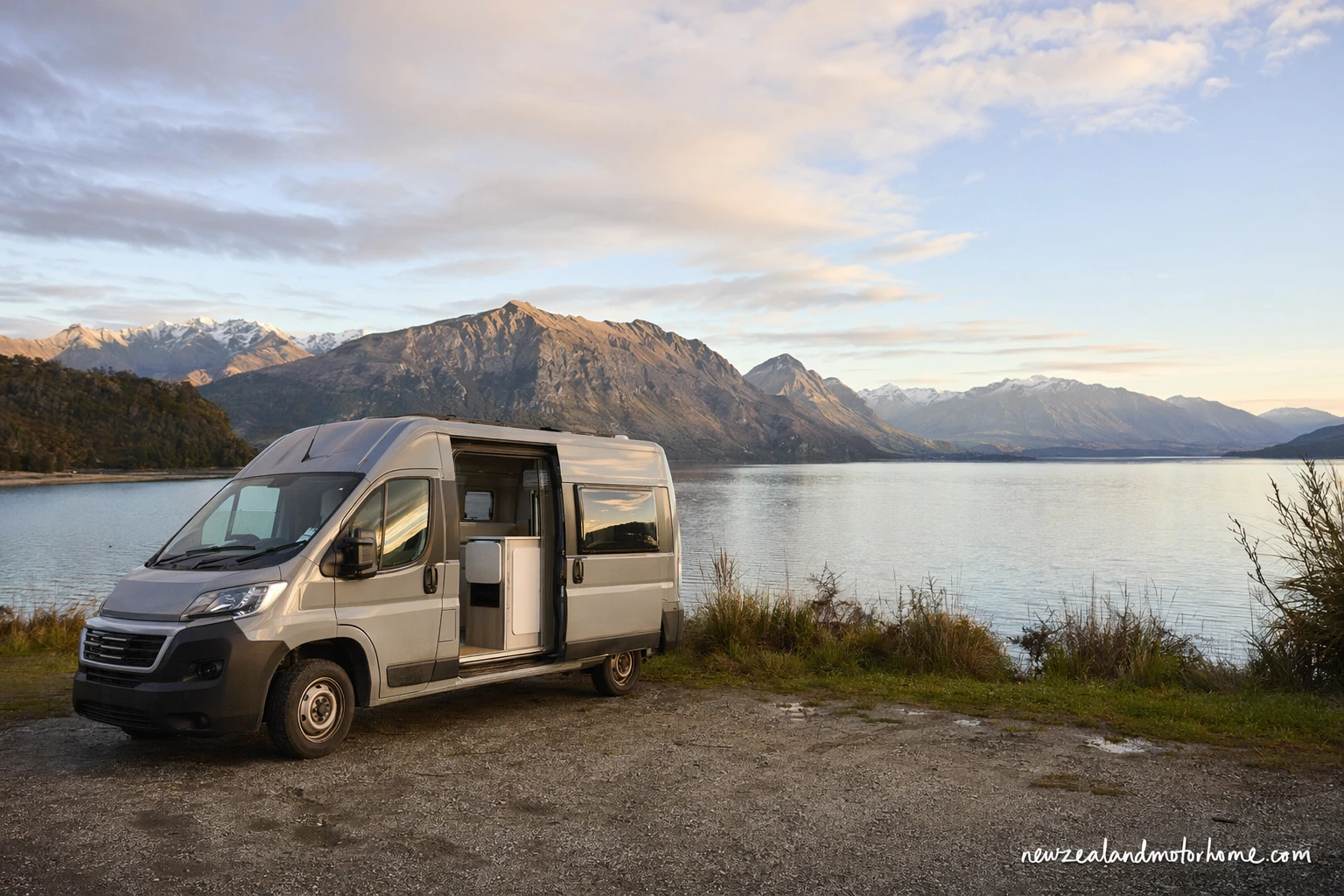
What is the smallest campervan with a toilet NZ travellers should hire?
- Best for 1-2 travellers
- Check self-containment status
- Dump stations needed often
- Powered sites useful every few nights
- Pack soft luggage
If you want the freedom of a little van but still want your own toilet on board, the choice is narrower than it first looks. In New Zealand, the smallest practical option is usually a compact 2-berth campervan with a fixed or cassette toilet, enough standing or crouching space to use it, and a certified self-contained setup if you plan to use freedom camping spots.
This page is for self-drive travellers choosing a hire van for real New Zealand roads: supermarket car parks in small towns, tight holiday park sites, gravel access roads to DOC camps, dump stations on the way out, and wet mornings when you are glad you do not have to walk across a campsite in socks and jandals.
How small can a campervan be and still have a usable toilet?
The smallest campervan with a toilet in NZ is rarely a tiny sleeper car. Once a van has a proper toilet, fresh-water storage, grey-water storage, a bed, cooking gear and enough headroom to move around, it usually sits in the compact 2-berth campervan category rather than the very smallest budget sleeper category.
For most travellers, the sweet spot is a short-wheelbase or medium-wheelbase van conversion. It is still easy to park at supermarkets, ferry terminals and beach towns, but it gives you a toilet you can actually use at night, in bad weather, or when a public toilet is closed.
- Best for: solo travellers or couples who value easy driving and simple overnight stops.
- Watch for: whether the toilet is fixed, cassette-style, or simply a portable unit stored under a bed.
- Ask before booking: whether the van has current self-containment certification accepted for the places you want to stay.
- Storage trade-off: a toilet usually takes space from luggage, bike gear or indoor seating.
Toilet type matters more than the brochure photo
In a small campervan, the toilet may be in a tiny enclosed cubicle, under a lift-up bench, or set into a wet-area layout where the shower and toilet share the same space. A fixed cassette toilet is the most useful for freedom camping planning because it is designed to be emptied at dump stations and is more likely to meet current self-containment expectations.
Portable toilets can be tempting in the smallest vans, but they are not the same as a proper onboard bathroom. New Zealand freedom camping rules and local bylaws are specific, and certification requirements have tightened. If a campsite says certified self-contained vehicles only, do not assume any van with a small toilet box will qualify.
- Fixed cassette toilet: usually easier to use, secure while driving, and emptied at a dump station.
- Portable toilet: may suit emergency use, but check certification and campsite rules carefully.
- Wet-room toilet: takes more van space, but gives better privacy and often a more comfortable layout.
- No toilet access at night: some layouts require the bed to be shifted first, which gets old quickly.
Where a tiny toilet van can overnight in New Zealand
A smaller campervan helps with parking, but it does not give you automatic overnight rights. In New Zealand, where you sleep depends on the vehicle certification, local council rules, DOC conditions and the specific signage at each site. A compact toilet van is excellent for flexibility, but you still need to plan each night rather than just pull up anywhere pretty.
Holiday parks are the simplest choice when you want showers, laundry, power and an easy place to empty rubbish. Many also have dump stations and fresh-water taps, though access can vary for non-guests. DOC and council sites can be more basic, with unpowered spaces, long-drop toilets or no water, so your onboard toilet and tanks become more important.
- Powered holiday park site: useful every few nights for charging devices, running a heater safely and resetting the van.
- Unpowered campsite: fine for a small van if your house battery, water and toilet cassette are managed.
- Freedom camping area: only use it if your van certification and the local signs allow it.
- Town parking: good for lunch or shopping, but check time limits, height barriers and overnight restrictions.
Driving and parking a small toilet-equipped campervan
The main advantage of going small is how easy the van feels on New Zealand roads. You will notice it in places like Coromandel coastal roads, the narrow streets around older South Island towns, and supermarket car parks where a larger motorhome needs two careful swings. A compact van is also less stressful on ferry boarding ramps and in windy weather.
Still, do not treat it like a car. Check the van height before driving into covered car parks, fast-food drive-throughs or motel-style forecourts. Allow extra braking distance on wet roads, pull over safely when traffic builds behind you, and be gentle on gravel access roads to campsites, especially after rain.
- Length: easier than a large motorhome, but reversing cameras or a spotter still help at tight campsites.
- Height: know the exact clearance before entering any car park with a barrier.
- Weight: water, LPG, food and luggage all affect handling on hills and corners.
- Parking tip: choose end bays where possible so sliding doors and rear doors can open without crowding another vehicle.
Water, waste, LPG and power in a small van
A toilet gives independence, but it also gives you chores. In a small campervan the toilet cassette, grey-water tank and fresh-water tank are all smaller than in a large motorhome, so you will stop more often to empty and refill. Build dump stations and water fills into the route rather than leaving them until the cassette is full and the next town is still an hour away.
Use official dump stations only, and never empty toilet waste into a public toilet, stormwater drain, river edge or campsite bush. Fresh water should come from marked potable taps. If the van uses LPG for cooking or hot water, check where bottle swaps or fills are available before heading into more remote areas.
If you are unsure whether a tiny van will suit your route, especially for a freedom-camping-heavy itinerary, use the talk to us step and we can help match the van size to the way you actually want to travel.
- Every 1-3 days: expect to manage toilet cassette, grey water and fresh water depending on use.
- Power: powered sites help recharge house batteries after cold or cloudy nights.
- LPG: check bottle level before leaving larger towns.
- Cleaning: keep gloves, treatment fluid and a dedicated rinse routine for the cassette.
Who should choose the smallest campervan with a toilet?
A compact toilet-equipped van suits travellers who want to move often, park easily and keep the trip simple. It is a strong choice for a 7- to 14-day North Island loop, a shoulder-season South Island road trip, or a couple who would rather have a small living space than drive a bigger motorhome through mountain passes and busy town centres.
It is less ideal if you are carrying large hard-shell suitcases, travelling in winter and expecting to spend long evenings inside, or wanting a separate shower, generous kitchen and permanent dining space. In those cases, stepping up to a larger 2-berth or small motorhome can feel calmer, even if it takes more care to park.
- Choose small if: you value easy driving, simple parking and occasional freedom camping.
- Go larger if: you want a shower, more storage, or a bed you never have to pack away.
- Pack soft bags: they fit much better around toilet compartments and under-bed storage.
- Plan shorter driving days: a small van is nimble, but the best stops still take time to enjoy.
Common questions
Can the smallest campervan with a toilet freedom camp in New Zealand?
Only if it is certified self-contained and the specific place allows overnight stays. Always check the current certification label and the local signs, because a toilet on board does not automatically mean freedom camping is permitted.
Is a portable toilet enough for a hired campervan in NZ?
It depends on the vehicle certification and where you plan to stay. For freedom camping, current rules favour properly installed toilet systems, so confirm the van's self-containment status before relying on a portable toilet layout.
How often will I need to empty the toilet cassette?
In a small 2-berth campervan, expect to empty it every couple of days, sooner if you use it heavily or stay away from campground facilities. Plan dump station stops alongside fuel, groceries and fresh-water fills.
Do small campervans with toilets usually have showers too?
Some do, but many do not. In the smallest vans, a toilet is more common than a proper shower, so you may still want holiday parks or campgrounds every few nights for hot showers and laundry.
Will a small toilet campervan fit in normal car parks?
Often yes for open-air parking, but you still need to check length, height and rear overhang. Avoid covered car parks unless you know the clearance, and watch for height barriers at beaches, supermarkets and city parking areas.
Is a small campervan with a toilet comfortable for two people?
It can be, if you pack light and are happy with a compact living space. Soft bags, a tidy nightly routine and regular powered-site stops make a small van much easier to live in for more than a weekend.
Have a planner shape this for your dates
Send a short outline — your dates, party size, and the kind of trip you want. A planner replies with a vehicle recommendation, a paced route, and the realistic budget.