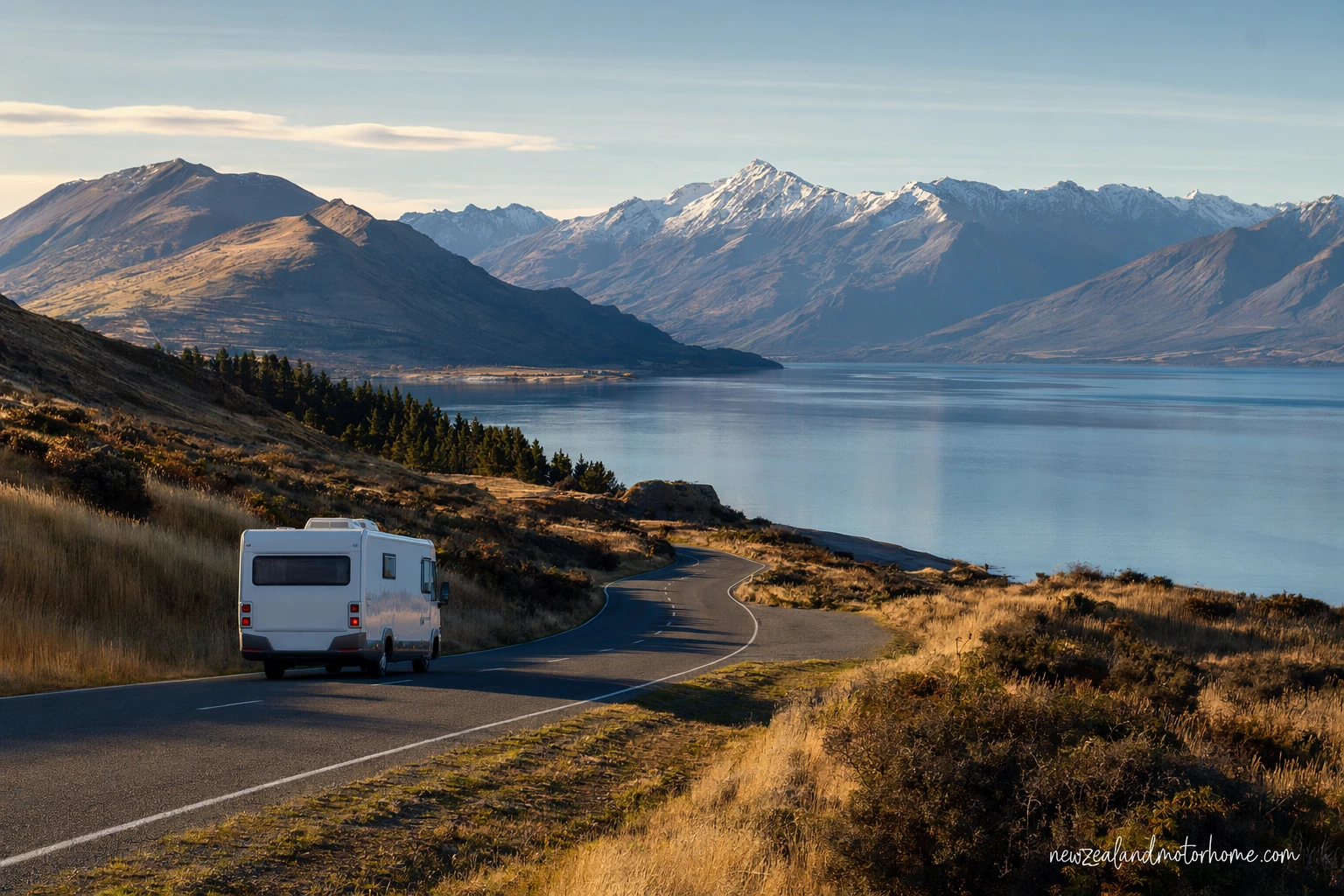
- Allow 7–10 days if you can
- Cook Strait ferry required
- Mostly SH1 sealed highway
- Powered reset nights recommended
- Self-containment needed for freedom camping
An Auckland to Dunedin campervan trip is a proper length-of-the-country run: city motorways, geothermal plateau, Cook Strait ferry, Kaikōura coast, Canterbury plains and Otago harbour hills. It is not a route to rush if you are sleeping in the van each night, managing water, power, waste and the occasional windy stretch of State Highway 1.
This guide is written for self-drive campervan and motorhome travellers, not day-trippers in cars. You will find sensible driving legs, where to think about powered and unpowered nights, ferry notes for taller vehicles, dump-station habits, water and LPG planning, and the road sections that deserve more attention in a longer van.
How many days to allow for the Auckland to Dunedin drive
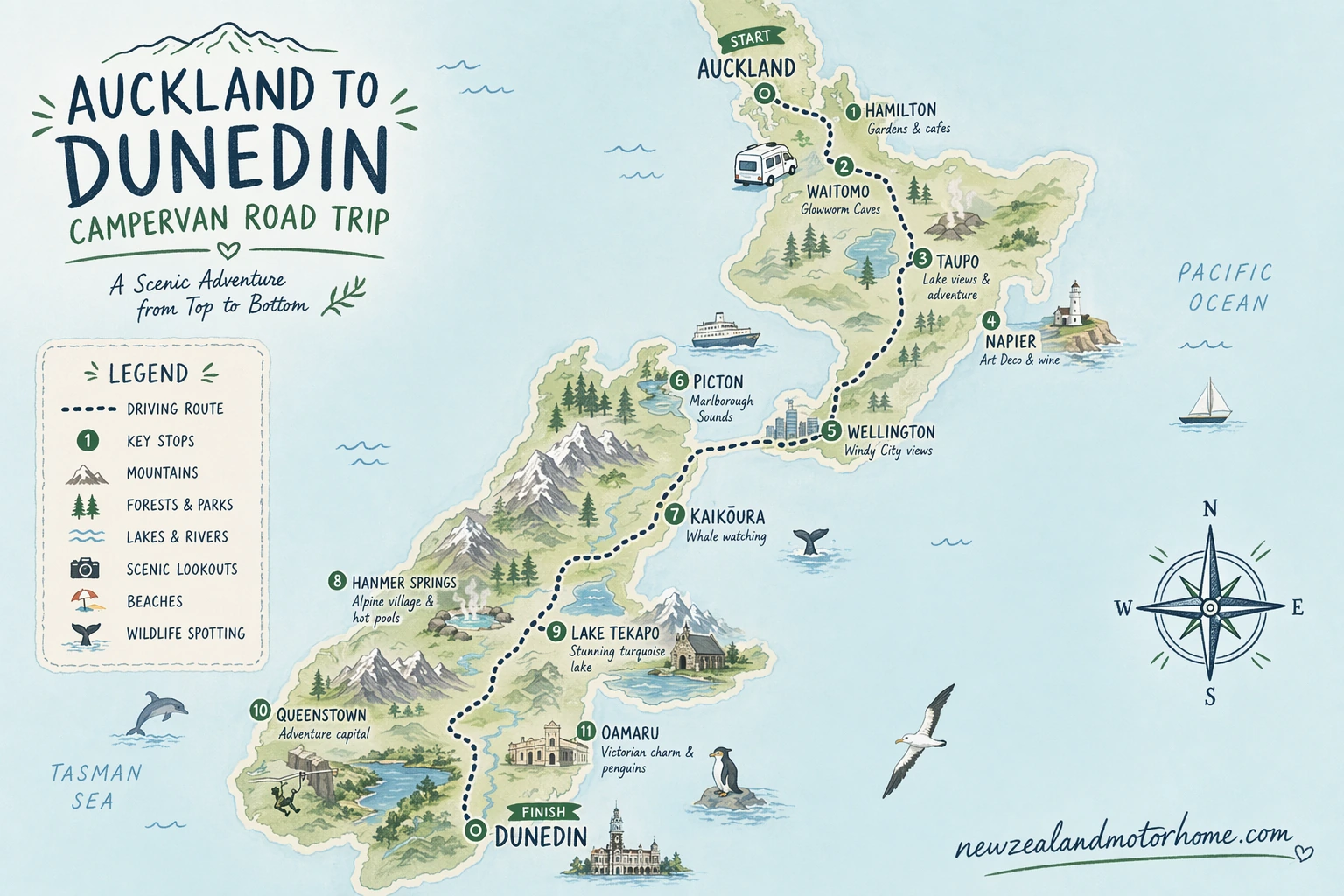
The direct Auckland to Dunedin drive is roughly 1,400-plus kilometres of road driving, plus the Cook Strait ferry crossing between Wellington and Picton. In a campervan, the better pace is not about how fast the van can go; it is about arriving at camp with enough daylight to level the vehicle, plug in if needed, cook, and sort the grey water before the next leg.
Five days is the brisk minimum if you only want to relocate the van. Seven to ten days is a far better rhythm, especially if this is your first New Zealand motorhome road trip or you are travelling in a larger berth with a higher roofline.
- Fast but workable: 5 days, with long driving days and limited sightseeing.
- Comfortable: 7 days, with one short day around the ferry and one relaxed South Island stop.
- Best pace: 10 days or more, allowing weather buffers, beach or hot-pool time, and fewer late arrivals at campgrounds.
- Van size note: most of this route is on State Highway 1, but city parking, ferry loading, coastal wind and tight town centres matter more in a 6–7 metre motorhome.
If you want help matching the days to your hire-van pick-up, ferry time and overnight style, you can use the talk-to-us planning step before locking in the route.
North Island legs: Auckland to Wellington by campervan
From Auckland, most vans head south on SH1 through the Waikato, then choose whether to overnight around Hamilton, Cambridge, Taupō, Turangi or the central plateau before continuing to Wellington. Avoid leaving Auckland at peak commuter times if you are new to driving a wider motorhome; the motorway lane changes and harbour bridge approaches are much easier outside the rush.
A sensible first night is somewhere around Taupō or Turangi if you have collected the van in Auckland and done a supermarket shop. Both areas have holiday parks with powered sites, and the larger towns are practical for topping up groceries, fresh water and LPG before the more exposed plateau section.
- Auckland to Taupō or Turangi: a solid first leg; use a proper holiday park if you need to unpack the van, charge devices and learn the onboard systems.
- Taupō or Turangi to Wellington: longer and more weather-dependent, especially over the Desert Road.
- Road note: SH1 over the central plateau can be icy, windy or temporarily closed in winter storms. Check conditions before committing in a large van.
- Service habit: empty the toilet cassette and grey water whenever you have an easy dump station, rather than waiting until the tank light says full.
Wellington is not the place to freestyle your overnight plan in a motorhome. Book a legal site or a van-friendly campground before you arrive, because central parking is tight, hills are steep, and freedom camping rules are closely managed around the harbour suburbs.
Cook Strait ferry notes for motorhomes
The ferry is the hinge point of an Auckland to Dunedin motorhome road trip. When booking, measure the campervan honestly: length, height, bike racks, rear storage boxes and anything on the roof all matter. Turning up with the wrong dimensions can create delays or a different fare category.
Arrive early, with the toilet emptied if possible and loose gear secured inside the van. LPG bottles usually need to be turned off for the crossing, and you should expect to leave the vehicle deck once parked. Do not plan on popping back to the camper for lunch, naps or forgotten jackets unless ferry staff specifically allow it.
- Before boarding: fill fuel if needed, secure cupboard latches, switch the fridge to the appropriate travel mode, and close roof vents.
- Wellington staging: stay the previous night within an easy drive of the terminal, not across town on a tight morning schedule.
- Picton arrival: if you land late, use a booked site in or near Picton rather than pushing down the coast tired.
- Wind note: Cook Strait and the Marlborough coast can be blustery; keep both hands on the wheel when leaving the ferry lanes.
The ferry timetable can shape the whole route. A midday crossing often gives you a calmer morning pack-up and an easy Picton overnight; an early crossing can make Kaikōura possible, but only if you are already organised the night before.
South Island legs: Picton to Dunedin
From Picton, the classic route follows SH1 through Blenheim, down the Kaikōura coast, across North Canterbury to Christchurch, then south through Ashburton, Timaru and Oamaru to Dunedin. It is mostly straightforward sealed highway, but it is still a long run in a house on wheels, with passing lanes, coastal wind, roadworks and busy town approaches.
Kaikōura makes an excellent overnight because it breaks the drive and gives you a proper coastal stop. Park only in marked areas that fit the van; some seafront and town spaces are not friendly to long rear overhangs. Christchurch is useful for a powered reset, laundry, groceries, dump station access and any van-supply errands before the final run south.
- Picton to Kaikōura: scenic but not fast; allow time for coastal traffic, rail crossings, seals near the road in some areas, and photo stops where parking is legal.
- Kaikōura to Christchurch: a manageable leg with good services at either end; powered sites are helpful if your batteries have had a few unpowered nights.
- Christchurch to Oamaru: flat, open driving through Canterbury and South Canterbury; watch for crosswinds and fatigue.
- Oamaru to Dunedin: shorter in kilometres but still needs care, especially on hills, bends and the busier approaches into Dunedin.
Oamaru is a good final overnight before Dunedin if you do not want to arrive in the city late. It also gives you time to empty waste, refill water and arrive with the camper tidy rather than trying to find services after dark.
Overnight stops, freedom camping and van services
For this route, mix powered holiday-park nights with the occasional unpowered or freedom-camping night where it is clearly allowed. A powered site every second or third night is useful for charging devices, running a heater or dehumidifying the van in damp weather, and giving the house battery an easier time.
Freedom camping rules change by district, and you need to check local signage and council information on the day. In most places, a certified self-contained campervan is the baseline requirement, but self-containment does not automatically mean you can stay anywhere. If a sign says no overnight camping, move on.
- Good service towns: Taupō, Turangi, Wellington, Picton, Blenheim, Kaikōura, Christchurch, Timaru, Oamaru and Dunedin are all sensible places to look for dump stations, water, fuel and groceries.
- Dump stations: use public or campground dump points only; never drain grey water roadside or into stormwater.
- Fresh water: refill from marked potable taps, and carry a hose fitting that suits common campground taps.
- LPG: top up in larger towns rather than assuming small settlements will have the right bottle-swap or refill option for your van.
- Parking: choose pull-through or easy-reversing sites if you are still learning the length and rear swing of the motorhome.
In Dunedin, book your first night rather than hoping to find a quiet street. The city is hilly, weather can be changeable, and some scenic roads on the Otago Peninsula are narrow for larger motorhomes, especially if you meet oncoming traffic on bends.
Worthwhile detours without making the route messy
You can add detours to this route, but keep the ferry day and your dump-station rhythm in mind. The easiest additions are close to SH1: Waikato river stops, Taupō lakefront walks, Tongariro viewpoints in settled weather, Kaikōura marine viewpoints, the Waitaki coast and Oamaru’s historic precinct.
If you want to detour through Rotorua, Hanmer Springs, Banks Peninsula or the Catlins, add nights rather than squeezing them into the same daily distances. Narrower rural roads, steep driveways and limited turning space are part of the charm in these places, but they are less fun when you are tired or arriving after dark.
- Easy with most vans: Taupō lakefront, Kaikōura, Oamaru and central Dunedin with a booked site.
- Check first in a larger motorhome: tight scenic roads, gravel access tracks, low trees at older campgrounds, and small beach car parks.
- Weather buffer: keep at least half a day spare around winter plateau driving or rough ferry weather.
The best detours on an Auckland to Dunedin campervan route are the ones that still leave you arriving at camp in daylight, with enough fresh water in the tank and enough space in the grey-water tank for the evening.
Keep planning
Visiting sky tower auckland by campervan
Read onVisiting rainbows end auckland by campervan
Read onVisiting larnach castle dunedin by campervan
Read onHoliday parks dunedin
Read onHoliday parks auckland
Read onCampervan supplies dunedin
Read onCommon questions
Can I drive Auckland to Dunedin in a campervan in three days?
It is technically possible but not a good campervan pace. You would have very long driving days, a ferry crossing to coordinate, and little time for dumping waste, refilling water or dealing with weather delays.
Do I need to book the Cook Strait ferry for a motorhome?
Yes, book ahead and enter the campervan dimensions accurately, including length, height and rear racks. Ferry space for taller and longer vehicles can be limited at busy times.
Is the whole Auckland to Dunedin route suitable for a large motorhome?
The main route via SH1 is generally suitable for hired motorhomes, but you still need to manage wind, city traffic, roadworks and narrower coastal sections. Be more cautious with detours, beach access roads and hilly Dunedin streets.
Can I freedom camp all the way from Auckland to Dunedin?
No, do not assume that. Freedom camping depends on local bylaws, signage and your van’s self-containment certification, and some districts restrict or prohibit overnight stays in popular areas.
Where should I plan powered nights on this route?
A practical pattern is a powered night near Taupō or Turangi, another around Wellington or Picton, and one in Christchurch or Oamaru before Dunedin. This helps with battery charging, laundry, heating and general reset days.
Is winter a problem for this campervan route?
Winter is doable, but watch the Desert Road, frosty South Island mornings and ferry weather. Carry warm bedding, check road conditions daily, and avoid late arrivals when campgrounds, dump stations and water points are harder to use in the dark.
Have a planner shape this for your dates
Send a short outline — your dates, party size, and the kind of trip you want. A planner replies with a vehicle recommendation, a paced route, and the realistic budget.