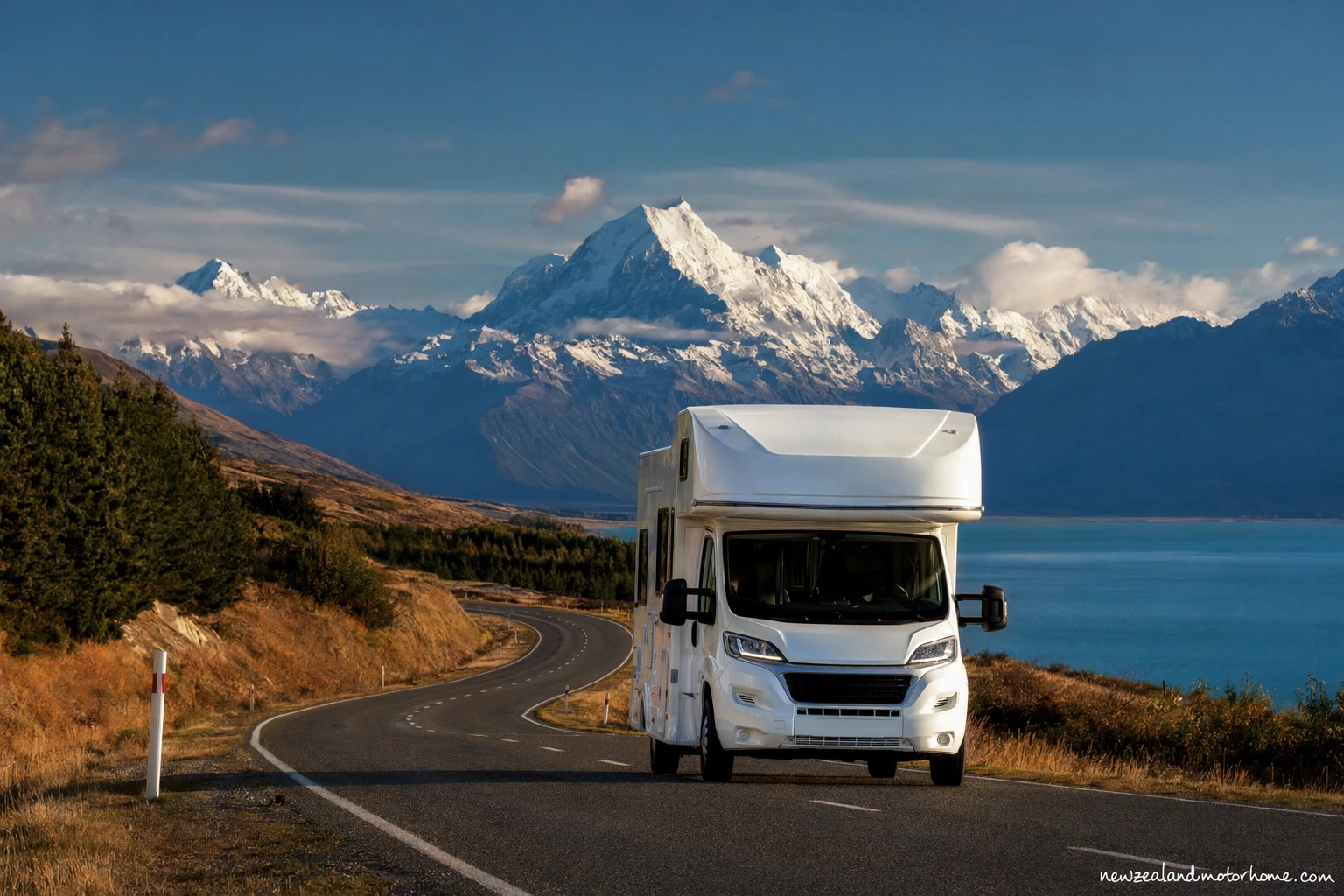
Auckland to Invercargill campervan route: a practical southbound plan
- Allow 10-14 days
- Cook Strait ferry required
- Best for certified self-contained vans
- Powered sites every few nights
- Watch wind on open roads
An Auckland to Invercargill campervan trip is a proper end-to-end New Zealand drive: city motorways, volcanic plateau, Cook Strait, braided Canterbury rivers, Otago harbour roads and the long, green run into Southland. It is not a route to rush in a big van, especially if you want time to plug in, empty the cassette, refill fresh water and actually enjoy where you have parked for the night.
This guide is written for self-drive motorhome travellers doing the full run in their own hired campervan. You will find realistic driving legs, van-suitable overnight bases, road notes for longer vehicles, ferry considerations, dump station planning and a sensible way to shape the auckland to invercargill drive without turning every day into a fuel-stop blur.
How many days to allow and the best overall route
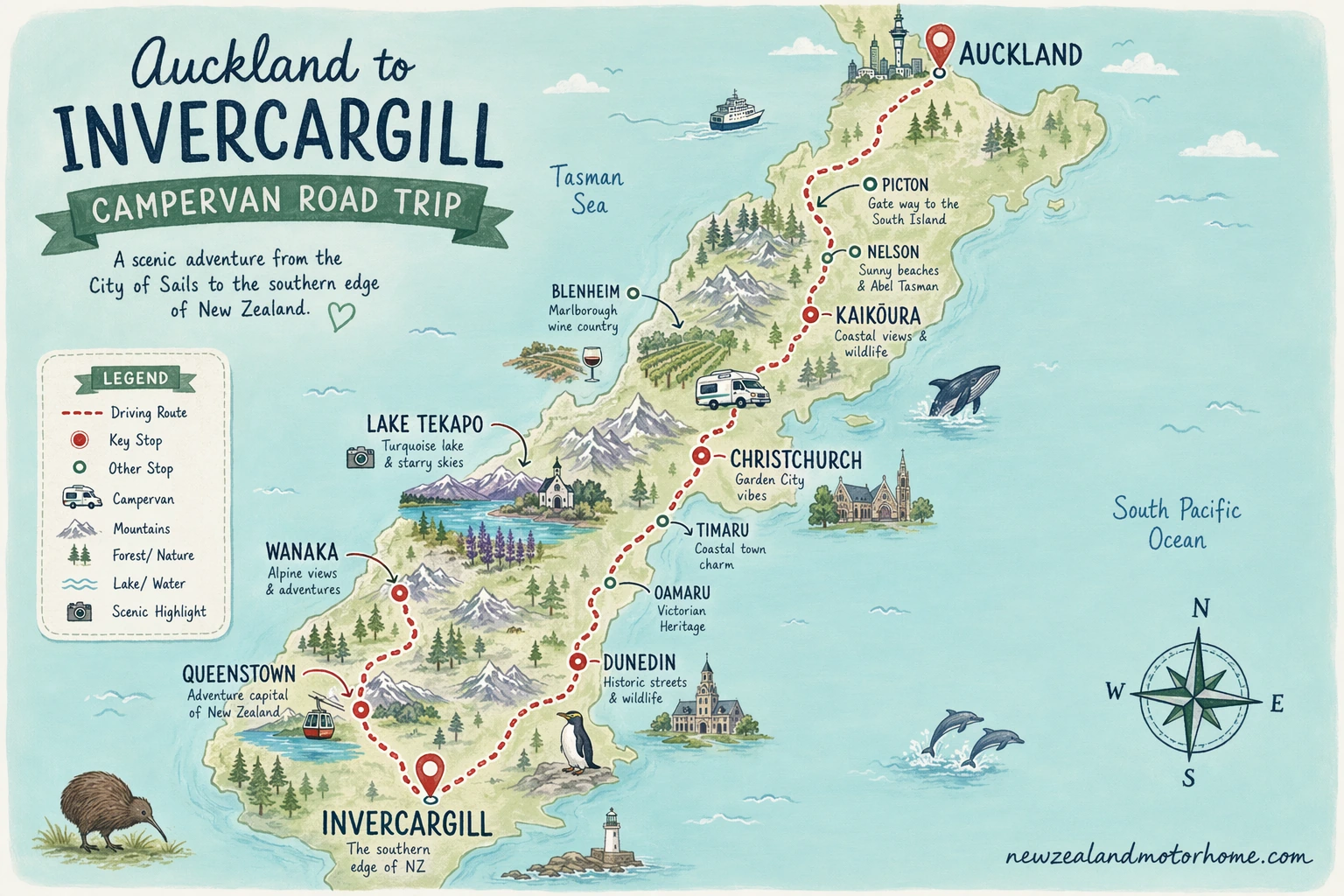
The direct road-and-ferry distance is long enough that seven days feels tight in a campervan, especially once you add check-in time for the Cook Strait ferry and slower sections through towns, roadworks and hill country. A comfortable auckland to invercargill motorhome road trip is usually 10 to 14 days, with a few two-night stops if you want to walk, do laundry and give the van a proper reset.
The most practical main route is Auckland to Taupo, Taupo to Wellington, ferry to Picton, then down the east side of the South Island via Kaikoura, Christchurch, Otago and Southland. You can divert through the Mackenzie Basin or the Catlins, but both add kilometres and deserve extra nights rather than being squeezed in after dark.
- Fast but still sensible: 8 to 9 days, mostly one-night stops, powered sites recommended every second night.
- Better pace: 10 to 12 days, with two nights around Wellington, Christchurch or Dunedin.
- Scenic pace: 14 days or more, allowing Tekapo, Oamaru, the Otago Peninsula or the Catlins.
- Van services: plan dump station and fresh-water stops before the ferry, before the Mackenzie Basin, and again before Southland.
Auckland to Wellington: North Island legs for a campervan
Leaving Auckland in a motorhome is easiest outside peak traffic. If you are collecting a van, use the first day to stock groceries, check the LPG bottle, learn the grey-water setup and get comfortable with mirrors, reversing camera and vehicle height before committing to a long motorway run.
A good first overnight is around Cambridge, Rotorua or Taupo, depending on your collection time. Taupo works well because there are holiday parks with powered sites, public dump station options in the wider district, supermarkets and fuel before the higher, more exposed run across the central plateau. If the weather is rough on the Desert Road, slow down and be ready for wind, fog or winter restrictions.
- Auckland to Taupo: a full but manageable first drive if you leave early and already have the van sorted.
- Taupo to Wellington: allow most of a day, with a proper rest stop rather than relying on roadside pull-offs.
- Overnight before the ferry: choose a holiday park or legal campervan site in the Wellington, Lower Hutt or Porirua area so you are not hunting for a park late.
- Before boarding: empty waste, top up fresh water if needed, secure cupboards and turn LPG off as required by ferry instructions.
Cook Strait and the first South Island night
Book the ferry as a vehicle crossing, not just as passengers. You will need the campervan length and height, and if you are carrying bikes or a rear box, include that extra length. Arrive with time to spare; ferry check-in lanes can feel tight the first time, but staff will direct you and there is no prize for rushing a high-sided van.
Picton is the easiest first South Island overnight if your sailing arrives late or you want a gentle reset. There are powered campgrounds, supermarkets in the wider Marlborough area, fuel, dump station options and sheltered places to reorganise the van after the crossing. If you arrive early, Blenheim is also a practical service stop before heading south.
The Picton to Kaikoura coastal drive is beautiful but can be slower than the map suggests. There are rail crossings, seal-viewing pull-offs, roadworks at times and limited places where a long motorhome can swing in and out easily. Use signed lay-bys only, avoid soft shoulders, and park with enough room for trucks and other campers to pass.
Kaikoura to Christchurch, then choosing your southern line
Kaikoura is a strong overnight for campervans because it breaks the South Island drive neatly and gives you a chance to walk from the van rather than drive again after parking. Choose a legal overnight site or holiday park; freedom camping rules in popular coastal towns are closely managed, and self-containment certification does not mean you can stop anywhere.
From Kaikoura, continue to Christchurch or a quieter base on the city edge if you prefer easier parking. Christchurch is useful for laundry, groceries, LPG swaps or fills, fresh water and dump stations before the long southern half. If you are in a larger motorhome, avoid nosing into tight central city car parks unless height and length are clearly suitable.
- Direct line: Christchurch to Oamaru or Dunedin on SH1, practical in poorer weather and good for services.
- Scenic inland line: Christchurch to Geraldine, Tekapo or Twizel, then down through Central Otago; allow extra nights and check winter conditions.
- Easy powered reset: plan a plugged-in night around Christchurch, Ashburton, Timaru or Oamaru before colder southern stops.
- Dump and water: do not leave Christchurch or Timaru with full grey water if you are heading inland or into smaller settlements.
Otago to Invercargill: final legs and overnight choices
The simplest southern run is Oamaru or Dunedin to Invercargill via SH1 and Gore or via Balclutha, depending on your chosen stops. Dunedin is worth at least one night if you want harbour views, the Otago Peninsula and a proper powered-site stop, but be aware that some peninsula roads are narrow and winding for larger vans. Park early, walk where you can, and avoid turning around in small residential streets.
If you have time, the Catlins route between Balclutha and Invercargill is memorable, but it is slower, hillier and more exposed than the main highway. Treat it as a scenic detour with legal overnight planning, not a shortcut. Fuel up, carry drinking water, and expect limited mobile coverage in places.
In Invercargill, choose an established campground or clearly permitted campervan area for your final night so you can clean the van, empty waste and organise gear before returning or continuing to Bluff, Stewart Island connections or the Southern Scenic Route. Invercargill has the services a long-route van needs: fuel, supermarkets, dump station options, fresh water access in designated places and roomier streets than many older coastal towns.
Road, freedom camping and service notes for this route
This route is suitable for standard rental campervans and motorhomes, but you still need to drive to the vehicle you have hired. A six-berth motorhome takes more space at fuel stations, needs wider turning room and can be affected by crosswinds on the Desert Road, the Canterbury Plains, coastal Kaikoura sections and the open Southland approach.
Freedom camping rules change by council area, and the rules are not identical in Auckland, Taupo, Wellington, Marlborough, Kaikoura, Christchurch, Dunedin and Invercargill. If you plan to use freedom camping, make sure your vehicle is certified self-contained, check the current local signs and maps, and arrive in daylight so you can confirm the bay is actually suitable for your van length.
- Powered sites: useful after cold nights, heavy heater use, laundry days or several nights of freedom camping.
- Unpowered sites: fine when your house battery is healthy and you are not relying on electric heating or frequent appliance use.
- Dump stations: build them into the route every couple of days rather than waiting until the cassette is urgent.
- LPG and fresh water: top up in larger towns; do not assume small scenic settlements will have the right fittings or opening hours.
- Need help shaping the days? If you want the legs matched to your van size and travel season, use the talk-to-us planning step before you lock in ferries and overnight stops.
Keep planning
Visiting sky tower auckland by campervan
Read onVisiting rainbows end auckland by campervan
Read onHoliday parks invercargill
Read onHoliday parks auckland
Read onCampervan supplies invercargill
Read onCampervan supplies auckland
Read onCommon questions
Can I drive Auckland to Invercargill in a campervan in one week?
You can, but it will feel rushed once you include the Cook Strait ferry and normal campervan chores. Seven days leaves little time for weather delays, dump stations, laundry or relaxed overnight stops. Ten to fourteen days is a much better fit for most self-drive travellers.
Do I need to book the Cook Strait ferry for my motorhome?
Yes. Book with the correct vehicle length and height, including anything fitted to the back of the van. Arrive early, secure loose items inside and follow the ferry operator's instructions for LPG and vehicle access during the crossing.
Is freedom camping possible on the Auckland to Invercargill route?
It is possible in some places if your campervan is certified self-contained, but each council has its own restrictions. Popular areas such as Wellington, Kaikoura, Christchurch, Dunedin and coastal Southland can be tightly controlled. Always use current local signage and do not assume a pretty car park is legal overnight.
Which route is best in winter?
The main SH1/east coast route is usually the most straightforward in winter, though you still need to watch wind, ice, snow warnings and road closures. The inland Mackenzie and Central Otago options are beautiful but more exposed to snow and freezing conditions. Carry warm bedding and plan more powered nights for heating and battery recovery.
Where should I plan dump station and fresh-water stops?
Good service points are usually easiest in larger centres such as Taupo, the Wellington region, Picton or Blenheim, Christchurch, Timaru or Oamaru, Dunedin, Gore and Invercargill. Do not wait until remote scenic areas, as access can be limited or seasonal. Empty grey water and the toilet cassette only at designated dump stations.
Is the Catlins worth adding before Invercargill?
Yes, if you have at least an extra night or two. The Catlins is slower than the main highway, with winding roads, limited services and some small parking areas that do not suit long motorhomes. Go with fuel, water and a legal overnight plan already sorted.
Have a planner shape this for your dates
Send a short outline — your dates, party size, and the kind of trip you want. A planner replies with a vehicle recommendation, a paced route, and the realistic budget.