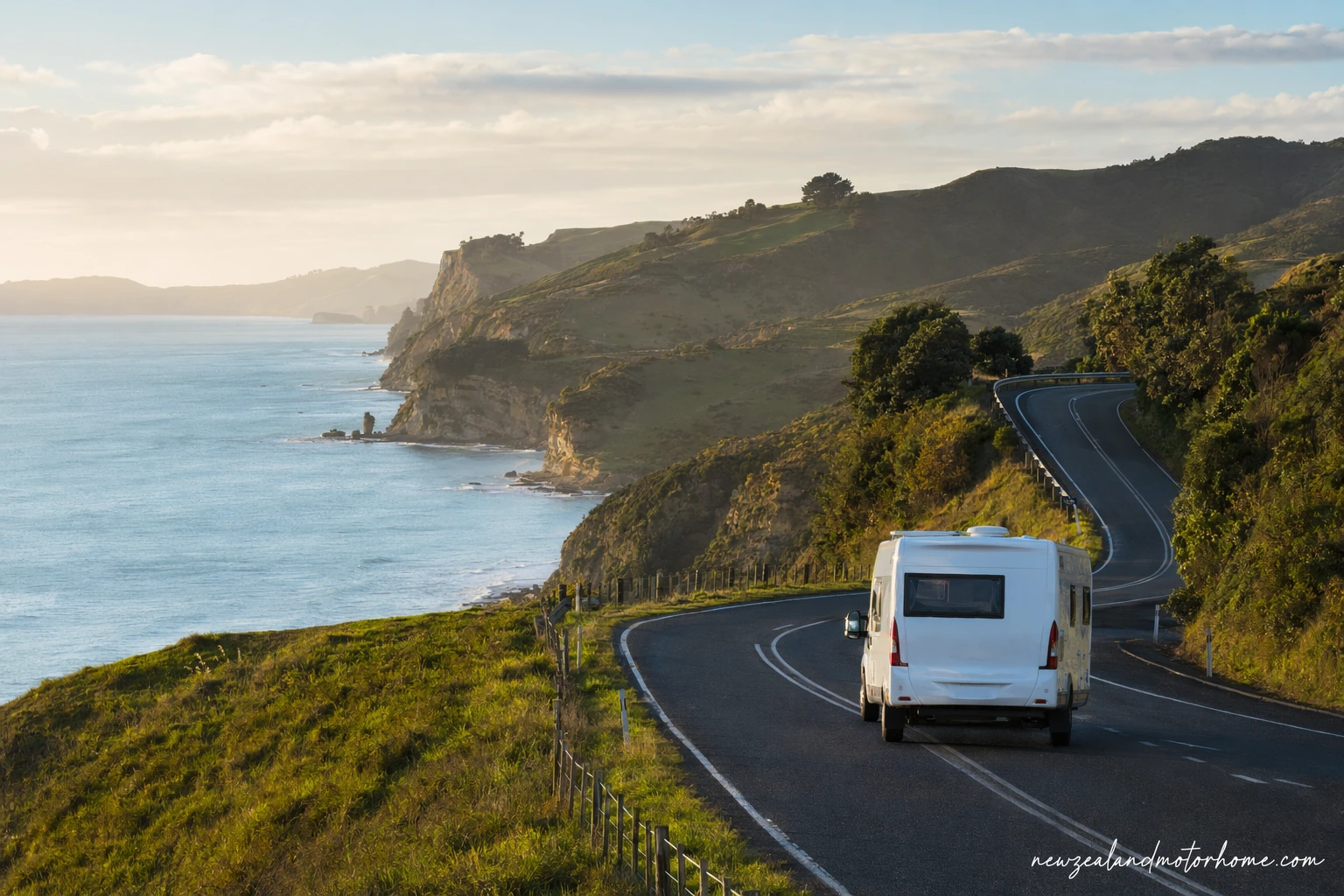
Auckland to Napier campervan route: Auckland, Taupō and Hawke’s Bay
- Best in 2–4 days
- Main route SH1 and SH5
- Taupō is the key service stop
- Certified self-contained needed for freedom camping
- SH5 suits vans but needs daylight and care
The Auckland to Napier campervan route is one of the North Island’s most useful cross-country drives: motorway out of the city, easy Waikato cruising, a lakeside breather at Taupō, then the forested and winding SH5 run over to Hawke’s Bay. You can push it through in a long day, but it feels much better as a two or three-night motorhome trip with time to empty tanks, refill fresh water and arrive in Napier without rushing the last hills.
This guide is written for people driving and sleeping in their hired van, not just ticking off kilometres in a car. You’ll find practical notes on where to park the van, when to choose powered or unpowered sites, how freedom camping rules affect certified self-contained vehicles, and what to expect from the Auckland to Napier drive in a larger motorhome.
If you want this fitted around your van pick-up time, first grocery stop, site preferences and return date, you can talk to us and we’ll shape the route around how you actually travel.
How many days to allow for the Auckland to Napier drive
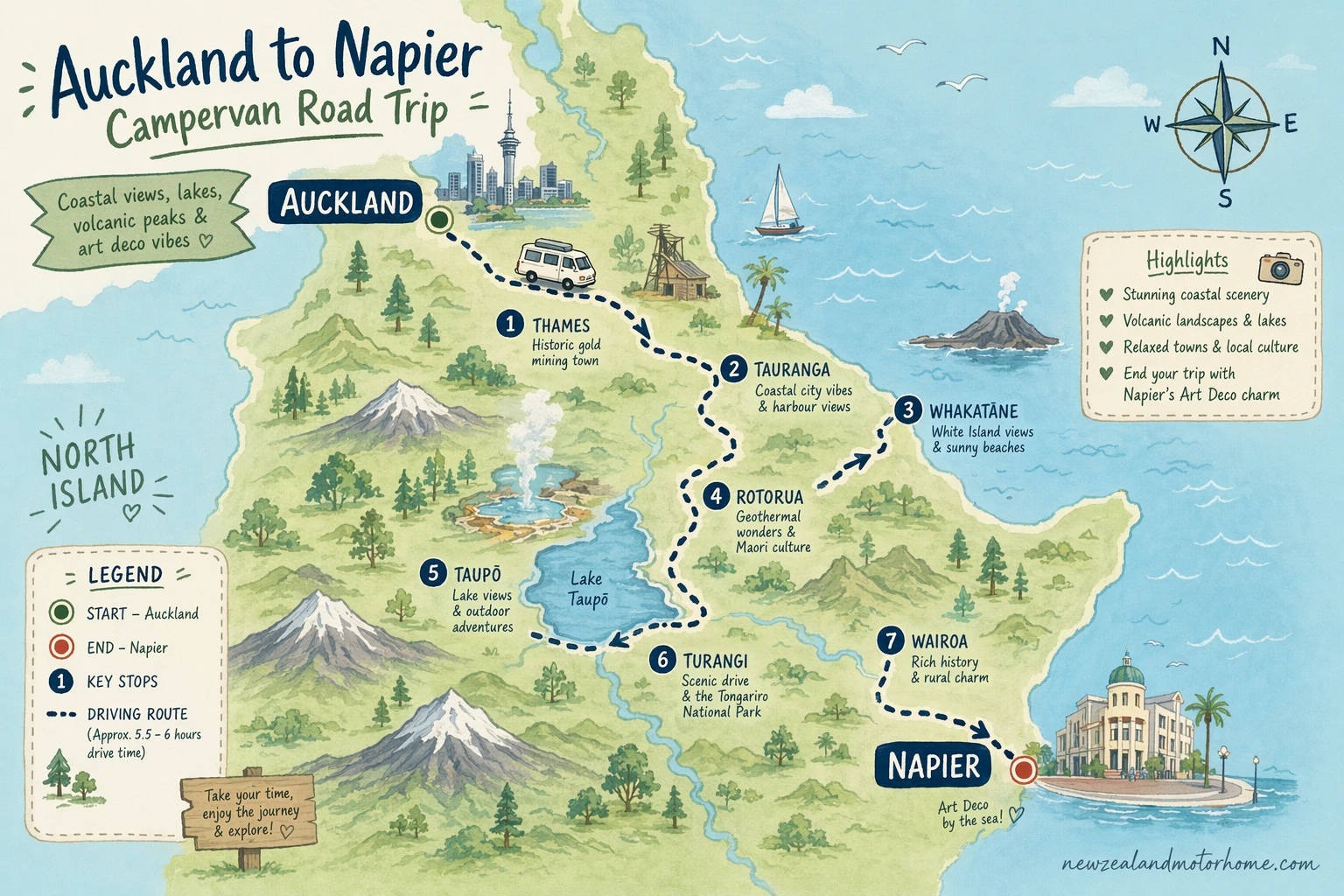
Auckland to Napier is roughly a 420-kilometre drive by the usual SH1 and SH5 route, and most campervan travellers should allow six to seven hours of wheel time before food, fuel, photo stops and toilet breaks. In a motorhome, that is a full day: you’ll be slower out of Auckland, more deliberate on the climbs, and happier if you are not hunting for a campsite after dark.
For a relaxed Auckland to Napier motorhome road trip, two travel days is the sweet spot. Overnight around Cambridge, Tirau or Taupō, then cross to Napier fresh the next morning. Three or four days gives you time for hot pools, lake walks, Hawke’s Bay wineries, Art Deco streets and a proper settle-in at a powered site.
- Fast but tiring: 1 long day, only if you leave early and know where you are staying in Napier.
- Best balance: 2 days with a Taupō or Waikato overnight stop.
- More comfortable: 3–4 days with time to service the van and explore without shifting every morning.
- Winter note: build in daylight for SH5, as fog, rain and occasional ice make the Napier-Taupō road slower.
Leg 1: Auckland to the Waikato in a campervan
Leaving Auckland in a campervan is mostly about timing. Try to clear the Southern Motorway outside the heaviest commuter flow, and make sure you have already done your first supermarket shop, checked gas bottle levels and filled fresh water if your hire depot did not send you away full. The Bombay Hills are straightforward, but keep left, let impatient traffic pass, and avoid last-minute lane changes in a taller vehicle.
Once you are on the Waikato Expressway, the road is generally kind to larger vans: divided highway, good sight lines and plenty of places to pull off into service towns. Hamilton, Cambridge and Tirau are sensible places to pause because they have fuel, groceries, cafés, public toilets and access to holiday parks or signposted dump station facilities nearby. Do not leave your first grey-water empty until you are already on the Napier side of Taupō.
- Good first break: Pōkeno or Mercer for an early leg stretch before the Waikato.
- Useful service towns: Hamilton and Cambridge for fuel, LPG, groceries and fresh supplies.
- Van parking: choose edge-of-town supermarket car parks or signed long bays rather than tight central angled spaces.
- Overnight option: Cambridge or Tirau works well if your Auckland pick-up is late in the day.
If you are staying overnight in this section, a powered site is useful on your first night so you can test the van properly: fridge, heater, hot water, charger points and battery behaviour. Unpowered sites are fine for certified self-contained vans, but your first evening is not the ideal time to discover how quickly you use water or power.
Leg 2: Taupō to Napier on SH5
Taupō is the natural pause point before the Napier-Taupō Road. It is a good place to top up diesel or petrol, refill LPG if needed, buy groceries and use a dump station before you leave the lake. The next leg has long rural stretches, forestry, passing lanes and fewer convenient places to service a motorhome, so start with tanks sorted and snacks in the cab.
SH5 is suitable for campervans and motorhomes, but it is not a road to rush. Expect steady climbs, sweeping bends, occasional tighter corners, logging trucks and changing weather as you cross the ranges. Use slow vehicle bays when traffic stacks up behind you, keep your speed comfortable rather than ambitious, and be especially careful after rain when the road surface can feel greasy.
- Before leaving Taupō: fuel up, empty grey and black water where permitted, and refill fresh water.
- On SH5: secure cupboards, keep an eye on engine temperature on climbs, and pull over only where there is proper space.
- Winter driving: check road conditions before departure; frost and low cloud can sit on the higher sections.
- Arrival timing: aim to reach Napier in daylight so you can find your campsite or legal overnight area calmly.
There are scenic places to stop, but not every gravel shoulder is suitable for a long or high-roof van. If a pull-off looks soft, narrow or sloping, keep going. A few extra minutes to a safer bay is better than blocking traffic or needing assistance.
Overnight stops: powered sites, unpowered sites and freedom camping
For this route, holiday parks around Taupō and Napier are the simplest overnight choices because they bundle together the jobs a campervan needs: powered and unpowered pitches, showers, rubbish disposal, fresh-water taps and dump station access. Powered sites are worth booking in school holidays, long weekends and during Hawke’s Bay events, when Napier can fill earlier than you expect.
Freedom camping is more restricted than many first-time visitors expect. You need a certified self-contained vehicle, and you still have to follow local council bylaws, which may limit where you can park overnight, how long you can stay and whether spaces are available for larger motorhomes. Napier and Taupō both use designated or restricted areas, so check the current council maps before you settle in for the night.
- Late Auckland pick-up: choose a Waikato holiday park rather than driving tired to Taupō.
- Classic stopover: Taupō for lake views, services and an easier next-day run to Napier.
- Napier base: a powered site is handy if you are staying two nights and using the fridge, heater and devices heavily.
- Freedom camping: only use legal, signed areas and keep within your self-containment limits.
Wherever you stop, do a quick van routine before dark: check the vehicle is level enough for sleeping, confirm the fridge is on the right power source, lock bikes or outdoor gear away, and know where the toilet block or dump point is for the morning.
Arriving in Napier with a motorhome
Napier is an easy city to enjoy in a campervan if you resist the urge to drive right into the tightest central streets. For the Art Deco area and Marine Parade, look for signed long-vehicle parking or roomier edge-of-centre streets, then walk in. Avoid squeezing a wide van into short angled parks; it is stressful, and you may overhang into traffic or the footpath.
Once you are set up, Napier is better explored slowly: waterfront paths, Ahuriri harbour, city architecture and short drives into the wider Hawke’s Bay. If you are heading towards Te Mata Peak, remember that some access roads and car parks are narrow or steep for larger motorhomes; parking lower and walking part of the way is often the calmer choice.
- Van services: use holiday park or signed public dump stations for grey and toilet waste; never empty into roadside drains.
- Fresh water: refill only from taps marked as potable, not from random park or beach taps.
- LPG and fuel: Napier and Hastings are the sensible places to sort bottles and fuel before the next leg.
- Parking style: choose flat, legal, well-lit parks and give yourself room to open side doors safely.
If Napier is your final stop, allow time before returning or moving on to clean the cassette, empty grey water, top up fuel and repack cupboards for the drive. The unglamorous jobs are much easier here than in a hurry on the edge of the next highway.
Keep planning
Visiting sky tower auckland by campervan
Read onVisiting rainbows end auckland by campervan
Read onHoliday parks napier art deco
Read onHoliday parks napier
Read onHoliday parks auckland
Read onCampervan supplies napier
Read onCommon questions
Can I drive Auckland to Napier in one day in a campervan?
Yes, but it is a long day in a larger van, especially if you collect the vehicle that morning. Two days is more comfortable, with an overnight stop around Taupō or the Waikato so you can service the van and drive SH5 in daylight.
Is the Napier-Taupō Road suitable for motorhomes?
SH5 is suitable for most hired campervans and motorhomes, but it has hills, bends, forestry traffic and changing weather. Drive to the conditions, use slow vehicle bays, and check winter road updates before leaving Taupō.
Where should I stay overnight between Auckland and Napier?
Taupō is the most practical stop because it has holiday parks, fuel, groceries, fresh water and dump station options. If you leave Auckland late, Cambridge, Tirau or nearby Waikato stops make a better first night than pushing on tired.
Can I freedom camp in Napier?
Only in places where local bylaws allow it, and only if your van meets the required certified self-contained standard. Napier’s rules and designated areas can change, so check the current council information before parking overnight.
Do I need a powered site on this route?
You do not need one every night if your van is self-contained and your batteries are healthy, but a powered site is useful on the first night and after heavy fridge, heater or device use. In Napier, booking power can also simplify a two-night stay.
Where can I dump waste and refill fresh water?
Use official dump stations at holiday parks or signed public facilities in service towns such as Taupō and Napier. Refill fresh water only from potable taps, and plan these stops before the SH5 crossing where services are more spread out.
Have a planner shape this for your dates
Send a short outline — your dates, party size, and the kind of trip you want. A planner replies with a vehicle recommendation, a paced route, and the realistic budget.