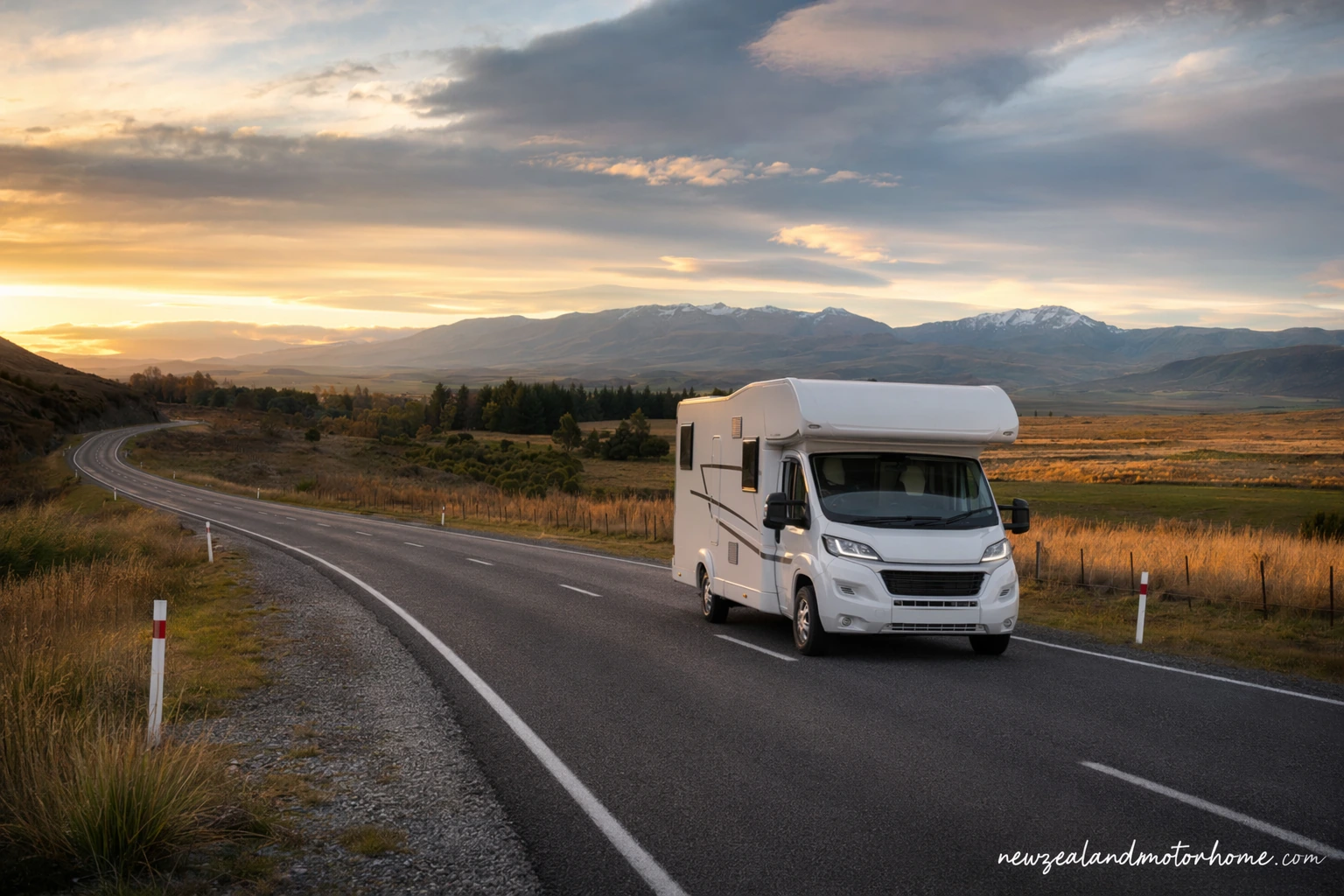
Christchurch to Invercargill campervan route: coast, towns and the deep south
- Best in spring to autumn
- Allow 3 to 5 days
- Main route suits large vans
- Catlins adds slower coastal roads
- Powered sites in main towns
A Christchurch to Invercargill campervan trip is one of the South Island’s most practical point-to-point drives: wide Canterbury plains, harbour towns, old stone Oamaru, Dunedin’s hills, then the long southern run into Southland. It is not a difficult route, but it rewards a slower pace, especially if you are driving a longer motorhome and want time for proper overnight stops rather than arriving tired.
This guide is written for travellers sleeping in their hired van, so the focus is on where the Christchurch to Invercargill drive works well in a motorhome: sensible legs, places to park without squeezing into tight streets, powered and unpowered overnight options, dump stations, fresh water, LPG and the bylaws that matter for certified self-contained vehicles.
Best route and how many days to allow
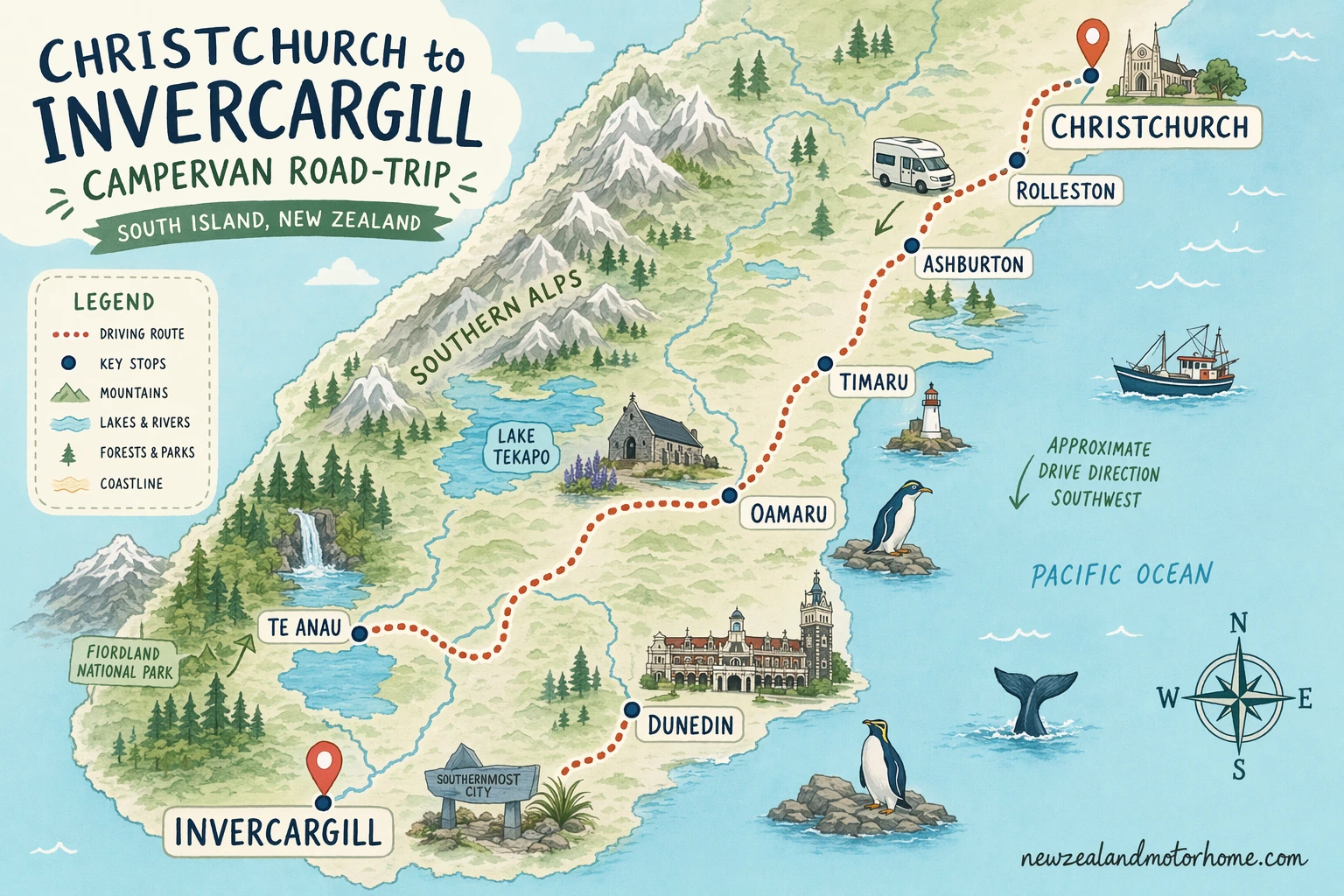
The direct Christchurch to Invercargill campervan route follows SH1 south through Ashburton, Timaru, Oamaru, Dunedin and Balclutha, then cuts inland through Gore before reaching Invercargill. It is roughly a full-day drive on paper, but in a campervan it is much better treated as a 3 to 5 day road trip, especially if you want Oamaru, Moeraki, Dunedin or the Catlins in the mix.
For a straightforward Christchurch to Invercargill motorhome road trip, keep to the main highways and choose overnight stops in towns with services. For a scenic version, add a Catlins detour after Balclutha; it is slower, with narrower sealed roads, occasional gravel access roads and fewer dump and LPG options, but it gives you beaches, waterfalls and coastal forest before rolling into Invercargill.
- Fast but comfortable: 2 nights, usually around Oamaru or Dunedin, then Gore or Invercargill.
- Balanced: 3 to 4 nights, with time for Timaru, Oamaru, Moeraki and Dunedin.
- Scenic slow route: 5 to 6 nights including the Catlins, best for self-contained vans and drivers happy with quieter rural roads.
- Winter note: the main route is generally lowland, but wind, rain and short daylight can make long driving days feel much harder.
Leg 1: Christchurch to Timaru or Oamaru
Leaving Christchurch, give yourself time to get out of the city without rushing. If you have just collected the van, use the first hour to learn its width, mirrors, braking distance and where the fresh-water, grey-water and LPG fittings are. The run across the Canterbury Plains is simple driving, but it can be exposed in strong nor’west winds, especially in a high-sided motorhome.
Rakaia, Ashburton and Temuka are useful pause points for groceries, fuel and a leg stretch without committing to tight central-city parking. Timaru is a good first overnight if you started late or want an easy coastal stop; Oamaru is better if you want to make more distance and still arrive with enough daylight to settle the van.
- Parking the van: look for waterfront or edge-of-town parking rather than compact main-street spaces, and avoid blocking angle parks with a rear overhang.
- Overnight style: Timaru and Oamaru both suit powered holiday park stays; unpowered sites may be available at campgrounds if you do not need to recharge heavily.
- Services: expect dump station, fresh-water and LPG options in larger towns on this leg, but check current locations before relying on one late in the day.
- Good stop: Oamaru’s harbour area is van-friendly for a walk if you arrive early, but overnight only where signage and booking rules allow.
Leg 2: Oamaru to Dunedin, with Moeraki in the middle
The Oamaru to Dunedin section is one of the most enjoyable parts of the Christchurch to Invercargill drive, with the road beginning to hug the coast and rise and fall more often. Moeraki is the classic stop, but the boulder car park can be busy; arrive outside the middle of the day if you are in a longer van, and do not assume you will be able to turn around easily if every bay is full.
South of Moeraki, the highway is still manageable for campervans, though you will notice more bends and short hills. Dunedin itself needs a little planning: some residential streets are steep, narrow or awkward for tall vehicles, and central parking can be tight. Use a campground or designated large-vehicle parking as your base, then explore on foot, bike, bus or with a smaller local transfer if needed.
- Powered stop: Dunedin is the best place on the route for a powered night, laundry, long showers and battery top-up.
- Dump and water: sort grey water, toilet cassette and fresh water before leaving Dunedin if you are heading into the Catlins.
- Van caution: avoid steep novelty streets and tight hill suburbs in a motorhome; they are not worth the stress.
- Weather: coastal fog and wind can change quickly, so secure roof vents and outside gear before leaving the van.
Leg 3: Dunedin to Balclutha, Gore and Invercargill
From Dunedin the main motorhome route returns to SH1 and runs south through Milton and Balclutha. This is steady rural driving with a few passing lanes, service towns and plenty of open country. If your goal is simply to reach Invercargill without the Catlins detour, continue via Gore; it is the most direct and practical option for a larger campervan.
Balclutha and Gore are useful reset towns. They are not just fuel stops: they are the places to think about rubbish, grey water, toilet cassette emptying, groceries and whether you want a powered site before Invercargill. The final approach into Invercargill is generally easy, but allow for wind on exposed roads and give stock trucks and farm vehicles plenty of room.
- Overnight idea: Balclutha or Gore works well if you want a shorter final day into Invercargill.
- Freedom camping: only use permitted areas and only if your van meets the current self-containment requirements displayed on its certificate.
- Vehicle note: keep left, use slow-vehicle bays when traffic builds behind you, and be patient on rural two-lane roads.
- Arrival: in Invercargill, choose a proper campground if you need power, laundry, dump facilities and a calm repack before continuing to Bluff, Stewart Island connections or Fiordland.
Optional Catlins detour for slower, scenic campervans
If you have extra days, the Catlins is the most rewarding variation on the Christchurch to Invercargill campervan route. From Balclutha, you can head towards Kaka Point, Nugget Point, Owaka, Papatowai, Curio Bay and Fortrose before reaching Invercargill from the east. The road is mostly sealed, but access to some beaches, waterfalls and viewpoints can involve narrow approaches, small parking areas or gravel sections.
This detour suits self-contained travellers who are happy to be more independent. Do not enter the Catlins low on fuel, fresh water or LPG, and do not count on finding a dump station at the exact moment your grey tank is full. In wet weather, grassed parking areas can be soft; a heavy motorhome is much harder to move once it has sunk in.
- Best for: 3 berth to 6 berth vans driven cautiously, with time to stop before dark.
- Overnight style: a mix of basic campgrounds, unpowered sites and limited freedom camping where bylaws allow.
- Road note: pull over only in formed areas; soft verges and hidden drains are common on rural coastal roads.
- Wildlife: keep well back from sea lions and penguins, and never leave food scraps outside the van.
Camping, dump stations and self-containment rules
This route crosses several council areas, so freedom camping rules change as you drive south. A certified self-contained van gives you more options, but it does not mean you can sleep anywhere. Check signs at reserves, beaches and car parks, and use a current camping app or council page before settling in for the night.
Powered sites are easiest to find in Christchurch, Timaru, Oamaru, Dunedin, Gore and Invercargill. Unpowered sites are useful when you are moving every day, but remember that fridge use, diesel heater time, device charging and gloomy weather can drain house batteries faster than expected. Dump stations and potable water are most reliable in the larger towns, so build service stops into your day rather than treating them as an afterthought.
If you want help matching your pace, van size and overnight style to the route, you can send us your rough dates through our plan-your-trip page and we will help shape a practical southbound plan.
- Before leaving Christchurch: fill fresh water, check LPG, confirm tyre pressure guidance and know how to empty the cassette.
- Mid-route service towns: Timaru, Oamaru, Dunedin, Balclutha and Gore are sensible places to reset tanks and supplies.
- Do not leave it late: dump stations can be busy, temporarily closed or awkward to access in a large van.
- Respect the basics: no grey-water draining, no toilet waste in public toilets, and no camping where signs prohibit it.
Keep planning
Holiday parks invercargill
Read onHoliday parks christchurch
Read onCampervan supplies invercargill
Read onCampervan supplies christchurch
Read onCampervan hire invercargill
Read onCampervan hire christchurch airport
Read onCommon questions
How long does the Christchurch to Invercargill campervan drive take?
The direct drive can be done in one very long day, but that is not a good campervan plan. Allow at least 2 nights, or 3 to 5 nights if you want Oamaru, Dunedin, Moeraki or the Catlins without rushing.
Is the road suitable for a large motorhome?
Yes, the main route via SH1, Balclutha and Gore is suitable for large motorhomes when driven carefully. The Catlins detour is also possible, but take extra care with narrow access roads, gravel approaches, soft verges and small parking areas.
Can I freedom camp between Christchurch and Invercargill?
Sometimes, but only in permitted places and only if your van meets current self-containment requirements. Bylaws change between districts, so check local signage and current council information before staying overnight.
Where should I plan dump station stops?
Plan to service the van in larger towns such as Timaru, Oamaru, Dunedin, Balclutha, Gore and Invercargill. If you are going into the Catlins, empty grey water and the toilet cassette beforehand and refill fresh water while services are easy.
Is it better to go through Gore or the Catlins?
Go through Gore if you want the simplest and most direct campervan route to Invercargill. Choose the Catlins if you have extra days, are comfortable with slower rural driving, and want beaches, waterfalls and wildlife stops.
Have a planner shape this for your dates
Send a short outline — your dates, party size, and the kind of trip you want. A planner replies with a vehicle recommendation, a paced route, and the realistic budget.