Christchurch to Rotorua campervan route: ferry, stops and road notes
- Allow 6–8 days
- Cook Strait ferry required
- Best with mixed powered and unpowered nights
- Certified self-contained needed for freedom camping
- Check Desert Road weather
A Christchurch to Rotorua campervan route is a proper two-island journey: Canterbury plains, the Kaikōura Coast, Cook Strait, the Kāpiti Coast, the central plateau and finally Rotorua’s lakes and steam vents. It is not a route to rush if you want the van to feel like a base rather than just a bed at the end of a long driving day.
This guide is written for self-drive campervan and motorhome travellers — with notes on where to overnight, how to handle the ferry with a longer vehicle, where to think about water, LPG and dump stations, and which roads need a bit more care in wind, winter or holiday traffic.
How long to allow for the Christchurch to Rotorua drive
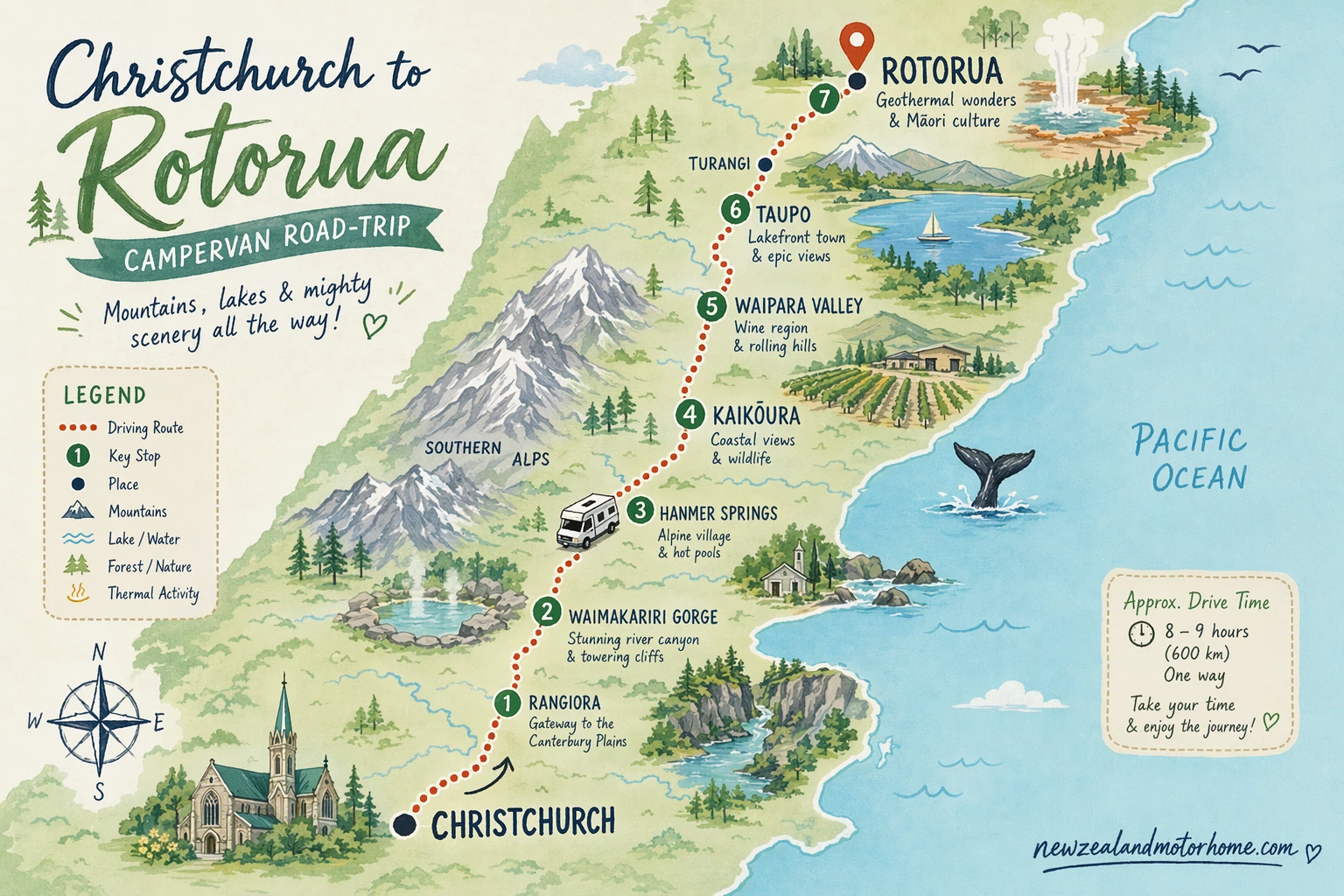
The road driving is roughly 790 kilometres, plus the Cook Strait ferry crossing between Picton and Wellington. You can technically make the Christchurch to Rotorua drive in three hard days, but most campervan travellers will enjoy it far more over six to eight days, especially if you want time in Kaikōura, Wellington, Taupō and Rotorua.
A comfortable pacing plan is to drive in the morning, park the van before late afternoon, then sort your plug-in, water top-up, dinner and showers without feeling squeezed. In summer, book powered sites ahead in Kaikōura, Picton, Wellington/Kāpiti, Taupō and Rotorua; in winter, keep an extra buffer day for the Desert Road or ferry delays.
- Fast but tiring: 4 days, with long driving legs and minimal sightseeing.
- Balanced: 6 days, with one night each around Kaikōura/Picton, Wellington/Kāpiti, Taupō and Rotorua.
- Better-paced: 8–10 days, adding rest nights, laundry stops and lake or geothermal time.
- Van note: book campsites and ferry space using your exact vehicle length and height, including bike racks, roof boxes and awnings.
Leg 1: Christchurch to Kaikōura, then Picton
Leave Christchurch with groceries, drinking water and LPG sorted if you can; it is easier to stock the van before you are threading through smaller coastal towns. SH1 north is fully motorhome-suitable, but the stretch through the Hundalees and along the Kaikōura Coast has bends, traffic bunching and scenic pull-offs that can fill quickly.
Kaikōura is a natural first overnight if you want the route to feel relaxed. Use a holiday park if you need power, showers, laundry or a dump station, and only freedom camp where the local signs specifically allow certified self-contained vehicles. Do not squeeze into small beach lay-bys if your rear overhang sticks out onto the road edge.
- Good van stops: Kaikōura for seafood, coastal walks and a practical overnight.
- Road care: use signed pull-offs for seal viewing rather than soft shoulders.
- Before Picton: Blenheim is a useful service town for fuel, supermarket supplies and last-minute van chores.
- Overnight choice: Picton or Waikawa gives an easier ferry morning than driving in from farther south.
If your ferry is early, stay close to Picton and pack the van the night before. Secure cupboards, empty loose cups and check that gas appliances are off before you roll into the ferry queue.
Cook Strait ferry and the Wellington arrival
The ferry is the hinge point of this Christchurch to Rotorua motorhome road trip. When booking, be precise about length and height; a six-berth motorhome, rear bike rack or high-top campervan may put you in a different vehicle category. Arrive with time to spare, because loading is managed by vehicle size and deck space, not just by who turns up first.
Before boarding, turn off LPG at the bottle, close roof vents and make sure the fridge is set for the crossing according to your hire vehicle instructions. Once parked on the ferry deck, you will leave the vehicle, so take warm layers, medication, chargers and anything you need during the sailing.
- Picton side: top up water or dump before ferry day if your overnight stop provides facilities.
- On board: remember you cannot pop back to the van during the crossing.
- Wellington side: avoid trying to sleep in city car parks unless signs clearly allow it.
- Best overnight zones: Hutt Valley, Porirua or the Kāpiti Coast are generally easier with a longer van than the central city.
Wellington’s streets can be tight, steep and windy. If you want city time, consider parking at a suburban campground or designated motorhome site, then use public transport or walk from a legal day park rather than hunting for a central overnight space.
Leg 2: Wellington to Taupō via Kāpiti, Taihape and the Desert Road
From Wellington, the usual van-friendly line north is SH1 through Kāpiti, Levin, Bulls, Taihape and the central plateau. It is straightforward in good conditions, but it is a long haul in a motorhome, and the Desert Road section can feel very exposed in high wind, heavy rain, fog or winter snow.
Break the day if you can. Kāpiti or Levin works well after a late ferry arrival, while Taihape or Tūrangi can split the run before Taupō. Towns along SH1 have fuel, food and, in many cases, public dump stations or campground facilities, but do not leave it until the grey-water tank is full and everyone is tired.
- Check before leaving: road conditions for SH1 and the Desert Road, especially from late autumn to spring.
- Driving style: give the van space on descents and let faster traffic pass at proper passing lanes.
- Fuel planning: top up before the plateau if your gauge is getting low.
- Overnight idea: Taupō is a strong stop for powered sites, dump facilities, lake walks and a shorter final leg to Rotorua.
Lake Taupō has plenty of scenic day parking, but lakefront spaces often have time limits or no-overnight signs. Treat them as picnic and walking stops unless the signage specifically permits certified self-contained overnight stays.
Leg 3: Taupō to Rotorua and where to park the van
The Taupō to Rotorua leg is shorter, so it is worth making it a slow day rather than charging straight into town. SH5 is used by campervans every day, but it has rolling country, forestry traffic and sections where you will want both hands on the wheel in wind or rain.
Geothermal stops between Taupō and Rotorua are tempting, but check parking layout before committing to tight entrances in a large motorhome. Use marked oversize bays where provided, avoid blocking tour bus turning areas, and never rely on attraction car parks for overnighting unless they are clearly signed for it.
- Rotorua day parking: look for larger public car parks around the lakefront edge and wider streets rather than small central bays.
- Overnight options: holiday parks and motorhome parks are the simplest for power, showers, laundry and secure parking.
- Freedom camping: only use council-approved spots and only if your vehicle meets current certified self-contained requirements.
- Van chores: Rotorua has practical options for groceries, fuel, LPG swaps or fills, fresh water and dump stations before you head onward.
Rotorua is one place where a powered site can be worth it, especially after several travel days. You can plug in, air bedding, empty tanks, refill water, and then use the van as an easy base for the Redwoods, lakefront, hot pools and geothermal areas.
Campervan planning notes before you set off
This route crosses different weather systems, ferry logistics and several council freedom-camping areas, so a little planning saves a lot of fiddling. Keep your first and last nights flexible if your hire pick-up or drop-off time is tight, and avoid planning a long drive immediately after collecting a van you have not packed or driven before.
For tanks, think in two-day blocks: fresh water, grey water, toilet cassette, rubbish and LPG. If you are staying at powered holiday parks every second night, life is easy; if you want more unpowered or freedom camping, map legal dump stations and refill points before you lose reception or arrive after dark.
- Carry: drinking-water hose, levelling ramps if supplied, head torches, warm layers and a proper road map or offline map.
- Book ahead: ferry, peak-season powered sites and any Rotorua holiday-park stay on weekends or school holidays.
- Watch height: supermarket car parks, city parking buildings and tree-lined lake reserves may not suit high-roof vans.
- Ask early: if you want help matching the route to your van size, travel dates and campsite style, you can talk to us while you are shaping the plan.
Most of all, do not treat the Christchurch to Rotorua campervan journey as dead transit. The best version has short enough legs to stop for a coastal walk, a proper coffee, a lake swim, a dump-station reset and a night where you can sit outside the van without already thinking about tomorrow’s alarm.
Keep planning
Visiting polynesian spa rotorua by campervan
Read onVisiting agrodome rotorua by campervan
Read onHoliday parks rotorua
Read onHoliday parks christchurch
Read onFarmers markets rotorua
Read onCampervan supplies rotorua
Read onCommon questions
Can I drive from Christchurch to Rotorua in a campervan without taking a ferry?
No. Christchurch is in the South Island and Rotorua is in the North Island, so you need the Cook Strait ferry between Picton and Wellington. Book with your exact campervan or motorhome length and height.
How many days should I allow for a Christchurch to Rotorua campervan route?
Allow at least 4 days if you are mainly relocating the van, but 6–8 days is a much better pace. That gives you time for Kaikōura, the ferry, Wellington or Kāpiti, Taupō and a less rushed arrival into Rotorua.
Is the Desert Road suitable for a motorhome?
Yes, SH1 across the central plateau is suitable for motorhomes in normal conditions. Check road and weather updates before leaving, because wind, fog, ice or snow can make it unpleasant or temporarily close the route in winter.
Can I freedom camp on this route?
Sometimes, but only in places where the local council allows it and only if your vehicle meets the current certified self-contained rules. Many beach, lakefront and city car parks are day-use only, so always read the signs before settling in.
Where should I plan dump station and water stops?
Good practical reset points are Christchurch before departure, Kaikōura or Picton, Wellington/Kāpiti, Taupō and Rotorua. Holiday parks are the easiest option when you also need power, showers, laundry and a fresh-water refill.
Should I stay in powered or unpowered sites?
Mixing both works well. Use powered sites after the ferry, before or after the Desert Road, and in Rotorua so you can recharge devices, run heating if needed, empty tanks and give the van a proper reset.
Have a planner shape this for your dates
Send a short outline — your dates, party size, and the kind of trip you want. A planner replies with a vehicle recommendation, a paced route, and the realistic budget.