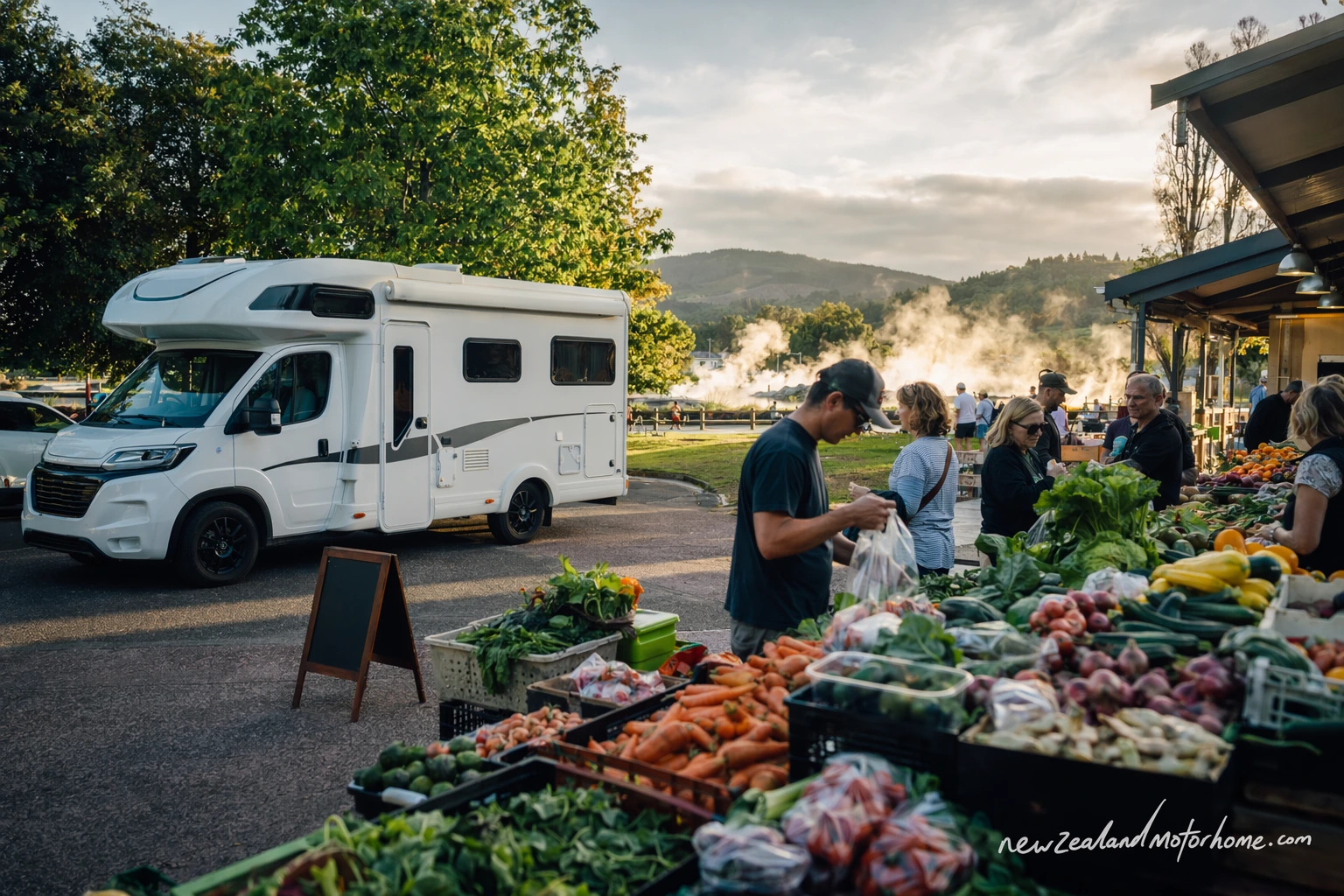
- Best market base: central Rotorua
- Main day: Sunday morning
- Also useful: Thursday evening food market
- Van note: park edge-of-centre and walk
- Overnight: use legal sites only
Rotorua is a useful place to restock the van without turning the day into a supermarket run. Between the central Sunday farmers market, Saturday stalls around Kuirau Park and the Thursday evening food market in town, you can pick up bread, fruit, veges, honey, coffee, dumplings and dinner before rolling back to your campsite.
This guide is written for self-drive campervan travellers: where to park a larger vehicle, when the main markets usually run, what fresh produce Rotorua is good for, and how to link the stop with dump stations, water fills, LPG and nearby overnights. Market times can shift for weather or public events, so treat the days below as your planning base and check local notices when you arrive.
The main Rotorua market stops to know
The central Rotorua Farmers Market is the one most van travellers build a weekend around. It is commonly held on Sunday mornings in the inner city area around Te Manawa, putting you within walking distance of cafés, public toilets, the lakefront and the main shopping streets.
For a broader local feel, look at the Saturday morning market activity around Kuirau Park, where food, plants, produce and community stalls are often part of the mix. Rotorua Night Market, usually on Thursday evenings in the central city, is less about filling the fridge and more about an easy dinner after a day at the lakes or geothermal parks.
- Sunday: best bet for fresh produce Rotorua growers and makers bring into town.
- Saturday: handy if you are overnighting centrally and want a casual morning wander.
- Thursday evening: useful for hot food before returning to a powered site.
If your route is tight, aim for one central market rather than trying to chase every stall. Rotorua roads can be busy around school holidays and event weekends, and a relaxed park-up is worth more than circling town in a long motorhome.
Parking the van without making hard work of it
Rotorua's central streets are manageable in a campervan, but the easiest market visit is usually made on foot after choosing a sensible edge-of-centre park. Short vans may fit ordinary angle parks, while longer motorhomes are better looking for parallel spaces or larger public car parks where you are not hanging over the line.
Around Kuirau Park, the streets and parking areas can suit campervans better than the tightest inner-city blocks, especially early in the morning. For the central Sunday and Thursday food markets, avoid squeezing into small retail car parks; park a few blocks away and walk in with reusable bags or a soft chilly bag.
- Arrive early for weekend markets Rotorua locals use as well as visitors.
- Fold mirrors in on narrower streets and watch for pedestrians stepping out between parked cars.
- Do not use supermarket or private customer parking unless you are genuinely shopping there and within posted limits.
- Check height clearance before entering any covered or basement parking; many motorhomes will not fit.
If you are carrying e-bikes, lock them properly and avoid leaving valuables visible in the cab. Rotorua is an easy town to explore from one well-chosen park-up, so there is rarely a need to keep shifting the van between stalls.
What to buy for a campervan kitchen
Rotorua markets are excellent for topping up the everyday campervan pantry: tomatoes, greens, berries in season, eggs, baked goods, preserves and locally made treats that travel well in a small fridge. If you have been eating out around the geothermal attractions, a market shop can reset the van menu for a lakeside dinner.
Think about storage before you overbuy. A compact campervan fridge fills quickly, and warm geothermal-country afternoons are not kind to delicate greens left on the bench while you drive to Wai-O-Tapu, Tikitapu or Tarawera.
- Choose sturdy produce for touring days: apples, carrots, potatoes, kūmara and onions.
- Buy leafy greens only if you can eat them within a day or two.
- Keep bread, pastries and soft fruit out of direct sun in the cab.
- Use a lidded tub for loose produce so it does not roll around on lake roads.
The Thursday night food market is particularly handy if you are arriving late and do not want to cook in the van. Park once, eat in town, then head back to a legal overnight site rather than trying to find a freedom camping spot in the dark.
Overnight stops near the markets
If you want power, showers and an easy reset, choose one of the holiday parks in or near Rotorua township and drive into the market in the morning. Powered sites are useful here because Rotorua is often a multi-night base: you may be charging devices, running the fridge steadily and washing clothes after lake or forest days.
Travellers with certified self-contained vehicles may find designated freedom camping options in the wider Rotorua Lakes district, but the rules are location-specific and can change. Do not assume you can sleep at the lakefront, beside a park or near a market just because other vans are there; check current council signage and only stay where overnighting is clearly permitted.
- Central holiday park: easiest for Sunday markets and evening food stalls.
- Lakeside campground: better for a slower stay, but allow driving time back into town.
- DOC-style sites: often more basic, sometimes unpowered, and may require booking or a self-contained setup.
Before settling in for the night, empty grey waste and toilet cassettes at an approved dump station and refill fresh water where allowed. Many holiday parks provide these services for guests; public dump stations and water points should be checked on current council or camping-app listings before you rely on them.
Linking the market with a Rotorua driving day
A good campervan rhythm is to shop early, stow chilled food properly, then choose one nearby outing rather than a full zigzag across the district. From the central markets you can drive to the lakefront, Government Gardens, the Redwoods area or one of the lake lookouts without spending the whole day in traffic.
Rotorua's main roads are generally comfortable for hired campervans, but some lake access roads are narrower, curvier and busier with cyclists, walkers and boat trailers. Take extra care if your vehicle is long or high, and do not pull into soft grass verges after rain; they can look firm and still trap a heavy van.
- Shop first if you need fresh food, then do a short attraction loop.
- Use sealed pull-offs only, especially after wet weather.
- Secure cupboards before driving the bends towards the lakes.
- Keep geothermal areas ventilated in the van; do not leave produce sitting in a hot, closed cab.
If you are building Rotorua into a longer North Island campervan route, you can send us your timing through /talk-to-us/ and we can help shape the market stop around legal overnights, driving distances and your van size.
Practical resets: fuel, LPG, water and waste
Rotorua is one of the easier places in the central North Island to reset the van. Before heading on to Taupō, the Bay of Plenty or Waikato back roads, use town time to top up diesel or petrol, check tyre pressures and make sure your LPG bottle is not running low.
Fresh-water fills, dump stations and LPG swaps are available around Rotorua through holiday parks, service stations and council-listed facilities, but access varies by site and season. Plan these chores in daylight rather than after the market, when you may be tired, carrying food and tempted to put it off.
- Empty toilet cassettes only at approved dump stations, never in public toilets.
- Use drinking-water taps only where potable water is clearly marked.
- Keep a small coin or card buffer for laundries, showers or campground extras.
- Check LPG before cooking a market dinner in the van.
A tidy service stop makes the markets more enjoyable. You can wander, eat and load the fridge without worrying about a full grey-water tank or a flat house battery overnight.
Keep planning
Wellington to rotorua campervan
Read onVisiting polynesian spa rotorua by campervan
Read onVisiting agrodome rotorua by campervan
Read onTauranga to rotorua campervan
Read onRotorua to whangarei campervan
Read onRotorua to timaru campervan
Read onCommon questions
What day is best for farmers markets Rotorua in a campervan?
Sunday morning is usually the strongest pick for a classic farmers market shop in central Rotorua. If you are arriving on a Thursday, the evening food market is better for dinner than pantry supplies, while Saturday stalls around Kuirau Park can suit a slower weekend start.
Can I park a large motorhome near the Rotorua markets?
Yes, but do not aim for the tightest inner-city spaces. Longer motorhomes are easier to manage in edge-of-centre streets or larger open parking areas, then you can walk a few blocks in. Always check time limits, loading zones and height restrictions.
Is freedom camping allowed near Rotorua markets?
Do not assume you can overnight near the market or lakefront. Freedom camping in Rotorua is controlled by local rules and is generally limited to specific places for certified self-contained vehicles. Check current council signage and use a campground if you are unsure.
Are the markets useful for stocking a campervan fridge?
Yes, especially for fresh produce Rotorua growers bring in season, plus bread, eggs, preserves and ready-to-eat food. Buy with your fridge size in mind and keep chilled items out of the cab sun while you drive.
Where should I empty grey water and refill fresh water in Rotorua?
Use an approved dump station or your holiday park facilities for grey water and toilet cassettes. Fresh-water access is available at some campgrounds and listed service points, but always confirm it is potable before filling your tank.
Can I combine Rotorua food markets with the lakes in one day?
Yes. Shop early, pack food securely, then choose one lake or forest stop rather than rushing several. The lake roads can be narrow and busy, so allow extra time if your campervan is long or you are new to driving NZ roads.
Have a planner shape this for your dates
Send a short outline — your dates, party size, and the kind of trip you want. A planner replies with a vehicle recommendation, a paced route, and the realistic budget.