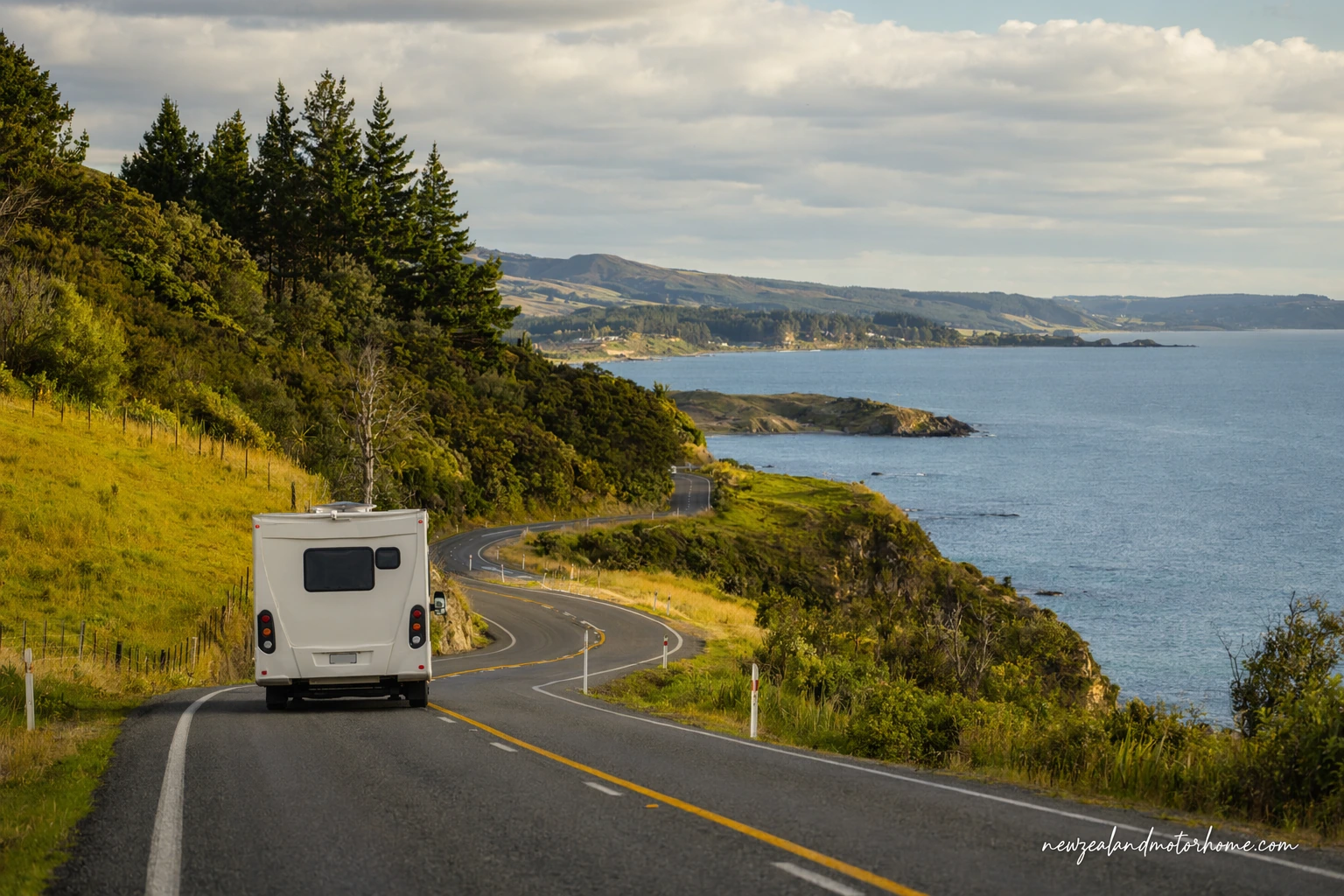
- Best in 2–3 days
- Main route via SH1
- Powered site useful mid-route
- Check Brynderwyn road updates
- Self-contained only for freedom camping
The Rotorua to Whangarei campervan route is a proper cross-island day if you rush it, but it is far better as a two or three-night roll north: geothermal Rotorua, easy Waikato country, Auckland’s motorway pinch points, then the beaches and hills of Northland before you park up in Whangārei.
This guide is written for travellers driving and sleeping in their hired campervan or motorhome. You’ll find van-suitable road notes, where to break the rotorua to whangarei drive, how to think about powered versus unpowered nights, and when to empty the toilet cassette or top up fresh water.
How long to allow and the best campervan line north
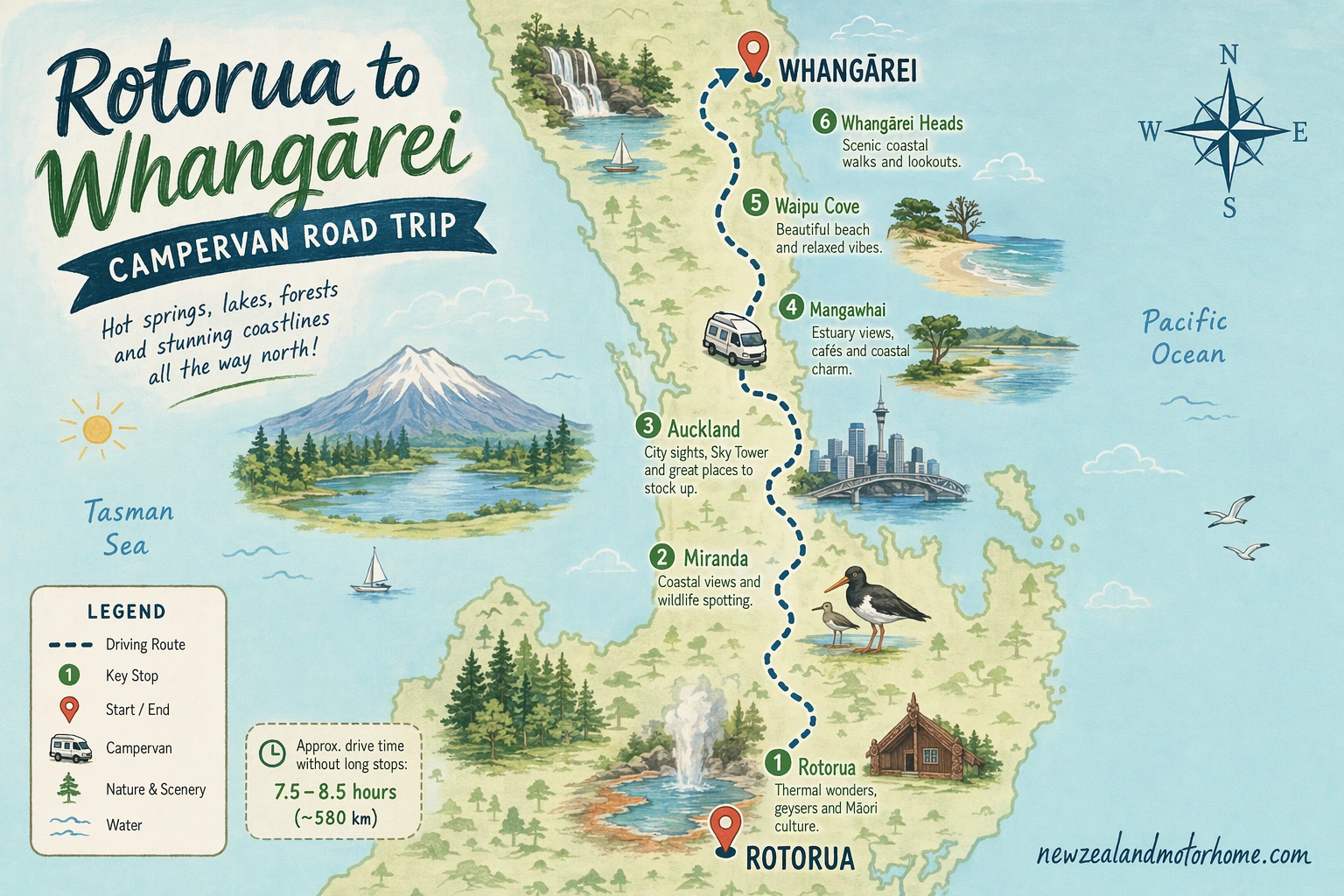
Rotorua to Whangārei is roughly a full day’s drive in a motorhome, but traffic through Hamilton, Auckland and the Brynderwyn area can turn a simple map line into a tiring van day. For most self-drive travellers, two days is the sensible minimum; three gives you time to stop at a beach north of Auckland and arrive in Whangārei with daylight for parking and set-up.
The most direct motorhome line is Rotorua to the Waikato, then SH1 north through Auckland, Warkworth, Wellsford and over the Brynderwyn Hills to Whangārei. Larger vans can do it, but it is not a road to treat like a small car: leave more braking room, use slow-vehicle bays, and avoid arriving in Auckland at peak commuter time if you can.
- Fast but tiring: one long day, only if you are confident in the van and have an overnight site already sorted.
- Best balance: two days, with a Waikato or north-Auckland overnight stop.
- Relaxed route: three days, adding a coast night around Warkworth, Mangawhai, Waipu or nearby signed camping areas.
- Big motorhome note: check your vehicle height before using supermarket car parks, service-station canopies and inner-city parking buildings.
Leg 1: Rotorua to the Waikato, with an easy first night option
Leave Rotorua with the van serviced if you can: empty the grey water and toilet cassette, fill fresh water, and check LPG if you are cooking or using gas heating. Rotorua has holiday parks with dump points, and public dump station information is usually listed by the local council or camping apps; do this before you get into the faster Waikato sections.
The drive across to the Waikato is straightforward by New Zealand standards, with rolling farmland, dairy traffic and occasional slow trucks. If you are still getting used to the width of your campervan, choose daylight, keep left on the narrower shoulders, and pull over only where the verge is firm and legal.
- Good overnight pattern: Rotorua to Cambridge, Hamilton or a nearby rural holiday park, then north the next morning.
- Powered site advantage: useful after a Rotorua stay if you have been running the fridge, charging devices and using heater or fan.
- Unpowered site advantage: fine for certified self-contained vans with healthy house batteries and a short evening stop.
- Parking tip: choose supermarkets or town stops with open-air edge parks rather than tight central bays.
Leg 2: Waikato through Auckland to Warkworth or the east-coast beaches
The Auckland crossing is the part of the rotorua to whangarei motorhome road trip that rewards patience. Motorways are wide, but the traffic is quick and lane changes come early; set your navigation before rolling, keep an eye on overhead signs, and take breaks before the city rather than trying to solve fatigue in the middle of it.
If your timing is flexible, aim to pass Auckland outside the morning and late-afternoon peaks. Many van travellers prefer to sleep either south of the city before tackling it fresh, or north of the city once the hardest driving is done. Central freedom camping is tightly controlled, and a long vehicle is rarely fun in inner-suburb streets.
- Practical stop south of Auckland: a holiday park or campground with powered sites, showers and dump facilities if you want a reset before the motorway.
- Practical stop north of Auckland: Warkworth, Matakana-side campgrounds, Mangawhai, Waipu or other signed coastal areas that suit longer vehicles.
- Freedom camping: only use places where overnight stays are clearly allowed for certified self-contained vehicles; Auckland and Northland councils enforce local bylaws.
- Supplies: top up groceries before you leave the bigger towns, but save bulky water refills for proper potable taps rather than random public taps.
Leg 3: Warkworth to Whangārei via Wellsford and the Brynderwyns
North of Warkworth the drive feels more open, but it is still busy SH1 with holiday traffic, trucks and limited passing in places. Wellsford is a useful pause for fuel, food and a leg stretch, though large motorhomes should choose open street or service-area parking and avoid squeezing into compact shop-front spaces.
The Brynderwyn Hills section is the main road note for this route. It has gradients, bends and roadworks from time to time, so check current road conditions before leaving and do not be surprised by temporary delays or diversions. In a heavier van, descend in a lower gear, brake gently and let faster traffic pass where it is safe.
Once you drop towards Whangārei, the road opens out again and the harbour city is much easier to approach in daylight. For town visits, look for larger open-air car parks and riverside or fringe parking rather than tight angle parks; walk the last few minutes to cafés, the Town Basin or shops if your van is long.
Where to sleep, empty, fill and settle the van
A comfortable Rotorua to Whangarei campervan trip usually works best with one powered night and one more flexible night. A powered site lets you fully charge devices, run appliances without battery anxiety, and use campground dump and fresh-water points. Unpowered sites are fine if your van is certified self-contained and you keep an eye on battery, water and toilet capacity.
Freedom camping rules change by district, and Northland councils can be strict about where overnight parking is allowed. Do not assume a beach car park is legal just because another van is there. Look for official signs, comply with any maximum-stay limit, and keep chairs, awnings and cooking gear packed away in places that are parking areas rather than campsites.
- Before leaving Rotorua: empty waste, fill fresh water, and confirm LPG level.
- Mid-route: use a holiday park or council-listed dump station around the Waikato or north Auckland if tanks are getting close.
- Before exploring Whangārei: dump and refill so you are not hunting for services at the end of the day.
- Self-containment: carry proof of current certification and use only facilities your van is set up for.
If you want this stitched into a day-by-day plan with site styles that match your van size and travel pace, you can send us your dates through Talk to us and we’ll help shape the route without overloading the driving days.
A simple 3-day itinerary that suits most hired vans
Day one is Rotorua to the Waikato: a gentle start, a supermarket restock, and a powered or unpowered campground night where you can check how the van is behaving. This is a good evening to learn your water gauge, fridge settings, cassette capacity and house battery display before Northland’s smaller roads.
Day two is Waikato through Auckland to Warkworth, Mangawhai, Waipu or a nearby legal overnight stop. Keep this day flexible, because motorway traffic can steal time. If the weather is good, choose a coast stop with room for the van; if it is wet and windy, a powered campground site is often the calmer option.
Day three is the shorter push into Whangārei. Arrive early enough to park, walk the Town Basin, check the next dump station or campground, and decide whether you are continuing towards Tutukākā, the Bay of Islands or the west coast. Northland rewards slow driving, so try not to arrive already behind schedule.
Keep planning
Visiting polynesian spa rotorua by campervan
Read onVisiting agrodome rotorua by campervan
Read onHoliday parks whangarei
Read onHoliday parks rotorua
Read onFarmers markets rotorua
Read onCampervan supplies whangarei
Read onCommon questions
Can I drive Rotorua to Whangārei in one day in a campervan?
Yes, but it is a long and fairly demanding day in a motorhome, especially with Auckland traffic and the Northland hills. Two days is much more comfortable, and three days lets you add a proper beach or Waikato overnight stop.
Is the Rotorua to Whangarei drive suitable for a large motorhome?
The main route is suitable for large motorhomes, but you need to drive it conservatively. Watch your speed on bends, use slow-vehicle bays, check height clearance at service stations, and avoid tight central-city parking in Auckland and Whangārei.
Where should I overnight between Rotorua and Whangārei?
Good breaks include the Waikato for the first night, or north Auckland and the lower Northland coast for a second night. Choose holiday parks for powered sites, showers and dump facilities, or use only clearly signed freedom camping spots if your van is certified self-contained.
Do I need to book campervan sites on this route?
In summer, school holidays and long weekends, book powered sites and popular coastal campgrounds ahead. Outside peak periods you may have more flexibility, but it is still wise to secure your overnight stop before you cross Auckland or head into Northland late in the day.
Where can I empty waste and fill fresh water?
Use holiday park dump points or council-listed public dump stations in Rotorua, the Waikato, north Auckland and Whangārei. Always use potable water taps for fresh-water fills, and never empty grey water or toilet waste anywhere other than an approved dump station.
Have a planner shape this for your dates
Send a short outline — your dates, party size, and the kind of trip you want. A planner replies with a vehicle recommendation, a paced route, and the realistic budget.