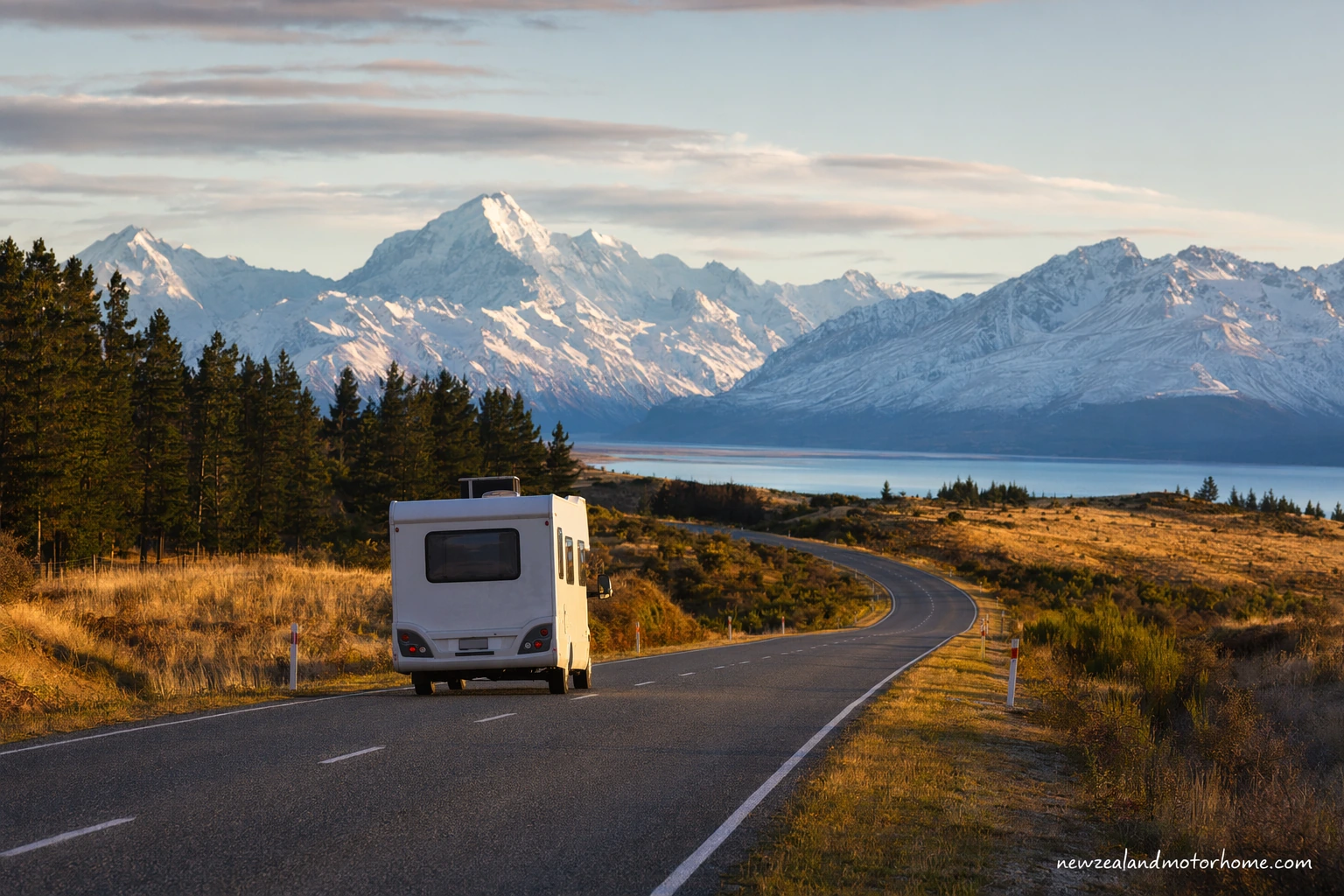
Rotorua to Timaru campervan route: geothermal north to South Canterbury
- Best pace: 5–6 days
- Includes Cook Strait ferry
- Mainly SH5 and SH1
- Powered reset nights advised
- Watch Desert Road weather
The Rotorua to Timaru campervan route is a proper cross-country run: thermal valleys and lake country, the open Central Plateau, a Cook Strait ferry crossing, then the east coast of the South Island down to South Canterbury. It is not a route to rush in one long push, especially in a motorhome where ferry check-in, dump stops, supermarket parking and weather windows all shape the day.
This guide is written for self-drive travellers sleeping in their hired van. You will find a practical Rotorua to Timaru drive plan, sensible overnight stops, where to think about powered sites versus freedom camping, and the road notes that matter when you are carrying your bed, water tank, gas bottle and grey-water tank with you.
How many days to allow in a campervan
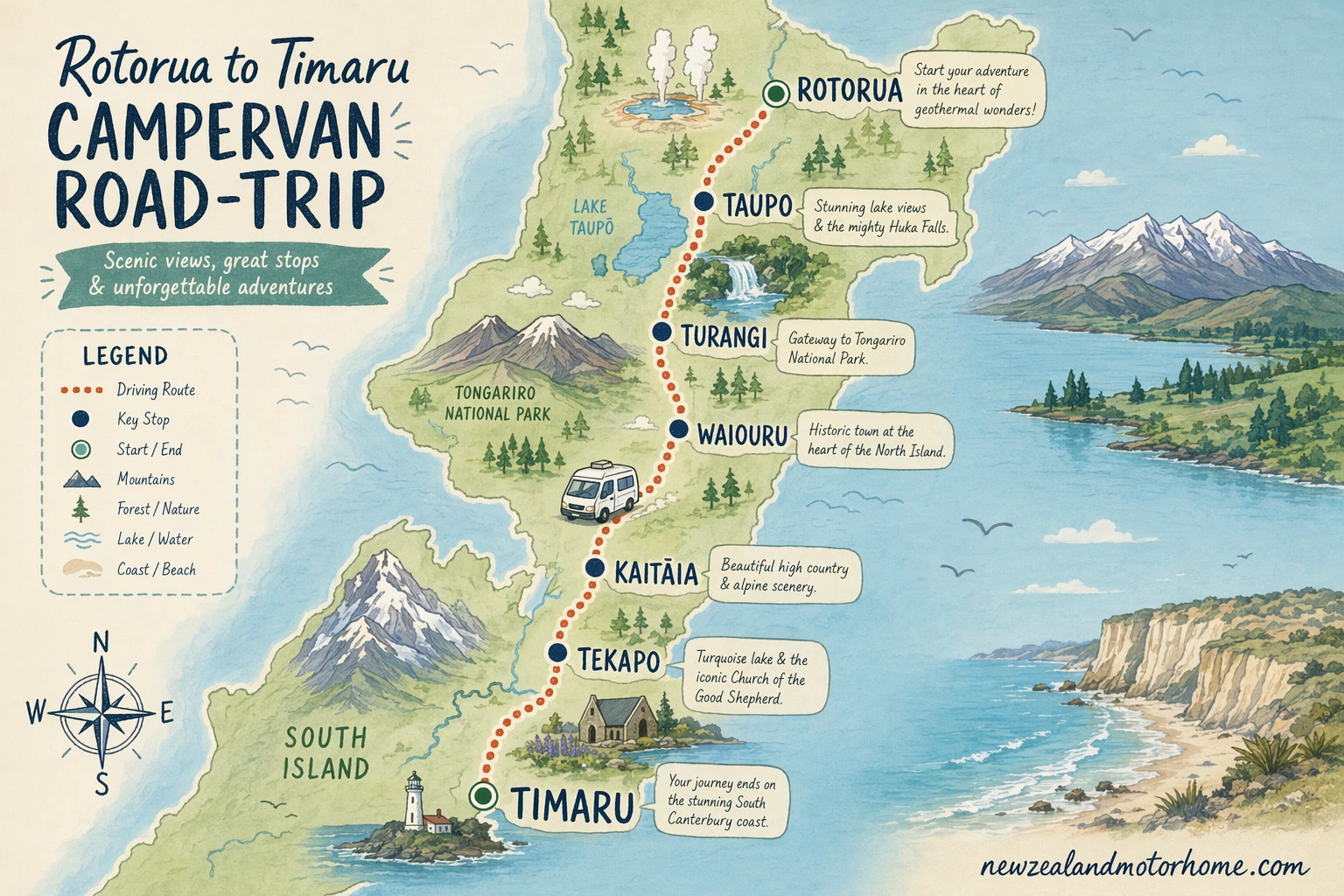
Allow at least four days for a direct Rotorua to Timaru campervan trip, and six or seven if you want it to feel like a road trip rather than a relocation. The driving distance is close to 1,000 kilometres, not counting ferry marshalling time, rest breaks, dump stations or the time it takes to thread a longer van through town parking.
A comfortable Rotorua to Timaru motorhome road trip usually breaks the North Island at Taupō or Tūrangi, then Wellington or the Kāpiti Coast before the ferry. On the South Island side, Picton, Blenheim, Kaikōura or North Canterbury make useful pauses before the final run to Timaru.
- Fast but workable: 4 days, with one North Island overnight, one ferry-side overnight and one South Island overnight.
- Better pace: 5–6 days, giving you time for Taupō, Wellington harbour, Kaikōura and a relaxed arrival into Timaru.
- Winter note: add slack for Desert Road closures, ferry delays and shorter daylight.
If you want the timing matched to your ferry sailing, van size and first-night pickup time in Rotorua, use the talk to us step and we can help shape the route without overloading the driving days.
Rotorua to Wellington: lakes, plateau and ferry positioning
From Rotorua, most campervans follow SH5 to Taupō, then SH1 around the lake to Tūrangi and across the Central Plateau via the Desert Road. This is a straightforward main-highway run, but it is still high country: wind, fog, snow and ice can affect the stretch between Tūrangi, Waiouru and Taihape, particularly from late autumn through spring.
For a first night, Taupō and Tūrangi both work well because they have holiday parks with powered sites, dump points, fresh-water fills and easier supermarket access than you will find once you are up on the plateau. Freedom camping around Lake Taupō is tightly controlled, so only use signed areas and only if your van has current self-containment certification.
- Good first stops: Rotorua lakes district, Taupō, Tūrangi or National Park village, depending on pickup time.
- Dump and water: plan to empty and refill at a holiday park or council dump station before crossing the plateau.
- LPG: Rotorua and Taupō are the safest places to sort gas before heading south.
- Road care: avoid pushing the Desert Road late in the day in a high-sided motorhome if strong winds are forecast.
From Waiouru south, SH1 settles into a long highway haul through Taihape, Bulls and Levin before Wellington. If you have a larger motorhome, choose a Wellington-region holiday park or legal overnight area with easy access to the ferry rather than trying to park overnight in the central city.
Cook Strait ferry notes for motorhomes
The ferry is the hinge point of the Rotorua to Timaru drive. Book your crossing with the full vehicle length, including tow bars, bike racks or rear storage boxes, and be honest about height. A van that fits easily in a supermarket bay still needs the correct ferry category.
Arrive with time to spare. Ferry terminals are not places to discover that your gas bottle is still open, your cupboards are loose or your grey-water tank is nearly full. You normally need to turn LPG off at the cylinder and switch off gas appliances before boarding; staff will direct you where to park the van on the vehicle deck.
- Before boarding: secure drawers, latch the fridge, close roof vents and stow anything loose on counters.
- Gas: turn LPG off at the bottle and follow crew instructions.
- Water and waste: dump grey and toilet waste before terminal queues; do not rely on finding time at the wharf.
- Overnight timing: if sailing early, sleep legally near Wellington or Porirua; if arriving late, consider Picton rather than driving on tired.
Cook Strait can be calm one day and lumpy the next. In a motorhome, that mainly means packing the living area properly and not leaving glassware, kettles or pantry items loose before you lock the van and head upstairs.
Picton to Timaru: coastal SH1 and South Canterbury
From Picton, the usual route heads through Blenheim and down SH1 via Seddon, Kaikōura, Cheviot, Christchurch and the Canterbury Plains to Timaru. It is a beautiful drive in places, but it is also a working state highway with trucks, bridges, coastal bends and exposed sections where wind can push a tall van around.
Picton and Blenheim are handy for restocking after the ferry, with easier parking on the edges of town than right in compact waterfront areas. Kaikōura is a natural overnight stop, but do not assume you can simply park on the beachfront; local freedom camping rules are strict and popular legal sites fill in peak season.
- Best South Island break points: Picton after a late ferry, Blenheim for errands, Kaikōura for a coastal night, or North Canterbury before Christchurch.
- Dump and water: use holiday parks or signed public dump stations in Picton, Blenheim, Kaikōura, Christchurch or Timaru.
- Road note: the Kaikōura coast has tunnels, rail crossings and small pull-offs; check sight lines before committing a long van.
- Final leg: Christchurch to Timaru is open and usually simple, but nor'west winds on the plains can be tiring in a high-roof campervan.
Timaru itself is easier to approach than larger cities, but still plan your arrival. Use designated long-vehicle parking where signed, avoid tight angle parks around busy shopping streets, and choose a holiday park or approved overnight stop before setting off to Caroline Bay or the port area on foot.
Overnight stop styles: powered, unpowered and freedom camping
This route suits a mix of powered and unpowered nights. A powered site is useful after a long driving day because you can charge devices, run heating more comfortably in winter, refill fresh water, empty waste and reset the van. Unpowered holiday park sites can be a good middle ground if your house battery is healthy and you still want showers and a dump station.
Freedom camping is possible only where local bylaws allow it, and you need a currently certified self-contained campervan. Rules vary between Rotorua, Taupō, Wellington, Marlborough, Kaikōura, Christchurch and Timaru districts, so read the sign at the actual site rather than relying on a memory from another town.
- Powered site nights: Rotorua or Taupō, Wellington before the ferry, and Timaru on arrival are the easiest places to reset.
- Unpowered site nights: work well at holiday parks if you still want facilities but do not need mains power.
- Freedom camping: use only signed legal areas, carry your self-containment proof, and leave before any posted time limits.
- Grey water: never drain roadside or into stormwater; use a proper dump station.
In a hired motorhome, keep a simple rhythm: dump before the tank is full, refill fresh water when you can, and do not leave LPG until the bottle is nearly empty. The long middle stretches of this route are easier when the van is already sorted.
Parking and road comfort for bigger vans
A Rotorua to Timaru campervan journey is mostly on major state highways, but bigger vehicles still need a little patience. Look for edge-of-town supermarkets, visitor centres with marked longer bays, and waterfront parking that specifically allows campervans. If a car park looks tight on the way in, it will feel tighter when you need to reverse out with people walking behind you.
At scenic stops, check the exit before you pull in. Some lakefront and coastal viewpoints have short turning areas, low branches or sloping gravel shoulders. In wet weather, avoid soft grass unless it is clearly an overnight site designed for motorhomes.
- Height: know your van height before entering covered parking, fuel station canopies or tree-lined side streets.
- Length: include rear bike racks when booking the ferry or choosing a bay.
- Wind: slow down on exposed lake, plateau and Canterbury sections; let faster traffic pass at safe pull-offs.
- Fuel: do not run low between Tūrangi and Taihape or on late-night South Island stretches when services may be closed.
The best days on this route are not the ones with the most kilometres. They are the ones where you park the van once, walk to dinner or the beach, and wake up with full water, empty waste and a sensible next leg.
Keep planning
Visiting polynesian spa rotorua by campervan
Read onVisiting agrodome rotorua by campervan
Read onHoliday parks timaru
Read onHoliday parks rotorua
Read onFarmers markets rotorua
Read onCampervan supplies timaru
Read onCommon questions
Can I drive from Rotorua to Timaru in two days in a campervan?
It is technically possible, but it is not a pleasant campervan plan because the ferry, check-in time and waste or water stops make the days long. Four days is a safer minimum, with five or six giving you proper rest and weather flexibility.
Where should I stay before the Cook Strait ferry?
Choose a legal overnight stop or holiday park in Wellington, Porirua, Lower Hutt or the Kāpiti Coast, depending on your sailing time. For an early ferry, being closer to the terminal reduces stress, but avoid assuming you can freedom camp in central Wellington.
Is the Desert Road suitable for motorhomes?
Yes, SH1 over the Desert Road is a main highway and is commonly used by campervans and motorhomes. In winter or bad weather, check road conditions before leaving Tūrangi or Waiouru, as snow, ice and strong wind can close or slow the route.
Do I need a self-contained campervan for this route?
You do not need one if you stay only in holiday parks, but it gives you more flexibility. For freedom camping, you must meet the current self-containment requirements and still obey each council's local signs and time limits.
Where can I dump waste on the Rotorua to Timaru route?
Plan dump stops in larger centres such as Rotorua, Taupō or Tūrangi, the Wellington region, Picton or Blenheim, Kaikōura, Christchurch and Timaru. Holiday parks often provide dump and fresh-water facilities for guests, and public dump stations should be checked against local council information while you travel.
Should I book powered sites in advance?
Book ahead in summer, school holidays, long weekends and around ferry nights. Powered sites near Taupō, Wellington, Picton, Kaikōura and Timaru can be busy, and a confirmed site makes it much easier to reset the van after a long drive.
Have a planner shape this for your dates
Send a short outline — your dates, party size, and the kind of trip you want. A planner replies with a vehicle recommendation, a paced route, and the realistic budget.