- Best base: Kerikeri/Waipapa
- Allow 1–2 relaxed days
- Arrive early for van parking
- Powered sites useful in summer
- Check market days before driving
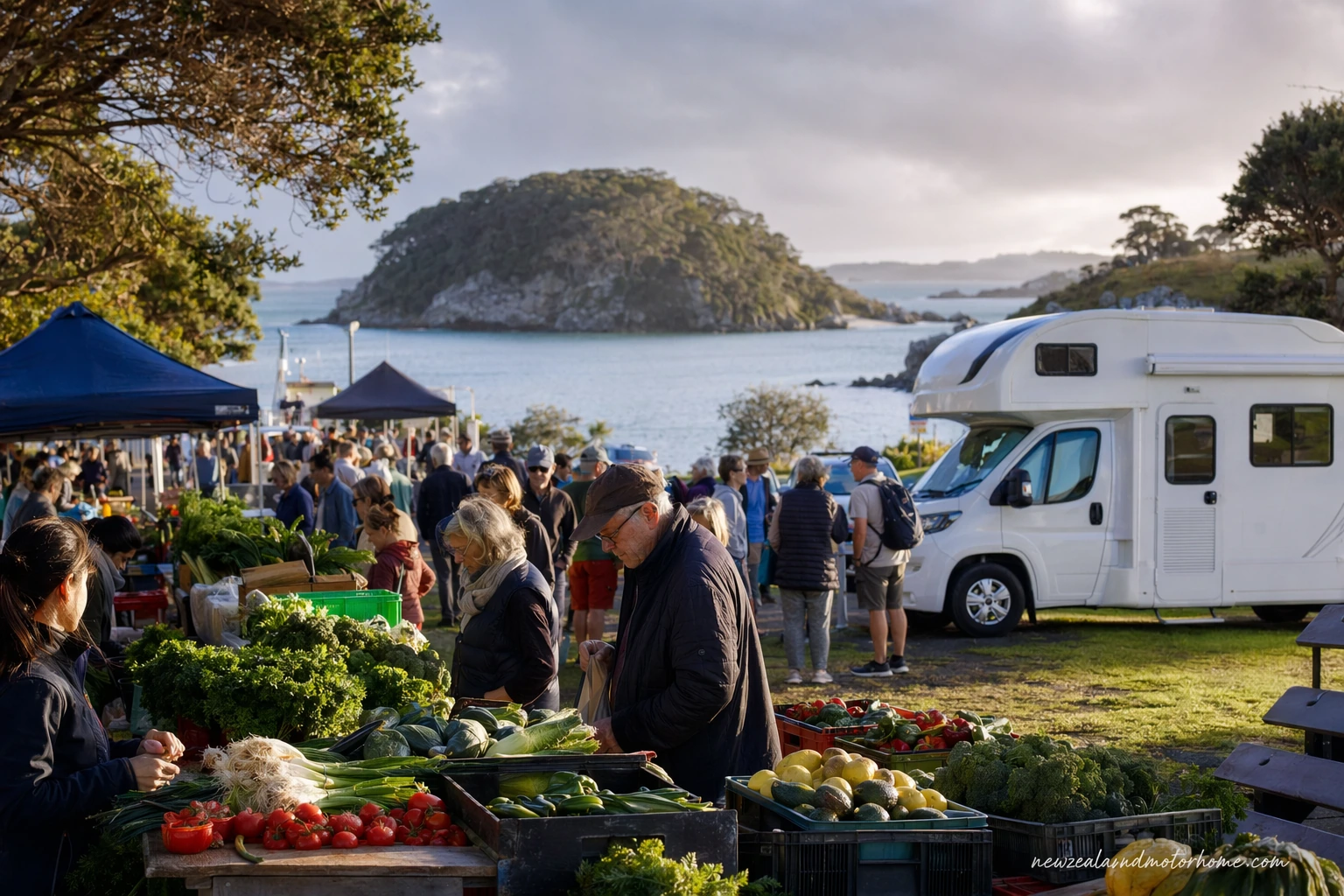
The Bay of Islands is a good place to slow the van down and shop the way locals do: citrus from Kerikeri, avocados and greens from the volcanic soils, bread still warm enough to perfume the cab, and small-batch preserves that make an easy campervan lunch feel less like leftovers.
This guide is written for travellers driving and sleeping in their hired campervan or motorhome. You’ll find the market rhythm, where parking is kinder for longer vans, how to line up fresh produce Bay of Islands stops with dump stations and water fills, and which towns make practical overnights before an early market run. If you want these stops folded into a wider Northland route, you can send us your dates through /talk-to-us/.
How the Bay of Islands market week usually works
The main food markets Bay of Islands campervan travellers tend to aim for are around Kerikeri, Paihia and the SH10 Waipapa corridor. Kerikeri is the strongest base for growers, with Sunday-morning-style farmers market trading common, while the larger weekend market scene around Waipapa is useful if you want produce, baking and prepared food in one stop.
Paihia’s market activity is more waterfront and visitor-facing, often timed for an afternoon or weekend feel, and it can shift with seasons, weather and events. Russell and Kawakawa can have smaller community markets or pop-up stalls, especially in warmer months, but they are best treated as a bonus rather than the only food shop for your van.
- Best grower base: Kerikeri and nearby Waipapa.
- Best ferry-and-waterfront pairing: Paihia, Waitangi and Russell.
- Best van approach: arrive early, use marked bays only, and avoid overhanging footpaths in the town centres.
- Check before you drive: market days and hours can change for public holidays, weather and seasonal supply.
Kerikeri and Waipapa: the easiest fresh food run by motorhome
Kerikeri is the heart of fresh produce Bay of Islands shopping. It is where you are most likely to find orchard fruit, avocados, citrus, salad greens, honey, eggs, baking, coffee and preserves with a real local grower feel. For a campervan pantry, it is a practical stop because you can buy food for several days before heading to quieter coves or north towards Whangaroa.
Parking in central Kerikeri is much easier if you arrive before the morning peak. Shorter campervans may fit in standard town parks, but longer motorhomes should look for signed larger bays or park a little further out and walk in. Do not squeeze into small private car parks unless they clearly allow it; Kerikeri’s town streets can be busy and turning a long rear overhang in tight spaces is no fun.
Waipapa, on SH10 just north of Kerikeri, is often kinder for bigger vans because access is flatter and parking areas tend to be more open. If you are travelling in a high-roof motorhome, still watch for low tree branches and uneven grass edges after rain.
- Good timing: morning markets first, then fuel, LPG or groceries before leaving town.
- Van note: Kerikeri side roads can be narrow with parked cars; take wider turns slowly.
- Service pairing: use Kerikeri/Waipapa as a practical place to check fresh water, waste and LPG before more remote beach nights.
Paihia, Waitangi and Russell: markets with harbour views
Paihia is the easiest Bay of Islands base if you want a market browse, a swim, a waterfront walk and an overnight site without moving the van too often. Market stalls here are usually more mixed than purely grower-focused: expect seasonal produce when available, baking, coffee, ready-to-eat food and local crafts. It is a handy stop if your fridge is small and you prefer to shop little and often.
Campervan parking near the Paihia waterfront fills quickly, especially in summer, on cruise-ship days and during school holidays. If you are in a larger motorhome, look for signed public parking away from the very front row, then walk back along the waterfront. Keep clear of bus stops, boat-ramp access, mobility parks and any bay with a time limit that does not suit your stop.
For Russell, remember the passenger ferry from Paihia does not take your van. To drive the motorhome over, you need the vehicle ferry route from Ōpua to Okiato, then the road into Russell. It is a lovely detour, but it adds time, so do it for the town and overnight feel rather than a quick vegetable top-up.
- Paihia advantage: easy to combine a market stop with paid holiday park nights, dump facilities and fresh-water top-ups.
- Russell advantage: slower harbour atmosphere and smaller local market feel when operating.
- Driving note: the Ōpua to Russell route has bends and narrow sections; let faster traffic pass when safe.
Weekend markets Bay of Islands: how to build them into a loop
The weekend markets Bay of Islands circuit works best if you avoid doubling back. A simple campervan pattern is to overnight near Kerikeri or Waipapa before a morning market, stock up, then drift towards Paihia or Waitangi for the afternoon. From there, choose whether to stay put, cross to Russell by vehicle ferry, or continue south towards Kawakawa.
If you are arriving from Auckland or Whangārei, do not plan on reaching an early market fresh and relaxed after a long drive. Northland roads are scenic but slower than the map suggests, with bends, town speed limits, one-lane bridges in places, and plenty of short pull-ins that are better for cars than for a 7-metre motorhome.
- One-night market loop: Whangārei area to Kerikeri/Waipapa overnight, morning market, Paihia or Waitangi afternoon.
- Two-night loop: Kerikeri/Waipapa, then Paihia/Waitangi, then Russell or south via Kawakawa.
- Best for food storage: buy the delicate greens and berries last, then drive straight to your overnight stop and get them into the fridge.
- Rain plan: choose markets with hardstand or nearby town parking, as grass overflow areas can become soft for heavy vans.
Overnight stops, self-containment and van services
The Bay of Islands has a mix of holiday parks, basic campgrounds and tightly controlled freedom camping areas. If you want showers, laundry, fresh water, dump access and a powered site to bring the fridge back down after a warm market day, a paid holiday park around Paihia, Waitangi, Kerikeri or Russell is the easy option. Unpowered sites suit self-contained vans with decent battery capacity, but Northland humidity can make fridge management more important than you expect.
Freedom camping rules are council-controlled and can change by location, season and vehicle certification. Only use legal sites for certified self-contained vehicles, obey maximum-stay signs, and do not assume a pretty beach reserve allows overnighting. Rangers do check popular areas in summer.
Plan your food shopping around services as much as scenery. A full fridge is useful only if your battery, water tank and waste tank are under control before you head to quieter bays.
- Dump stations: check current council maps, camping apps or your campground on arrival; do not leave it until the cassette is full.
- Fresh water: fill at approved potable taps only, usually at campgrounds or signed service points.
- LPG: top up in larger service towns before committing to remote beach nights.
- Powered vs unpowered: choose powered after hot driving days or if you are carrying seafood, dairy or a full produce shop.
Keep planning
Common questions
Which Bay of Islands market is best for a campervan food shop?
Can I park a large motorhome at the Bay of Islands markets?
Are Bay of Islands market days fixed year-round?
Where should I stay overnight before a morning market?
Is freedom camping easy around Paihia and Kerikeri?
How do I keep market produce fresh in a campervan?
Have a planner shape this for your dates
Send a short outline — your dates, party size, and the kind of trip you want. A planner replies with a vehicle recommendation, a paced route, and the realistic budget.