- Best in spring to autumn
- Allow 5 to 7 days
- Main route uses SH1
- Powered sites in all major towns
- Self-contained freedom camping only
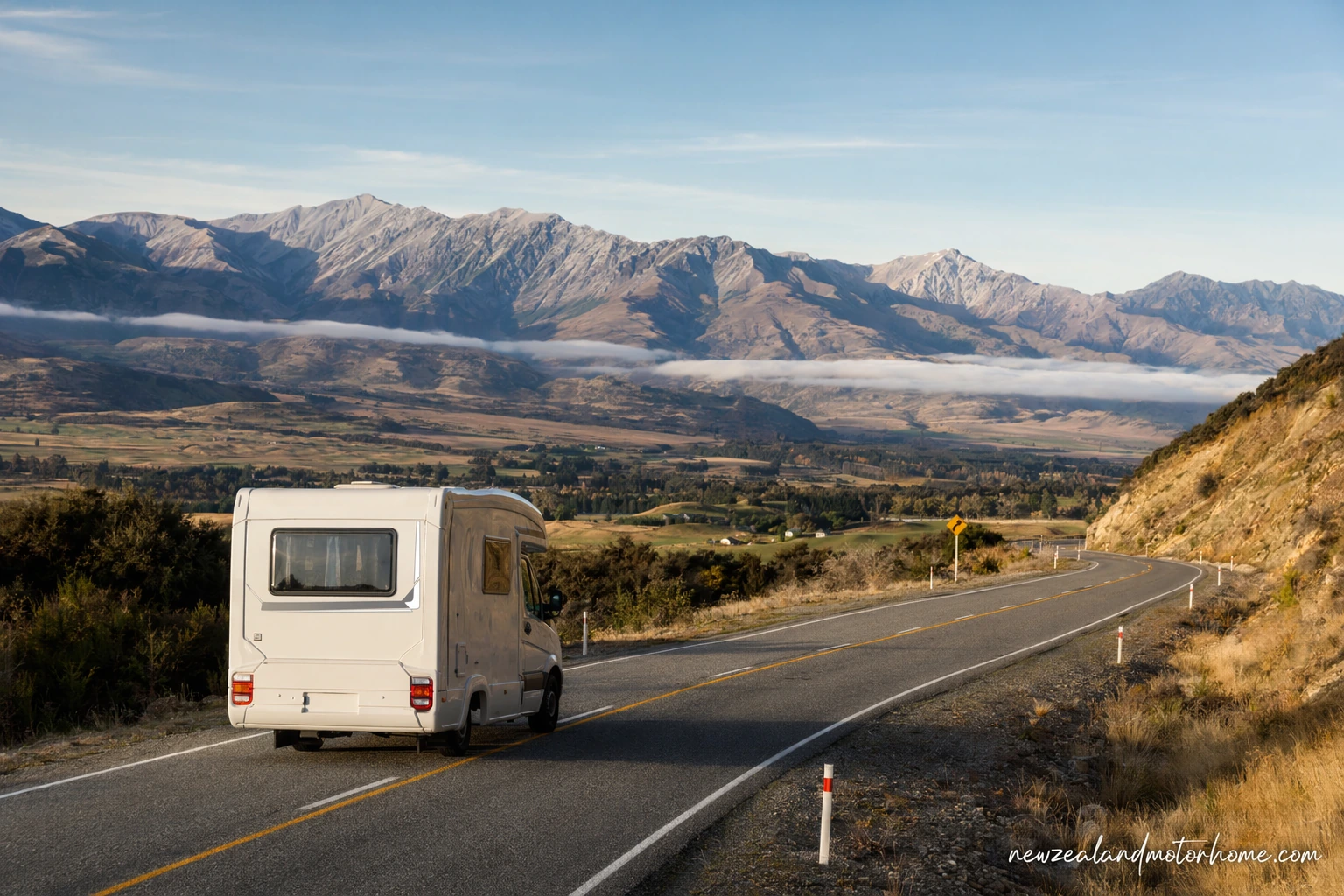
The Invercargill to Blenheim campervan route is a proper South Island crossing: farmland out of Southland, Otago harbour views, limestone coast, Canterbury plains, the rebuilt Kaikōura coast road, then vineyards and big skies into Marlborough. You can drive it quickly, but in a motorhome it is much better treated as a 5 to 7 day trip with sensible legs and time to empty tanks, top up water and park the van somewhere you actually want to wake up.
This guide is written for self-drive campervan travellers, not people rushing between motels. You will find van-suitable road notes, realistic overnight stop ideas, powered and unpowered camping options, freedom camping cautions, dump station planning and the small logistics that make an Invercargill to Blenheim motorhome road trip feel easy rather than improvised.
Route shape, distance and how many days to allow
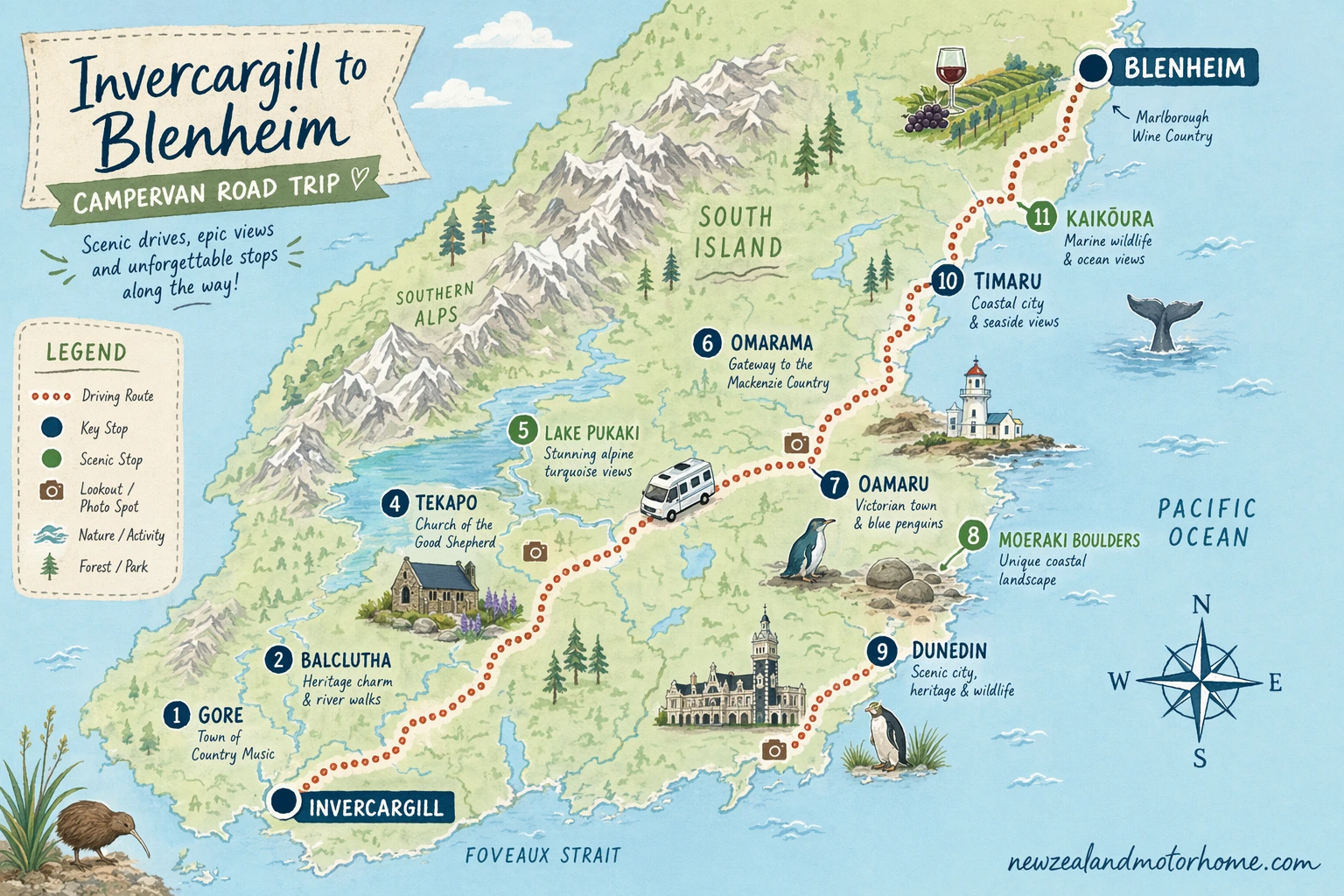
The most direct Invercargill to Blenheim drive follows State Highway 1 north through Gore, Balclutha, Dunedin, Oamaru, Timaru, Christchurch, Kaikōura and on to Blenheim. It is a long South Island haul, roughly a full day and a half of wheel time before you add meal stops, viewpoints, supermarket runs, dump stations and the slower pace of a larger van.
For most campervan travellers, 5 nights is the comfortable minimum. If you want to include the Catlins, Otago Peninsula, Moeraki Boulders, central Christchurch or a whale-watching stop in Kaikōura, make it 7 nights or more. Trying to do it in 2 or 3 days means you mostly see fuel pumps and white lines.
- Fast but tiring: 3 days, using holiday parks or simple campgrounds near Dunedin and Kaikōura.
- Balanced: 5 to 6 days, with short coastal stops and time for dump and water routines.
- Unhurried: 7 to 10 days, adding the Catlins, Oamaru, Banks Peninsula or Marlborough wine country.
If you are still choosing how much to trim or add, use this page as a base plan and then talk to us before you lock in your overnight stops, especially if you are travelling in a larger motorhome or during school holidays.
Leg 1: Invercargill to Dunedin or the Catlins
From Invercargill, the simplest campervan route is SH1 through Gore and Balclutha to Dunedin. The road is generally straightforward for hired motorhomes, with regular fuel, supermarkets and service stops. It is a good first leg if you have just collected the van, because you can settle into driving height, mirrors and braking distance without too many narrow coastal bends.
The scenic alternative is to swing through the Catlins. It is slower, more winding and better suited to confident drivers, but it rewards you with beaches, waterfalls and quieter campgrounds. Take extra care with overhanging branches, gravel access roads and farm traffic. In wet weather, do not push a heavy van into soft roadside verges just to get closer to a viewpoint.
- Overnight base: Dunedin has the widest choice of powered sites and dump facilities, useful after your first full day.
- Quieter option: Catlins campgrounds can suit self-contained vans, but check road surface, arrival times and site access before committing.
- Van note: Dunedin hills and one-way streets can feel tight in a long motorhome; park once and use walking routes or local transport where practical.
Leg 2: Dunedin to Oamaru, Moeraki and Timaru
North of Dunedin, SH1 becomes an easy touring run, though it still pays to keep your speed modest in a high-sided van. Moeraki is the classic coastal pause, but the boulder beach car parks can be busy and are not always relaxed for long vehicles at peak times. Arrive early, park only in marked spaces and avoid blocking turnaround areas.
Oamaru is a strong campervan overnight because it breaks the route neatly and has supermarkets, fuel, laundry options and holiday parks where you can plug in, refill fresh water and reset the van. If you are not staying, it is still a sensible place to stretch your legs around the Victorian precinct before continuing to Timaru.
- Powered sites: Look around Oamaru or Timaru if batteries are low after several nights off-grid.
- Unpowered sites: Often fine for certified self-contained vans in calm weather, but keep an eye on fridge draw and heater use.
- Dump planning: Use council-listed or holiday-park dump stations in Dunedin, Oamaru or Timaru rather than waiting until tanks are urgent.
This section of the Invercargill to Blenheim motorhome road trip is also where wind can start to matter. If norwesters are strong across open farmland, slow down and keep both hands on the wheel, particularly when passing trucks.
Leg 3: Timaru to Christchurch and the Canterbury plains
The Timaru to Christchurch leg is open, useful and not especially dramatic, which is exactly why it works well as a logistics day. Ashburton and the towns along SH1 are good for fuel, groceries, bakery stops and fresh-water top-ups where available. Large supermarket car parks can be busy, so park at the far edge and avoid straddling bays unless there is clearly room for the van.
Christchurch is the biggest service hub on the route. If you need LPG, a tyre check, replacement hose fittings, a proper laundry stop or a powered night before the Kaikōura coast, this is the place to sort it. Do not assume you can freedom camp casually around the city; local rules are specific and enforcement can be active.
- Best use of Christchurch: resupply, dump, recharge and plan the next coastal leg.
- Parking tip: choose peripheral parking for sightseeing rather than taking a long motorhome deep into tight central streets.
- Overnight choice: holiday parks and designated council-compliant sites are safer bets than guessing from a roadside pull-off.
Leg 4: Christchurch to Kaikōura
The road north from Christchurch through North Canterbury is one of the best parts of the route once you reach the coast. It is also a section to drive with patience in a campervan. There are winding stretches, tunnels, rail crossings, ocean-side pull-offs and areas where rockfall or roadworks can affect traffic flow after bad weather.
Kaikōura makes an excellent overnight stop before the final run to Blenheim. It has paid campgrounds, dump station options, fresh-water access through formal facilities and enough food stops that you do not need to cook if the wind is up. Book ahead in summer and around long weekends, because van sites can fill quickly and freedom camping is tightly controlled.
- Where to park the van: use marked visitor parking near the township or official attraction car parks; do not squeeze into small residential corners.
- Wildlife stops: keep well clear of seals and never block the road edge for a photo.
- Road note: allow extra time for slow vehicles and roadworks on the coastal highway.
Leg 5: Kaikōura to Blenheim and arriving in Marlborough
The final leg from Kaikōura to Blenheim follows the coast before turning inland through the Awatere and Marlborough country. It is a beautiful drive in a motorhome, but keep your attention on the road rather than the view. Crosswinds can be sharp, and the mix of trucks, cyclists, campervans and local traffic means you should use slow-vehicle bays when a queue builds behind you.
Once in Blenheim, treat arrival as a reset rather than just an endpoint. Empty grey and black water at an approved dump station, refill fresh water, restock groceries and choose a legal overnight site before exploring wineries or the Wairau Valley. Many cellar-door car parks are not designed for large motorhomes, so check access and turning space before driving in.
- Powered night: useful if you have been running the fridge, lights and devices heavily since Kaikōura.
- Freedom camping: only use permitted areas and only if your van meets current self-containment requirements.
- Van size note: longer motorhomes should avoid last-minute U-turns on rural winery roads; plan your loop before leaving town.
Keep planning
Common questions
How long should I allow for an Invercargill to Blenheim campervan trip?
Allow at least 5 days if you want a comfortable self-drive pace with proper overnight stops. Seven days is better if you want the Catlins, Oamaru, Christchurch or Kaikōura without driving long hours every day.
Is the Invercargill to Blenheim drive suitable for a large motorhome?
Yes, the main SH1 route is suitable for larger motorhomes, but you still need to drive to the conditions. Take extra care on the Catlins detour, Dunedin hills, the Kaikōura coast and in strong Canterbury or Marlborough winds.
Can I freedom camp on this route?
Sometimes, but rules change by district and many coastal or urban areas are restricted. Only use legal sites for certified self-contained vehicles, obey signage on the day and have a paid campground backup during busy periods.
Where should I plan dump station stops?
Plan to empty tanks in larger centres such as Dunedin, Oamaru, Timaru, Christchurch, Kaikōura and Blenheim using approved public or holiday-park dump stations. Do not wait until tanks are full, because access can vary with time of day, season and maintenance.
Which direction is better, Invercargill to Blenheim or Blenheim to Invercargill?
Both directions work well in a campervan. Travelling north gives you a gradual build from Southland farmland to Otago coast, Canterbury services, Kaikōura and Marlborough; travelling south can suit ferry arrivals into Picton and onward plans for Fiordland.
Have a planner shape this for your dates
Send a short outline — your dates, party size, and the kind of trip you want. A planner replies with a vehicle recommendation, a paced route, and the realistic budget.