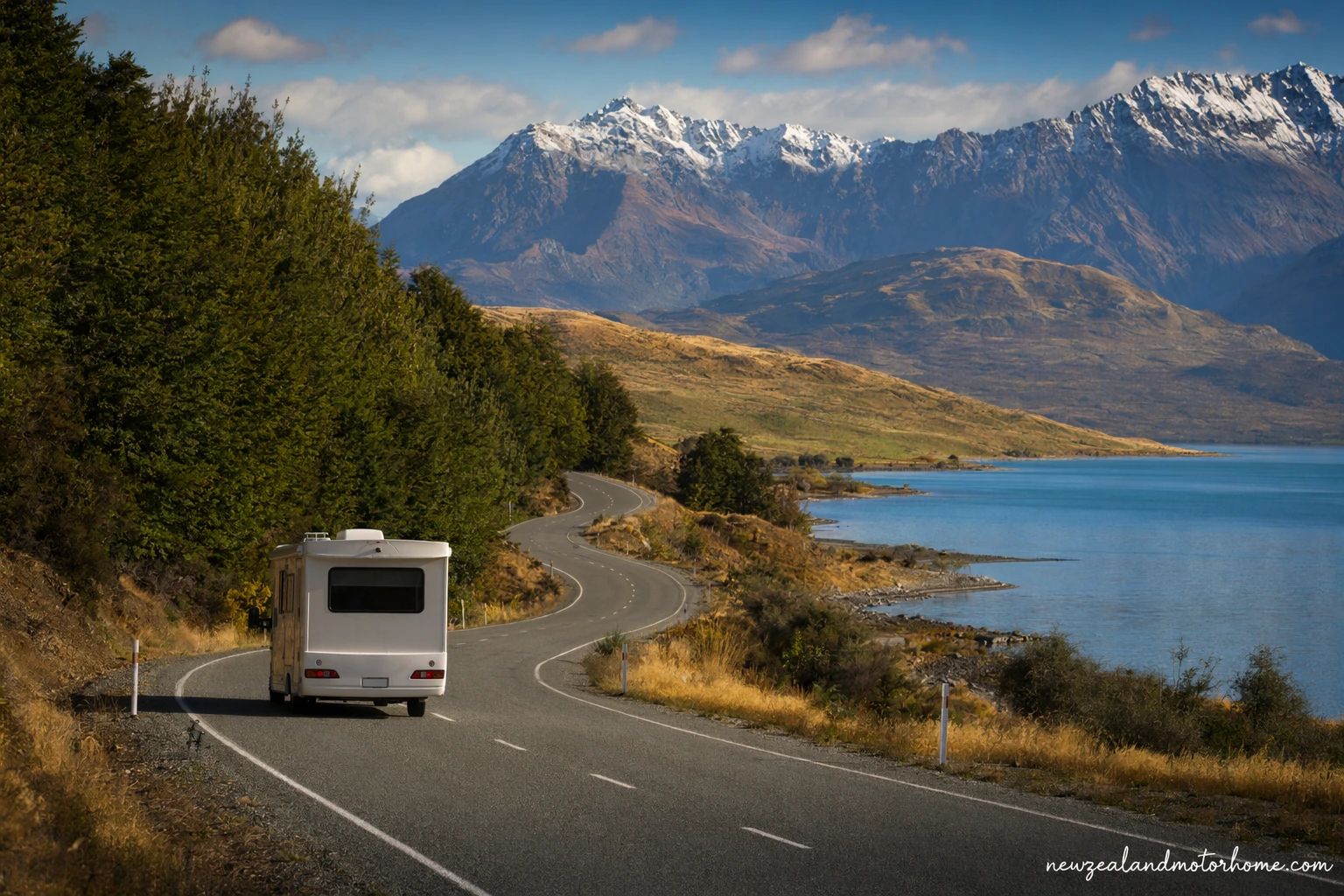
Invercargill to Rotorua campervan route: south to north by van
- Allow 6–10 days
- Cook Strait ferry required
- Best in spring to autumn
- Main route suits large vans
- Mix powered and self-contained stops
The Invercargill to Rotorua campervan route is a proper end-to-end New Zealand drive: southern farmland, the Otago coast, Canterbury plains, the Kaikōura shoreline, Cook Strait, then the volcanic plateau and steaming Rotorua. It is not a route to rush in a tired van or with a tight ferry connection; the best trips leave room for weather, wind, dump-station stops and an unplanned extra night somewhere good.
This guide is written for self-drive campervan and motorhome travellers, so it focuses on where the van fits, where to sleep, how to handle the Picton-Wellington ferry, and which road notes matter when you are driving a taller, heavier vehicle. Use it as a practical framework for your Invercargill to Rotorua drive, then adjust the pace around your hire handover times, season and van size.
How long to allow and the best overall route
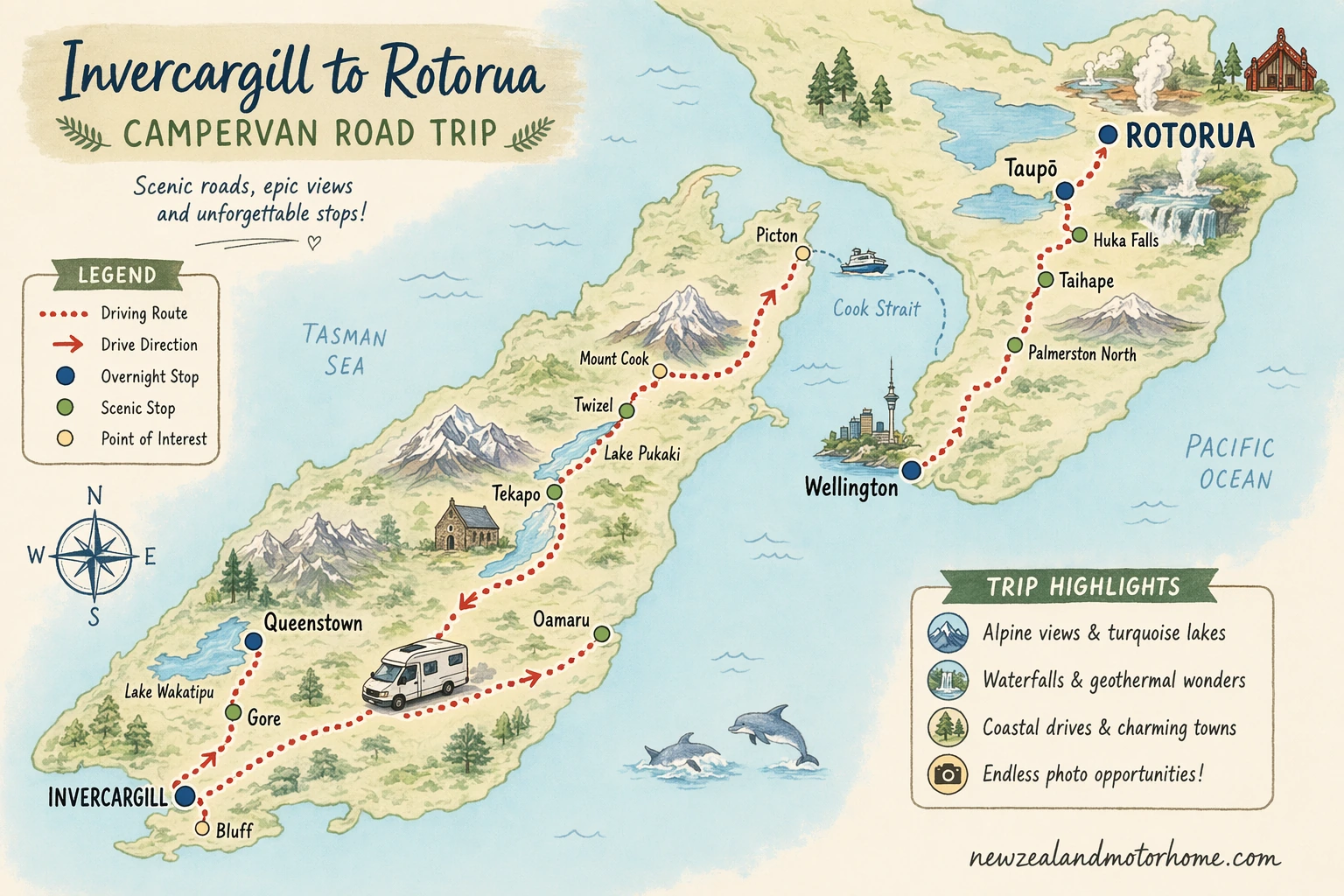
The most straightforward Invercargill to Rotorua motorhome road trip follows SH1 north through Dunedin, Oamaru, Timaru, Christchurch, Kaikōura and Picton, crosses Cook Strait to Wellington, then continues via SH1 and SH5 through Taupō to Rotorua. It is all sealed state highway, but the distance, ferry logistics and changing weather make it feel bigger than it looks on a map.
Allow at least six driving days if you are comfortable with longer stints, and eight to ten days if you want proper overnight stops rather than just arriving, plugging in and leaving again. In a campervan, time disappears into fresh-water fills, supermarket parking, dump stations, laundry, ferry check-in and slower hill sections.
- Fast but realistic: 6 days, with longer driving days and simple holiday park overnights.
- Comfortable pace: 8 days, including Kaikōura or Taupō time and a less stressful ferry day.
- Slow scenic version: 10+ days, adding the Catlins, Aoraki/Mount Cook or a Wairarapa/Hawke’s Bay detour.
- Van note: book and plan using your full vehicle length, including bike racks, tow bars or rear storage boxes.
If you want help shaping the route around your van size, ferry day and overnight style, you can talk to us before locking in the plan.
Leg 1: Invercargill to Dunedin or Oamaru
From Invercargill, the direct run to Dunedin is a gentle first day on SH1, with rolling Southland and Otago farmland and plenty of small-town fuel and food stops. It is a good leg for settling into the hire van: mirrors, braking distance, reversing camera, fridge settings, gas bottles and how the vehicle handles in crosswinds.
Dunedin is the natural first overnight if you start late, need supplies, or want a powered site after collecting the van. Oamaru works well if you get away early and want a slightly longer first push north, with easier onward timing for Canterbury the next day.
- Overnight style: use holiday parks for powered sites, showers, laundry and fresh water; unpowered sites suit certified self-contained vans that do not need mains power.
- Dump and water: Invercargill, Dunedin and Oamaru all have campervan services through holiday parks and public dump-station networks; check current access before arriving late.
- Road note: the Catlins coastal route is beautiful but slower, narrower and more tiring in a larger motorhome. Add a day if you choose it.
- Parking: in Dunedin, avoid squeezing into steep central streets if you are in a long van; use larger signed car parks and walk in.
Before leaving Southland, top up LPG if your heater, hot water or cooking depends on gas. Cold southern mornings can empty bottles faster than expected, especially if you are freedom camping without power.
Leg 2: Otago to Christchurch across the plains
North of Oamaru, SH1 becomes an easy but exposed drive through Timaru, Ashburton and into Christchurch. The road is van-suitable and mostly straightforward, but Canterbury nor’westers can push hard at high-sided campervans, especially on open stretches and bridge approaches.
Christchurch is a practical reset point on the Invercargill to Rotorua campervan journey. It is the place to do a proper supermarket restock, empty and refill tanks, check tyre pressures if the van feels loaded, and choose between a powered holiday park night or a simpler unpowered stop outside the city.
- Good break towns: Timaru, Geraldine if detouring inland, Ashburton and Rolleston all work for fuel, groceries or a driver swap.
- Overnight options: Christchurch holiday parks suit powered sites and laundry; small-town campgrounds north or south of the city can be quieter for self-contained vans.
- Van height: watch for covered supermarket parking and city car parks. Many campervans are too tall for standard height barriers.
- Freedom camping: only stay where it is specifically permitted for certified self-contained vehicles, and check the local council rules for that exact area.
If the weather is poor, it is worth stopping short rather than forcing the Kaikōura coast in the dark. The next leg is much nicer, and safer in a tall vehicle, when you can see the road edge, sea wall and passing bays clearly.
Leg 3: Christchurch to Kaikōura, Blenheim and Picton
The coastal drive north of Christchurch is one of the memorable parts of the route, but it asks for patience in a motorhome. SH1 around Kaikōura has winding sections, railway crossings, seal-viewing pull-offs, and occasional roadwork or weather-related delays after heavy rain.
Kaikōura is a good overnight if you want to split the distance before Picton. Blenheim is useful for a flatter, more spacious stop with fuel, groceries and service options, while Picton is best if you have an early ferry and do not want to drive far on sailing day.
- Parking the van: use marked larger bays and avoid stopping half-on the shoulder for photos; the coastal road carries trucks and has limited room.
- Overnight stops: choose Kaikōura for coast and wildlife, Blenheim for practical services, or Picton for ferry timing.
- Dump stations: plan to empty black and grey water before the ferry day if possible, so you are not searching under time pressure.
- Road note: check current SH1 conditions before leaving Christchurch or Kaikōura, especially after storms or in winter.
For larger motorhomes, Picton’s harbour streets and ferry lanes are manageable, but you will be happier arriving early, with fuel sorted and the van interior secured before boarding.
Cook Strait ferry with a campervan
The ferry is the hinge of the whole route. When booking, enter the correct vehicle length and height, including anything mounted at the rear or on the roof. If you understate the size, it can create problems at check-in or loading, especially in peak season.
On sailing day, turn off LPG at the bottle as required by ferry instructions, secure fridge contents, close roof vents, lock cupboards and make sure nothing can roll around on the vehicle deck. You will not be able to return to the van during the crossing, so take jackets, medication, snacks and valuables upstairs with you.
- Picton side: stay nearby the night before an early sailing; it removes the risk of a slow coastal drive or late dump-station stop.
- Wellington side: avoid planning a long night drive immediately after arrival, especially if the crossing has been rough.
- Powered night: a Wellington, Hutt Valley or Kāpiti holiday park stop is useful for recharging batteries after the ferry day.
- Fresh water: refill either before sailing or at your next proper campground; do not rely on finding water at the terminal.
Cook Strait weather can change plans, so keep the next night flexible if you can. A delayed ferry is annoying in any vehicle, but in a campervan it can also affect fridge battery time, campground check-in and how far you safely drive afterward.
Leg 4: Wellington to Taupō and Rotorua
From Wellington, the direct route to Rotorua usually follows SH1 north through the Kāpiti Coast, Levin, Bulls, Taihape and the Desert Road, then SH5 past Taupō to Rotorua. It is a full, varied drive with urban traffic, rolling farmland, high plateau weather and a final stretch of forested highway.
Breaking the North Island leg is strongly recommended. Taihape, Tūrangi and Taupō all make practical overnight points depending on your ferry timing. Taupō is especially useful for a powered night, dump station, groceries and a relaxed final run into Rotorua the next morning.
- Desert Road: check conditions in winter and after storms. Snow, ice, fog and strong wind are all possible, and closures do happen.
- SH5 to Rotorua: allow time for hills, bends and slower traffic. Keep your following distance generous in a heavier van.
- Rotorua arrival: book a powered site if you want showers, laundry and battery recovery after several moving days.
- Freedom camping: Rotorua has specific rules and restricted areas; do not assume a lakefront car park is an overnight stop unless signs clearly allow it.
Once in Rotorua, park in larger signed areas when visiting geothermal parks, redwood walks or lakefront spots. The sulphur smell is part of the place; it is also a reminder not to leave wet gear sealed in cupboards for days while you continue travelling.
Keep planning
Visiting polynesian spa rotorua by campervan
Read onVisiting agrodome rotorua by campervan
Read onHoliday parks rotorua
Read onHoliday parks invercargill
Read onFarmers markets rotorua
Read onCampervan supplies rotorua
Read onCommon questions
How many days do I need for an Invercargill to Rotorua campervan trip?
Can I freedom camp the whole way?
Is the route suitable for a large motorhome?
Should I book the Picton to Wellington ferry in advance?
Where should I stop overnight between Wellington and Rotorua?
Have a planner shape this for your dates
Send a short outline — your dates, party size, and the kind of trip you want. A planner replies with a vehicle recommendation, a paced route, and the realistic budget.