- Allow 3-5 days
- Cook Strait ferry required
- Best for certified self-contained vans
- Powered sites useful before and after ferry
- Check Desert Road weather in winter
A nelson to rotorua campervan trip is a proper cross-country run: sheltered Tasman Bay roads, the Cook Strait ferry, Wellington traffic, big central North Island skies, then the geothermal steam and lakes around Rotorua. It is not a route to rush if you are driving a larger motorhome, because ferry check-in, dump station stops and slower hill sections all take time.
This guide is written for travellers driving and sleeping in their own hired van. You will find a sensible leg-by-leg plan, where to think about powered and unpowered nights, how to handle water, LPG and waste, and the road notes that matter when your home is taller and longer than a car.
How long to allow for the Nelson to Rotorua drive
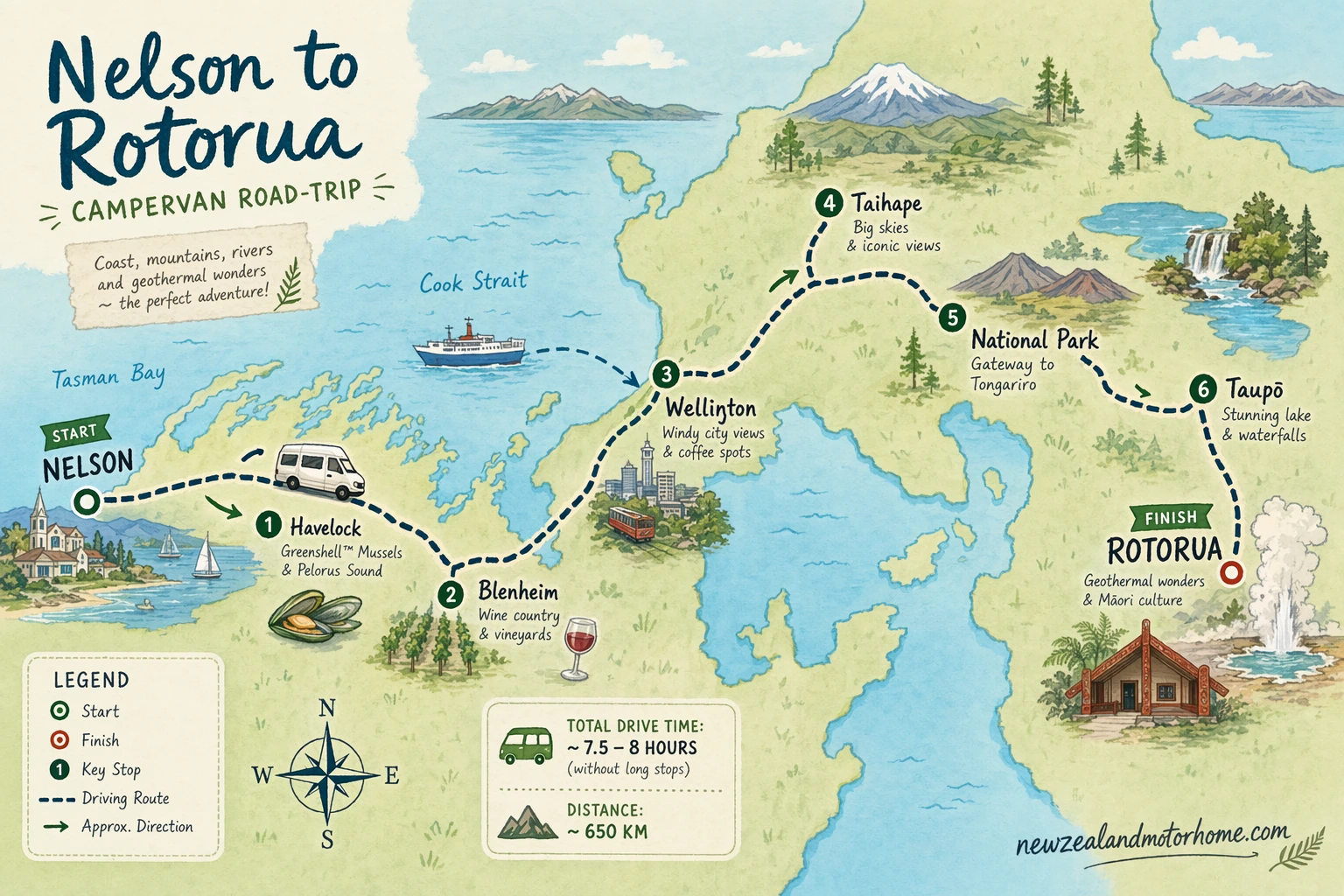
The nelson to rotorua drive is around 600 kilometres of road driving, plus the Cook Strait ferry. In a campervan, the ferry day behaves like a travel day of its own: you need to arrive early, allow for loading and unloading, and secure everything inside the van before sailing.
Three days is possible if you are comfortable with long driving days and already have campsites booked. Four to five days is much more relaxed, especially if you want a night near Wellington, time at Lake Taupō, or a slower start from Nelson.
- Fast but tidy: Nelson or Picton to Wellington, then Wellington to Taupō, then Taupō to Rotorua.
- Balanced: Nelson to Picton, Wellington or Kāpiti, Tongariro/Tūrangi or Taupō, then Rotorua.
- More scenic: add a night for Marlborough Sounds, Wellington harbour, or the central plateau.
If your hire van is over 7 metres, build in extra time for parking, supermarket stops, slower corners and campsite manoeuvring. The most stressful versions of this route usually come from trying to match a tight ferry booking with a long same-day drive.
Leg 1: Nelson to Picton and the Cook Strait ferry
From Nelson, the easiest motorhome-friendly approach to Picton is usually via SH6 towards Blenheim and then SH1 to Picton. It is not the shortest-feeling option on a map, but it avoids some of the tighter, twisting sections around the Sounds that can be tiring in a wider van.
Queen Charlotte Drive between Havelock and Picton is beautiful, with bush, bays and high viewpoints, but it is narrow and winding in places. Confident drivers in compact certified self-contained campervans may enjoy it in good weather; larger motorhomes should think carefully, keep left, use pull-outs, and avoid being hurried by traffic behind.
- Before leaving Nelson/Richmond: top up groceries, drinking water and LPG if needed, and use a dump station if your waste tanks are near full.
- Picton overnight: a powered site is handy before an early ferry, especially if you want the fridge fully chilled and devices charged.
- Ferry booking: book the correct vehicle length, including bike racks or rear boxes, and check LPG and gas appliance rules before boarding.
On ferry morning, close roof vents, latch cupboards, turn off gas appliances, and leave enough time for check-in queues. Picton’s foreshore is pleasant for a stretch of the legs, but do not rely on finding easy long-vehicle parking at the last minute in peak summer.
Leg 2: Wellington to Kāpiti, Whanganui or Taihape
Rolling off the ferry into Wellington can feel busy after the South Island. If you are not used to city driving in a campervan, take the motorway section calmly, avoid low-clearance inner-city parking buildings, and head for a pre-booked campsite or an approved motorhome stop rather than trying to improvise a street park.
The main northbound route uses SH1 through the Wellington region and up the Kāpiti Coast. Transmission Gully has made this section smoother, but it is still worth watching wind warnings, following safe distances, and letting faster traffic pass where there are proper lanes.
- Easy first night north: look at Kāpiti or Ōtaki if you want a shorter post-ferry drive.
- Longer push: Whanganui gives you a riverside stop and more of a town feel.
- Central option: Taihape works well if you want to be closer to the Desert Road and Taupō next day.
Dump stations and fresh-water taps are easier to plan around in the bigger towns on this leg. If you are freedom camping, check the current district council bylaw and your van’s self-containment certification; rules can change between neighbouring councils, and some coastal areas are tightly controlled.
Leg 3: Central plateau to Taupō and Rotorua
The central North Island is one of the best parts of a nelson to rotorua motorhome road trip, but it asks for weather awareness. The Desert Road section of SH1 can be affected by snow, ice, high wind or poor visibility outside summer, so check current road conditions before leaving your overnight stop.
Tūrangi and Taupō are both useful campervan pauses before the final run to Rotorua. Tūrangi is quieter and close to the southern end of Lake Taupō; Taupō gives you more choice for groceries, fuel, LPG, fresh water and dump stations, plus easy access to the lakefront and Huka Falls.
- Parking the van: use signed long-vehicle spaces where available, especially around Taupō lakefront and popular waterfall stops.
- Road feel: SH5 from Taupō to Rotorua has forested stretches, bends and gradual climbs; take it steadily and use lower gears on descents.
- Fuel planning: do not run the tank low before evening drives across the plateau or through forest sections.
Rotorua has several lakes, geothermal areas and forest walks spread around town, so a powered campsite for two nights is a good reset after the crossing. It gives you time to empty waste, refill fresh water, dry towels and explore without packing up the van every morning.
Campervan overnights: powered, unpowered and freedom camping
For this route, a mix of holiday park nights and carefully checked low-cost or freedom camping works best. Powered sites are most useful before or after the ferry, after cold central plateau nights, and in Rotorua if you want to run heating, recharge house batteries and reset the van properly.
Unpowered sites suit certified self-contained vans with a healthy battery, sensible water use and a plan for toilets and grey water. Freedom camping is not a backup for arriving late without a plan; it is only appropriate where local bylaws allow it, and you must follow all signage on the day.
- Good powered-site moments: Picton before the ferry, Wellington/Kāpiti after the ferry, Taupō or Rotorua near the end.
- Good unpowered moments: quieter rural campgrounds when your tanks are empty and batteries are topped up.
- Freedom camping check: confirm your self-containment certification, maximum stay, toilet rules, and whether the site allows your vehicle size.
Because this trip crosses council boundaries, do not assume a rule from Nelson applies in Wellington, Taupō or Rotorua. If you want help lining up overnight stops with ferry times and driving distances, you can use the talk to us step and we will shape the route around how you actually like to travel in a van.
Practical road notes for longer motorhomes
A larger motorhome can do this route comfortably, but it changes how you use the day. You will want wider supermarket car parks, earlier campsite arrivals, more frequent driver breaks and less ambitious detours down narrow scenic roads.
Keep an eye on height and length restrictions at city car parks, attraction entrances and older service stations. In Wellington and Rotorua especially, it is better to park once in a sensible open-air area and walk, shuttle or cycle where practical, rather than threading a high-roof van through tight streets repeatedly.
- Tyres and brakes: use engine braking on long descents and avoid riding the brakes behind slower traffic.
- Wind: Cook Strait, Wellington motorway sections and the central plateau can all be gusty for high-sided vans.
- Water: refill before quiet overnight spots; do not count on every freedom camping area having a tap.
- Waste: empty grey and toilet tanks at official dump stations only, never at roadside drains or public toilets.
Leave scenic gravel shortcuts out of the plan unless your hire agreement clearly allows them. The sealed highways are already varied enough, and staying on van-suitable roads makes the trip easier on your insurance, tyres and nerves.
Keep planning
Visiting polynesian spa rotorua by campervan
Read onVisiting agrodome rotorua by campervan
Read onHoliday parks rotorua
Read onHoliday parks nelson tasman
Read onHoliday parks nelson
Read onFarmers markets rotorua
Read onCommon questions
Can I drive from Nelson to Rotorua in one day in a campervan?
It is not a sensible one-day campervan drive because the Cook Strait ferry breaks the trip and adds check-in, sailing and unloading time. Plan at least two long days, though three to five days is far more comfortable for a motorhome.
Which way should I drive from Nelson to Picton in a larger motorhome?
For bigger vans, SH6 via Blenheim and then SH1 to Picton is generally the easier-feeling route. Queen Charlotte Drive is scenic but narrow and winding, so it is better suited to confident drivers in smaller vans and good conditions.
Do I need to book the ferry for my campervan?
Yes, book ahead and enter the full vehicle length, including anything attached to the rear. On busy summer and holiday sailings, campervan spaces can be limited, and turning up without the right booking can disrupt the whole route.
Where should I stop overnight between Wellington and Rotorua?
Kāpiti or Ōtaki works for a short post-ferry day, while Whanganui, Taihape, Tūrangi and Taupō all make useful stepping stones depending on your pace. Choose powered sites when you need a full reset, and only freedom camp where your certified self-contained van is legally allowed.
Are there dump stations and fresh-water fills on this route?
Yes, but you should plan them around towns rather than leaving it to remote stops. Nelson/Richmond, Picton, the Wellington region, larger SH1 towns, Taupō and Rotorua are the practical places to look for official dump stations, fresh water and LPG.
Is the Nelson to Rotorua route okay in winter?
It can be, but winter needs more flexibility. The central plateau and Desert Road can be affected by snow, ice, fog or wind, so check road conditions and keep an extra night in the plan if the weather turns.
Have a planner shape this for your dates
Send a short outline — your dates, party size, and the kind of trip you want. A planner replies with a vehicle recommendation, a paced route, and the realistic budget.