- Best over 4–6 days
- Includes Cook Strait ferry
- Main highways suit most vans
- Powered sites recommended pre-ferry
- Check freedom camping bylaws
A Nelson to Tauranga campervan trip is a proper cross-country run: Tasman Bay vineyards, the Cook Strait crossing, the big open middle of the North Island, then the warmer Bay of Plenty finish. It is not a route to rush in one hit, especially once you factor in ferry check-in, mountain weather, dump stations and sensible overnight stops.
This guide is written for self-drive travellers sleeping in their hired van. You will find realistic driving legs, where to base yourself overnight, how to think about powered versus unpowered sites, and the road notes that matter when your home for the week is taller and heavier than a car.
How many days to allow for the Nelson to Tauranga drive
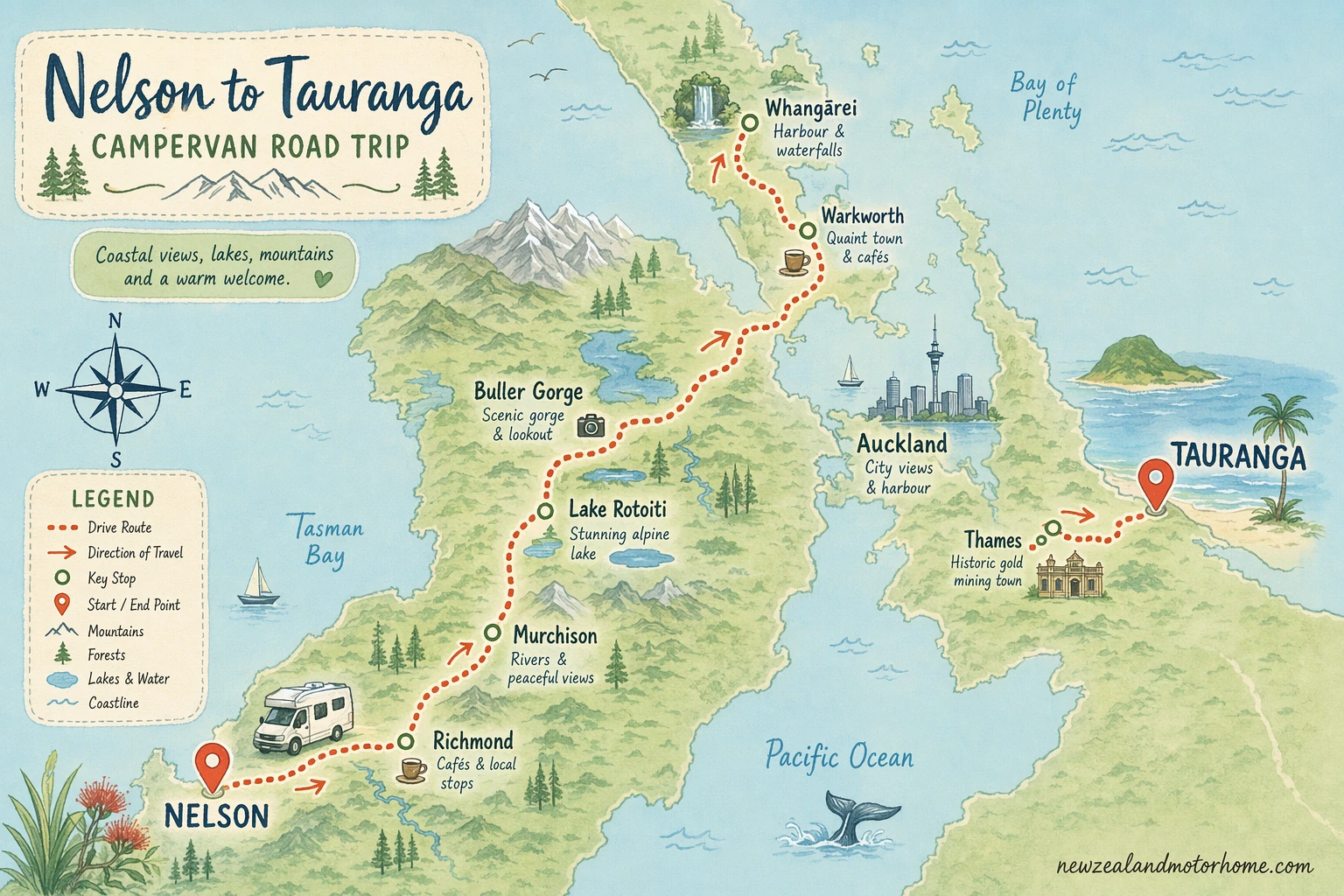
The Nelson to Tauranga drive is best treated as a 4 to 6 day motorhome route, not just a transfer. You can technically cover the distance faster, but ferry timing, supermarket stops, fresh-water fills and the slower rhythm of a campervan make a short schedule feel tight.
A comfortable Nelson to Tauranga motorhome road trip usually has one night near Picton or Wellington, one night around the lower North Island or Tongariro, and one night around Taupō or Rotorua before rolling into Tauranga. Add extra time if you want Abel Tasman, Marlborough Sounds, the Tongariro area or geothermal stops around Rotorua.
- Quick but workable: 3 long travel days, with little room for bad weather or ferry delays.
- Better pace: 4 to 5 days, with daylight arrivals and easier campsite check-ins.
- Scenic pace: 6 days or more, adding a rest day in Taupō, Rotorua or the Marlborough Sounds.
Leg 1: Nelson to Picton, with a calm first night
From Nelson, most campervans take SH6 through Havelock and on to Picton. It is a beautiful but bendy drive, with sections where a long or high-roof van should sit back, use slow-vehicle bays when safe, and avoid pulling into tiny gravel lay-bys unless there is a clear turning space.
Nelson is a useful place to start topped up: buy groceries, fill fresh water at an approved point if your campsite allows it, and empty the toilet cassette before leaving town. Picton has holiday parks and council-listed dump station options, which makes it a practical pre-ferry stop if your sailing is early the next morning.
- Overnight style: powered sites in Nelson, Havelock or Picton are easiest before the ferry.
- Freedom camping: check current council rules and only use legal sites if your van is certified self-contained.
- Van note: Queen Charlotte Drive is scenic but tighter and slower; SH6 is the simpler choice for larger motorhomes.
Cook Strait ferry planning for a campervan
The ferry is the hinge of this route, and it needs more planning in a motorhome than it does in a small car. When booking, use your actual vehicle length and height, include bike racks if fitted, and allow time to secure cupboards, gas bottles and loose items before boarding.
Arrive with fuel in the tank and the toilet cassette sorted, rather than assuming you can do everything at the terminal. Once you reach Wellington, city driving can feel busy after the South Island roads, so many van travellers either stay near the harbour, head north to a holiday park around the Kapiti Coast, or keep moving to a quieter stop beyond the commuter belt.
- Before sailing: close roof vents, latch drawers and switch off LPG as instructed.
- On arrival: expect tight lanes, wind exposure and urban traffic around Wellington.
- Overnight options: powered sites are useful after the crossing if batteries or devices need a reset.
Leg 2: Wellington to Taupō or Tongariro
From Wellington, the usual motorhome line north follows SH1 through the Kapiti Coast and Manawatū, then up towards the central plateau. This is a big driving day, so choose your stop based on weather and energy rather than forcing a fixed destination.
The Desert Road section can be stunning in clear weather and difficult in wind, rain, ice or snow. In winter, or whenever warnings are active, check conditions before committing; a tall campervan catches gusts more than you expect. If the forecast looks rough, break the trip earlier and continue in daylight.
- Good overnight areas: Kapiti, Whanganui, Palmerston North outskirts, National Park village, Turangi or Taupō.
- Services: use council-listed dump stations and fresh-water points in larger towns rather than leaving it late.
- Site choice: powered sites help if you have been running the heater, fridge and device charging heavily.
Leg 3: Taupō and Rotorua through to Tauranga
The final stretch gives you choices. Taupō to Rotorua is a natural campervan leg, with geothermal walks, lakeside stops and plenty of places to pause without squeezing the van into small city parks. From Rotorua, continue over to Tauranga and Mount Maunganui, allowing extra time for traffic around the urban edge.
Do not arrive in Tauranga assuming every beachside car park allows overnight stays. The Bay of Plenty has specific freedom camping rules, and they can vary by location and season. If your van is not certified self-contained, plan on a holiday park or campground; even if it is self-contained, check signage before settling in.
If you would like this route shaped around your ferry time, van size and preferred campsite style, use the soft planning step at talk to us and we can help you avoid awkward overnight gaps.
- Finish services: Tauranga and Mount Maunganui have fuel, LPG swap/fill options, supermarkets and dump station listings nearby.
- Parking the van: use larger signed car parks for beach walks and avoid height-restricted entrances.
- Best final night: a powered site is handy for repacking, cleaning tanks and getting ready for handover.
Common questions
Can I drive from Nelson to Tauranga in one day in a campervan?
No, not sensibly. The Cook Strait ferry alone makes it a multi-leg journey, and a campervan needs slower road speed, check-in time, fuel, water and dump-station stops. Plan at least 3 days, with 4 to 6 days far more comfortable.
Do I need to book the ferry for my motorhome in advance?
Yes, especially in summer, school holidays and around long weekends. Book using the full length and height of the campervan, including rear racks or roof fittings, so you are allocated the right vehicle space.
Is the route suitable for a large motorhome?
Yes, if you stick to the main highways and drive to the conditions. Avoid tight scenic shortcuts unless you are confident with narrow, winding roads, and be cautious on exposed sections such as the Desert Road in strong wind or winter weather.
Where should I empty the toilet cassette on this route?
Use official dump stations only, usually found through council or camping maps in places such as Nelson, Picton, Wellington or Porirua, Taupō, Rotorua and Tauranga. Do not leave it until the tank is full, as closures or awkward access can happen.
Can I freedom camp between Nelson and Tauranga?
Sometimes, but only where local rules allow it and generally only in a certified self-contained vehicle. Always read the signs at the actual parking area, as rules can change between districts and beachside areas are often more restricted.
Have a planner shape this for your dates
Send a short outline — your dates, party size, and the kind of trip you want. A planner replies with a vehicle recommendation, a paced route, and the realistic budget.