- Allow 5–8 days
- Best in spring to autumn
- Powered sites advised in main towns
- Certified self-contained needed for freedom camping
- Use SH1 for the easiest van route
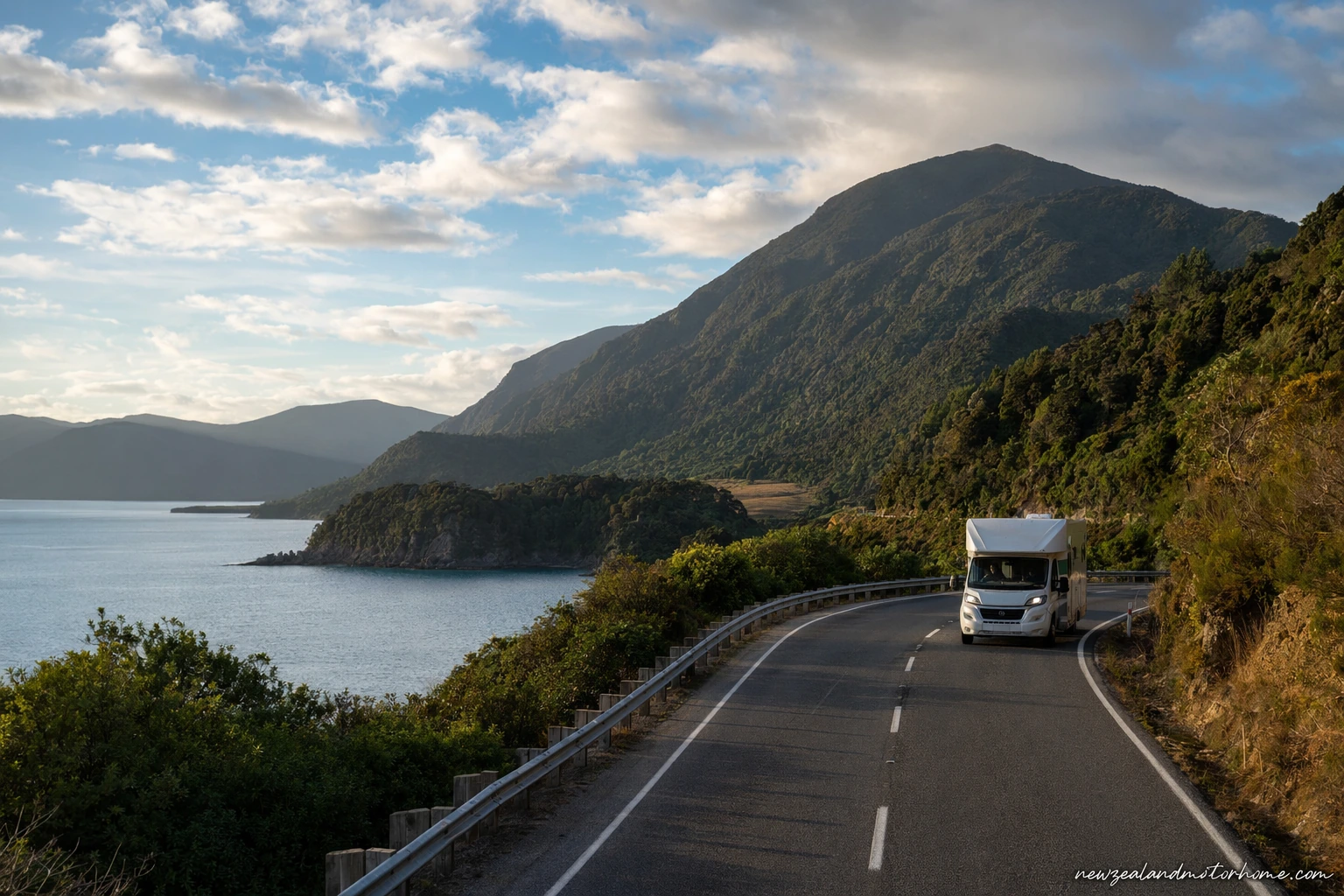
The Picton to Invercargill campervan route is a proper top-to-bottom South Island run: ferry-town harbour, Marlborough vines, Kaikōura coast, Canterbury plains, Otago stone towns and the long roll into Southland. It suits travellers who want steady driving days, reliable places to plug in, and enough time out of the cab to enjoy the sea air, old railway precincts and southern light.
This guide is written for self-drive campervan and motorhome travellers, not quick car touring. You’ll find practical notes on where to park the van, how to space your overnight stops, when to choose powered sites, where to think about dump stations and fresh water, and the road sections that need a little more patience in a longer vehicle.
How many days to allow for the Picton to Invercargill drive
The Picton to Invercargill drive is about distance management. You can drive it quickly, but in a campervan that usually means arriving tired, missing the best small-town stops, and relying too heavily on late check-ins. A comfortable pace is five to seven days, with eight or more if you want a rest day around Kaikōura, Ōamaru or Dunedin.
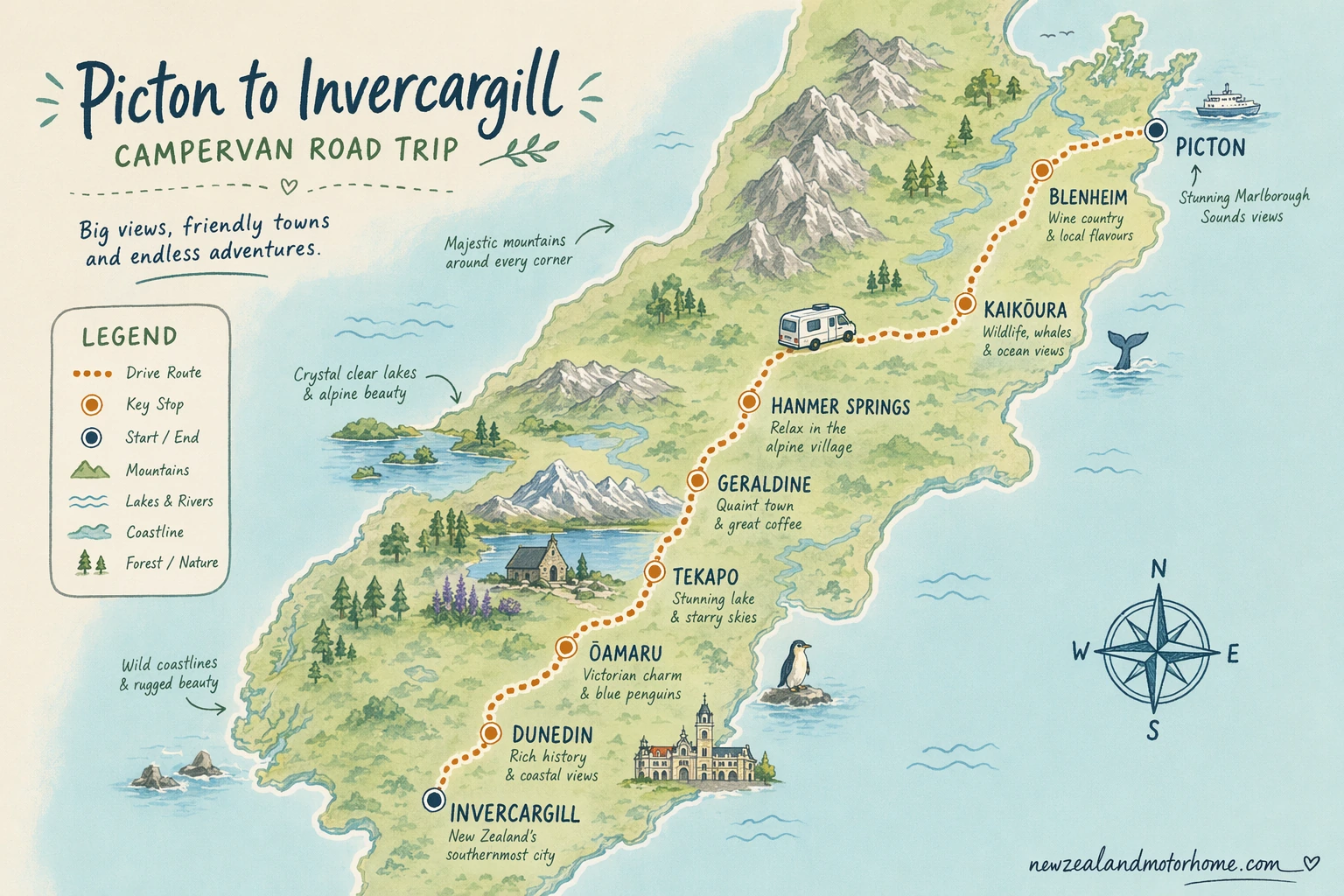
The most straightforward route follows State Highway 1 for much of the way: Picton, Blenheim, Kaikōura, Christchurch, Timaru, Ōamaru, Dunedin, Balclutha, Gore and Invercargill. It is a mostly van-friendly road, though the Kaikōura coast has tunnels, rail crossings, sea-wall sections and places where wind and spray can make you slow down.
- Fast but tiring: 4 days, using holiday parks or booked sites each night.
- Balanced: 6 days, with time for groceries, dump stations and short walks.
- Unhurried: 8–10 days, adding Banks Peninsula, the Otago Peninsula or the Catlins.
- Best approach: avoid planning a long driving leg immediately after the Cook Strait ferry in case of weather delays.
Leg 1: Picton to Kaikōura via Blenheim
Start by taking time in Picton to sort the van after the ferry: secure cupboards, check the gas is off if required, refill fresh water if your site allows it, and confirm your first night. Picton has holiday park options that suit a first powered night, useful if you have arrived late or want to fully charge devices and run the fridge on mains before heading south.
The road to Blenheim is easy-going, with fuel, supermarkets and LPG options in town before the more open coastal stretch. Longer motorhomes should park on the edge of town centres rather than trying to nose into tight main-street angle parks. From Blenheim, the road turns towards the coast and then follows a beautiful but more attentive line into Kaikōura.
Kaikōura is a good first or second overnight stop. Choose a holiday park if you need a dump station, showers, laundry and a powered site; use council-designated freedom camping only if your vehicle is certified self-contained and the signs specifically allow overnight stays. Coastal parking can be exposed, so check the forecast before choosing an unpowered seafront stop.
Leg 2: Kaikōura to Christchurch or Ashburton
South of Kaikōura, give yourself time. The coast road is scenic but not a place to rush a tall van: expect changing speed limits, narrow-feeling sections, tunnels and trucks. Pull into signed lookouts rather than stopping on shoulders, and use lower gears on descents if your motorhome is loaded with water and gear.
Christchurch works well as a practical reset. If you are carrying laundry, need groceries, want a powered site, or have to deal with a toilet cassette and grey water, a holiday park on the outskirts is usually simpler than trying to sleep in the central city. For sightseeing, park the campervan in larger public car parks or use public transport from your campground rather than threading through tight city streets.
If you prefer to keep moving, continue across the Canterbury Plains to Rakaia or Ashburton for a quieter overnight. This makes the next day to Ōamaru or Dunedin shorter, and it avoids arriving in a busy city at dusk. Watch for crosswinds on the plains, especially in high-sided motorhomes.
Leg 3: Canterbury to Ōamaru and Dunedin
The middle part of this Picton to Invercargill motorhome road trip is steady highway driving through Timaru, Waimate and Ōamaru. Timaru is handy for fuel, supermarkets and a general van tidy-up; Ōamaru is the more characterful overnight, with its Victorian precinct, harbour area and penguin viewing nearby. Park only where signs allow, especially near wildlife areas and the waterfront.
Ōamaru and Dunedin both have holiday park and public dump station options, but locations and access can change, so check current council information before committing your cassette and grey-water plan. If you are not staying in a serviced campground, make sure you still schedule a legal dump station and fresh-water fill every couple of days.
Between Ōamaru and Dunedin, the road is generally manageable for hired campervans, but take care around the hills and sharper bends near the coast. Dunedin itself is hilly and some suburban streets are steep, narrow or awkward for longer vehicles. Base yourself at a van-friendly campground, then explore by smaller local transport or on foot where possible.
Leg 4: Dunedin to Invercargill via Balclutha and Gore
The final run south feels different: wider skies, working farmland and fewer big service centres. The main highway through Balclutha and Gore is the simplest campervan line into Invercargill. It is far easier than detouring through remote coastal roads if you are short on time, low on fuel, or driving a larger motorhome in poor weather.
Balclutha and Gore are useful for fuel, groceries and a pause before the last push. Invercargill has the best range of services at the end of the route, including powered sites, supermarkets, LPG suppliers, fresh-water points and dump station options. Arrive with enough daylight to find your site, especially in winter when southern evenings close in early.
If you are adding the Catlins, treat it as a separate slower loop rather than a quick shortcut. The roads are sealed in many parts but can be winding, narrower and slower in a van, with limited services and patchy coverage. For a personalised day-by-day version of this route, you can talk to us before you lock in your overnight stops.
Overnight stops, freedom camping and van services
This route has enough infrastructure for a relaxed campervan trip, provided you do not leave every practical job until the tank lights are flashing. A sensible pattern is to book powered sites in Picton or Kaikōura, Christchurch or Ashburton, Ōamaru or Dunedin, and Invercargill, then use the odd unpowered or freedom camping night only where the local rules clearly allow it.
Freedom camping rules vary by council area and can change from one car park to the next. You’ll generally need a certified self-contained campervan, and even then you must follow the signs for time limits, vehicle type, and where overnight parking is allowed. Do not assume a beach car park or reserve is legal just because another van is there.
- Dump regularly: plan legal cassette and grey-water stops in larger towns such as Blenheim, Kaikōura, Christchurch, Timaru, Ōamaru, Dunedin, Gore and Invercargill.
- Refill fresh water: use campgrounds, signed public taps or approved fill points only, not random park taps.
- Manage LPG: top up in bigger centres rather than waiting until rural Southland.
- Choose powered sites: useful after cold nights, heavy fridge use, laundry days or several unpowered stops.
- Respect length limits: if a site lists a maximum vehicle length, take it seriously, especially in older holiday parks and compact coastal reserves.
Common questions
Is the Picton to Invercargill campervan route suitable for first-time motorhome drivers?
Yes, if you allow enough days and avoid night driving. The main highway route is generally suitable for hired campervans, but the Kaikōura coast, Dunedin hills and windy open plains deserve extra care in a tall vehicle.
How many overnight stops should I plan between Picton and Invercargill?
Most campervan travellers are happiest with four to six overnight stops. A practical sequence is Picton or Blenheim, Kaikōura, Christchurch or Ashburton, Ōamaru or Dunedin, then Invercargill.
Can I freedom camp the whole way from Picton to Invercargill?
It is not a good plan to rely only on freedom camping. Rules vary by district, many areas require a certified self-contained vehicle, and some popular coastal parks prohibit overnight stays. Mix legal freedom spots with powered campground nights for showers, laundry, battery charging and dump station access.
Do I need to book powered sites in advance?
In summer, school holidays and around events, booking is wise in Picton, Kaikōura, Christchurch, Dunedin and Invercargill. Outside peak times you may have more flexibility, but a quick same-day check saves stress if you are arriving late in a larger motorhome.
Is the Catlins a good add-on before Invercargill?
Yes, if you have extra time and are comfortable with slower, winding coastal roads. Do not treat the Catlins as a fast detour; plan fuel, water and overnight stops carefully, and check whether your chosen roads and sites suit your campervan length.
Have a planner shape this for your dates
Send a short outline — your dates, party size, and the kind of trip you want. A planner replies with a vehicle recommendation, a paced route, and the realistic budget.