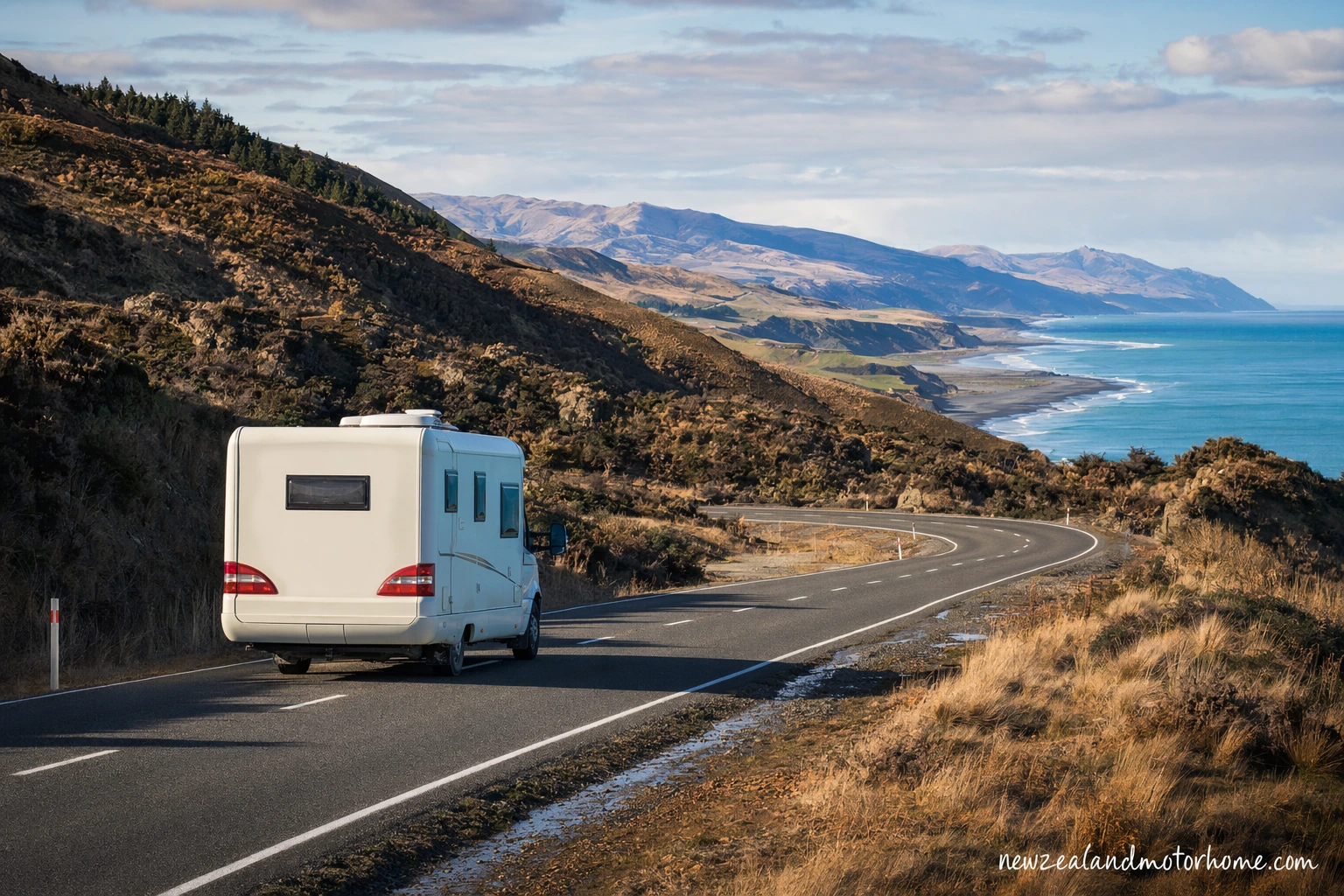
Queenstown to Napier campervan route: alpine roads to Hawke’s Bay
- Allow 6–9 days
- Includes Cook Strait ferry
- Best on main highways
- Powered sites useful in winter
- Self-contained rules apply
The Queenstown to Napier campervan route is a proper cross-country journey: lake country, high passes, Canterbury plains, the Kaikōura coast, a Cook Strait ferry crossing, then the long rural sweep through Wairarapa and into Hawke’s Bay. It is not a route to rush in a large motorhome, but it is a rewarding one if you break the driving into sensible legs.
This guide is written for self-drive van travellers — where to park the van overnight, when to book powered sites, how to think about fresh water and dump stations, and which roads deserve extra care in wind, snow or a longer vehicle. Use it as a practical framework for your Queenstown to Napier motorhome road trip, then adjust the pace for weather, ferry timing and how long you want to linger by the lakes or sea.
How long to allow for the Queenstown to Napier drive
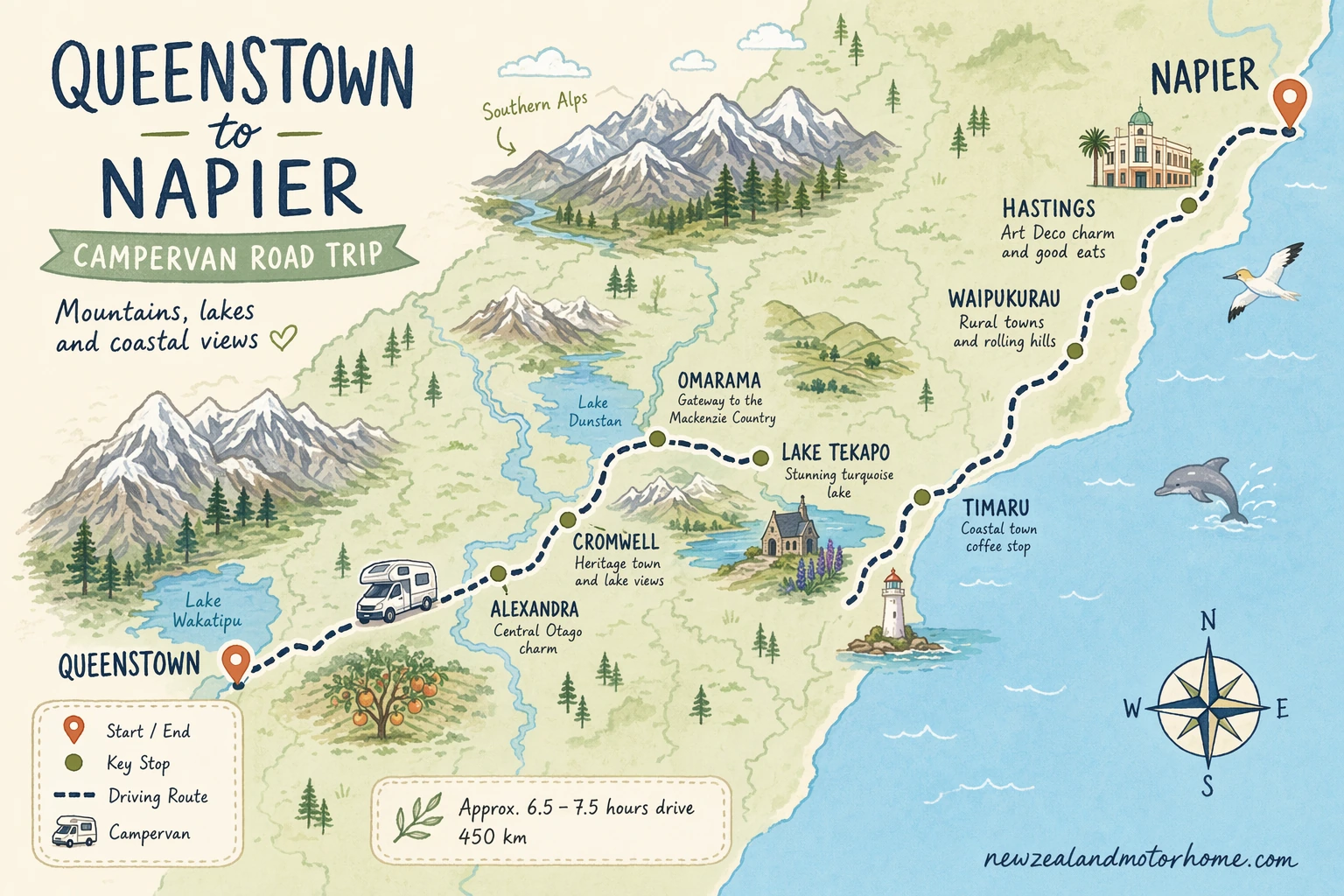
The direct Queenstown to Napier drive is a big one because it includes most of the South Island, the Cook Strait ferry, and a long final push across the lower North Island. In a campervan, allow at least six days if you mainly want to keep moving. Seven to nine days feels much better, especially if you want powered-site nights, laundry stops and time to walk somewhere without worrying about your next check-in.
A realistic route runs Queenstown to Cromwell or Twizel, then Tekapo or Geraldine, Christchurch or Kaikōura, Blenheim or Picton, Wellington, Wairarapa, and Napier. The exact overnight pattern depends on ferry availability and whether you prefer holiday parks, low-cost council sites or certified self-contained freedom camping where permitted.
- Fast but manageable: 6 days, with longer driving days and pre-booked ferry timing.
- Comfortable campervan pace: 7–9 days, with shorter legs and room for weather delays.
- Best for larger motorhomes: 8+ days, avoiding late arrivals, night driving and rushed hill roads.
- Key booking point: the Cook Strait ferry needs your vehicle length and height, including bike racks or roof boxes.
Queenstown to Mackenzie Country: lakes, passes and first-night options
From Queenstown, the most straightforward motorhome line heads via SH6 through the Kawarau Gorge to Cromwell, then over the Lindis Pass towards Ōmarama, Twizel and Lake Tekapo. This is a far more sensible choice for most hired campervans than cutting over the Crown Range, particularly in winter or in a longer vehicle.
Fill fuel, top up drinking water and check LPG before you leave the Queenstown basin or at Cromwell, because services thin out once you head into the high country. The Lindis Pass is wide enough for motorhomes but exposed; in winter, check road conditions before committing, carry chains if your hire agreement requires them, and do not pull into soft shoulders for photos.
- Good first stops: Cromwell for an easy shakedown night, or Twizel/Lake Tekapo if you are ready for a longer day.
- Powered sites: useful here in colder months, when heater use and battery charging matter.
- Freedom camping: only use signed, legal areas and only if your van is certified self-contained; Mackenzie District is closely managed.
- Van parking tip: use marked lakefront and town parking rather than squeezing into small roadside viewpoints.
Across Canterbury to the Kaikōura coast
From Tekapo or Twizel, most vans drop through Fairlie and Geraldine before joining the Canterbury plains. This is easier driving than the alpine section, but it can be tiring in crosswinds and bright sun, especially in a high-sided motorhome. Christchurch makes a practical services stop if you need supermarket supplies, a dump station, laundry or a powered night before heading north.
Beyond Christchurch, the route follows SH1 towards Kaikōura and Blenheim. The Kaikōura coast is one of the memorable sections of the trip, with sea on one side and steep country on the other, but it is not a place to hurry. Expect tunnels, narrow-feeling sections, occasional roadworks and plenty of slow vehicles.
- Overnight choices: Geraldine, Christchurch, Kaikōura or Blenheim all work well for campervan spacing.
- Dump stations: plan to empty at official facilities in larger towns or holiday parks rather than waiting until the cassette is urgent.
- Parking the van: in Kaikōura, use signed town or beach parking and avoid blocking boat ramps, beach access or resident driveways.
- Road note: keep left, use slow-vehicle bays, and give yourself extra braking distance on the coastal highway.
Picton ferry logistics for campervans and motorhomes
Picton is the hinge point of this route. Book the Cook Strait ferry early in busy periods and enter your campervan’s full length and height accurately, including rear bike racks, ladders, roof vents or storage pods. Arrive with time to spare; ferry check-in is not the moment to be hunting for LPG, repacking cupboards or dealing with a full grey-water tank.
Before boarding, secure loose items inside the van, close roof vents, switch off appliances as instructed, and follow the operator’s rules around LPG cylinders. Many travellers choose to overnight near Blenheim or Picton the night before sailing rather than drive in from Kaikōura on the same morning.
- Pre-ferry jobs: dump grey and black water, refill fresh water if needed, fuel up, and charge devices.
- Best timing: avoid booking a tight same-day connection from a distant South Island stop.
- Picton parking: use signed long-vehicle areas where available; do not assume a standard town car park will fit a motorhome.
- If plans feel tight: ask us to help shape the timing via talk to us, especially if ferry space or van size is the constraint.
Wellington to Napier: Wairarapa roads and Hawke’s Bay arrival
Once off the ferry in Wellington, resist the urge to bolt straight for Napier unless you have allowed a full, unhurried day and the weather is settled. The common campervan route takes SH2 over the Remutaka Hill into Wairarapa, then north through Masterton, Pahiatua, Dannevirke, Waipukurau and Hastings before reaching Napier.
The Remutaka Hill is a proper winding road with tight bends, speed changes and strong-wind potential. It is manageable in a motorhome if you take it slowly, but nervous drivers may prefer to overnight in Wellington or Upper Hutt and tackle it fresh. If there are severe wind warnings, consider waiting or taking a longer alternative via Kāpiti and the Manawatū.
Napier itself is campervan-friendly if you arrive with a plan. Book a holiday park or legal site if you want to walk the waterfront and leave the van settled; freedom camping rules in Hawke’s Bay are specific and enforced, so check current council maps before stopping overnight.
- Useful final overnights: Wellington/Upper Hutt, Greytown/Masterton, or Waipukurau before Napier.
- Services: dump stations and fresh-water fills are easier in larger towns than on rural stretches of SH2.
- Powered vs unpowered: choose powered after the ferry if your batteries have worked hard on fridge, lights and device charging.
- Arrival tip: park the van once in Napier and explore the waterfront and Art Deco centre on foot or by bike.
Keep planning
Visiting skyline queenstown gondola by campervan
Read onHoliday parks queenstown skyline
Read onHoliday parks queenstown lakes
Read onHoliday parks queenstown
Read onHoliday parks napier art deco
Read onHoliday parks napier
Read onCommon questions
Can you drive Queenstown to Napier in a campervan in one or two days?
It is not realistic or safe to treat this as a one- or two-day campervan run, especially with the ferry crossing. Allow at least six days, and more if you want relaxed overnights, legal dumping and time to deal with weather.
Is the Queenstown to Napier route suitable for a large motorhome?
Yes, if you stay on the main highways, drive to the conditions and avoid unnecessary shortcuts such as alpine side roads in poor weather. The Lindis Pass, Kaikōura coast and Remutaka Hill all need patience in a longer or high-sided vehicle.
Where should we book powered sites on this route?
Powered nights are most useful around Tekapo or Twizel in colder weather, Christchurch or Kaikōura for laundry and recharging, and Wellington or Wairarapa after the ferry. Mix these with legal unpowered or freedom camping only if your van’s battery, water and toilet capacity suit it.
Do we need a certified self-contained campervan for freedom camping?
Yes. Freedom camping areas generally require a properly certified self-contained vehicle, and local councils set their own rules about where you may stay. Always check current signage and council maps before settling in for the night.
What is the hardest section of the Queenstown to Napier motorhome road trip?
Most drivers notice three demanding sections: the Lindis Pass in winter, the Kaikōura coast in wind or roadworks, and the Remutaka Hill north of Wellington. None need to be rushed; plan shorter days around them and avoid driving after dark.
How should we manage dump stations and fresh water?
Do not wait until tanks are full or empty. Build service stops into bigger towns such as Cromwell, Twizel or Tekapo, Christchurch, Kaikōura, Blenheim or Picton, Wellington, Masterton and Napier, using official dump stations or holiday park facilities.
Have a planner shape this for your dates
Send a short outline — your dates, party size, and the kind of trip you want. A planner replies with a vehicle recommendation, a paced route, and the realistic budget.