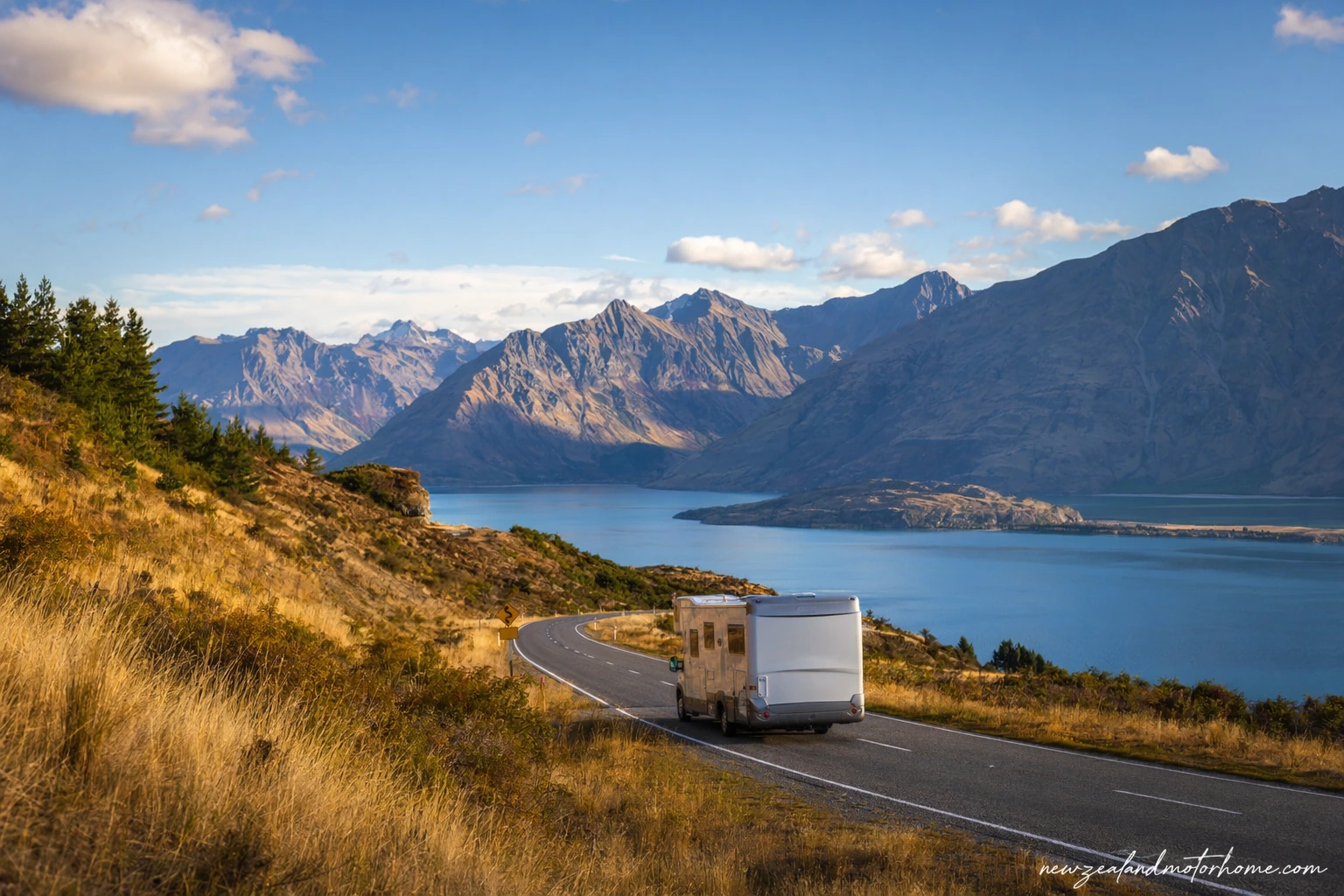
- Allow 5–7 days
- SH6 via West Coast, about 870 km
- Best Oct–Apr; winter needs care
- Powered, unpowered and approved freedom options
- Long vans: use Blenheim approach to Picton
The queenstown to picton campervan route is one of the South Island’s big, satisfying drives: alpine lakes out of Queenstown, the Haast Pass, rainforest and glaciers, the Buller Gorge, then vineyard country and the Marlborough Sounds.
This guide is written for people driving and sleeping in their hired van, not just passing through by car. You’ll find sensible daily legs, where to aim for powered or unpowered nights, road notes for longer motorhomes, and the practical stuff that matters before you roll into Picton: dump stations, fresh water, LPG, and ferry-ready parking.
How many days to allow, and the best overall line
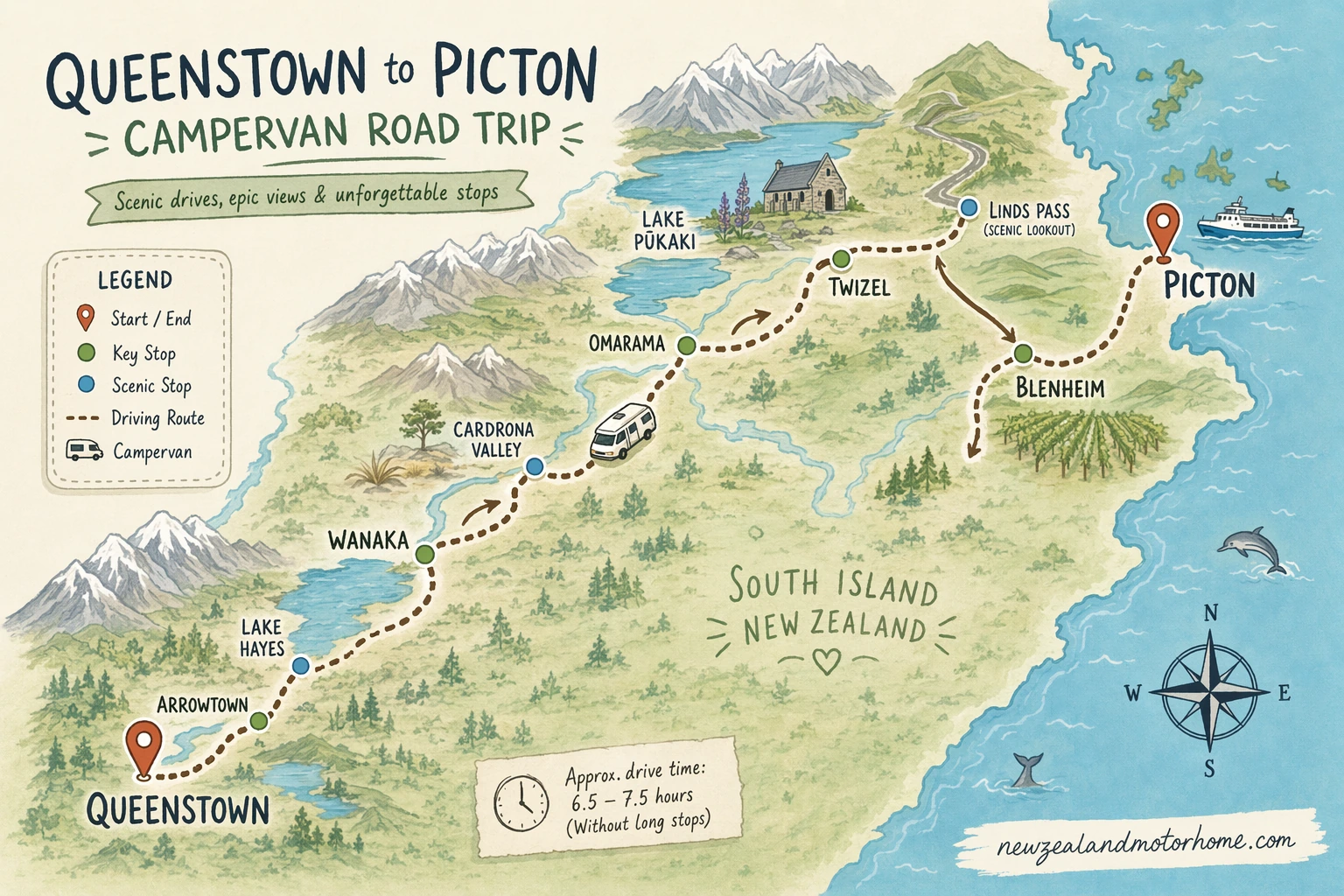
The most rewarding queenstown to picton drive for a campervan follows SH6: Queenstown, Wānaka, Haast, the West Coast, Murchison, Nelson or Blenheim, then Picton. It is not the shortest line on a map, but it is a natural motorhome road trip because the overnight stops are well spaced and you avoid threading a large van through Christchurch traffic.
You can push through in three long days, but five to seven days is far kinder. That gives you time to arrive at campsites before dark, plug into power every few nights, and use dump stations without turning the day into a chore.
- 3 days: possible, but mostly driving and weather-dependent.
- 5 days: a practical pace with Wānaka, glacier country, and Nelson Lakes or Murchison.
- 7+ days: best for short walks, restocking, laundry, and a relaxed final night near Picton.
If you are still choosing between the West Coast and the faster east-coast line, you can talk to us before locking in your overnight stops.
Queenstown to Wānaka or Makarora: leave the basin with a plan
Leaving Queenstown in a campervan is easiest if you shop, fill fresh water, and empty grey water before you climb out of town. Supermarket car parks can be tight in peak season, so use the larger outer parking areas where you can swing the van without blocking cars.
There are two main ways to Wānaka. The Crown Range is spectacular but steep, winding, and exposed in winter; it is not the relaxed choice for a first day in a long motorhome. The Kawarau Gorge route via Cromwell is longer, generally easier on the van, and gives you more room to settle into left-side driving.
- Good first nights: Queenstown holiday parks if you arrive late, Wānaka for powered sites and laundry, Lake Hāwea for a quieter stop, or Makarora if you want to be close to the Haast Pass.
- Practical chores: use Queenstown or Wānaka for fuel, LPG bottle swaps, groceries, potable water, and dump station access.
- Van note: take pull-outs early on lake roads; locals and smaller vehicles may sit behind a high-roof van through the bends.
Haast Pass to glacier country: slow roads, big scenery
From Makarora the road climbs through beech forest and waterfalls before dropping to Haast. This is a beautiful section, but it asks for patience in a campervan: corners tighten quickly, rain can be heavy, and mobile coverage is patchy. Start with fuel in the tank and do not leave the pass for late evening.
Between Haast, Fox Glacier, Franz Josef, and Hokitika, the West Coast rewards short driving days. Many travellers on a queenstown to picton motorhome road trip use this stretch for a mix of powered holiday park nights and simpler unpowered sites, especially after a wet day when heating, charging, and drying gear matter.
- Overnight rhythm: Haast or Ōkārito for a quieter night, Fox or Franz Josef for easy services, Hokitika for a beachside town stop.
- Dump and water: look for public dump stations and holiday park facilities in the main West Coast townships; do not assume smaller scenic stops have them.
- Road note: one-lane bridges are common. Slow early, read the give-way signs, and avoid stopping the van on bridge approaches for photos.
Hokitika, Punakaiki and the Buller Gorge to Murchison
North of Hokitika, the road through Greymouth, Punakaiki and the Buller Gorge is classic campervan country: coastal lookouts, rainforest, river valleys, and enough small towns to keep the van topped up. Car parks at popular stops can fill fast, so arrive early or be ready to continue to the next pull-off rather than squeezing a 7-metre van into a car-sized gap.
If you have time, split this leg with a night near Punakaiki, Westport, Reefton, or Murchison. Powered sites are useful here after several nights of freedom or DOC-style camping, especially if your house battery has had cloudy West Coast days.
- Parking the van: use signed long-vehicle spaces where provided at busy walks and coastal viewpoints.
- Services: Greymouth and Westport are sensible places for fuel, groceries, laundries, LPG, potable water, and dump station planning.
- Driving: the Buller Gorge is sealed and manageable, but it is bendy; keep speed down and let faster traffic past at safe pull-outs.
Murchison to Picton: Nelson, Blenheim and the final approach
From Murchison you can aim for Nelson, continue towards Blenheim, or break the trip around Nelson Lakes if you want one more mountain night. For larger motorhomes, the main highway line via Richmond, Nelson’s outskirts, and Blenheim is usually less stressful than taking every scenic side road.
Queen Charlotte Drive between Havelock and Picton is gorgeous, but it is narrow, winding, and slow in a high-sided van. Confident drivers in shorter campervans may enjoy it in settled weather; if you are tired, towing, or driving a longer motorhome, the Blenheim approach to Picton is the calmer finish.
- Final night: Picton holiday parks are useful if you want power, showers, laundry, and an easy pack-up before a ferry sailing.
- Before Picton: Blenheim and Picton are your key places for fuel, supermarket top-ups, water, LPG, and dumping grey and black water.
- Ferry-ready: know your vehicle length and height, fold in mirrors where instructed, and keep gas bottles turned off for the crossing if required by your operator.
Freedom camping, self-containment and weather timing
Freedom camping rules change by district, and the Queenstown to Picton campervan route crosses several councils. Only use places where overnight stays are clearly permitted for your vehicle type, and check whether the sign requires a certified self-contained vehicle. A toilet on board does not automatically mean your van meets the current certification requirements.
Weather matters on this route. The Haast Pass and West Coast can get heavy rain, slips, and temporary delays; winter adds ice risk around Queenstown, Wānaka, and higher inland sections. Build a spare half-day into your plan if you have a ferry booking from Picton.
- Best habit: dump before you are full, refill before you are empty, and arrive at overnight spots with daylight left.
- Freedom camping: read local signage on the day, not an old app listing alone.
- Van comfort: alternate unpowered scenic nights with powered sites for heating, batteries, laundry, and device charging.
Keep planning
Visiting skyline queenstown gondola by campervan
Read onHoliday parks queenstown skyline
Read onHoliday parks queenstown lakes
Read onHoliday parks queenstown
Read onHoliday parks picton
Read onFarmers markets queenstown lakes
Read onCommon questions
How long is the Queenstown to Picton drive in a campervan?
Via SH6 and the West Coast, allow roughly 870 kilometres, depending on side trips and overnight stops. In a campervan, think in days rather than hours: five to seven days gives you a much safer and more enjoyable pace.
Can I drive from Queenstown to Picton in two or three days?
Three days is possible for experienced van drivers, but it leaves little room for weather, slow traffic, dump stations, or sightseeing. Two days is not a good plan for most campervan travellers, especially if you need to reach a booked ferry.
Is the Crown Range suitable for a motorhome?
The Crown Range is sealed but steep, narrow in places, and exposed to winter conditions. If you are in a larger motorhome, new to driving in New Zealand, or travelling in cold weather, the Kawarau Gorge route via Cromwell is usually the easier choice.
Do I need a self-contained campervan for this route?
You do not need self-containment to stay in holiday parks, but it gives you more flexibility for approved freedom camping and some low-cost sites. Always check current local rules and signage, because requirements differ between districts.
Where should I empty tanks before arriving in Picton?
Plan to use dump stations in larger towns such as Wānaka, Hokitika, Greymouth, Westport, Murchison, Blenheim, or Picton, depending on your timing. Do not leave grey or black water until the final hour before a ferry, as queues and opening access can affect your day.
Should I take Queen Charlotte Drive into Picton?
Queen Charlotte Drive is scenic but tight and winding, so it suits confident drivers in shorter vans more than nervous drivers in long motorhomes. If you want an easier final approach, continue via Blenheim and arrive in Picton on the main road.
Have a planner shape this for your dates
Send a short outline — your dates, party size, and the kind of trip you want. A planner replies with a vehicle recommendation, a paced route, and the realistic budget.