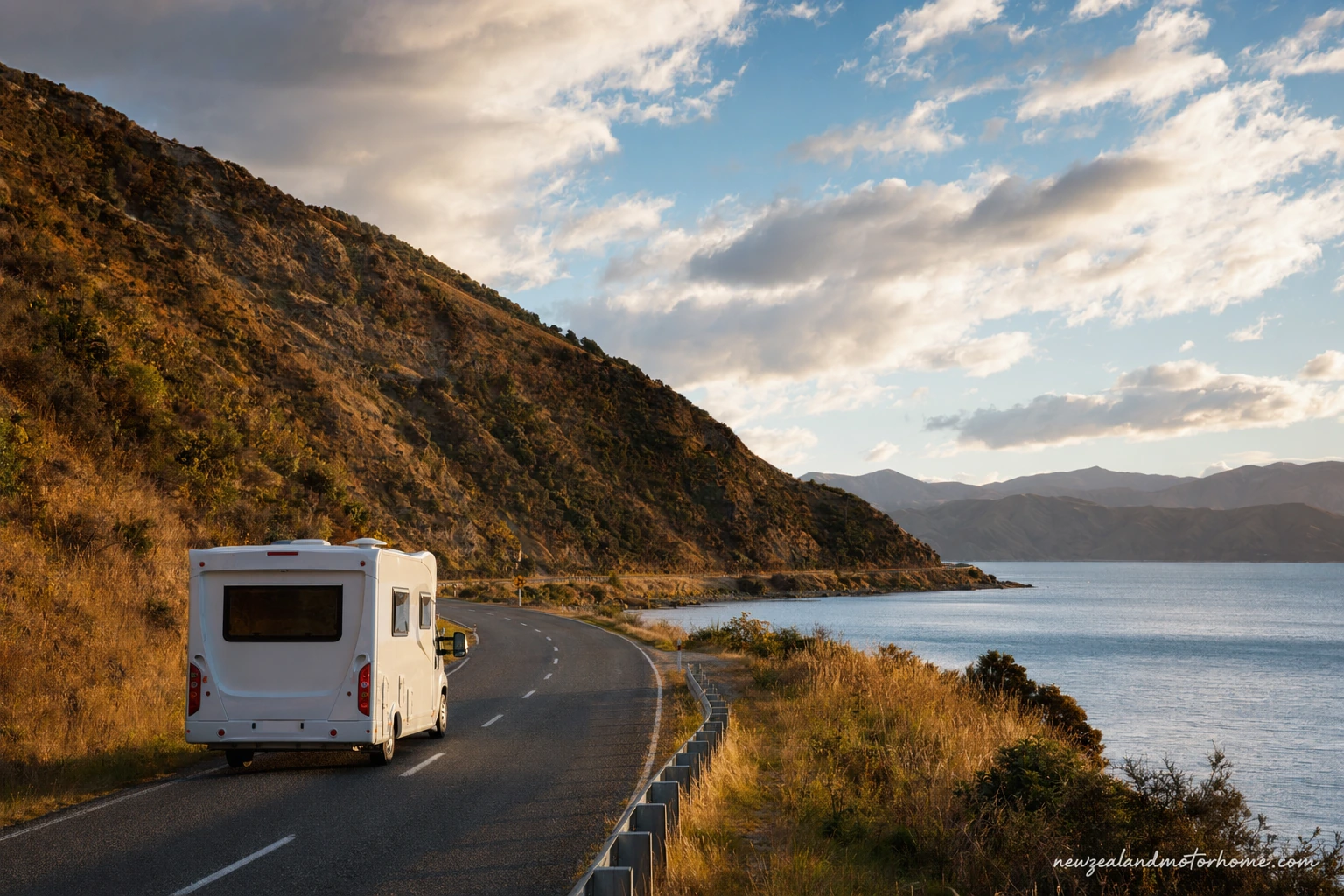
Queenstown to Wellington campervan route: alpine lakes to the ferry
- Allow 5–9 days
- Best route via SH6, SH8 and SH1
- Book the Cook Strait ferry
- Powered sites useful in cold months
- Check self-containment rules
The queenstown to wellington campervan trip is one of those routes where the drive matters as much as the destination: high-country passes, glacial lakes, coastal seal colonies, Marlborough vineyards, then the Cook Strait ferry into the capital. It is a proper point-to-point motorhome journey, not a one-day dash, and it rewards travellers who build in time for weather, roadworks and unhurried overnight stops.
This guide is written for people driving and sleeping in their own hired van. You will find practical notes on where to break the queenstown to wellington drive, which roads suit larger motorhomes, how to think about powered versus unpowered nights, and what to sort before rolling onto the ferry at Picton.
How many days to allow and the best overall route
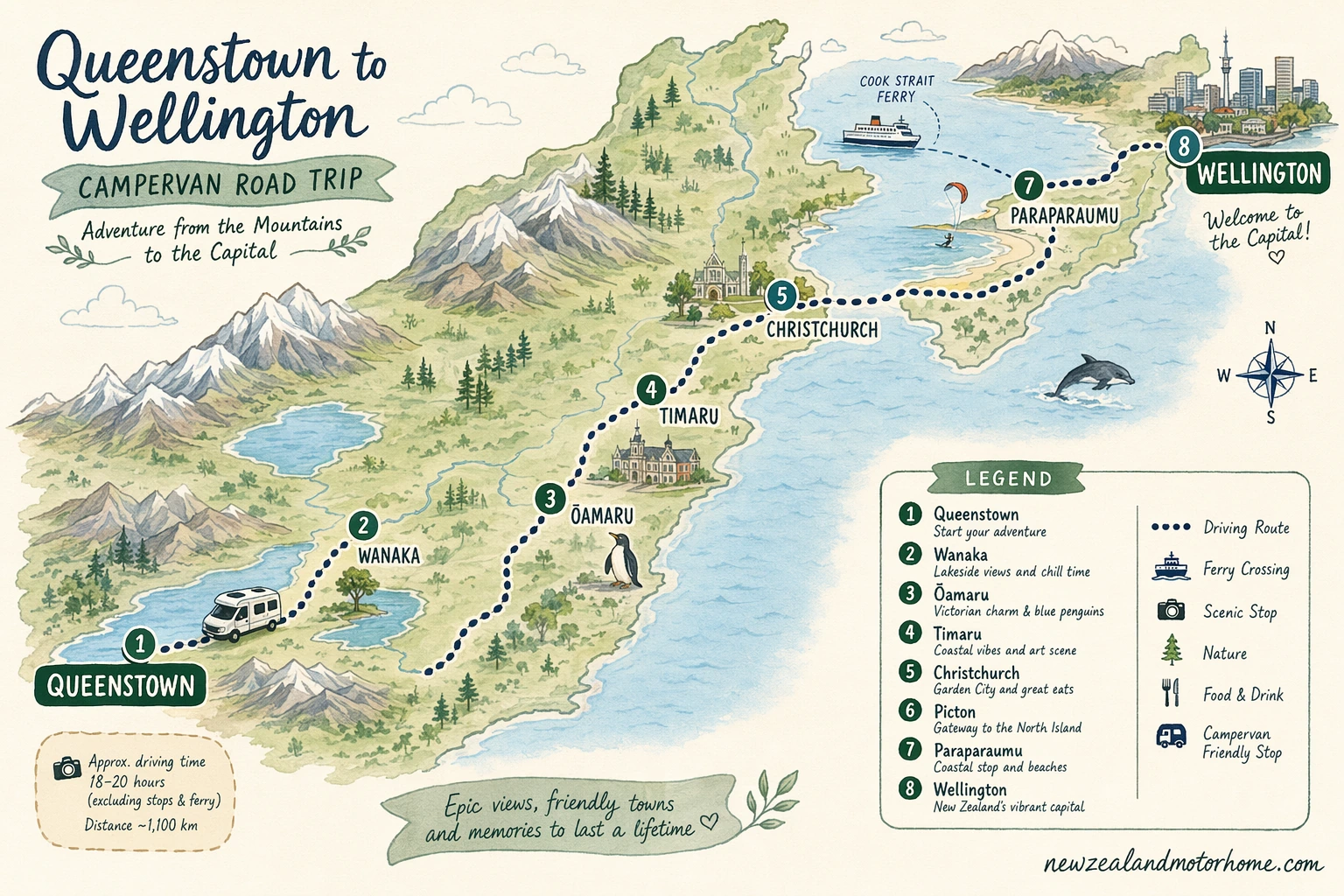
Allow at least 5 days for a queenstown to wellington campervan run, and 7 to 9 days if you want the route to feel like a holiday rather than a relocation. The most straightforward motorhome route is Queenstown to Cromwell, over the Lindis Pass to the Mackenzie Basin, then north via Canterbury and the Kaikōura coast to Picton for the ferry.
That routing keeps you mainly on state highways used by trucks and larger vehicles, which is helpful if you are in a 6-berth motorhome or travelling with bikes on the back. The alternative through the West Coast is beautiful but longer, wetter, and more demanding on time; keep that for a separate loop unless you have a generous schedule.
- Suggested minimum: Queenstown, Mackenzie Country, Kaikōura, Picton, Wellington.
- Comfortable pace: Add Wānaka or Cromwell, Ōamaru or Timaru, and a spare night in Marlborough.
- Ferry buffer: Sleep near Picton the night before sailing if your crossing is early or if winter weather is unsettled.
Leg 1: Queenstown to Cromwell, Wānaka or the Mackenzie Basin
From Queenstown, the easiest van-friendly exit is usually via SH6 through the Kawarau Gorge to Cromwell. The gorge is narrow in places but well used by motorhomes; take it steadily, use pull-outs for faster traffic, and avoid last-minute stops for photos where the shoulder disappears. Larger vans are generally better off using this route rather than the Crown Range Road, especially in winter.
Cromwell makes a practical first break if you are getting used to the van, topping up food, or checking your fresh-water and LPG levels before the more open high-country section. Wānaka is a scenic detour with good holiday park options, but parking can be tight near the lakefront in peak season, so arrive early and use marked oversized vehicle spaces where provided.
- Overnight ideas: Queenstown or Frankton holiday parks for a first powered night; Cromwell or Wānaka holiday parks for easier access to supermarkets and dump stations; DOC-style or basic unpowered sites only where your van and the local rules allow.
- Road note: The Lindis Pass on SH8 is sealed and scenic, but exposed. In winter, check road conditions before leaving and carry chains if your hire agreement or conditions require them.
- Van jobs: Empty grey and black water before heading into remote areas, refill fresh water, and check diesel range before the pass.
Leg 2: Mackenzie Country to Canterbury and the Kaikōura coast
The Mackenzie Basin is a highlight of any queenstown to wellington motorhome road trip. Lake Pukaki, Aoraki/Mount Cook viewpoints and Lake Tekapo all suit slow travel, but wind can be fierce across open parking areas. Park nose-to-wind where you can, secure roof vents before walking away, and be careful opening large side doors in gusts.
Tekapo, Twizel, Geraldine, Timaru and Ōamaru all work as overnight options depending on how far you want to push. Holiday parks are the easiest choice if you need powered heating, laundry, hot showers and a dump station. Freedom camping rules vary between districts, and many lakefront or town-centre areas are restricted, so use only signed areas that match your vehicle’s self-containment certification.
North of Canterbury, SH1 along the Kaikōura coast is sealed and spectacular, with rail, sea and cliff squeezed close together. It can also be slow after slips or roadworks, so do not plan this stretch too tightly before a ferry booking.
- Good driving rhythm: Mackenzie Basin to Geraldine or Timaru, then a separate day to Kaikōura.
- Parking the van: Use long-vehicle bays at lake viewpoints where available, and avoid blocking boat ramps or farm gates.
- Facilities: Look for public dump stations and potable water in larger service towns; smaller scenic stops may have toilets but no motorhome servicing.
Leg 3: Kaikōura to Picton, then the Cook Strait ferry
Kaikōura is a sensible last South Island coastal stop, with van-friendly holiday parks and town services close to SH1. If you are in a longer motorhome, park on the flatter signed areas rather than squeezing into small beachfront side streets. The peninsula roads are worth a look, but take care with tight turnarounds and pedestrians near seal viewing areas.
From Kaikōura to Picton, allow more time than the kilometres suggest. The road rolls through the Hundalees, Blenheim and Marlborough before dropping into Picton, and it is better to arrive with daylight to spare than to rush into the ferry queue tired. Blenheim is a useful place for groceries, fuel, LPG bottle swaps or refills where available, and a final dump-station stop.
For the ferry, book using your motorhome’s full length and height, including bike racks, roof boxes and anything mounted on the rear. Turn off LPG at the bottle before boarding if instructed, secure cupboards and fridge contents, and keep essentials with you because you will not normally access the vehicle deck during the crossing.
- Best overnight before sailing: Picton or Blenheim, especially for morning ferries.
- Before check-in: Dump waste, top fresh water only if needed, check fuel, and stow loose items.
- Timing: Build in a weather buffer; Cook Strait sailings can be delayed in strong wind or rough seas.
Arriving in Wellington with a campervan
Wellington is compact, hilly and windy, so treat arrival day as a city-driving day rather than a touring day. From the ferry terminal, follow the signed routes and avoid diving into narrow residential streets with a large van. If your accommodation is outside the CBD, the Hutt Valley or Porirua sides can be easier for longer vehicles than tight central parking.
Do not assume you can sleep in any waterfront or suburban car park. Wellington and surrounding councils have specific freedom camping rules, and enforcement is active in popular areas. A booked holiday park or approved campervan site is the low-stress option if you want to plug in, use showers, empty tanks and explore the city without worrying about the van overnight.
- City parking: Check height limits before entering car parks; many covered buildings will not suit high-top campervans or motorhomes.
- Wind note: Take extra care opening doors and parking on exposed hill roads or harbourfront areas.
- Plan help: If you want a route paced around your ferry time, van size and preferred campsite style, use the soft planning step at /talk-to-us/ before locking in nights.
Powered sites, freedom camping, dump stations and road checks
A good pattern for this route is to mix powered holiday park nights with a few approved unpowered stops. Powered sites are useful in Queenstown, the Mackenzie Basin and Wellington when nights are cold, batteries are low, or you need laundry and longer showers. Unpowered sites can work well in settled weather if your house battery, water supply and self-containment set-up are in good order.
Dump stations are commonly found in larger towns and many holiday parks, but do not leave emptying tanks until they are full. On a northbound route, think of Queenstown or Frankton, Cromwell or Wānaka, Twizel or Tekapo, Geraldine or Timaru, Kaikōura, Blenheim or Picton, then Wellington as your servicing chain. Always use designated dump points only, and keep a separate hose or container system for fresh water.
Before each driving day, check NZTA road updates, weather, and any local camping restrictions for the district you are entering. Snow, wind, slips and holiday traffic can all change the feel of the queenstown to wellington drive, particularly around the Lindis Pass, the Mackenzie Basin, the Kaikōura coast and Cook Strait.
- Self-containment: Carry proof of certification and follow the newer rules for certified self-contained vehicles.
- LPG: Refill or swap in larger towns; do not rely on small scenic villages for gas.
- Water: Fill fresh water at signed potable taps only, and avoid topping up from untreated sources.
- Vehicle size: Know your height, width and total length before ferries, bridges, car parks and tight supermarket lots.
Keep planning
Visiting zealandia wellington by campervan
Read onVisiting weta workshop wellington by campervan
Read onVisiting te papa wellington by campervan
Read onVisiting skyline queenstown gondola by campervan
Read onHoliday parks wellington
Read onHoliday parks queenstown skyline
Read onCommon questions
Can you drive Queenstown to Wellington in a campervan in one day?
No, not realistically or safely. The distance, the Cook Strait ferry and variable road conditions make it a multi-day route for a campervan. Plan at least 5 days, with more time if you want to stop in the Mackenzie Basin, Kaikōura and Marlborough.
Is the Crown Range Road suitable for a motorhome on this route?
Smaller campervans may use it in good conditions, but many travellers in larger motorhomes will find the SH6 route through the Kawarau Gorge and Cromwell more comfortable. In winter, the Crown Range can have snow, ice and chain requirements, so check your hire conditions and road updates first.
Where should I stay before the Picton to Wellington ferry?
Picton is the simplest option if you have an early sailing, while Blenheim gives you easy access to fuel, groceries and motorhome servicing before driving to the terminal. Book ahead in busy periods and allow time for ferry check-in with a larger vehicle.
Can I freedom camp between Queenstown and Wellington?
Sometimes, but only in areas where local rules allow it and only if your vehicle meets the required self-containment standard. Many lakefront, town-centre and coastal spots are restricted, so check current council signage or official camping maps before settling in for the night.
Do I need to book powered sites in advance?
In summer, school holidays and ski season around Queenstown, Wānaka and Tekapo, booking powered sites is wise. Outside peak periods you may have more flexibility, but Wellington and Picton can still fill around ferry times and events.
What should I know about taking a campervan on the Cook Strait ferry?
Book the correct vehicle length and height, including rear racks and roof gear. Arrive early, follow staff instructions, turn off LPG if required, and take valuables, warm layers and medication with you because access to the vehicle deck is usually restricted during the sailing.
Have a planner shape this for your dates
Send a short outline — your dates, party size, and the kind of trip you want. A planner replies with a vehicle recommendation, a paced route, and the realistic budget.