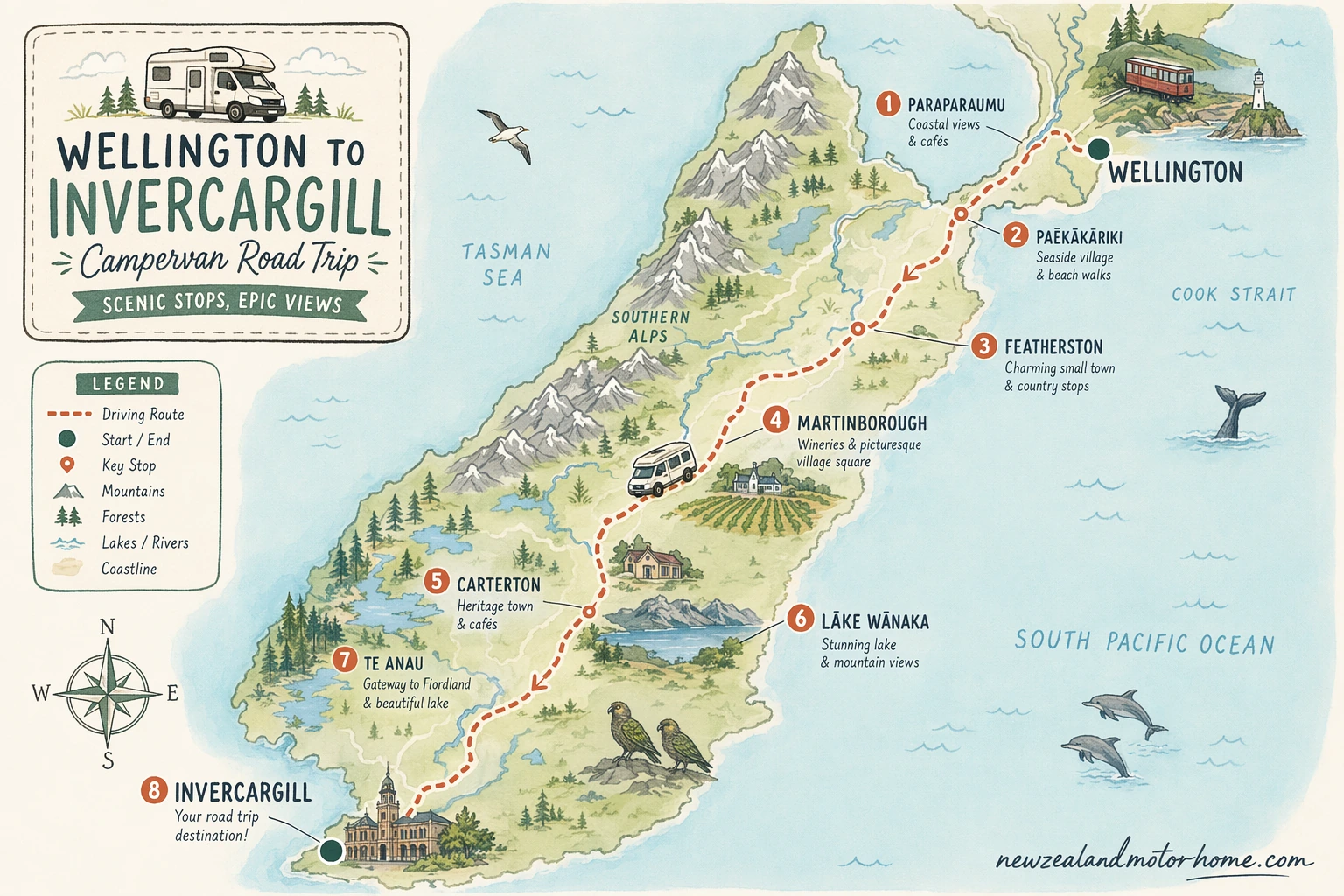
Wellington to Invercargill campervan route: ferry, coast and southern plains
- Best allowed time: 6 to 8 days
- Includes Cook Strait ferry
- Sealed main route via SH1
- Powered resets in main cities
- Self-contained only for freedom camping
A Wellington to Invercargill campervan trip is a proper north-to-south run: harbour city, Cook Strait, Marlborough, the Kaikōura coast, Canterbury plains, Otago harbour and the wide southern roads into Southland. It is not a route to rush in a big van, especially with a ferry crossing and several towns where parking height, wind and one-way streets matter.
This guide is written for travellers driving and sleeping in a hired campervan or motorhome. You will find a sensible day-by-day shape, where powered and unpowered nights make sense, how to think about freedom camping, and the practical bits that keep the trip easy: dump stations, fresh-water fills, LPG, ferry booking details and road notes for longer vehicles.
How many days to allow for the Wellington to Invercargill drive
The Wellington to Invercargill drive can be done in four long travel days if the ferry lines up, but that leaves very little room for weather, laundry, dump-station stops or simply sitting with the side door open somewhere good. For a self-drive campervan, six to eight days is a much kinder pace. Ten days lets you add the Catlins without treating it like a detour you regret.
Remember that the Cook Strait ferry is part of the route, not a pause between routes. When you book, enter your campervan length accurately, include bike racks or rear boxes, and check height if you are in a high-top or larger motorhome. LPG bottles usually need to be turned off for the sailing, and fridges should be set up before you board because you may not be able to access the vehicle deck during the crossing.
- Fast but tiring: 4 days, mostly driving, powered sites recommended each night.
- Balanced: 6 to 8 days, with time for Kaikōura, Oamaru or Dunedin.
- Scenic southern finish: 9 to 10 days, adding the Catlins on the way to Invercargill.
- Best overnight rhythm: alternate freedom or low-cost unpowered nights with holiday park nights for showers, laundry, charging and water.
If your ferry time, van size or first-night plan is still loose, the team can help you shape it through talk to us before you lock in the trip.
Suggested campervan legs and overnight stops
A clean way to plan the Wellington to Invercargill motorhome road trip is to keep each driving leg realistic and avoid arriving after dark. South Island evenings can be beautiful, but finding a legal overnight spot in a new town is much easier while you can still read signs and assess turning space.
For the first night, many travellers either stay near Wellington before an early ferry or cross to Picton and stop in Marlborough. If your sailing lands late, do not plan to drive far down the coast. Picton and Blenheim both have established campground options, dump facilities in the wider area and supermarkets for restocking the van.
- Day 1: Wellington to Picton by ferry, then overnight Picton or Blenheim.
- Day 2: Picton or Blenheim to Kaikōura, with coastal pull-outs used only where your van fits fully off the road.
- Day 3: Kaikōura to Christchurch or Selwyn district, good for powered sites and laundry.
- Day 4: Christchurch to Oamaru or Moeraki, a gentler run with seaside and Victorian streets.
- Day 5: Oamaru to Dunedin, or continue to Balclutha if you are not stopping in the city.
- Day 6: Dunedin or Balclutha to Invercargill, via Gore for a straightforward inland finish or via the Catlins if you have extra time.
Powered sites are useful in Wellington, Christchurch and Dunedin because city touring tends to mean more device charging, heating or cooling, and less solar. Unpowered sites work well on settled nights in smaller towns if your house battery is healthy and you have enough fresh water.
Road notes for larger vans: ferry, coast and southern highways
The main route is sealed all the way, but it still deserves respect in a motorhome. Around Wellington, allow extra time for harbour traffic and do not follow car navigation into tight inner-city parking buildings. Use open-air parking where height is not an issue, and arrive at the ferry terminal with enough time to queue without stress.
South of Picton, State Highway 1 includes rolling Marlborough roads, the Kaikōura coast, river bridges and sections where wind or road works can slow traffic. Keep left, use slow-vehicle bays when traffic builds behind you, and avoid stopping on narrow shoulders for photos. The coast is better enjoyed from marked pull-offs that have room for your full vehicle length.
- Kaikōura coast: watch for seals, cyclists, works crews and sudden speed changes.
- Christchurch approaches: use the ring-road and campground access routes rather than cutting through small suburban streets.
- Dunedin: expect hills, one-way streets and tighter parking; consider leaving the van at your campground and using local transport or walking.
- Catlins option: scenic but slower, with narrow sealed roads, gravel access roads to some beaches, limited fuel and fewer dump points.
In winter, frost is more of a concern inland and around shaded Otago roads than people expect. If you are in a large rear-wheel-drive motorhome, keep an eye on weather warnings and do not let the fuel tank run low between rural stops.
Where to sleep: powered sites, unpowered stops and freedom camping
For this route, a mix of formal campgrounds and carefully chosen low-cost or freedom camping stops works best. Wellington, Christchurch and Dunedin are the nights where a powered site pays off: you get secure parking for the van, showers, laundry, fresh water, grey-water disposal and an easy reset before the next leg.
Freedom camping rules change by council area, and they are enforced. If you plan to freedom camp, your campervan must meet the current self-containment requirements and display the correct certification. Even then, you must check local signs and approved-area maps, because a legal spot in one district can become a no-camping area a few kilometres later.
- Good powered-night candidates: Wellington region before the ferry, Kaikōura after the coast, Christchurch, Dunedin and Invercargill.
- Good unpowered-night candidates: smaller holiday parks around Marlborough, North Otago and South Otago when you do not need mains power.
- Freedom camping approach: arrive early, park only in marked spaces, keep awnings and chairs packed away unless allowed, and leave before the area becomes busy with day users.
- Avoid: beach access tracks, soft grass after rain, residential streets without clear permission, and any spot signed no overnight camping.
Invercargill is a sensible final reset point. Choose a site that lets you dump grey water, refill fresh water and sort rubbish before returning a van or continuing towards Bluff, Fiordland or the southern coast.
Dump stations, fresh water, LPG and food stops
The practical rhythm of this route is simple: dump and refill before the ferry, again around Marlborough or Kaikōura, then use Christchurch or another main centre as your big service stop before the lower South Island. Do not wait until tanks are full or fresh water is nearly empty, because rural Southland and the Catlins have longer gaps between facilities.
Most major towns on the wellington to invercargill campervan route have public or campground dump stations, but access, hours and potable-water taps can vary. Holiday parks are often the easiest place to combine grey-water disposal, toilet cassette emptying, laundry and a powered night without driving around looking for separate facilities.
- Before the ferry: top up drinking water, empty grey water and make sure the toilet cassette has capacity.
- Picton or Blenheim: restock groceries and check your next dump option before heading down the coast.
- Christchurch area: a good point for LPG bottle swaps or refills, supermarket restocking and any van troubleshooting.
- Oamaru, Dunedin, Balclutha or Gore: useful service towns before the final Southland leg.
- Invercargill: plan a final dump, water fill and rubbish sort before ending the hire or driving on.
For LPG, check what your hired van uses before you leave: swap bottle, refillable bottle or fixed tank. Do the same for water hoses and dump-station fittings, as it is easier to learn your van systems in daylight at a relaxed stop than in rain at the end of a long driving day.
What to see without making the route too rushed
The best stops on this route are the ones where you can park the van without turning the day into a manoeuvring exercise. In Marlborough, use larger car parks near waterfronts, river walks or wineries that specifically accommodate campervans. In Kaikōura, choose marked seaside parking and be patient around busy seal-viewing areas, where small car spaces fill quickly.
Further south, Oamaru is a good overnight because you can walk from a campground or large parking area to the historic precinct and harbour. Dunedin rewards a slower stop: park the motorhome for the night rather than trying to thread it through steep residential streets, then visit the Octagon, railway station or Otago Peninsula with a plan that suits your vehicle size.
- Easy van-friendly highlights: Picton foreshore, Kaikōura coastal walks, Oamaru harbour, Dunedin waterfront and Invercargill parks.
- Worth extra time: Moeraki, the Otago Peninsula and the Catlins if your itinerary allows two more nights.
- Be cautious with: steep side roads, tight historic streets, soft beach parking and unsealed access tracks after rain.
If you add the Catlins, treat it as a scenic branch rather than a shortcut. The roads are slower, services are thinner and phone coverage can be patchy, but with a full water tank, an empty cassette and an early start, it is a memorable way to finish the journey into Invercargill.
Keep planning
Visiting zealandia wellington by campervan
Read onVisiting weta workshop wellington by campervan
Read onVisiting te papa wellington by campervan
Read onHoliday parks wellington
Read onHoliday parks invercargill
Read onFarmers markets wellington
Read onCommon questions
Can I drive from Wellington to Invercargill in a campervan without taking a ferry?
No. A self-drive campervan must cross Cook Strait by ferry between Wellington and Picton. Book the sailing with your correct vehicle length and height, and allow time for check-in, loading and unloading.
How many days do I need for a Wellington to Invercargill campervan trip?
Allow at least six days for a comfortable one-way route. Four days is possible but rushed, while eight to ten days gives you time for Kaikōura, Dunedin and the Catlins without long daily drives.
Is freedom camping easy on this route?
It is possible in places, but only if your van is correctly self-contained and the local council allows overnight camping at that specific spot. Always check signs on arrival and have a paid campground backup, especially near cities and popular coastal areas.
Where should I plan powered nights?
Powered nights are most useful around Wellington, Christchurch, Dunedin and Invercargill. These stops let you charge devices, run heating or cooling, do laundry, fill fresh water and empty grey water before the next rural leg.
Is the Catlins route suitable for motorhomes?
Yes for most hired campervans and motorhomes, but it is slower than the inland route and some side roads are narrow or gravel. Check weather, fuel up beforehand, and avoid beach or grass parking if the ground is soft.
Do I need to book campgrounds ahead?
In summer, school holidays and long weekends, book key nights ahead, especially Wellington, Kaikōura, Christchurch, Dunedin and Invercargill. Outside peak periods you can be more flexible, but still ring or book online before arriving late in the day.
Have a planner shape this for your dates
Send a short outline — your dates, party size, and the kind of trip you want. A planner replies with a vehicle recommendation, a paced route, and the realistic budget.