Auckland to Blenheim campervan route: ferry, stops and road notes
- Best pace: 3–5 days
- Includes Cook Strait ferry
- Watch Desert Road weather
- Powered sites useful before and after ferry
- Certified self-containment needed for freedom camping
The Auckland to Blenheim campervan route is a proper two-island journey: motorway out of the north, big central North Island distances, a Cook Strait ferry crossing, then a short roll from Picton into Marlborough. It suits travellers who want the freedom of sleeping in their own hired van, with time to pause for lake views, hot pools, Wellington harbour and a first taste of the South Island.
This guide keeps the Auckland to Blenheim drive practical for motorhomes and campervans. You’ll find sensible daily legs, where to aim for powered or unpowered nights, what to know about dump stations and fresh-water fills, and the road details that matter when you’re driving something taller and heavier than a car.
How many days to allow from Auckland to Blenheim
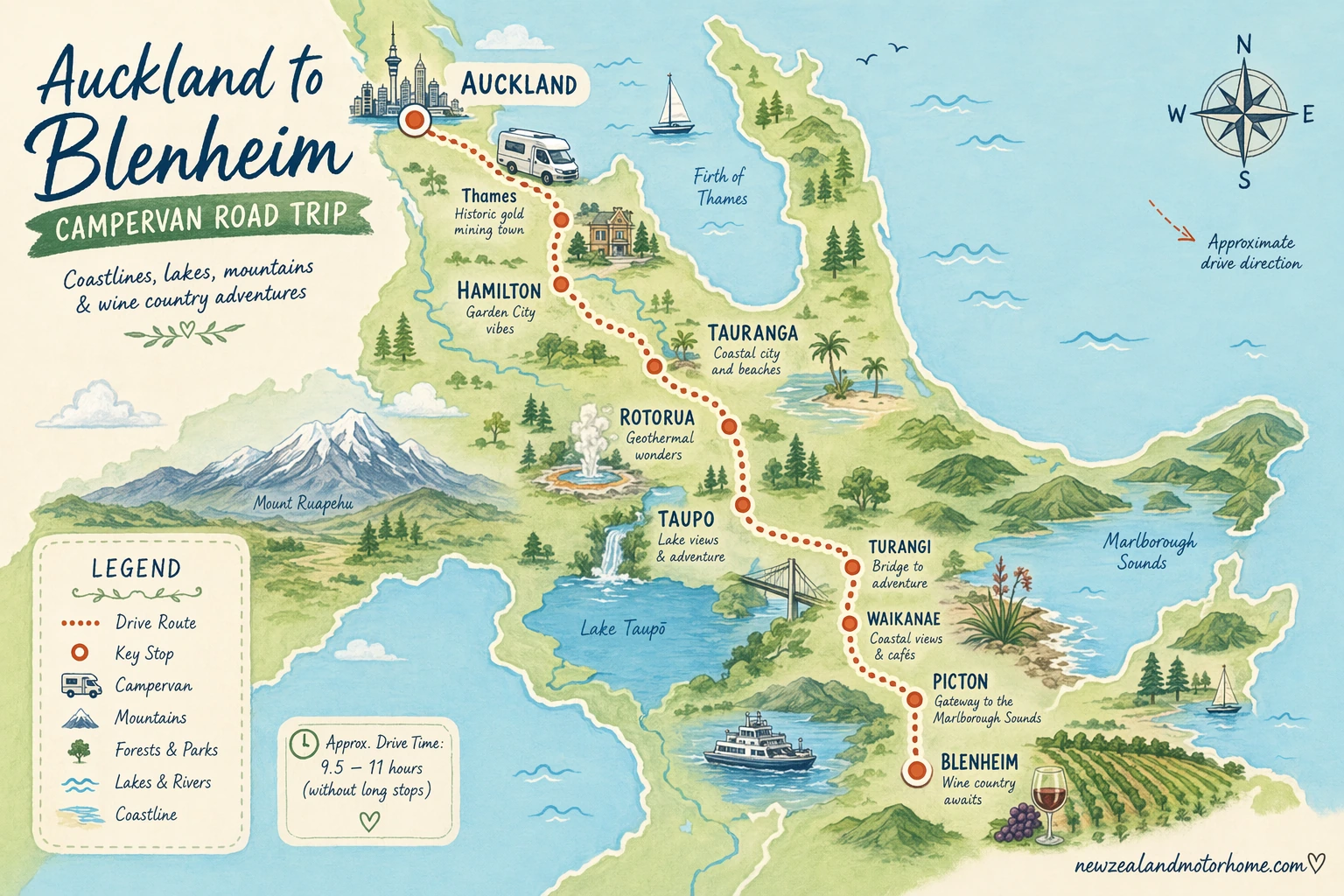
You can technically cover the Auckland to Blenheim motorhome road trip in two long driving days plus the ferry, but it is a tiring way to do it in a van. Three days is a more comfortable minimum, while four to five days lets you avoid arriving at campsites in the dark and gives you a weather buffer for the Cook Strait sailing.
A practical rhythm is Auckland to Taupō or Turangi, then on to Wellington or the Kāpiti Coast, ferry to Picton, and the short final leg to Blenheim. If you are new to driving a motorhome in New Zealand, keep your first day shorter so you can get used to the vehicle’s width, braking distance and turning circle.
- Fast but full-on: 2 nights, with long days and little sightseeing.
- Best balance: 3 nights, using Taupō/Turangi and Wellington/Kāpiti as main stops.
- More relaxed: 4–5 nights, adding Tongariro, Wellington or Picton time.
- Ferry buffer: Stay near Wellington the night before an early sailing rather than driving down from the central North Island that morning.
Leg 1: Auckland to Taupō or Turangi
Leaving Auckland, use the motorway network and State Highway 1 south. Traffic can be slow around the city edge, and a supermarket or fuel stop before you leave the urban area is easier than squeezing into small service stations later. Once south of Hamilton, the drive opens out through the Waikato before the climb towards the central plateau.
Taupō is the easier first overnight stop for many campervan travellers because it has lakefront walks, supermarkets, fuel, LPG swap/fill options and holiday parks with powered sites. Turangi is quieter and well placed if you want a shorter run the next morning over the Desert Road.
- Good overnight style: Powered holiday park site in Taupō if you need to charge devices, top up water and do laundry.
- Self-contained option: Only use designated freedom camping areas and check the current local bylaw signage before settling in.
- Dump and water: Taupō and Turangi both commonly have public or holiday-park dump station options; plan to empty before heading into hillier country.
- Van note: Give yourself extra space in Hamilton and Taupō town centres; rear overhangs and low branches can catch new drivers out.
Leg 2: Central North Island to Wellington or Kāpiti
From Taupō or Turangi, the route follows SH1 past Tongariro National Park and across the Desert Road, one of the most exposed sections of the Auckland to Blenheim drive. In clear weather it is memorable, with views to Ruapehu and Ngauruhoe, but in winter or a southerly it can be icy, windy or temporarily closed.
After Waiouru and Taihape, the road continues through rolling hill country before flattening out towards the coast. Wellington traffic is manageable in a van if you avoid peak commuter times, but if your ferry is not until the next day, the Kāpiti Coast can be a calmer place to overnight with easier site access.
- Weather check: Look at the road conditions for the Desert Road before leaving; do not push on in snow, ice or strong wind warnings.
- Fuel planning: Fill before long rural stretches rather than running low between plateau towns.
- Overnight choice: Kāpiti or Hutt Valley holiday parks can be easier for larger motorhomes than inner-city parking.
- Wellington parking: Use proper large-vehicle parking or your campground base; do not rely on finding kerbside parks for a high-roof van near the waterfront.
Cook Strait ferry with a campervan
The ferry is the key planning point on this route. Book for the full length and height of your campervan or motorhome, including bike racks, roof boxes or rear storage. Arrive with time in hand, because vehicle check-in is not the same as walking on with a bag, and late arrival can upset the rest of your Blenheim plan.
Before boarding, turn off LPG at the cylinder as instructed and secure loose items inside the van. The crossing can be calm and scenic or rough and delayed, so avoid scheduling a tight activity or late-night rural arrival immediately after your sailing.
- Best pre-ferry night: Stay in or near Wellington, Kāpiti or the Hutt Valley so the morning is simple.
- On board: You will not usually stay in the vehicle deck during the crossing, so take warm layers, medication and valuables with you.
- Delay buffer: Keep Picton or Blenheim plans flexible, especially in winter and spring.
- Van prep: Check cupboards, fridge latch and grey-water cap before driving onto the ferry ramp.
Picton to Blenheim and where to stop overnight
Once you roll off in Picton, Blenheim is a short drive south on SH1 through the Wairau plain. It is not a difficult leg, but take it slowly if you are fresh off the ferry; there can be heavy vehicles, crosswinds and travellers adjusting to South Island roads. If you arrive late, Picton is a perfectly sensible overnight stop rather than pressing on tired.
Blenheim has the better base if you are staying for wineries, the aviation museum, bike trails or stocking the van before continuing deeper into the South Island. Choose a powered site if you have been freedom camping or using unpowered sites for a few nights; it is a good chance to reset the batteries, refill fresh water and empty grey and black water where permitted.
If you want help matching ferry times with realistic overnight stops, use the talk-to-us step and we can sanity-check the route for your van size and travel season.
- Picton: Handy for a late ferry arrival, with harbour walks and easier morning departures.
- Blenheim: Better for supplies, dump station planning, laundry and Marlborough day trips.
- Freedom camping: Only stay where permitted for certified self-contained vehicles, and check signs on the day.
- Continuing south: Fill water and fuel before heading towards Kaikōura or Nelson, as services spread out quickly.
Keep planning
Visiting sky tower auckland by campervan
Read onVisiting rainbows end auckland by campervan
Read onHoliday parks blenheim
Read onHoliday parks auckland
Read onCampervan supplies blenheim
Read onCampervan supplies auckland
Read onCommon questions
Can I drive from Auckland to Blenheim in a campervan in two days?
Yes, but it is a big ask once you include the Cook Strait ferry and check-in time. For most campervan travellers, three days is the sensible minimum, with an extra night if you want a calmer pace or are travelling in winter.
Where should I stay before the ferry to Picton?
Stay in Wellington, the Hutt Valley or on the Kāpiti Coast, depending on your sailing time. For an early ferry, being close to the terminal removes a lot of stress, especially in a larger motorhome.
Is the Desert Road suitable for motorhomes?
In good conditions, yes, SH1 over the Desert Road is commonly used by campervans and motorhomes. The main issue is weather: snow, ice, fog and strong wind can make it unsuitable, so check road conditions before leaving Taupō or Turangi.
Do I need a self-contained campervan for this route?
You do not need one if you are staying in holiday parks every night, but certified self-containment gives you more flexibility at designated freedom camping spots. Always follow local council rules and on-site signs, as permitted areas can change.
Should I book powered sites on the Auckland to Blenheim route?
Book powered sites for the nights when you need to recharge house batteries, run heating comfortably, do laundry or reset after a few unpowered stops. Around weekends, school holidays and ferry-delay periods, booking ahead near Wellington, Picton and Blenheim is wise.
Have a planner shape this for your dates
Send a short outline — your dates, party size, and the kind of trip you want. A planner replies with a vehicle recommendation, a paced route, and the realistic budget.