- Best allowed: 5–7+ days
- Requires Cook Strait ferry
- Main highways suit most vans
- Powered sites useful around ferry
- Self-containment needed for freedom camping
The Auckland to Christchurch campervan route is a proper top-to-middle New Zealand journey: city motorway, volcanic plateau, Cook Strait ferry, Marlborough coast, and the long run down to Canterbury. It suits travellers who want to see both islands without rushing the van from one depot to the next.
This guide is written for people driving and sleeping in their hired campervan or motorhome. You’ll find practical leg planning, where to overnight, how to think about powered versus unpowered sites, ferry and road notes, and the little logistics that matter in a van: fresh water, dump stations, LPG, supermarket stops and parking that doesn’t leave you wedged in a tight town centre.
How many days to allow for the Auckland to Christchurch drive
You can physically cover the Auckland to Christchurch drive in three long driving days, but that is not a relaxed campervan trip. Five to seven days gives you time to park up before dark, use dump stations without stress, and actually enjoy the places you are sleeping beside.
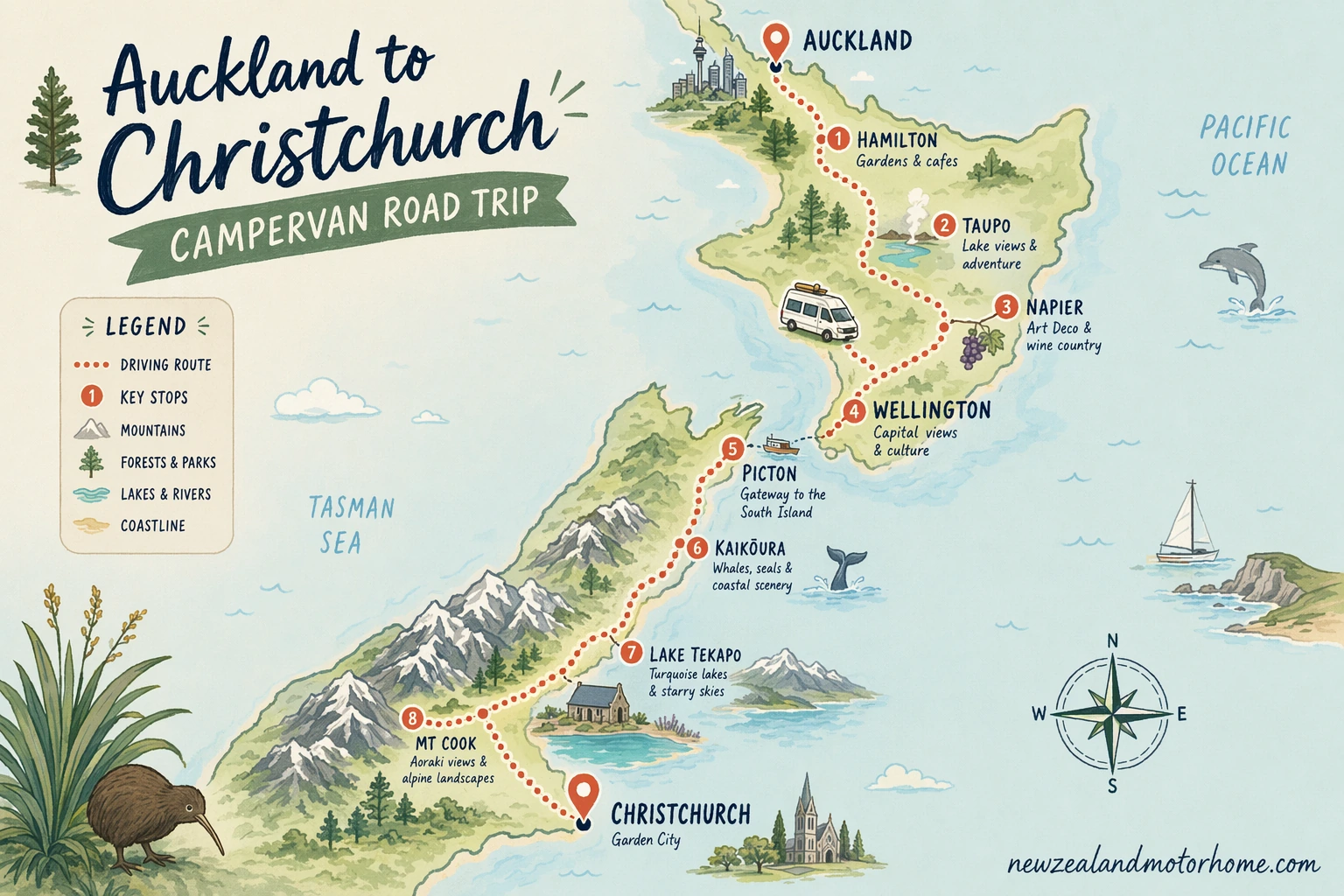
A sensible rhythm is Auckland to the central North Island, then to Wellington, ferry to Picton, and one or two South Island legs to Christchurch. Add extra nights if you want Tongariro, Taupō, Kaikōura or Marlborough to be more than a fuel-and-photo stop.
- Fast but tiring: 3 days, best only if you are relocating a van and already confident on NZ roads.
- Comfortable: 5 days, with two North Island overnights and two South Island overnights.
- Better for first-timers: 7 or more days, with time for restocking, laundry, weather delays and shorter driving days.
If you are matching flights, ferry space and campsite availability, sketch the bones of the route first, then firm up each overnight. We can help you shape that through the talk-to-us step if you want a second set of eyes on timing and van logistics.
Auckland to Taupō or Tongariro: leaving the city in a van
The first leg is about getting out of Auckland cleanly and settling into campervan pace. From the airport or a city depot, allow more time than a car traveller would: supermarket loading, checking LPG, learning the water and waste set-up, and getting used to the van’s mirrors and height.
State Highway 1 south is the direct line through Waikato. Hamilton, Cambridge and Tīrau all work as practical food or fuel breaks, though you will want to choose larger car parks rather than squeezing a motorhome into small angled street parks. If you are in a longer vehicle, skip the cutest-looking main-street park and look for wider supermarket or reserve-style parking where permitted.
Taupō is the easiest first overnight for many travellers because it has holiday parks, lakefront walks, supermarkets, fuel and camper services nearby. Tongariro National Park gives a wilder first night, but check the weather and campsite access carefully; alpine roads can feel different in a high-sided van, especially in wind, rain or winter conditions.
- Overnight style: Taupō holiday parks for powered sites, showers and dump station access; DOC-style or designated camping nearer Tongariro for a quieter unpowered night if your van and conditions suit.
- Van jobs: Top up fresh water before heading into more exposed country, empty grey/black water where facilities are provided, and check LPG if you will be heating the van overnight.
- Road note: Keep left, let faster traffic pass safely, and avoid overcommitting to tight lakeside or scenic pull-offs if there is no clear turning space.
Central North Island to Wellington: planning the ferry approach
The run from Taupō or Tongariro to Wellington is a solid driving day in a campervan, particularly if the weather is rough across the Desert Road or traffic builds near the capital. Build in breaks around Taihape, Bulls, Levin or Ōtaki, and remember that a motorhome takes longer to park, refuel and repack than a car.
Wellington needs a little forethought. The city is hilly, windy and busy, and many streets are not pleasant in a long or tall van. For the night before your ferry, a holiday park or designated motorhome-friendly site on the edge of the city is usually calmer than trying to sleep near the central waterfront.
Book the Cook Strait ferry with the correct vehicle length, height, bike racks and any rear storage included. Arrive with time to spare, secure loose items inside the van, turn off gas at the bottle if instructed, and keep essential medication, warm layers and snacks with you because you may not be able to access the vehicle during the crossing.
- Best overnight approach: Stay within an easy morning drive of the ferry terminal rather than gambling on a same-day long drive from the plateau.
- Dump and water: Empty and refill before boarding if your next South Island night is unpowered or remote.
- Wind note: Wellington and the Kāpiti Coast can be gusty; reduce speed and give yourself more lane space in a high-sided campervan.
Picton to Kaikōura: coastal driving after the ferry
Rolling off the ferry in Picton is one of the best moments of the Auckland to Christchurch motorhome road trip. Do not rush straight out of town if you have been on a rough crossing or arrived late. Picton and nearby Blenheim are useful places to restock groceries, fill fuel, do laundry and reset the van.
The route south through Marlborough and along the coast to Kaikōura is scenic but deserves attention. Expect sections of winding road, rail crossings, coastal pull-offs and variable wind. In a campervan, choose proper lay-bys and signed viewpoints rather than stopping on narrow shoulders for photos.
Kaikōura makes an excellent overnight because you can park the van, walk to food or the waterfront, and wake up close to the sea without adding another late drive. Holiday parks are the easiest option for powered sites and showers; self-contained travellers may find designated council or freedom camping areas, but rules change, so check current local signage and apps before committing.
- Good van break: Blenheim for supermarkets, fuel and a gentler town layout than central Wellington.
- Overnight style: Powered holiday park sites in Kaikōura if you need batteries, showers and dump facilities; unpowered or designated self-contained sites only where clearly allowed.
- Road note: Keep your speed down on coastal bends and watch for seals, cyclists and vehicles pulling in and out of viewing areas.
Kaikōura to Christchurch: the final Canterbury leg
The last leg from Kaikōura to Christchurch is usually straightforward, but it is still worth treating as a campervan day rather than a quick car commute. South of the coast the road opens into North Canterbury, with easier driving, larger service towns and more chances to choose spacious parking for lunch.
Amberley, Waipara and the northern edge of Christchurch are practical places to fuel, shop and clean up the van before returning it or settling in for a city stay. If your drop-off is near the airport, allow for traffic, refuelling, waste emptying, packing and the rental company’s vehicle check. Do not leave the dump station stop until the final ten minutes.
Christchurch itself is flatter than Wellington but still needs care in a motorhome. Low branches, tight motel-style driveways, central-city parking limits and one-way streets can make casual exploring awkward. It is often easier to park at your holiday park or a large legal car park, then use walking, cycling, public transport or a rideshare for the central city.
- Before drop-off: Empty grey and toilet waste at an approved dump station, refill fuel as required by your hire agreement, and remove food from cupboards and the fridge.
- If staying overnight: Choose a Christchurch holiday park or approved self-contained site that matches your van certificate and site needs.
- Van size note: Check height before entering any covered parking, supermarket basement, motel archway or tree-lined driveway.
Camping, freedom camping and service stops on this route
This route is well set up for campervans, but it still rewards planning. Holiday parks are the simplest backbone: powered sites, showers, laundry, rubbish, fresh water and dump stations in one place. They are especially useful after a long driving day, before and after the ferry, and whenever the weather turns wet.
Freedom camping can work in a certified self-contained campervan, but it is not a blanket right to stay anywhere. Councils set local rules, and some areas allow only certain vehicle types, certain nights or marked spaces. Always check current signs on arrival, keep your self-containment certificate visible if required, and move on if the area is full or unclear.
Think of your van services as a daily habit, not a last-minute chore. Fresh water, grey water, toilet cassette capacity, rubbish, LPG and house battery levels all affect where you can comfortably sleep that night.
- Powered sites: Best for cold nights, laptop or camera charging, laundry days and resetting batteries after several unpowered stops.
- Unpowered sites: Fine for a night or two if your battery, fridge, water and toilet capacity are in good shape.
- Dump stations: Use approved facilities only; many holiday parks, some service stations and council sites provide them, but availability varies.
- LPG and water: Refill before remote or alpine sections rather than assuming the next small settlement has everything your particular van needs.
Keep planning
Visiting sky tower auckland by campervan
Read onVisiting rainbows end auckland by campervan
Read onHoliday parks christchurch
Read onHoliday parks auckland
Read onCampervan supplies christchurch
Read onCampervan supplies auckland
Read onCommon questions
Can I drive from Auckland to Christchurch in a campervan without taking a ferry?
How long should I allow for an Auckland to Christchurch campervan trip?
Is the route suitable for a large motorhome?
Do I need powered sites every night?
Can I freedom camp between Auckland and Christchurch?
Where should I stay before the Cook Strait ferry?
Have a planner shape this for your dates
Send a short outline — your dates, party size, and the kind of trip you want. A planner replies with a vehicle recommendation, a paced route, and the realistic budget.