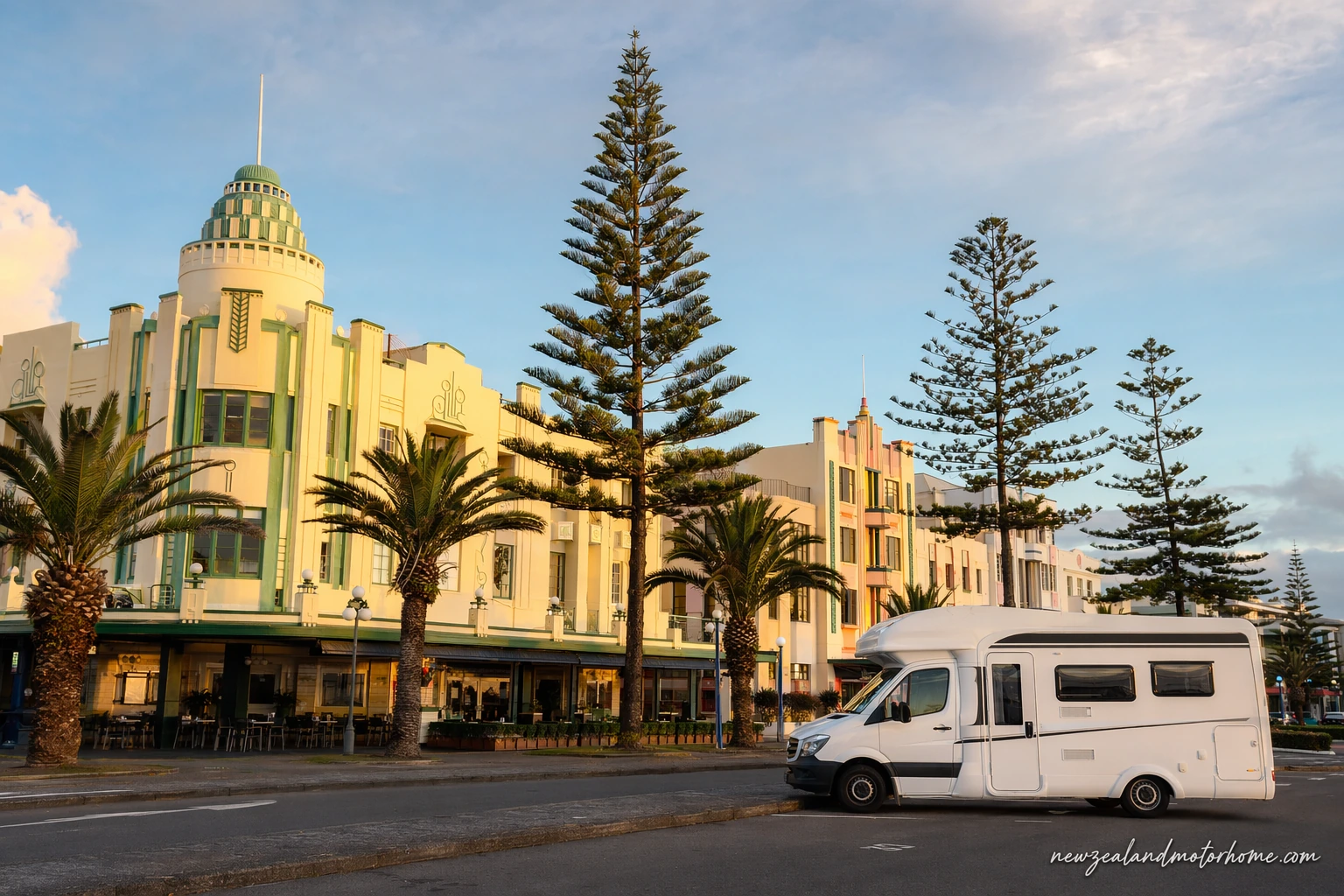
- Best stay: 1–2 nights
- Park once, explore on foot
- Powered and unpowered sites nearby
- Check self-containment rules
- Large vans: avoid Bluff Hill streets
Napier is one of New Zealand’s easiest small cities to enjoy from a campervan, as long as you treat the Art Deco quarter as a place to park once and explore on foot. The best streets are compact, flat and full of detail: zigzags, sunbursts, pastel facades, verandahs and old theatre fronts tucked between cafés and the waterfront.
This napier art deco campervan guide is written for travellers driving and sleeping in their hired van. You’ll find notes on where to leave the motorhome while you wander, how to choose an overnight base, where to think about water, LPG and dump stations, and how Napier fits into a wider Hawke’s Bay or East Coast route.
Arriving in Napier by campervan
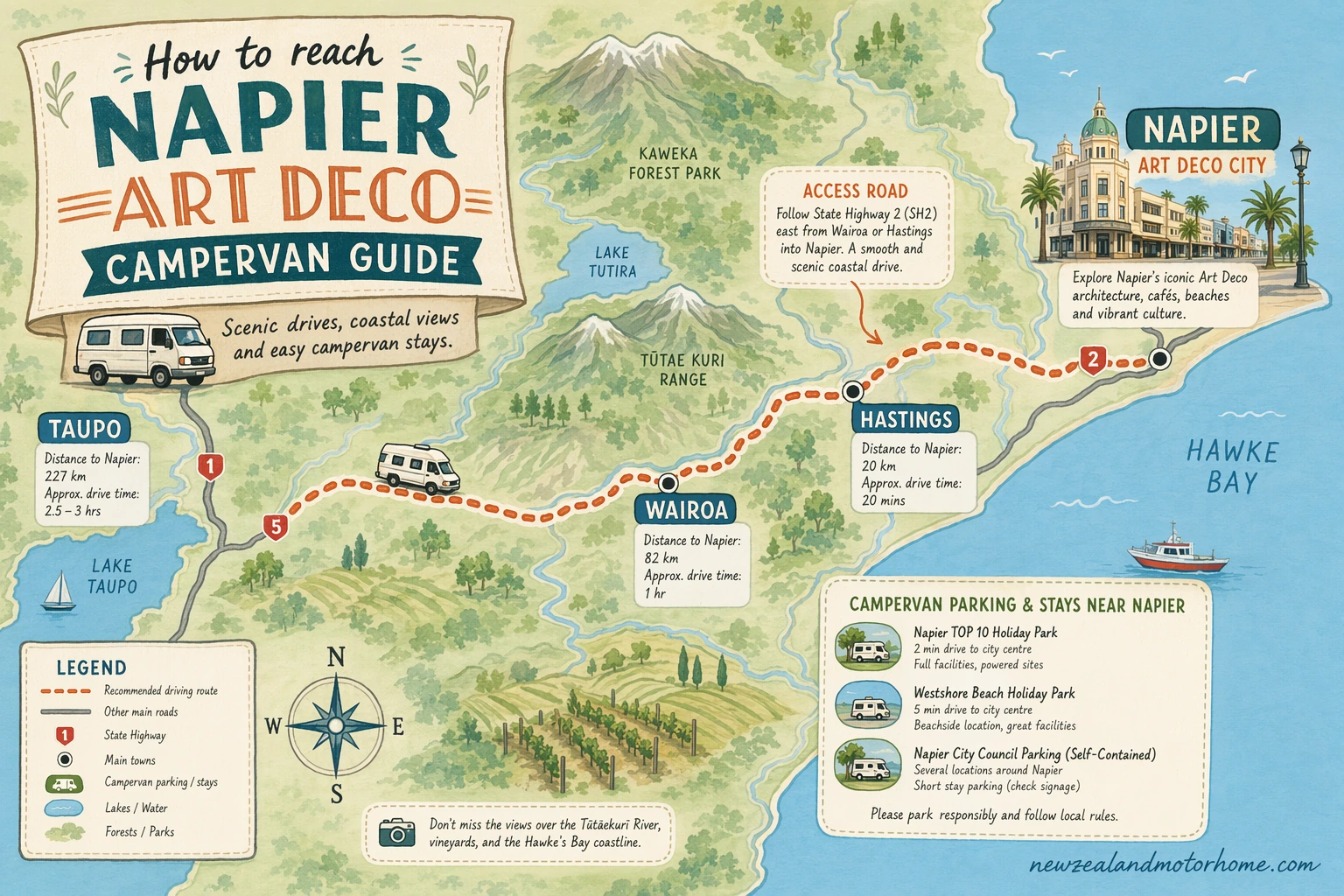
Most campervan travellers reach Napier via SH5 from Taupō, SH2 from Gisborne or SH2 from Wellington and the Wairarapa. The Taupō road is scenic but can feel longer in a high-sided van than it looks on the map, with forested hills, passing lanes and weather that changes quickly. Take the corners steadily, especially if the van is loaded with fresh water and luggage.
Coming from the south, the final run through Hawke’s Bay is more open, with orchards, vineyards and small service towns before the road feeds you towards the coast. From the north, SH2 down from Wairoa is a rewarding East Coast drive but has fewer big-city services, so check fuel, groceries and your grey-water situation before you arrive.
- Best first move: aim for the waterfront or your overnight park before driving into the tightest Art Deco streets.
- Large van note: Bluff Hill has steep, narrow residential roads; save it for a small van or visit on foot if you are in a longer motorhome.
- Wind note: Hawke’s Bay can be gusty on exposed roads, so keep both hands on the wheel in a tall campervan.
Parking the van for the Art Deco quarter
The Art Deco core is centred around Tennyson Street, Emerson Street, Hastings Street and the blocks leading towards Marine Parade. It is not a place to keep circling in a motorhome. Street bays can be short, verandahs and trees overhang in places, and reversing a long rental van in busy pedestrian areas is no one’s idea of a relaxed holiday.
For a smoother campervan Napier Art Deco visit, park once on the edge of the centre and walk in. Marine Parade and the waterfront side generally feel easier for longer vehicles than the tight inner blocks, particularly earlier in the day. Always check posted time limits, paid parking instructions and any signs excluding overnight stays.
- Short vans: may fit ordinary marked bays, but avoid overhanging the lane or footpath.
- Longer motorhomes: look for end spaces, longer kerbside areas or designated larger-vehicle parking where signed.
- During events: Art Deco Festival periods can fill central parking early, so base yourself at a campground and walk, cycle or use local transport.
Once parked, the best part of Napier is slow travel: look up at the building details, duck down the side streets, and give yourself time to reach the seafront without moving the van.
Where to stay overnight near Napier Art Deco
Camping near Napier Art Deco is easiest if you separate your sightseeing parking from your overnight stop. The central heritage area is for daytime wandering, not assuming you can sleep kerbside. Napier has a mix of holiday park-style bases around the coast and suburbs, plus restricted freedom camping rules that can change by season and location.
If you want showers, laundry, reliable fresh-water fills and a dump station, choose a powered or unpowered site at a formal holiday park in the Napier, Westshore or Bay View area. Powered sites are handy in summer if you need the fridge working hard, or in cooler months if you are using a safe electric heater. Unpowered sites suit self-contained vans that only need a legal place to sleep and basic facilities.
- Powered site: best for longer stays, e-bike charging, CPAP machines or hot-weather fridge confidence.
- Unpowered site: often fine for one night if your house battery and water tanks are in good shape.
- Freedom camping: use only signed or council-approved areas, and only if your van meets current self-containment requirements.
- Late arrivals: book ahead in summer, school holidays and festival weekends; Napier’s compact size means sites can fill quickly.
Before settling in, check where the nearest legal dump station is rather than expecting to sort grey water in the city centre. Many travellers find it easier to empty and refill at their campground, then head into town with lighter tanks the next morning.
Water, dump stations, LPG and city services
Napier is a comfortable service stop on a Hawke’s Bay motorhome route, but the practical chores are best done outside the Art Deco blocks. Fresh-water taps, dump stations and LPG refills or bottle swaps are generally easier around campgrounds, suburban service areas and main road approaches than beside the heritage streets.
Plan your service routine before a full day in town. Empty the grey-water tank, top up fresh water, secure cupboards, and keep the van light if you are heading onwards over hill roads. If your hired campervan uses a removable LPG bottle, ask at handover whether it is a swap or refill system so you know what to look for in Napier.
- Dump station: check current council, campground or campervan app listings before you drive into the centre.
- Fresh water: refill only from marked potable taps, not public garden or beach taps.
- LPG: use signed service stations or hardware-style outlets on main routes; do not leave it until you are parked deep in town.
- Rubbish: keep recycling and rubbish contained in the van until you reach proper bins at your overnight stop.
This is also a good place to reset the van before more remote driving north towards Wairoa and Gisborne or inland towards Taupō.
What to do once the van is parked
Napier’s Art Deco centre is made for walking, and that suits motorhome travellers perfectly. Leave the van, take a small day bag, and spend a few hours moving between the facades, the waterfront, the Soundshell area and the museum precinct. The city’s post-earthquake rebuild story is easier to appreciate when you are not watching mirrors and kerbs from the driver’s seat.
For a wider motorhome Napier Art Deco day, add Ahuriri’s harbour area, where the old industrial buildings and seaside cafés give a different feel from the central city. If you are in a big van, check parking carefully and avoid squeezing into small waterfront bays at peak lunch times.
- Easy add-on: Marine Parade for the sea air, gardens and level walking paths.
- Architecture stop: Ahuriri for heritage buildings beyond the main Art Deco core.
- Active option: hire bikes or ride sections of the Hawke’s Bay Trails if your van is set up for cycle storage.
- Wine country: visit nearby cellar doors only if you have a sober driver and a sensible parking plan for the van.
If you want help fitting Napier into your own hire-van timing, you can use the talk-to-us trip planning step and share your van size, dates and preferred driving pace.
How Napier fits a wider campervan route
Napier works well as a one or two-night pause between bigger drives. One night is enough for a late-afternoon waterfront walk and a morning in the Art Deco quarter. Two nights gives you time for Ahuriri, a cycle, a relaxed campground reset and a day trip into the wider Hawke’s Bay region without rushing the van from car park to car park.
Southbound travellers often continue towards Hastings, Havelock North, Central Hawke’s Bay and the Wairarapa. Northbound travellers may follow the coast towards Wairoa and Gisborne, allowing extra time for slower roads and fewer campervan services. Inland, SH5 takes you back towards Taupō and the central North Island.
- Good pairing: Napier plus Taupō for lake, geothermal and heritage contrast.
- Slow coast route: Napier to Gisborne if you have time and are comfortable with longer rural stretches.
- Food and wine loop: Napier, Hastings and Havelock North with campground nights rather than moving after tastings.
- Best pace: avoid arriving late, doing the Art Deco walk, dumping tanks and leaving all in the same half-day.
Keep planning
Holiday parks napier art deco
Read onWellington to napier campervan
Read onRotorua to napier campervan
Read onQueenstown to napier campervan
Read onPicton to napier campervan
Read onNelson to napier campervan
Read onCommon questions
Can I park a campervan in central Napier to see the Art Deco buildings?
Yes, but it is usually easier to park on the edge of the centre and walk in. Longer motorhomes may not fit standard street bays, so check signs, time limits and whether your vehicle overhangs the marked space.
Is freedom camping allowed near Napier Art Deco?
Do not assume you can sleep in the central city. Freedom camping around Napier is restricted to approved areas and generally requires a properly self-contained vehicle, so check the current council map and on-site signs before settling in.
Should I choose a powered or unpowered site in Napier?
A powered site is useful if you want easy charging, strong fridge performance or more comfort during hot or cool weather. An unpowered site can work well for a short stay if your battery, gas and water levels are healthy.
Where should I empty grey water before visiting Napier’s Art Deco area?
Use a legal dump station at your campground or a listed public facility before heading into the compact city centre. Do not drain grey water into street drains, beach areas or public car parks.
How many nights do I need in Napier in a campervan?
One night covers the main Art Deco walk if you arrive early enough. Two nights is more comfortable for campervan travel because you can park once, explore Ahuriri or the waterfront, and still handle water, laundry and dump-station chores without rushing.
Have a planner shape this for your dates
Send a short outline — your dates, party size, and the kind of trip you want. A planner replies with a vehicle recommendation, a paced route, and the realistic budget.