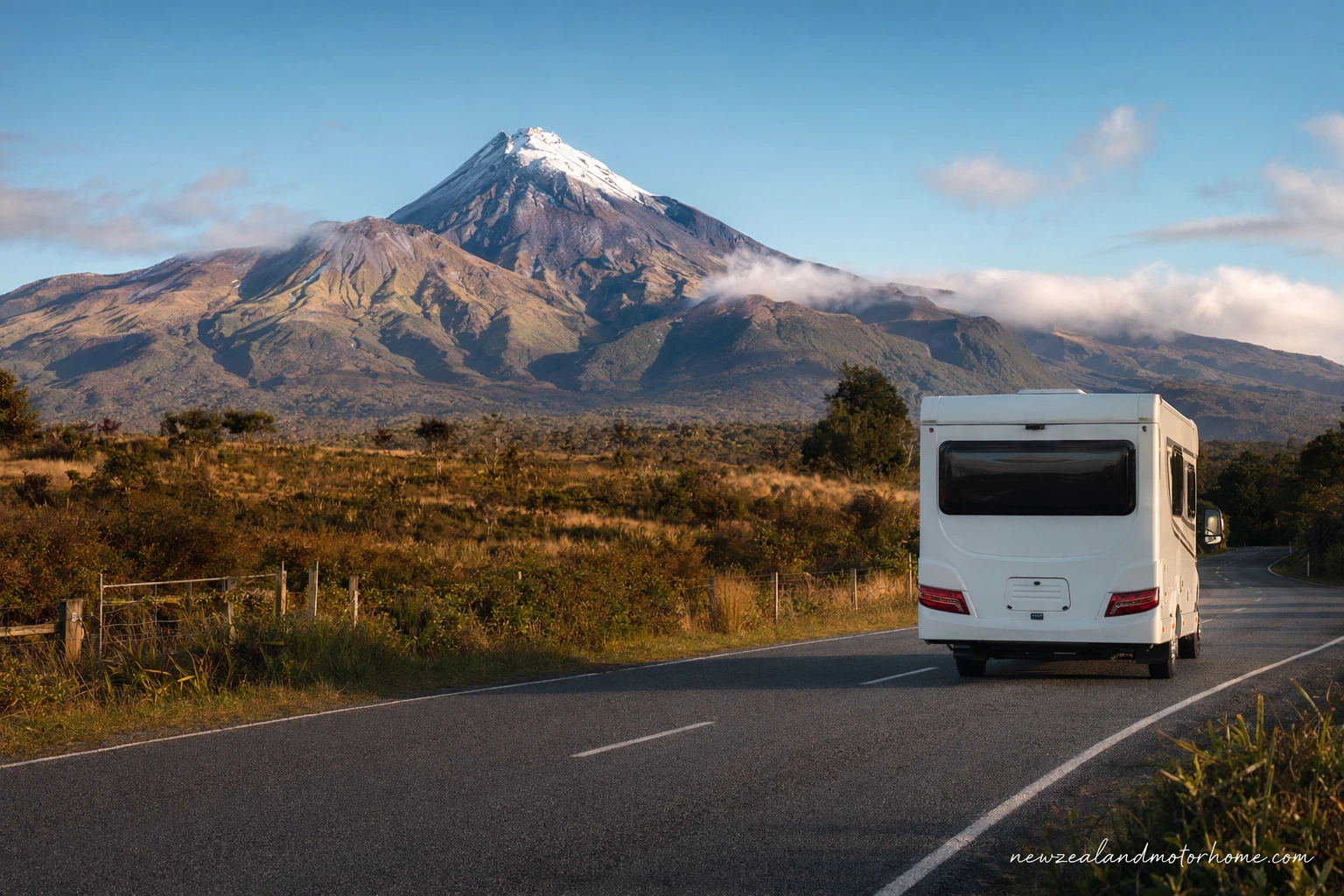
- Best length: 3–5 nights
- Good for certified self-contained vans
- Main services: New Plymouth, Stratford, Hāwera
- Take care on mountain access roads
- Powered and unpowered sites available
Taranaki is one of those regions that suits a campervan beautifully: one clear mountain to navigate by, a coast road full of surf beaches, and enough towns close together that you are never too far from fresh water, LPG, groceries or a dump station.
This campervan guide Taranaki NZ page is written for travellers driving and sleeping in their own hired van. You’ll find practical notes on where to park the van, how to link New Plymouth, Surf Highway 45 and Taranaki Maunga, what to watch on the roads, and how many nights to allow without rushing your overnights.
How many days to allow in a Taranaki campervan
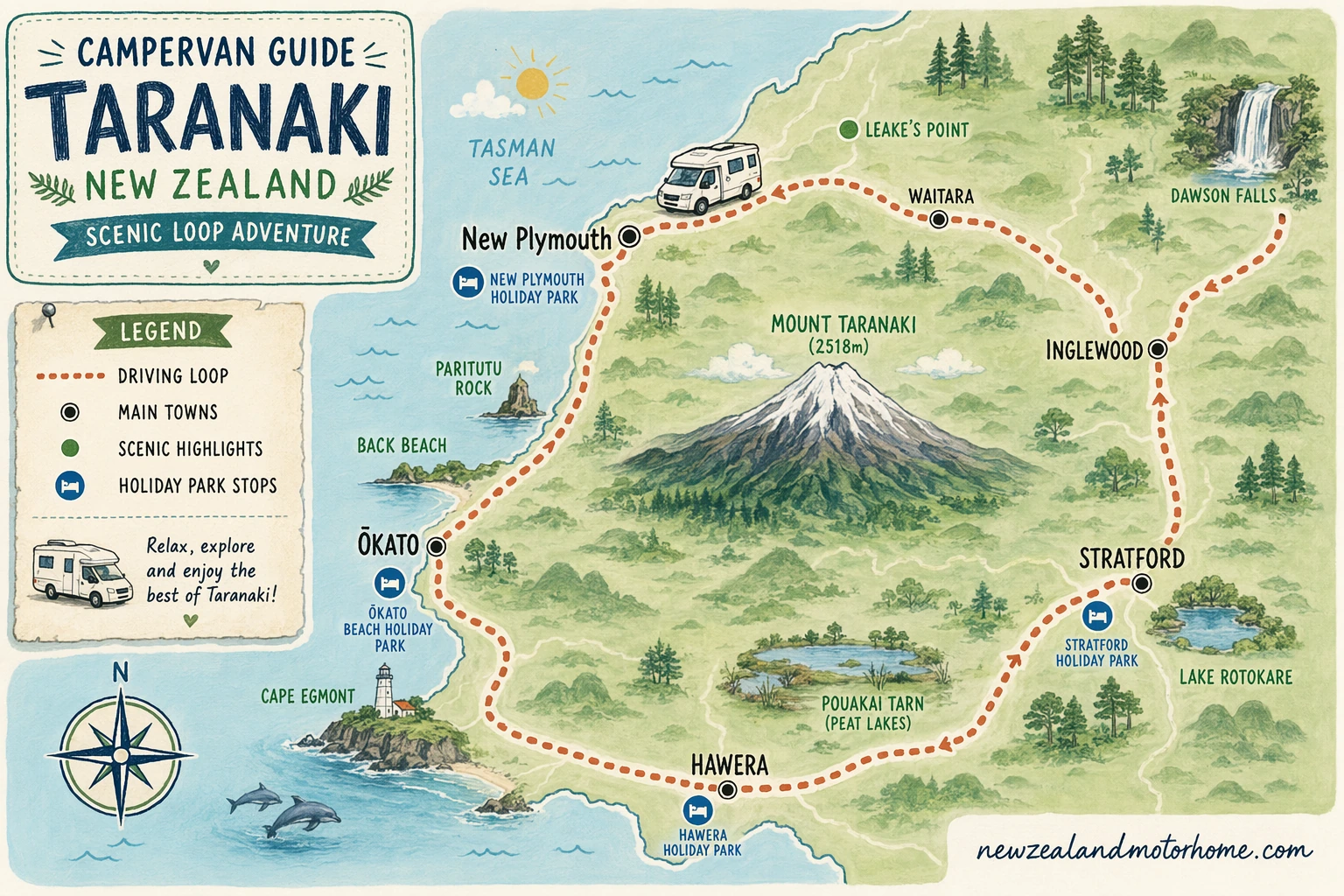
Three days gives you a tidy loop: New Plymouth, a coastal run down Surf Highway 45, then back through Hāwera or Stratford. Four to five days is better if you want to wait for a clear maunga view, spend a proper afternoon on the Coastal Walkway, and build in time for short walks without arriving at your overnight stop in the dark.
A simple motorhome Taranaki loop works well either clockwise or anticlockwise. New Plymouth is the easiest place to stock the fridge, fill fresh water if your site allows it, and sort LPG before you head around the coast.
- 2 nights: New Plymouth base, Coastal Walkway, one mountain road-end visit.
- 3 nights: New Plymouth, Ōpunake or coastal holiday park, Stratford or Hāwera.
- 4–5 nights: Add Tongapōrutu/Three Sisters at low tide, extra surf beaches, and a weather-flexible maunga day.
If you are trying to fit Taranaki between Waitomo, Whanganui or the Forgotten World Highway, keep the daily kilometres modest. The roads are not long, but they are more interesting when you can stop the van without watching the clock.
Best campervan stops around New Plymouth
New Plymouth is the natural hub for a Taranaki campervan trip. It has supermarkets, fuel, LPG options, laundries, holiday parks and public facilities, so it is a good place to reset tanks before heading further around the cape.
The Coastal Walkway is the easiest win in town. Look for legal daytime parking near the foreshore, Ngāmotu Beach or the lake and parks area, but read signs carefully; some seafront spaces have time limits, height barriers or no-overnight rules. If you are in a longer motorhome, arrive earlier in the day and avoid squeezing into small angled parks.
- Good daytime van stops: Coastal Walkway access points, Pukekura Park area, Ngāmotu Beach and the city foreshore where signage permits.
- Overnight style: Choose a powered site if you want heater use, battery top-up or an easy laundry night; unpowered sites suit smaller certified self-contained vans in settled weather.
- Service rhythm: Empty grey and black water before leaving town if you are heading to smaller coastal communities.
For things to do Taranaki campervan style, New Plymouth is best treated as a park-once town. Leave the van in a legal space and walk or bike the foreshore rather than moving it every few minutes.
Surf Highway 45: beaches, lighthouses and overnights
Surf Highway 45 is the classic west-coast section from New Plymouth towards Hāwera, passing places like Ōākura, Okato, Cape Egmont and Ōpunake. The driving is mostly sealed and straightforward, but the best beach access roads can be narrower, with farm traffic, tight turns and little room to turn a large van around at the end.
Ōākura and Ōpunake are the most comfortable coastal bases for many campervan travellers because they have services nearby and a choice of holiday-park-style overnights. Powered sites are useful here if salt air, rain or cooler evenings have you running lights and charging gear more than expected.
- Before turning down a beach road: check whether there is space to turn your vehicle length around.
- At surf beaches: keep off soft sand and grass verges, especially after rain.
- Freedom camping: use only signed, permitted areas and only if your van meets current self-containment requirements.
- Rubbish and toilets: do not rely on small beach reserves having full facilities; pack out rubbish and use public toilets where provided.
Cape Egmont Lighthouse is a worthwhile detour on a clear day, with the maunga behind and the Tasman Sea in front. Park respectfully, avoid blocking farm gates, and remember that exposed coastal wind can make van doors lively.
Taranaki Maunga road notes for motorhomes
The roads into Egmont National Park/Taranaki Maunga are sealed but narrower and more winding than the highways. Egmont Road to North Egmont, Pembroke Road to the Stratford Plateau, and Manaia Road towards Dawson Falls all climb steadily, with bush edges, tight corners and car parks that can fill quickly in good weather.
For larger motorhomes, the main advice is to go early, take it slowly, and do not assume you can easily park or turn at every lookout. Use low gear on the descent to save your brakes, keep well left on blind bends, and be ready for walkers, small cars and shuttle activity near popular trailheads.
- Overnighting: do not assume road-end car parks allow camping; use approved holiday parks, DOC/council-listed sites or designated freedom-camping areas outside the park.
- Weather: cloud can hide the summit while the coast is sunny, so keep a flexible maunga day.
- Van comfort: carry warm layers inside the living space; the mountain side can be much cooler than New Plymouth.
If your main goal is a sunrise or longer walk, plan the previous night close by rather than driving a winding access road half-asleep. That makes the whole motorhome Taranaki loop safer and calmer.
Dump stations, water, LPG and site choices
Taranaki is practical for campervans because the main towns are close enough to manage tanks without stress. New Plymouth, Stratford and Hāwera are the key service towns, and councils list public dump stations in the region; check the current location and access notes before you rely on one, especially if you are arriving late.
Holiday parks are the easiest option when you need a full reset: powered site, showers, laundry, potable water and often a dump point for guests. Unpowered sites work well on mild nights if your house battery is healthy and you are not running high-draw appliances.
- Fresh water: fill only from marked potable taps, not beach or toilet-block taps unless signed.
- Grey water: empty at a dump station, never into drains, grass or beachside gutters.
- LPG: sort bottle swaps or refills in larger towns rather than leaving it to a small coastal stop.
- Self-containment: carry proof of certification and follow the site’s rules on toilets, waste and maximum stay.
If you want help matching your van size, travel pace and overnight style to a Taranaki route, you can use the talk-to-us step and we’ll shape the plan around real driving days rather than just dots on a map.
Roads to take care with beyond the main loop
State Highway 3 is the main north-south approach, while Surf Highway 45 gives you the coast. Both are manageable in a campervan, but Taranaki rewards slower driving: dairy tankers, rain showers, side winds and short scenic pull-ins are all part of the trip.
The Forgotten World Highway from Stratford towards Taumarunui is a different proposition. It is remote, winding and has limited services, with sections that may have roadworks or changing surface conditions. Smaller vans can enjoy it in fine weather with a full tank and patient driving; larger motorhomes should check current road conditions and think carefully about comfort, fuel range and turning options.
- Fuel: top up in New Plymouth, Stratford or Hāwera before remote sections.
- Vehicle size: know your length and height before committing to narrow detours or small car parks.
- Rain: allow extra braking distance and avoid grassy roadside parking.
- Night driving: avoid it if you can; rural roads are darker, with stock, bends and few safe pull-offs.
Build your Taranaki campervan itinerary around daylight arrivals. It is much easier to read campsite signs, choose a level bay and sort the power lead or water hose before the evening damp rolls in.
Common questions
Is Taranaki good for a first campervan trip?
Yes. Distances are short, the main towns have useful services, and you can make a satisfying loop without huge driving days. The main caution is to treat mountain access roads and small beach roads with patience, especially in a larger motorhome.
Can I freedom camp in Taranaki?
Only in places where it is permitted, and your van must meet the current self-containment requirements if the site requires it. Always read local council signs on arrival, as coastal reserves can have time limits, restricted bays or no-camping areas.
Where should I stay overnight with a campervan in Taranaki?
New Plymouth, Ōākura, Ōpunake, Stratford and Hāwera all make useful bases depending on your route. Choose powered holiday-park sites for easy charging and laundry, or designated unpowered/freedom spots when you are fully self-contained and the rules allow it.
Are the roads to Taranaki Maunga suitable for motorhomes?
They are sealed but winding, narrow in places and steeper than the coastal roads. Larger motorhomes should go early, avoid peak car-park times where possible, use low gear downhill and never assume an overnight stay is allowed at a road-end car park.
How many days do I need for things to do in Taranaki by campervan?
Allow at least three nights if you want New Plymouth, Surf Highway 45 and one mountain-side visit. Four or five nights gives you better weather flexibility, which matters because the maunga can be hidden while the coast is clear.
Do I need to book powered sites in advance?
In summer, school holidays and long weekends, booking is wise, especially around New Plymouth and popular coastal towns. Outside peak periods you may have more flexibility, but it is still better to secure your first night if you are arriving late in the day.
Have a planner shape this for your dates
Send a short outline — your dates, party size, and the kind of trip you want. A planner replies with a vehicle recommendation, a paced route, and the realistic budget.