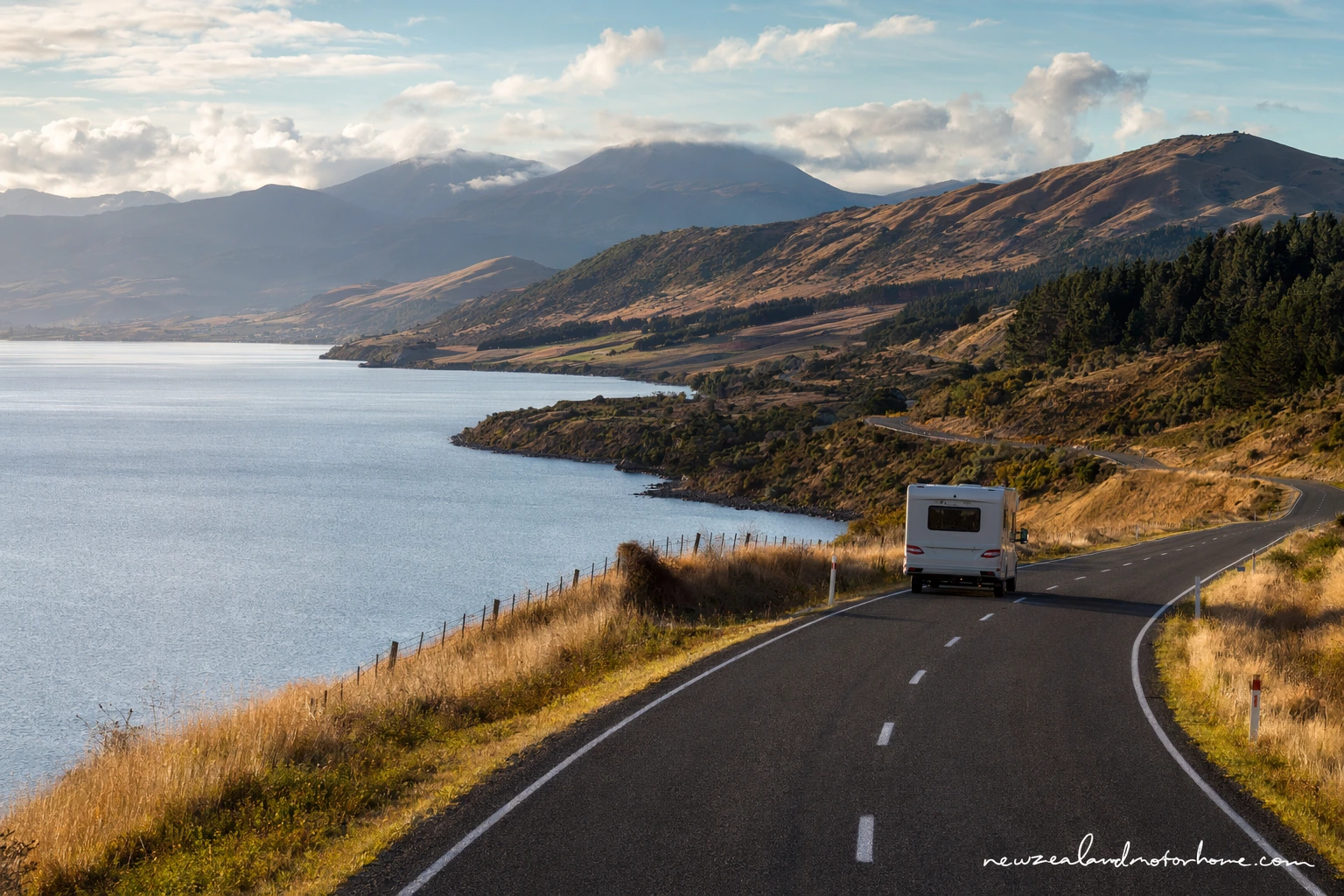
- 6–8 days recommended
- Cook Strait ferry required
- Best in spring to autumn
- Powered reset every 2–3 nights
- Hill-road care in larger vans
A Dunedin to Tauranga campervan trip is a proper length-of-the-country journey: Otago stone buildings and harbour air, Canterbury plains, the Kaikōura coast, a Cook Strait ferry, then the hills, lakes and geothermal country of the central North Island before you roll down to the Bay of Plenty.
This guide is written for people travelling in a hired campervan or motorhome, not just passing through in a car. You’ll find realistic legs, overnight ideas, ferry and road notes, where to think about dump stations and fresh water, and the places where a powered site makes the drive feel much easier.
Route overview: distance, pace and the shape of the trip
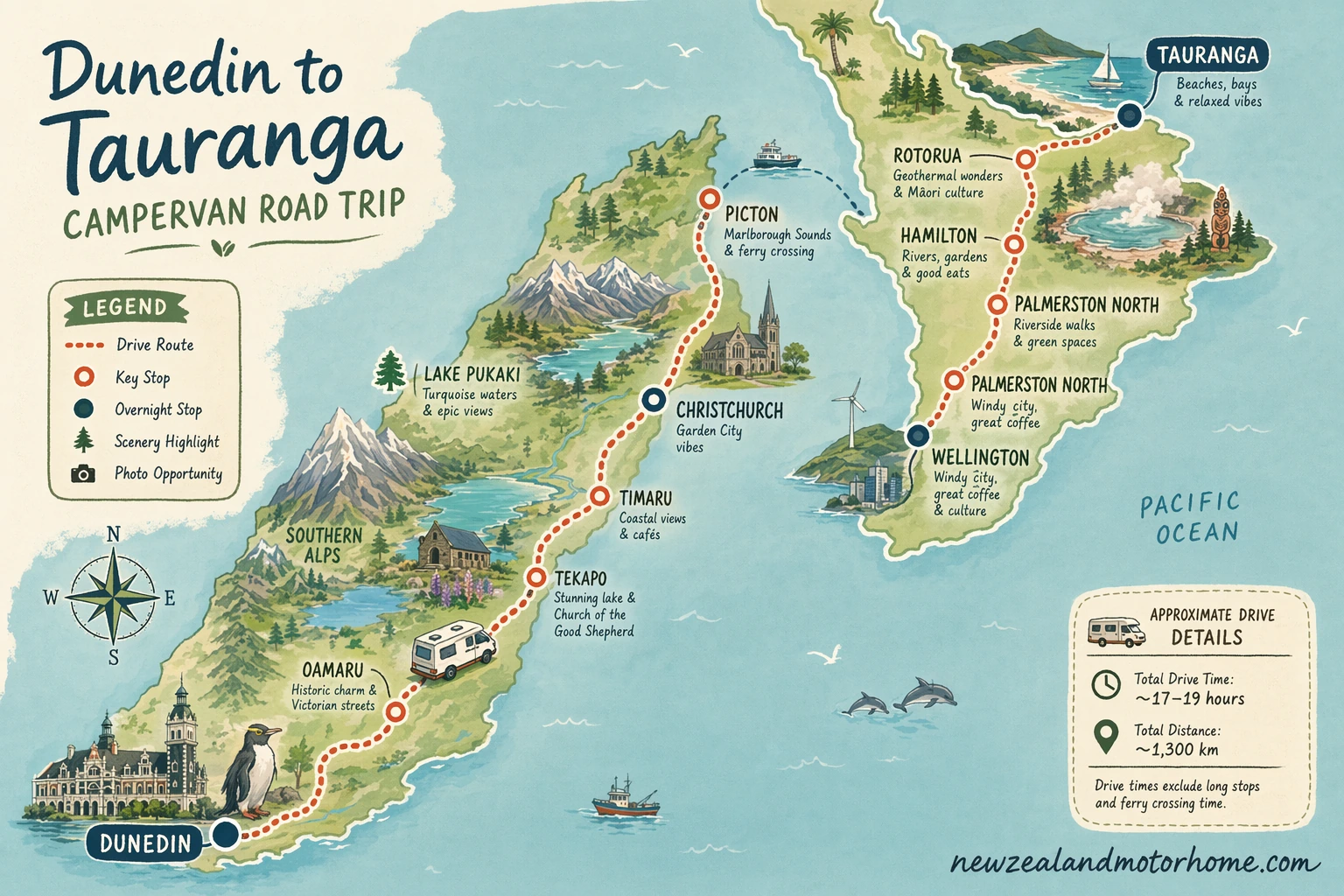
The Dunedin to Tauranga drive is not one to rush unless you enjoy long days behind a large windscreen. Depending on whether you go via Hawke’s Bay, Taupō and Rotorua, or take a more direct central North Island line, expect roughly 1,250 to 1,400 kilometres of road driving plus the Cook Strait ferry.
For a comfortable Dunedin to Tauranga motorhome road trip, allow 6 to 8 days. That gives you time to empty the cassette without it becoming urgent, plug into power every couple of nights, and avoid arriving at unknown holiday parks after dark in a long vehicle.
- Fast but tiring: 4 to 5 days, with long driving days and little sightseeing.
- Balanced: 6 to 8 days, with nights around Ōamaru or Timaru, Kaikōura or Picton, Wellington, Hawke’s Bay or Taupō, and Rotorua or Tauranga.
- Slow touring: 9 to 12 days, adding Aoraki/Mackenzie Country, Marlborough, Wairarapa or extra beach time in the Bay of Plenty.
Before you lock in ferry times and peak-season campsites, it can help to sanity-check your van length, driving pace and overnight style. If you want a hand turning this into a day-by-day plan, you can talk to us and we’ll shape it around how you actually like to travel.
Leg 1: Dunedin to North Otago, Timaru or Christchurch
Leave Dunedin on SH1 and give yourself time to get used to the van before the kilometres stack up. The first part of the route is straightforward, but keep an eye on crosswinds north of town and take extra care pulling back onto the highway after photo stops.
Good first-night stops include Ōamaru, Timaru or Christchurch, depending on your arrival time and how fresh you feel. Ōamaru works nicely if you want a gentler first day and a walk around the old harbour area; Timaru gives you a useful midway reset; Christchurch is better if you are pushing north and want a full-service powered site before the Kaikōura coast.
- Parking the van: Use larger public car parks on the edge of town centres where turning space is easier, and check signs for time limits or overnight restrictions.
- Overnight style: Holiday parks in Ōamaru, Timaru and Christchurch are the simplest choice for powered sites, showers, laundry and water fills.
- Dump and water: Main towns on this leg have public or holiday-park dump points; don’t assume smaller beach settlements will have one.
- Supplies: Stock up before leaving Dunedin or Christchurch, especially if you need LPG, supermarket groceries or tyre pressure checks.
If your van is freshly collected, make this a systems day: test the fridge on the road, learn where the grey-water tap is, check the power lead and hose fittings, and confirm how your self-containment certification is displayed before you try any freedom camping later in the trip.
Leg 2: Christchurch to Kaikōura, Blenheim and the Picton ferry
North of Christchurch, SH1 runs through the Hurunui district and then onto the Kaikōura coast. It is a beautiful section in a campervan, but it asks for patience: there can be roadworks, tight coastal pull-offs, rail crossings and queues behind slower vehicles.
Kaikōura is a good overnight if you want to split the South Island drive before the ferry. In a motorhome, choose your parking carefully around the waterfront and seal-viewing areas; some spaces are too short for a rear overhang, and summer traffic can make reversing awkward.
- Van-friendly rhythm: Christchurch to Kaikōura is a comfortable leg; Kaikōura to Picton is another solid half-day with time for stops.
- Overnight options: Kaikōura, Blenheim and Picton all have holiday-park style stays, with powered and unpowered sites depending on season and availability.
- Before the ferry: Empty waste, top up fresh water only if needed, secure loose cupboards and book using the correct vehicle length and height.
- Gas and access: Turn LPG off as instructed for the sailing, and expect to leave the vehicle deck during the crossing.
Picton is the natural pre-ferry stop if you want a calm morning departure. If your sailing is late, consider staying in Blenheim instead and driving through with a buffer, rather than sitting for hours in a port queue with a full fridge and restless passengers.
Leg 3: Wellington to Wairarapa, Hawke’s Bay or Taupō
After the ferry, decide whether to overnight around Wellington or keep moving. For many campervan travellers, a powered site in the Wellington region is worth it after the South Island run: you can do laundry, recharge devices, reset water and waste, and avoid tackling unfamiliar hills in the dark.
The scenic line towards Tauranga can run over the Remutaka Hill into Wairarapa, then north via Masterton, Dannevirke and on to Napier or Hastings. The Remutaka Hill is sealed and well used, but it is steep and winding; in a longer motorhome, stay left, use lower gears, and let local traffic pass when it is safe.
- Wellington parking: Use designated motorhome parking or a holiday park base rather than squeezing into central city streets.
- Wairarapa stops: Featherston, Greytown and Masterton are useful for coffee, groceries and a break from the cab.
- Hawke’s Bay overnight: Napier or Hastings gives you powered sites, dump points, fresh-water access and a warmer coastal pause.
- Alternative: If weather is rough or you prefer simpler highway driving, head north on SH1 towards Taupō and save Hawke’s Bay for another trip.
This is the section where the route choice changes the feel of the journey. Wairarapa and Hawke’s Bay are slower and more scenic; the central route is more direct. Either way, check your fuel, water and cassette before leaving larger towns, as rural service points are not always set up for motorhomes.
Leg 4: Taupō, Rotorua and the final run into Tauranga
Taupō is a natural reset point on the North Island half of the route. There are large supermarkets, fuel, LPG swap or fill options, dump stations, lakefront walks and plenty of places where a campervan feels normal rather than in the way.
From Taupō, SH5 takes you towards Rotorua through forestry, thermal country and rolling farmland. Rotorua is worth a night if you want hot pools, lakes, geothermal parks or simply a powered site before the last drive to Tauranga. Secure the van when you park for attractions, and avoid leaving valuables visible through the windscreen.
- Taupō to Rotorua: Allow time for slower traffic, steam vents, forestry trucks and photo stops rather than treating it as a quick dash.
- Rotorua overnight: Powered sites are useful here because sulphur, lake activities and damp towels tend to make a van feel lived-in quickly.
- Rotorua to Tauranga: SH36 via Pyes Pa is the common line, with winding sections and changing speeds as you approach the city.
- Arriving in Tauranga: Book ahead in summer; freedom camping around Tauranga and Mount Maunganui is tightly controlled and signposted.
If you are coming from the Waikato instead, SH29 over the Kaimai Range is another approach to Tauranga, but it is a hill road with heavy traffic and gradients. In a motorhome, use engine braking, avoid rushing downhill, and be ready for impatient commuters at peak times.
Campervan practicalities for this route
This route crosses very different driving environments: southern highway, coastal road, ferry terminal, city traffic, hill passes and warmer Bay of Plenty conditions. Treat the van like a small travelling home and plan the boring jobs before they become trip-spoilers.
A simple pattern works well: empty grey and black water before major travel days, refill fresh water at known stops rather than remote freedom spots, and plug into power every second or third night if you are using heating, hot water, laptops or lots of phone charging.
- Self-containment: Only use freedom camping areas if your vehicle is certified self-contained and the local bylaw permits overnight stays.
- Powered vs unpowered: Unpowered sites are fine for one or two nights in mild weather; powered sites make laundry, heating and battery management easier.
- Vehicle size: Know your height, width and rear overhang before entering town car parks, ferry lanes, fuel stations and beach access roads.
- Weather: Watch for wind on exposed Canterbury roads, rain on the Remutaka or Kaimai ranges, and hot sealed car parks in Tauranga summer.
- Dump stations: Plan around Dunedin, Ōamaru or Timaru, Christchurch, Picton or Blenheim, Wellington, Napier or Taupō, Rotorua and Tauranga rather than hoping for one at every stop.
The best version of this trip has enough structure to keep the van comfortable, but enough slack that you can wait out a wet ferry day, add a hot-pool night in Rotorua, or linger by the coast before handing the keys back.
Keep planning
Common questions
How many days should I allow for a Dunedin to Tauranga campervan trip?
Allow 6 to 8 days for a comfortable trip with the ferry, sensible driving legs and a few powered-site resets. You can do it faster, but it becomes more of a relocation drive than a motorhome holiday.
Can I take a hired campervan on the Cook Strait ferry?
Yes, but you need to book with the correct vehicle length and height, including bike racks if fitted. Follow ferry instructions for LPG, handbrake and access to the vehicle deck during the sailing.
Is freedom camping easy between Dunedin and Tauranga?
It is possible in some places, but not something to rely on every night. Your van must be certified self-contained, and local council bylaws vary, especially around coastal towns, city centres and Tauranga beaches.
Which North Island route is best for a motorhome?
For scenery, Wellington to Wairarapa, Hawke’s Bay, Taupō, Rotorua and Tauranga is a rewarding line. For a more direct run, head north on SH1 towards Taupō, but still plan for hills, traffic and overnight stops.
Are the roads suitable for a large motorhome?
Yes, the main route uses sealed state highways, but some sections need care. The Kaikōura coast, Remutaka Hill, SH36 into Tauranga and SH29 over the Kaimais all require slower speeds, lower gears and patient driving.
Where should I plan dump stations and fresh-water fills?
Use larger towns as your anchor points: Dunedin, Ōamaru or Timaru, Christchurch, Picton or Blenheim, Wellington, Napier or Taupō, Rotorua and Tauranga. Holiday parks are often the easiest option when you also need power, laundry and showers.
Have a planner shape this for your dates
Send a short outline — your dates, party size, and the kind of trip you want. A planner replies with a vehicle recommendation, a paced route, and the realistic budget.