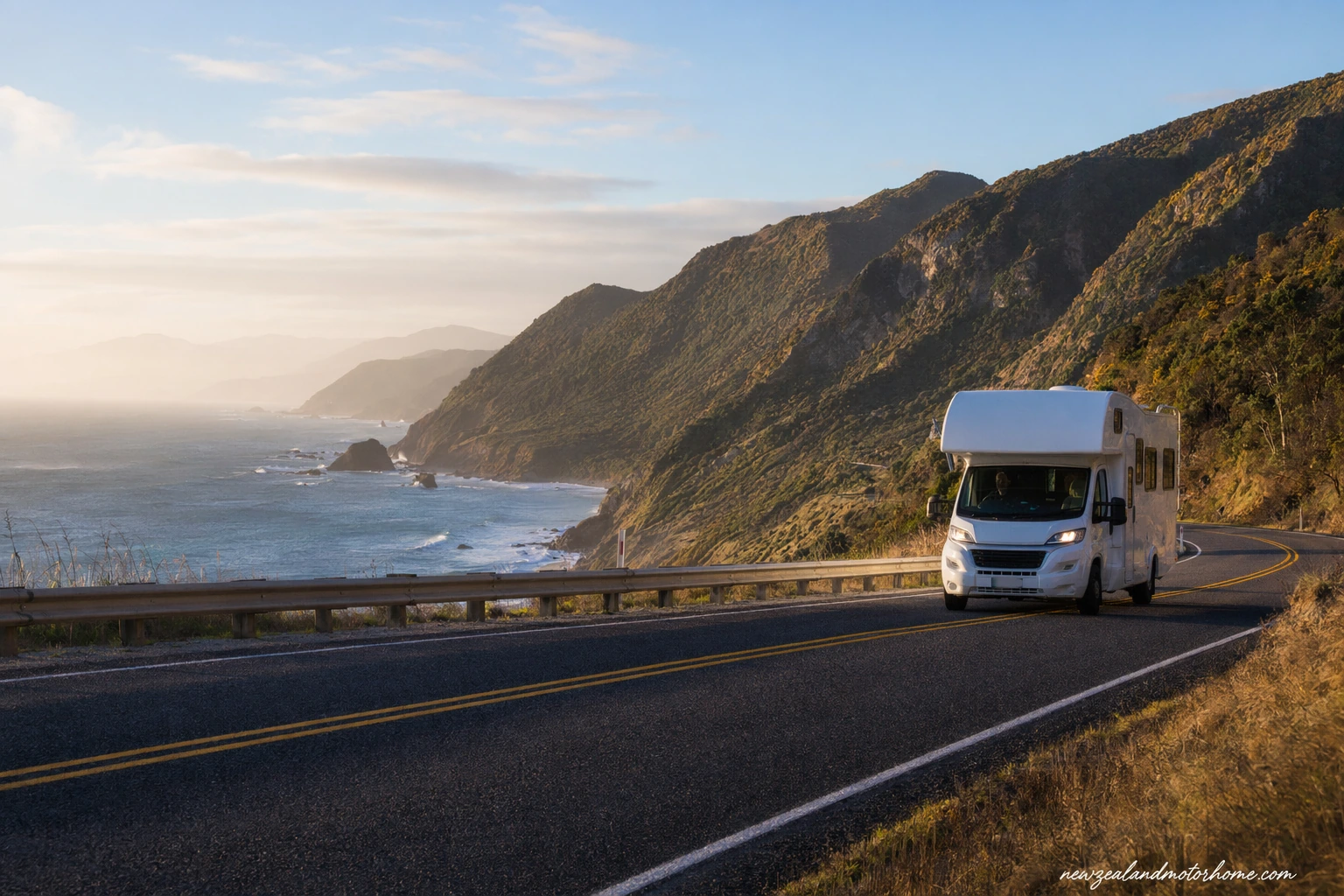
Invercargill to Gisborne campervan route for a big NZ crossing
- Best with 8-12 days
- Cook Strait ferry required
- Mix powered sites and permitted freedom camping
- Check SH2 Napier-Gisborne after rain
- Certified self-contained van recommended
An Invercargill to Gisborne campervan journey is not a quick point-and-shoot drive. You are taking a hired home on wheels from the bottom of the South Island, up the eastern side, across Cook Strait, then through the lower North Island to the warm, surfy edge of Tairāwhiti.
This guide is written for self-drive van travellers: where the road feels easy or slow, where to break the trip, how to think about powered sites versus freedom camping, and where to keep an eye out for dump stations, fresh water and LPG. Treat it as a practical route plan, then adjust the pace around ferry times, weather and how long you like to linger beside the sea.
Route shape, distance and days to allow
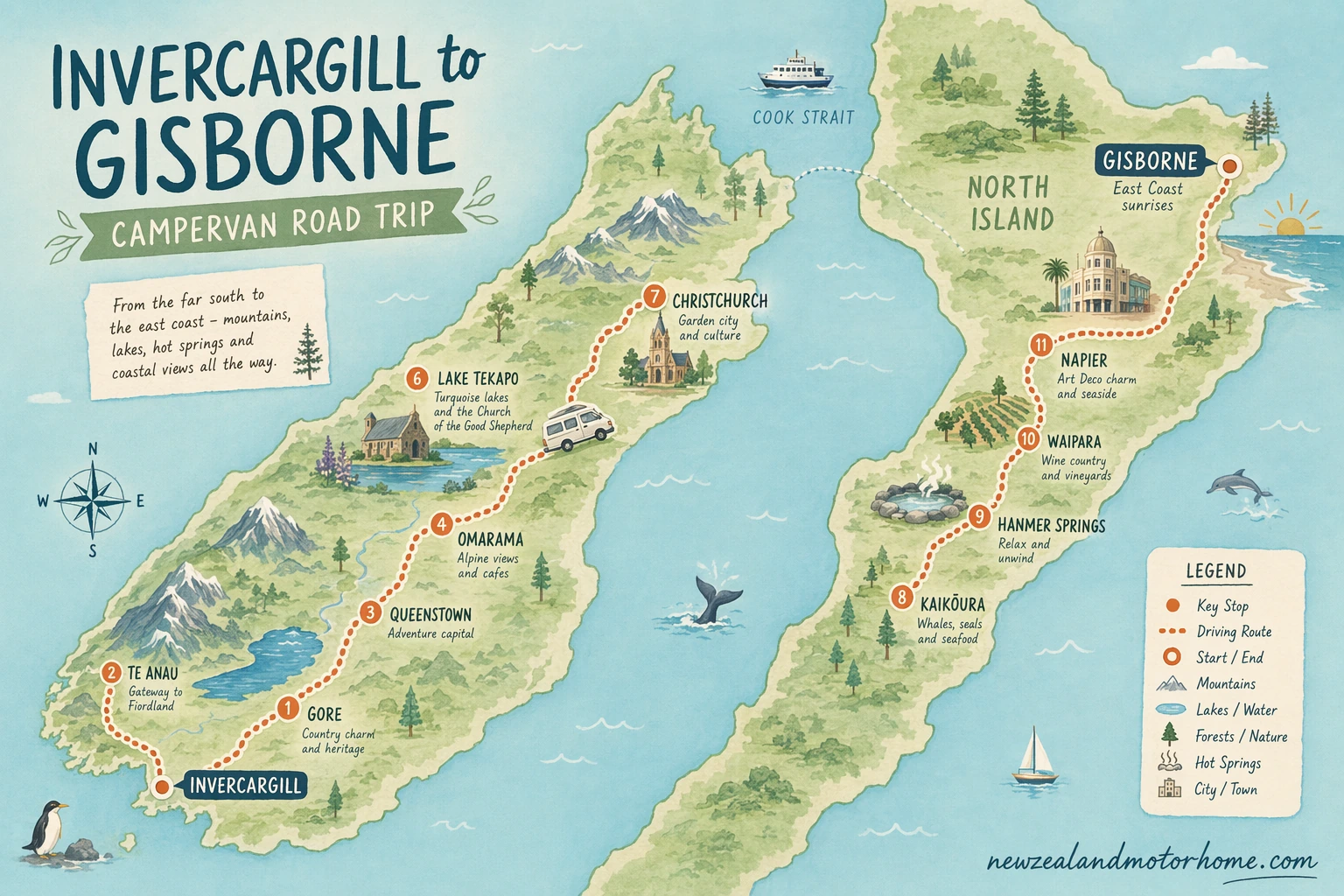
The most direct Invercargill to Gisborne drive follows SH1 north through Otago, Canterbury and Marlborough, crosses Cook Strait by ferry, then continues through Wellington, Hawke's Bay and Wairoa to Gisborne. With the ferry included, expect roughly 1,250 to 1,350 kilometres of driving, depending on where you detour and where you overnight.
For a comfortable Invercargill to Gisborne motorhome road trip, allow 8 to 12 days. You can technically move faster, but long van days become tiring on the Kaikōura coast, around Wellington, and on SH2 between Napier and Gisborne. Build in at least one short day after the ferry so you are not trying to tackle hills, wind and city traffic while tired.
- Minimum practical pace: 6 to 7 days, with long driving days and limited exploring.
- Better pace: 9 to 10 days, with time for Dunedin, Kaikōura, Wellington or Napier.
- Slow, scenic pace: 12 days or more, adding the Catlins, Banks Peninsula or extra Gisborne coast time.
If you want help fitting the ferry, overnight stops and van size into one clean plan, you can send your dates through /talk-to-us/ and we will help shape the route around how you actually travel.
Leg 1: Invercargill to Dunedin, Oamaru or Timaru
Leaving Invercargill, stock the van before you roll: groceries, drinking water, LPG if your bottle is low, and a toilet cassette empty if you have already been freedom camping. Invercargill has easier large-vehicle streets than many NZ cities, but choose supermarket and park-side spaces where you can drive through rather than reverse a long motorhome into busy angled parking.
The simplest line north is SH1 through Gore or Balclutha to Dunedin, then on to Oamaru and Timaru. The Catlins is a beautiful add-on, but it is slower, narrower and more exposed in wind; if you take it in a larger motorhome, start early and avoid arriving at rural campsites after dark.
- Dunedin: good for a powered night, laundry, supermarket restock and a dump station before the longer coastal run north.
- Oamaru: useful harbour stop for a shorter driving day; check local signs carefully for day parking versus overnight rules.
- Timaru: a sensible break before Christchurch if you want to avoid arriving in city traffic late in the day.
Watch your speed on the rolling Southland and Otago highways. A campervan feels stable until a gust, passing truck or rough shoulder reminds you it is taller and heavier than a car. Use slow-vehicle bays, pull over where safe, and give following traffic space to pass.
Leg 2: Canterbury coast, Kaikōura and Picton ferry planning
From Timaru or Oamaru, continue north through Ashburton and Christchurch. If you do not need city time, consider skirting Christchurch outside peak commuter hours and aiming for a holiday park or council camping area north of the city. This keeps the next day to Kaikōura more relaxed.
The SH1 coastal road around Kaikōura is one of the best scenic sections of this route, but it is not a road for rushing in a van. Expect tunnels, curves, rail crossings, sea glare and busy pull-outs. South Bay is often easier for larger vehicle parking than squeezing into the most crowded town-front spaces.
- Kaikōura overnight: choose a powered site if your fridge, heater or house battery has been working hard.
- Blenheim or Picton overnight: practical before an early ferry, with dump, fresh-water and grocery options nearby.
- Ferry booking: book the campervan length, height, bike racks and any rear overhang accurately.
For the Cook Strait crossing, turn LPG bottles off as instructed and arrive with enough time to queue without stress. Do not assume you can sleep at or near the terminal; use a proper campground or permitted overnight area the night before, then board rested.
Leg 3: Wellington to Hawke's Bay and Gisborne
After the ferry, Wellington is the one place on this route where van size really changes the day. Central streets, steep suburbs and tight paid parking are not relaxing in a motorhome. If you want city time, park or stay on the fringe and use public transport or walking routes rather than driving the van into every stop.
There are two sensible ways north-east. The scenic line goes over the Remutaka Hill into the Wairarapa, then through Masterton, Dannevirke and on to Hawke's Bay. The easier big-van alternative is to head north on SH1 and cut across toward Hawke's Bay, avoiding the tightest hill driving at the cost of extra kilometres.
- Remutaka Hill: sealed and commonly driven by motorhomes, but winding, exposed and best taken slowly in low gear on descents.
- Napier or Hastings: strong restock point before the more isolated Gisborne leg; fill water and empty waste here if needed.
- Napier to Gisborne via SH2: allow time for hills, roadworks and weather-related delays, especially around Wairoa and the Wharerata section.
Try not to drive the Napier to Gisborne stretch late in the day. It is fully doable in a hired campervan, but the bends, bridges and changing surfaces ask for attention. Check Waka Kotahi road updates after heavy rain, as this part of the country can be affected by slips and closures.
Overnight stops, freedom camping and van services
On a route this long, mix powered sites with the occasional unpowered or freedom camping night. Powered sites are not just about comfort; they give your house battery a proper reset, let you run heating or cooling without anxiety, and make laundry, showers and cassette emptying much easier.
Freedom camping rules vary sharply between Southland, Otago, Canterbury, Marlborough, Wellington, Hawke's Bay and Gisborne. You generally need a certified self-contained vehicle, and in many areas you must use only signed or mapped permitted spots. If there is a no camping sign, a full car park, or no safe way to park within marked bays, move on.
- Dump stations: plan regular empties at larger towns such as Invercargill, Dunedin, Oamaru, Christchurch, Kaikōura, Blenheim, Wellington, Napier, Wairoa and Gisborne.
- Fresh water: refill from signed potable taps only; do not use beach showers or garden taps unless clearly permitted.
- LPG: top up in the larger service centres rather than waiting for remote East Coast stretches.
- Arrival habit: reach overnight stops by mid-afternoon where possible, especially in summer and school holidays.
In Gisborne, be especially careful with foreshore and reserve parking rules. Day parking near beaches and lookouts can be excellent for lunch or a swim, but overnight camping is only for places where the local signage or council information allows it.
Keep planning
Common questions
How many days do I need for an Invercargill to Gisborne campervan trip?
Allow at least 8 to 10 days for a comfortable trip, including the ferry. Six or seven days is possible if you mainly drive, but it leaves little room for weather, road delays or proper rest days in a motorhome.
Do I need to book the Cook Strait ferry in advance with a campervan?
Yes, especially in summer, school holidays and around public holidays. Book the correct vehicle length and height, including bike racks or rear storage, and follow ferry instructions for LPG and gas appliances.
Is the Napier to Gisborne road suitable for a motorhome?
SH2 from Napier to Gisborne is suitable for campervans and motorhomes, but it is not a fast road. Expect hills, bends, narrow sections, roadworks at times and weather-related disruptions, so drive it in daylight and check road conditions before leaving.
Can I freedom camp the whole way from Invercargill to Gisborne?
Not realistically. You will cross several council areas with different bylaws, and many places allow freedom camping only in designated areas for certified self-contained vehicles. Plan paid campground nights for power, showers, laundry, dumping and water refills.
What is the best overnight pattern for this route?
A simple pattern is Invercargill, Dunedin or Oamaru, Christchurch or north Canterbury, Kaikōura, Picton or Blenheim, Wellington/Wairarapa, Napier, then Gisborne. Add extra nights if you want the Catlins, Wellington city time or a slower East Coast finish.
Have a planner shape this for your dates
Send a short outline — your dates, party size, and the kind of trip you want. A planner replies with a vehicle recommendation, a paced route, and the realistic budget.