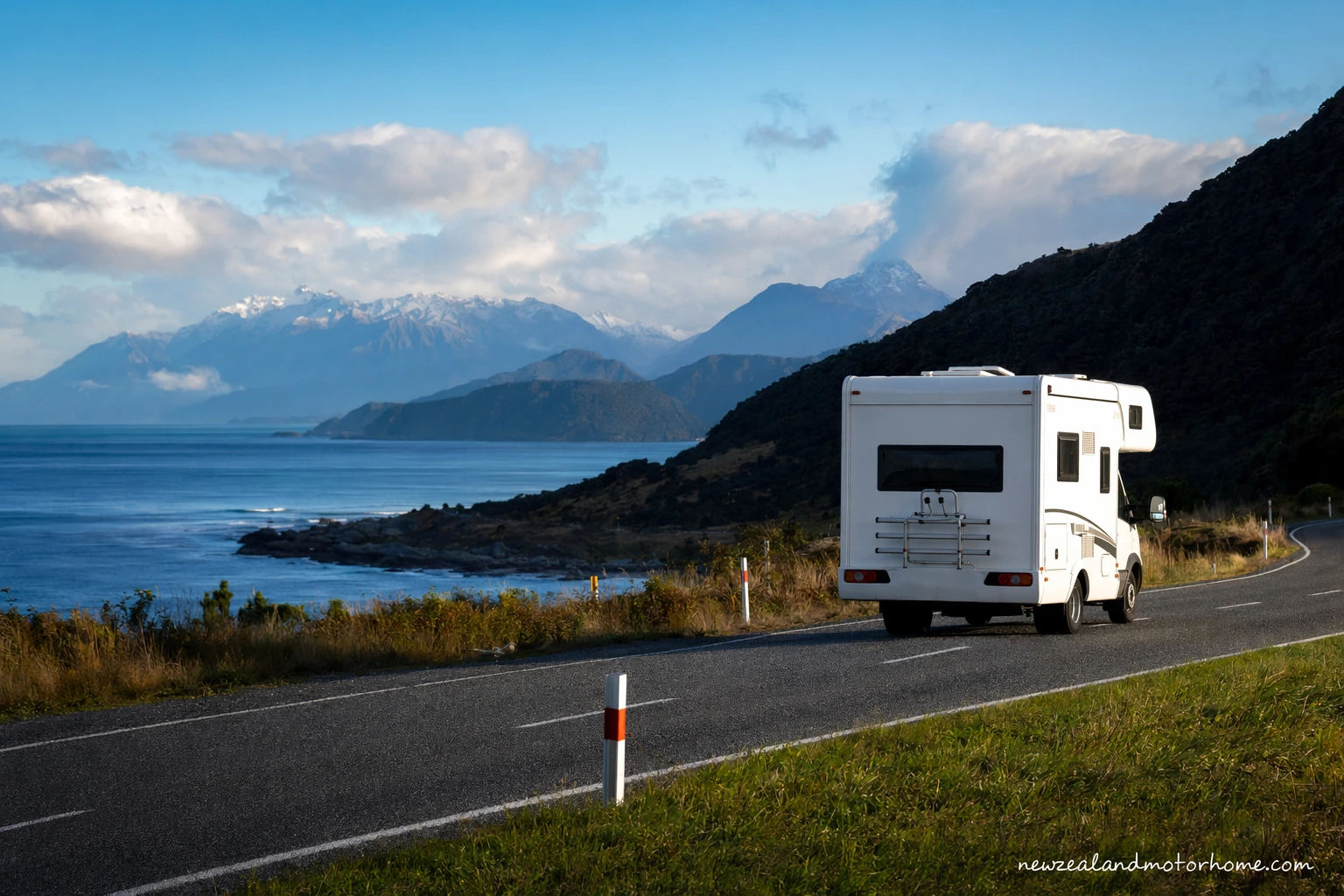
- Allow 8-12 days
- Cook Strait ferry required
- Best in spring-autumn
- Powered sites every 2-3 nights
- Check self-containment rules
A tauranga to invercargill campervan trip is a proper end-to-end New Zealand drive: Bay of Plenty beaches, the Central Plateau, the Cook Strait ferry, Canterbury plains, Otago coast and the wide, windswept run into Southland. It is not a route to rush if you are living out of the van; the distance, ferry timing, weather and dump-station rhythm all matter.
This guide is written for self-drive campervan and motorhome travellers, so the focus is practical: where to break the tauranga to invercargill drive, when to choose powered sites, how to handle water and LPG, what roads feel easy in a longer vehicle, and where to slow down for a better overnight stop.
How many days to allow in a campervan
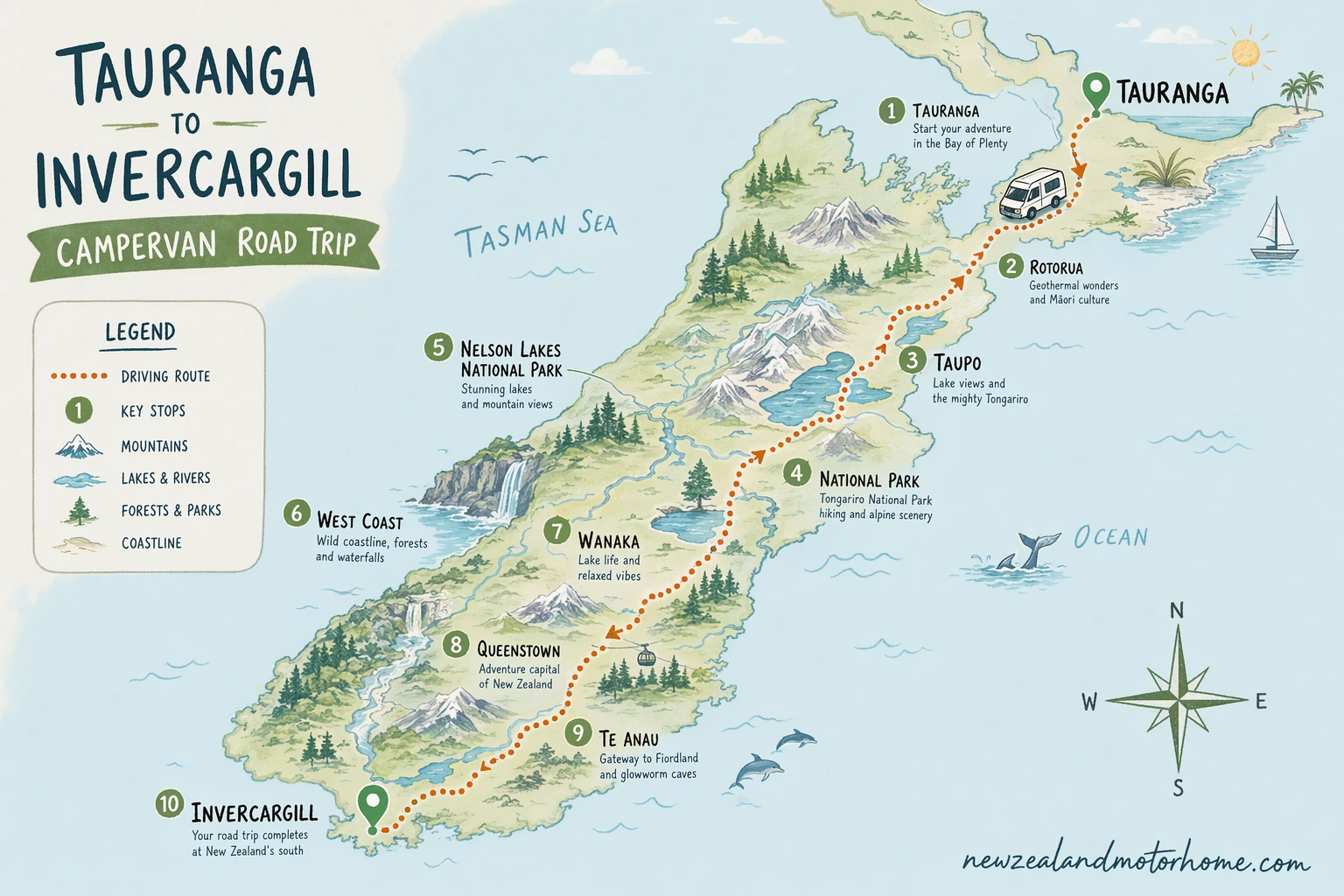
You can physically complete a tauranga to invercargill motorhome road trip in about five long driving days if ferry times line up, but it will feel more like a relocation than a holiday. For a settled campervan pace, allow 8 to 12 days. That gives you time to charge batteries on powered sites, empty waste regularly, wait out a windy Cook Strait crossing if needed, and arrive in Southland without feeling wrung out.
A comfortable southbound rhythm is Tauranga to Taupō, Taupō to the lower North Island, ferry to Picton, then two or three legs through the South Island before pushing into Invercargill. If you have a larger motorhome, shorter daily distances also make supermarket stops, fuel fills and campground check-ins easier.
- Fast but tiring: 5 to 6 days, mostly one-night stops and motorway-style driving days.
- Balanced: 8 to 10 days, with a rest night in Taupō, Wellington/Picton or Otago.
- Slow scenic: 12+ days, adding Kaikōura, Mackenzie Country, Dunedin or the Catlins.
- Best first booking: the Cook Strait ferry, especially once you know your van length and height.
North Island leg: Tauranga to Wellington
From Tauranga, most campervan travellers head inland through the Waikato and Taupō rather than trying to stitch together too many coastal detours. SH29 over the Kaimai Range has steeper sections and can be busy with freight, so use lower gears on descents and give yourself room if the van is heavy with water, food and luggage.
Taupō is the natural first overnight stop. It has holiday park options where you can plug in, refill fresh water, use showers and reset after the first day. If you are certified self-contained and considering freedom camping near the lake, check current local rules carefully; many lakefront areas have restrictions, time limits or designated bays only.
The next leg runs past the Central Plateau and down SH1 towards the lower North Island. The Desert Road can close in snow, ice or high wind, and it is exposed enough that a high-sided motorhome can feel it. Keep water topped up before you leave Taupō or Tūrangi, but avoid travelling with a completely full fresh tank if you are trying to keep weight down on a long driving day.
- Good van reset points: Taupō/Tūrangi, Bulls or the Kāpiti/Wellington region.
- Road watch: Kaimai Range gradients, Desert Road weather, Wellington wind.
- Practical tip: arrive near Wellington with enough time to dump waste and sort food before the ferry.
Cook Strait ferry planning for motorhomes
The ferry is the hinge of this route. Book using the exact length and height of your campervan or motorhome, including bike racks, rear boxes and anything on the roof. Turning up with the wrong dimensions can cause delays, and peak sailings can be tight for larger vehicles.
Before boarding, secure cupboards, close roof vents, turn LPG off as required by the operator, and keep any medication, jackets, chargers and snacks with you because you generally cannot access the vehicle deck during the crossing. If the forecast is rough, consider leaving a buffer night either side rather than locking in a big drive immediately after arrival.
For overnights, avoid assuming you can simply sleep close to the ferry terminal. Wellington and Picton both have rules around overnight parking, and spaces that suit a 7-metre motorhome are not the same as spaces that suit a car. A powered site before or after the crossing is often worth it for battery charging, laundry and an easy morning departure.
South Island options: Picton to Otago
From Picton, the straightforward line south is via Blenheim, Kaikōura, Christchurch and then down the east coast towards Otago. It is the most practical route for a longer van because you stay close to fuel, supermarkets, dump stations and holiday parks. The Kaikōura coast is stunning, but allow extra time for slow sections, seal viewing pull-offs and roadworks after weather events.
Christchurch makes a useful service stop on the tauranga to invercargill campervan route. This is a good place to restock, check tyres, refill LPG if needed and book a powered night if the house battery has been working hard. South of Christchurch, the drive through Ashburton, Timaru and Oamaru is easier on wider roads, though crosswinds can be noticeable across the plains.
If you have extra days, you can swing inland through Lake Tekapō and the Mackenzie Basin before returning towards Oamaru or Dunedin. It is a beautiful motorhome detour, but winter ice, alpine weather and fully booked campsites can make it less forgiving. In summer, book ahead for powered sites around popular lake towns rather than arriving late in a large van.
- Direct and practical: Picton, Kaikōura, Christchurch, Oamaru, Dunedin.
- Scenic detour: Tekapō and the Mackenzie Basin if time and weather suit.
- Van note: use signed pull-outs on the Kaikōura coast; do not squeeze onto narrow shoulders for photos.
Dunedin, the Catlins and the final run to Invercargill
Dunedin is a sensible last city stop before Southland. Use it to fill food, fresh water and LPG, and to empty grey and black water before heading into smaller-town country. Central Dunedin streets can be tight for larger motorhomes, so park in larger signed parking areas and walk or use local transport where practical.
From Dunedin, the simplest drive is through Balclutha and Gore or onwards towards Invercargill on the main highways. If you have time, the Catlins route is more memorable, with forest, waterfalls, surf beaches and lighthouse country, but it is slower and has fewer services. Some roads to lookouts and bays are narrow, gravel or not ideal for long rear overhangs, so read signs before committing the van down a side road.
Freedom camping rules vary across Clutha, the Catlins and Southland, and they can change. If you are relying on self-contained overnight stops, check the current council maps and respect no-camping areas, especially near beaches and reserves. If you would like the route shaped around your van size, ferry date and preferred mix of powered sites and freedom camping, you can ask us through /talk-to-us/ before you lock it in.
Dump stations, water, LPG and overnight strategy
On a route this long, do not leave waste and water until the warning lights come on. A good pattern is to empty grey and toilet cassettes every two or three days, refill fresh water when you are already at a holiday park or public dump station, and plan LPG before rural stretches. In winter, LPG use rises quickly if you are heating the van at night.
Holiday parks are the easiest reset because you can usually combine a powered site, showers, laundry, rubbish disposal and dump-station access. Unpowered sites work well when you have solar and moderate weather, but long driving days, cloudy conditions and fridge use can drain batteries faster than expected. Freedom camping should only be used where your vehicle meets the current self-containment requirements and local bylaws allow overnighting.
- Useful service towns: Taupō, Tūrangi, Wellington region, Picton, Kaikōura, Christchurch, Timaru, Oamaru, Dunedin, Balclutha and Invercargill.
- Powered nights: plan them before/after the ferry and after cold or wet stretches.
- Fresh water: fill from signed potable taps only, not public bathroom basins or beach taps.
- Waste: use official dump stations; never empty grey water into drains or onto grass.
Keep planning
Common questions
How far is the Tauranga to Invercargill drive in a campervan?
Can I freedom camp the whole way from Tauranga to Invercargill?
Is the route suitable for a large motorhome?
Where should I book powered sites?
What is the best season for this campervan route?
Do I need to book the Cook Strait ferry ahead?
Have a planner shape this for your dates
Send a short outline — your dates, party size, and the kind of trip you want. A planner replies with a vehicle recommendation, a paced route, and the realistic budget.