- Best with 3 to 6 nights
- Good year-round, wet roads need care
- Self-contained rules vary by district
- Service vans in main towns
- Large vans need early parking at attractions
The Waikato is made for a self-drive campervan loop: green dairy country, limestone caves, surf-town evenings, river walks and easy overnight hops between towns. The best campervan stops Waikato travellers talk about are not always the flashiest ones — often they are the pull-in with room to turn, the holiday park near a dump station, or the viewpoint where you can open the side door and make a proper cup of tea.
This guide is written for people driving and sleeping in their hired van. You will find practical notes on where a campervan fits, how to think about freedom camping Waikato rules, where powered sites are useful, and how to string Hamilton, Raglan, Waitomo, Matamata and the inland lakes into a sensible route.
How to shape a Waikato campervan loop
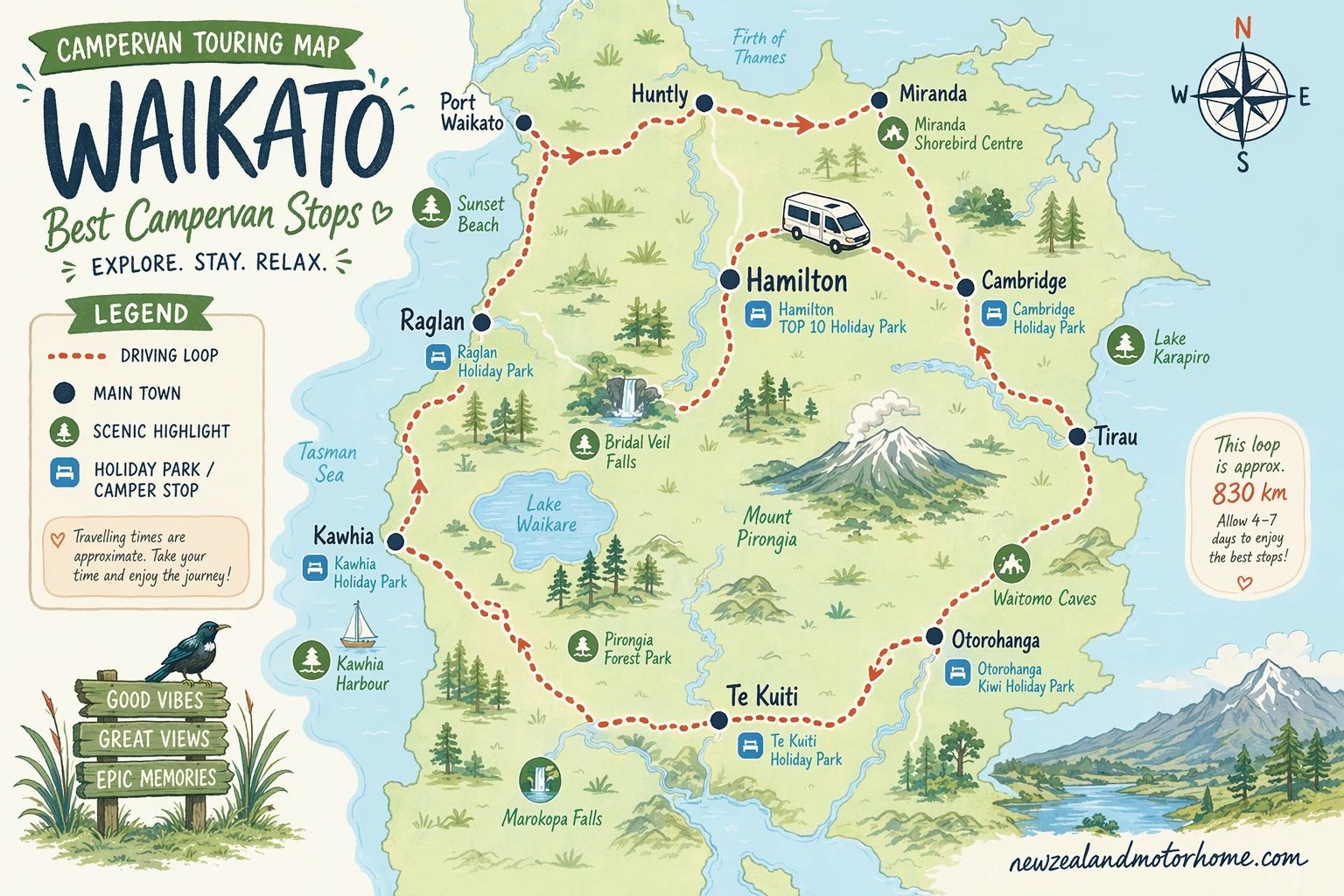
A comfortable Waikato loop usually works best as a slow triangle rather than a straight dash. Start with Hamilton or Cambridge for supplies, swing west to Raglan if the weather is kind, drop south to Waitomo and Ōtorohanga, then return through Te Awamutu, Maungatautari, Matamata or Te Aroha depending on how much time you have.
For most hired motorhomes, the main roads are straightforward, but the smaller scenic roads can be narrow, shaded and bendy after rain. If you are in a longer van, allow extra time near Raglan, Waitomo backroads and rural one-lane bridges; you will enjoy the drive more if you are not arriving at your overnight stop in the dark.
- Easy pace: 3 nights gives you Hamilton/Cambridge, Raglan and Waitomo without rushing.
- Better pace: 5 to 6 nights lets you add Maungatautari, Matamata, Te Aroha or extra beach time.
- Van services: Hamilton, Cambridge, Te Awamutu, Raglan and the Waitomo/Ōtorohanga area are the logical places to check dump stations, fresh water and LPG before heading rural.
- Planning help: if you want the route matched to your vehicle size and campsite style, use the soft planning step at /talk-to-us/ before you lock in the hire dates.
Hamilton, Cambridge and Lake Karāpiro: easy first-night stops
Hamilton is the practical reset point of the region. Park the van for Hamilton Gardens early in the day if you want easier spaces, then keep valuables out of sight and avoid squeezing into central streets that are better suited to cars. The river paths are a good leg-stretch after a long drive, especially if you have just collected the campervan.
Cambridge is gentler for an overnight stop, with a compact town centre, good food supplies and quick access to Lake Karāpiro. Around the lake, use formed parking areas and watch for event traffic; rowing and cycling weekends can fill the easiest bays quickly, and grass verges are not a good idea for heavy motorhomes after rain.
- Where to stay campervan Waikato style: choose a holiday park or designated motorhome site around Hamilton, Cambridge or Karāpiro if you want a low-stress first night.
- Powered vs unpowered: powered sites are handy here for topping up batteries before quieter rural nights.
- Servicing: this is one of the best parts of the region to empty grey water, refill fresh water and check LPG before heading west or south.
- Driving note: keep an eye on bridge approaches and low tree cover near river and lake reserves if your van is tall.
Raglan coast, harbour views and Waireinga/Bridal Veil Falls
Raglan is one of the classic campervan stops in the Waikato, but it rewards patience. The road in from Hamilton is sealed and scenic, with bends and hills that feel bigger in a motorhome than on a map. Once in town, park in larger edge-of-centre spaces where you can open doors safely, then walk to the wharf, harbour and cafés rather than nudging the van into tight streets.
For Waireinga/Bridal Veil Falls, use the signed car park and go early or later in the day if you are driving a larger van. The walk is short but the parking area can be busy in fine weather; do not overhang the road edge, and be ready to move on if there is no sensible place to fit.
- Overnight options: Raglan has holiday park-style camping where powered sites are useful after a beach day with wet towels, cameras and devices.
- Freedom camping Waikato note: only stay where the current district signs or council information allow it, and only if your van meets self-containment requirements.
- Best pull-ins: harbour viewpoints, the wharf area and west-coast lookouts are better daytime stops than overnight assumptions.
- Road note: after heavy rain, expect slippery rural shoulders and take extra care turning a long vehicle around near beach access roads.
Waitomo, Ōtorohanga and Pirongia: caves, birds and rural nights
Waitomo is an attraction stop where your campervan logistics matter. Cave tours and short walks are much easier if you arrive with time to park properly, because the village roads and attraction car parks can get busy. If you are in a longer motorhome, avoid last-minute manoeuvres and use designated visitor parking rather than roadside edges.
Nearby Ōtorohanga and Pirongia make useful overnight bases if you want a quieter evening after the caves. They also help break the drive between Raglan and the southern Waikato without pushing into winding rural roads late in the day.
- Good daytime stops: Waitomo village, Ruakuri walk area, Mangapohue Natural Bridge and Pirongia village all work well with a sensible arrival time.
- Van fit: limestone-country side roads can be narrow; fold mirrors where needed and pull over only in firm, formed areas.
- Where to stay: look for holiday park, farm-stay campground or designated self-contained options around Waitomo, Ōtorohanga and Te Kuiti rather than assuming every reserve allows overnighting.
- Servicing: check dump station and fresh-water options before you leave the main towns, as rural scenic stops are often toilet-and-walkway only.
Matamata, Maungatautari and Te Aroha for a slower inland finish
The eastern side of a Waikato loop is softer and more open, with excellent campervan breathing room if you plan it well. Matamata is the obvious stop for film-set visitors, but it is also useful for groceries and fuel before continuing to Cambridge, Te Aroha or the Kaimai foothills.
Sanctuary Mountain Maungatautari is a memorable nature stop, especially if you want native bush and birdlife without pushing deep into backcountry roads. Te Aroha adds heritage streets, mountain views and a relaxed final night, with the bonus of being close to routes north towards the Coromandel or back towards Auckland.
- Parking the van: use signed visitor parking at attractions and avoid small town angle parks if your rear overhang blocks traffic.
- Overnight style: this side of the region suits a mix of powered holiday park nights and designated self-contained stops, depending on your battery, water and toilet capacity.
- Road note: Kaimai and foothill roads can be steep and misty; descend in a lower gear and let faster traffic pass when safe.
- Route link: Matamata to Cambridge to Hamilton is an easy return, while Te Aroha makes a good stepping stone if your next campervan leg is the Coromandel or Bay of Plenty.
Common questions
Can I freedom camp in the Waikato in a campervan?
Sometimes, but it depends on the district, the exact location and your van's self-containment certification. Always check current council signs or official maps before staying overnight, because rules can change between reserves, beaches and town car parks.
How many days should I allow for the best campervan stops in Waikato?
Allow at least 3 nights for Hamilton or Cambridge, Raglan and Waitomo. With 5 to 6 nights you can slow down, add Maungatautari, Matamata or Te Aroha, and avoid driving rural roads after dark.
Are Waikato roads suitable for a large motorhome?
Most main Waikato roads are fine for larger motorhomes, but take care on the Raglan road, Waitomo side roads, rural bridges and steep Kaimai approaches. Drive slower than you would in a car, use formed pull-offs only, and plan parking before you reach busy attractions.
Where should I fill water and empty waste in the Waikato?
Hamilton, Cambridge, Te Awamutu, Raglan and the Waitomo/Ōtorohanga area are the practical places to check for dump stations, fresh-water fills and LPG. Do this before heading to beaches, waterfalls or rural reserves, where facilities are often limited.
Do I need powered sites every night?
Not necessarily if your campervan has good house batteries, solar and you are driving regularly. Powered sites are still worth using after wet beach days, before quieter freedom camping nights, or when you need to recharge devices, run heating or reset the fridge properly.
Have a planner shape this for your dates
Send a short outline — your dates, party size, and the kind of trip you want. A planner replies with a vehicle recommendation, a paced route, and the realistic budget.