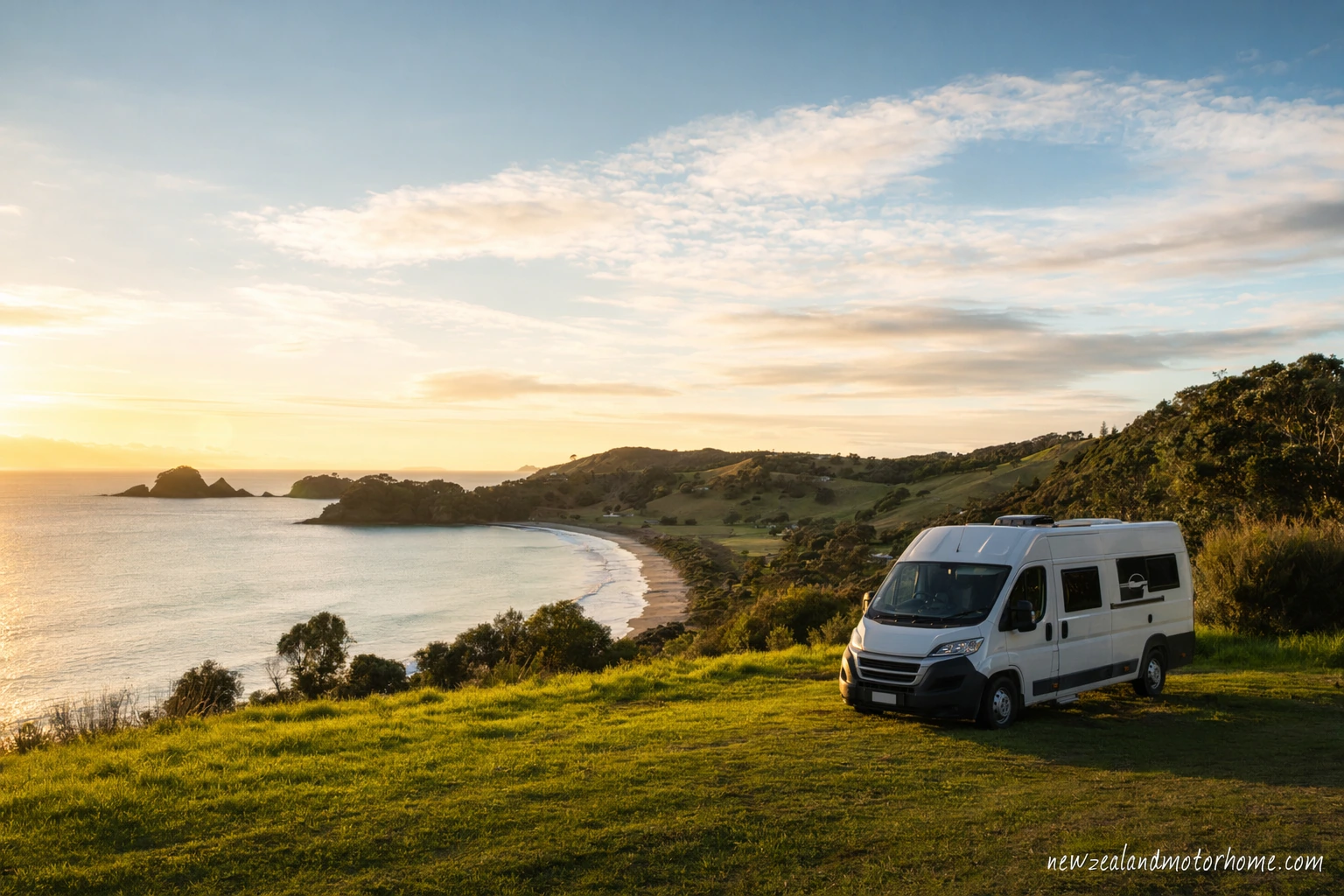
- Best season: March to May
- Summer sites book early
- Certified self-contained for freedom camping
- Allow 7–10 days for a relaxed loop
- Avoid Ninety Mile Beach driving
Northland is one of those regions where the van becomes part of the trip: sandy feet at the sliding door, wet towels over the cab seats, and a slower rhythm between harbours, headlands and kauri forest. The best time to visit Northland NZ depends less on one perfect month and more on how you feel about heat, school-holiday crowds, wet roads and how far you want to push north in a motorhome.
This guide is written for self-drive campervan and motorhome travellers, not day trippers. You will find the practical seasonal detail that matters on the road: when powered sites book out, when freedom camping is most tightly managed, what Northland weather by month usually feels like, and where to think ahead for water, LPG, dump stations and longer driving days.
Quick answer: March to May is the easiest Northland campervan season
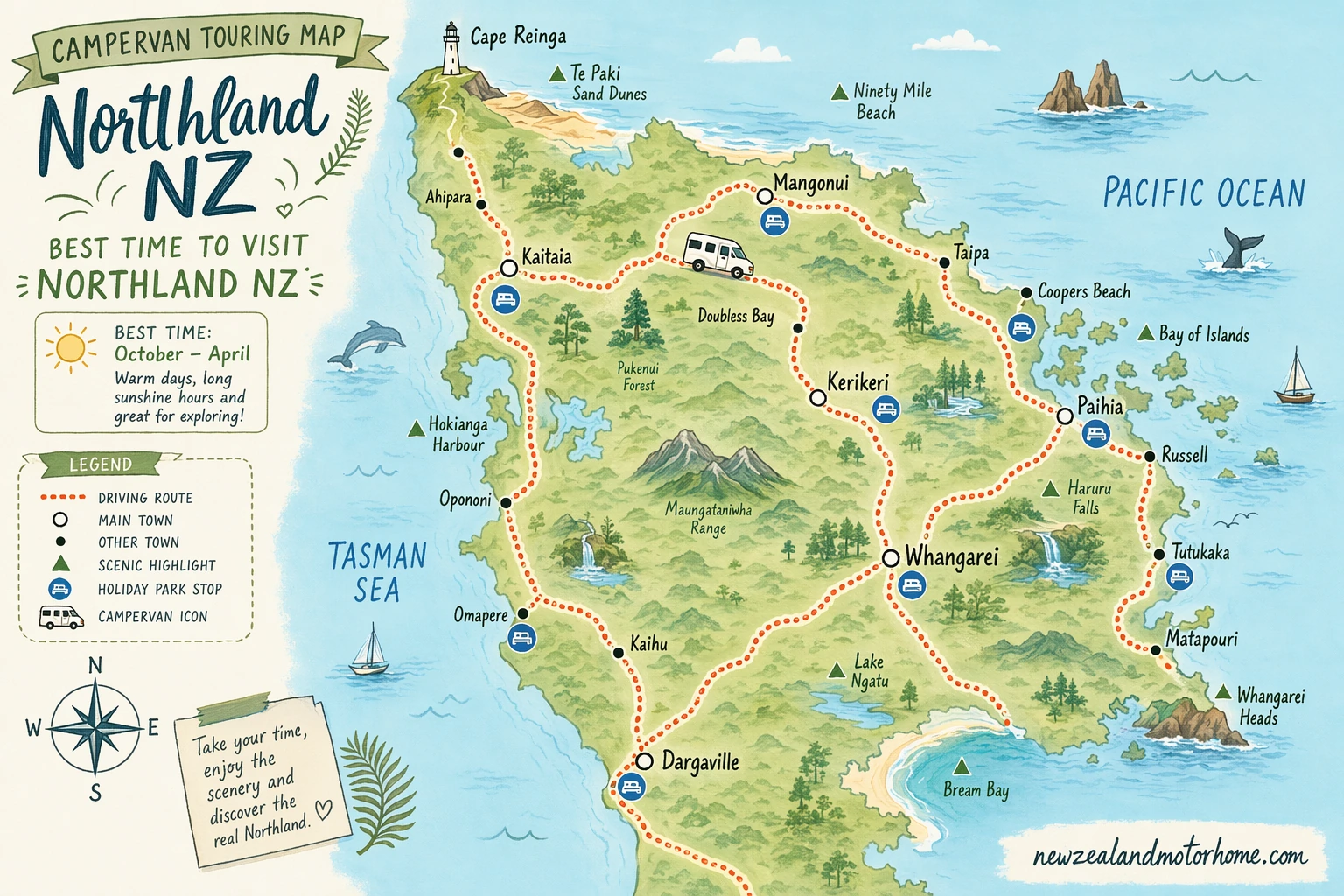
For most van travellers, March, April and early May are the sweet spot. The sea is still warm enough for swims around the Bay of Islands, Tutukaka, Doubtless Bay and Ahipara, but the busiest summer pressure has eased. Holiday parks are usually easier to book, powered sites are less frantic, and you are less likely to be shuffling the van between full campgrounds at the end of a hot day.
That said, when to visit Northland depends on your style of trip. Summer gives you long evenings and beach weather, winter gives you quieter roads and moody west-coast light, and spring suits travellers who do not mind showers between sunny breaks.
- Best all-round months: March, April and early May for warmth without peak crowds.
- Best for swimming and long daylight: December to February, with advance bookings essential.
- Best for quieter campgrounds: June to August, especially midweek.
- Best shoulder-season value: May, September and November, if you are flexible with weather.
Northland weather by month for campervan travel
Northland is subtropical by New Zealand standards, so winters are mild and summers can feel humid inside a parked van. Rain can arrive in any season, and it often falls hard for a short time rather than politely all day. In a motorhome, that means ventilation, shade, drying space and choosing sealed overnight sites matter as much as the forecast temperature.
As a broad guide, December to February is warm, busy and beach-focused. March and April are settled more often than not, with good swimming and fewer people. May starts to cool at night, while June to August brings wetter spells, softer ground and a stronger case for powered sites so you can run heating or dry gear responsibly. September and October are changeable, and November often feels like early summer before the main rush arrives.
- January: hottest and busiest; book powered or unpowered sites well ahead in Paihia, Russell, Tutukaka and coastal holiday parks.
- April: one of the most comfortable months for sleeping in the van without heavy condensation.
- July: quiet, green and damp; choose hardstand sites where possible.
- October: a good touring month, but keep a rain plan for Cape Reinga, Waipoua Forest and coastal walks.
Campsites, holiday parks and freedom camping by season
Northland has a mix of holiday parks, DOC-style camps, council-managed areas and private campgrounds, but the rules vary from district to district. If you are relying on freedom camping, do not assume that a beach car park allows overnight stays just because other vans are there. You will need a certified self-contained vehicle, and you still need to follow local signs and time limits.
In peak summer, treat Paihia, Russell, Kerikeri, Mangawhai, Tutukaka, Doubtless Bay, Ahipara and the Hokianga as book-ahead areas. Powered sites can disappear first because travellers want fans, charging and fridge confidence in the heat. Unpowered sites may be easier, but they are not a fallback if the campground is full.
- Summer: book holiday parks before you arrive, especially around Christmas, New Year and long weekends.
- Autumn: more flexibility for a loose route, though waterfront sites can still be popular.
- Winter: fewer crowds, but some smaller camp facilities may reduce hours or feel basic in wet weather.
- Spring: check ground conditions at grassy sites after rain, especially in a heavier motorhome.
Driving conditions: roads, vehicle size and northern distances
Northland looks compact on a map, but the driving is often slower than the kilometres suggest. Roads thread around harbours, ridgelines and forest, with plenty of bends and occasional narrow shoulders. A long-wheelbase campervan is fine on the main touring routes, but give yourself time, pull over to let locals pass, and avoid arriving at tight coastal campgrounds after dark.
If you are heading to Russell in a larger motorhome, the vehicle ferry route from Opua is usually less demanding than the winding coastal road through Helena Bay. The Waipoua Forest road is beautiful but narrow and shaded, so drive it in daylight and take extra care in wet conditions. For Cape Reinga / Te Rerenga Wairua, start with a full fuel tank, full fresh water and an empty grey-water tank; services thin out as you travel north.
- Ninety Mile Beach: do not drive a hired campervan on the beach; use the sealed road and park at approved access points.
- Gravel roads: check your hire agreement before taking any unsealed access road to a remote bay or campground.
- Large motorhomes: watch overhanging branches, one-lane bridges and tight campground turns.
- Wet weather: avoid soft verges and choose sealed or gravel hardstand parking where available.
What is open, and how to keep the van supplied
Northland’s main towns are your best places to reset the van. Whangārei, Kerikeri, Paihia, Kaitaia and Dargaville are useful for supermarkets, fuel, LPG swaps or fills, laundries, fresh-water top-ups and dump stations. Smaller coastal settlements may have limited hours outside summer, so do not leave your grey-water tank, toilet cassette or drinking water until the last minute.
In summer, cafés, boat trips and campground offices usually run longer hours, but queues and full car parks are part of the trade-off. In winter, you get quieter bays and easier parking, but it pays to check opening days for activities and to arrive at camp before reception closes. If you want help matching your travel dates with a sensible loop, you can talk to us before you lock in the van and nights.
- Before Cape Reinga: fill fuel and water, empty waste, and carry food for the day.
- Before Waipoua or Hokianga: check dump station locations and allow for slower forest and harbour roads.
- Before beach stays: confirm whether your site is powered, unpowered, self-contained only, or no overnight parking.
Common questions
What is the best month to campervan around Northland?
April is hard to beat for a Northland motorhome trip: warm days, swimmable water, fewer summer crowds and more campsite choice. March and early May are also excellent if you want a relaxed coastal loop.
Is Northland too wet for a winter campervan trip?
No, but you should plan for damp gear, shaded roads and softer campsite ground. Choose powered sites or hardstand parking more often, keep your driving days shorter, and avoid leaving forest or coastal roads until after dark.
Do I need to book campsites in Northland in summer?
Yes, especially from late December through January and on long weekends. Book ahead for Paihia, Russell, Tutukaka, Mangawhai, Doubtless Bay, Ahipara and popular beachfront holiday parks, whether you want powered or unpowered sites.
Can I freedom camp around Northland beaches?
Only where local rules and signs allow it, and only if your campervan meets the required self-containment certification. Northland councils actively manage popular coastal spots, so always check the sign where you park rather than relying on an app alone.
Is Cape Reinga suitable for a campervan day trip?
Yes, if you start early and treat it as a long driving day from Kaitaia, Ahipara or Doubtless Bay. Fill fuel and fresh water first, empty waste if needed, and do not plan to drive your hired campervan on Ninety Mile Beach.
Have a planner shape this for your dates
Send a short outline — your dates, party size, and the kind of trip you want. A planner replies with a vehicle recommendation, a paced route, and the realistic budget.