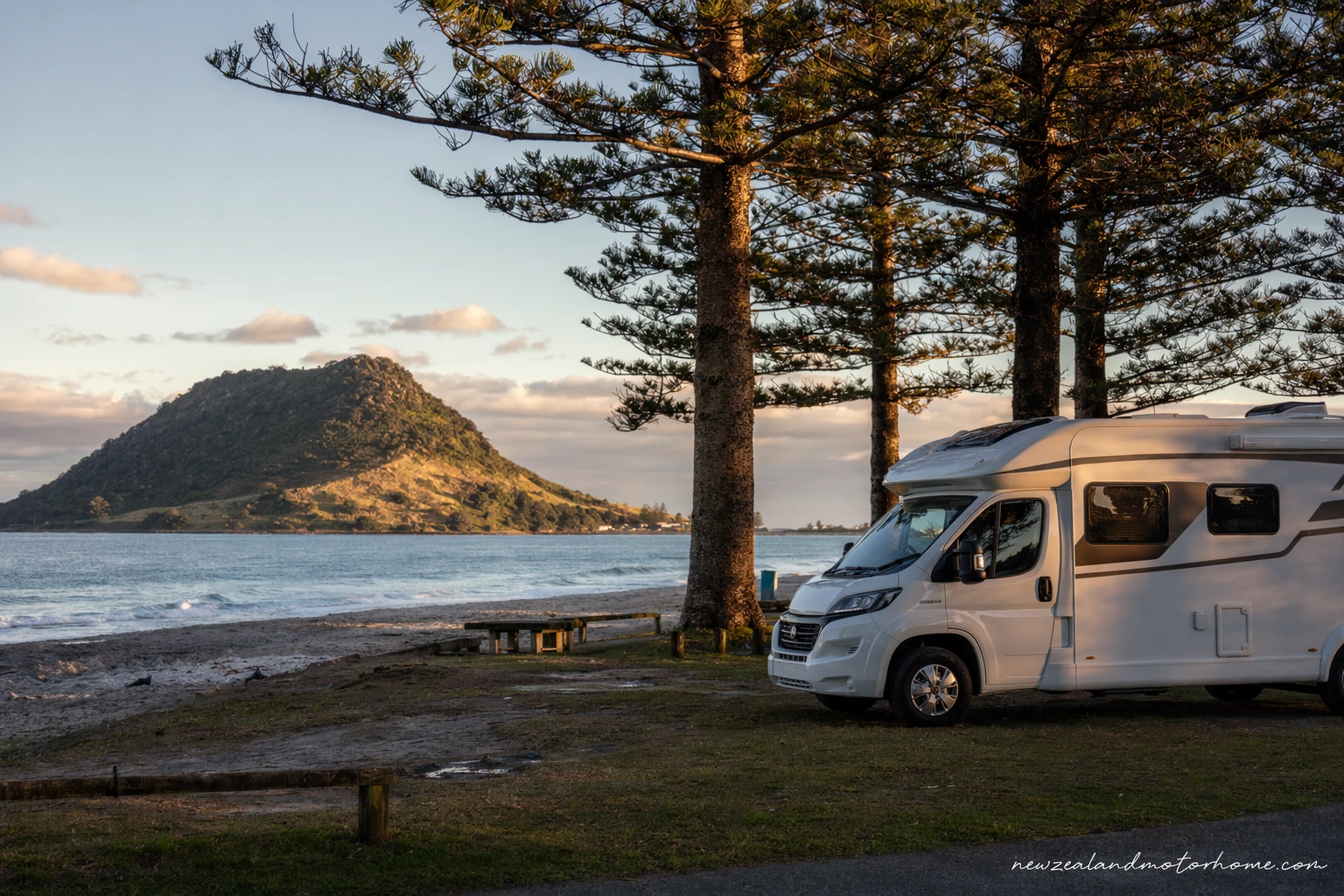
Mount Maunganui campervan guide for parking, stays and coastal driving
- Best with 2-3 nights
- Book summer sites early
- Tight central parking
- Powered sites useful
- Freedom camping restricted
Mount Maunganui is one of those places where a campervan makes perfect sense in theory: surf beach on one side, Pilot Bay on the other, Mauao rising at the end of the peninsula, and Tauranga just over the harbour. In practice, it pays to arrive with a plan, because central Mount streets are busy, summer parking is tight, and overnighting is tightly controlled.
This mount maunganui campervan guide is written for self-drive travellers sleeping in their own hired van or motorhome. You will find practical notes on getting there, where to park the van during the day, what to expect from powered and unpowered stays, how to manage water, LPG and dumping, and how to fit the Mount into a wider Bay of Plenty route.
Getting to Mount Maunganui by campervan
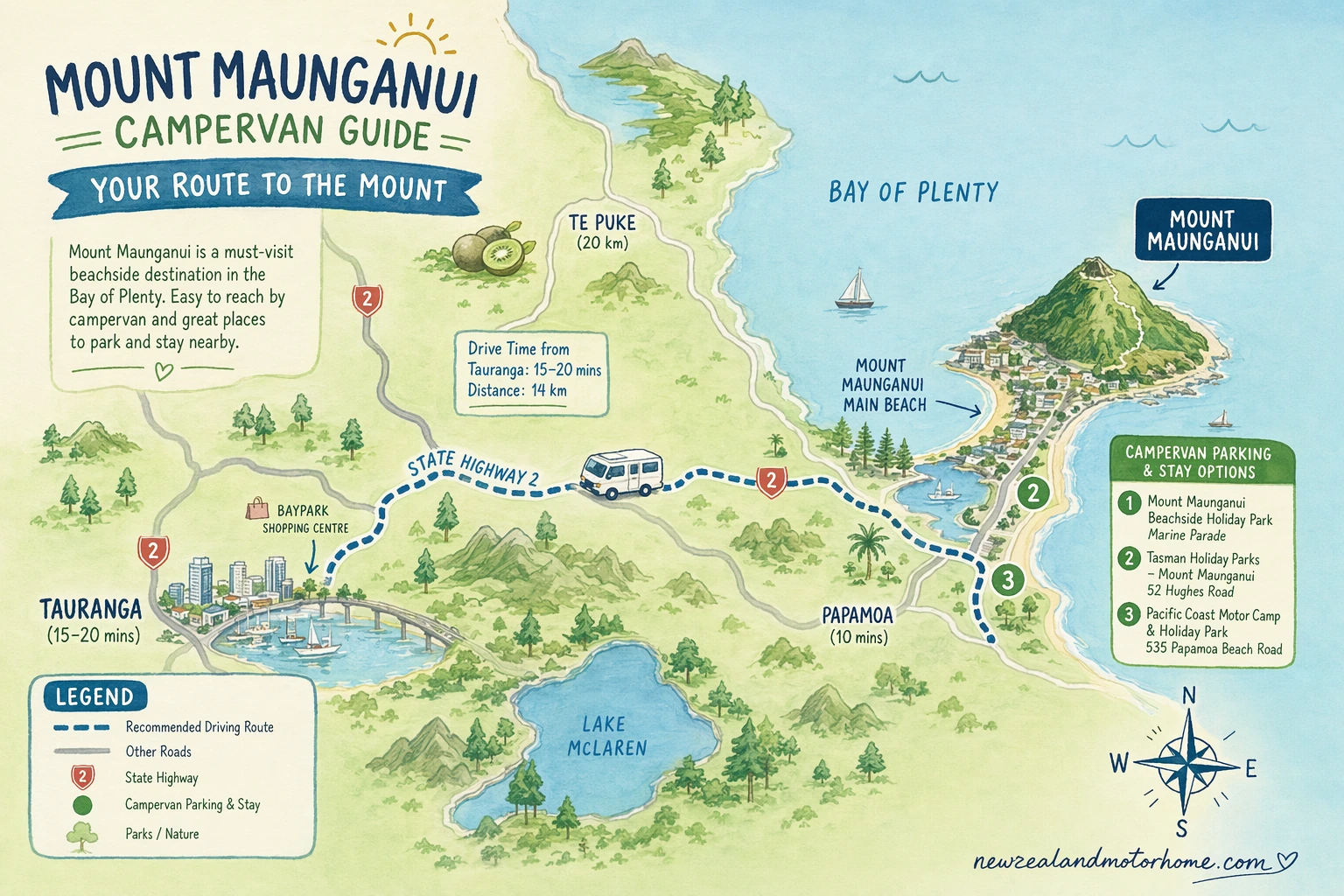
Most campervan Mount Maunganui trips arrive via Tauranga, either from Auckland and the Coromandel on SH2, from Rotorua on SH36 or SH33, or from Matamata and the Waikato over the Kaimai Range on SH29. The Kaimai route is scenic but can feel slow in a larger motorhome: expect bends, steady climbs, engine braking on the descent, and plenty of commuter traffic at the Tauranga end.
Once you are near the coast, leave more time than the map suggests. The roads around Hewletts Road, Maunganui Road, Totara Street and the harbour bridge can crawl at peak times, and a high-roof van is not something you want to be lane-hopping in. If you are arriving for a first night, it is easier to check into your campground before exploring the beach end of town on foot or by bike.
- From Auckland: allow for motorway, SH2 and Bay of Plenty traffic, especially Friday afternoons and holiday weekends.
- From Rotorua: the drive is straightforward, but fuel up before you get too low; the last stretch into Tauranga can be slow.
- From the Coromandel: SH2 around Katikati and Te Puna is busy and has limited easy pull-offs for long vehicles.
- Van note: keep an eye on mirrors and kerbs in central Mount streets, where parked cars, cyclists and pedestrians are part of the daily rhythm.
Day parking the van near Mauao, the beach and Pilot Bay
The best approach is to treat Mount Maunganui as a park-once destination. Central spaces around the base of Mauao, Marine Parade, Pilot Bay and Maunganui Road can fill quickly, and many bays are designed for cars rather than a long-wheelbase campervan. Arrive early, avoid school-holiday midday arrivals if you can, and be prepared to park a little further back and walk in.
For a motorhome Mount Maunganui stop, look for legal roadside spaces without overhanging trees, tight angle parks or signs excluding longer vehicles. Do not assume that a pretty waterfront space is suitable for a van: some areas have time limits, no-overnight rules, boat-ramp access needs, or resident pressure. Always read the sign closest to the space you are using, not just the sign at the street entrance.
- Mauao walks: park early if you want the base track or summit track; the area is popular from sunrise.
- Pilot Bay: good for calmer water and sunset, but boat trailers and day visitors compete for space.
- Main beach: easy beach access, but tight summer parking and busy pedestrian crossings.
- Longer vans: avoid nosing into short angle parks if your rear overhang blocks traffic or footpaths.
Where to stay overnight in or near Mount Maunganui
Camping near Mount Maunganui is easiest when you book a proper campground or holiday park, especially from late December through Waitangi weekend and during major surf, sport or music events. The most convenient sites put you within walking or cycling distance of the beach, Mauao and cafes, which means you can leave the van plugged in rather than searching for a second park.
Powered sites are worth considering here if you want to run the fridge confidently, charge devices, rinse sandy gear and use campground facilities after beach days. Unpowered sites suit travellers with good house batteries, solar and modest water use, but check whether your van setup is allowed on the site type you book. If your hired campervan is large, confirm site length and turning room before arrival; some coastal parks have mature trees, narrow lanes or compact older layouts.
Freedom camping in Tauranga and Mount Maunganui is restricted and changes with council bylaws, so only use designated areas where your certified self-contained vehicle is clearly permitted. Do not overnight in beach car parks, reserve edges or quiet suburban streets unless signage specifically allows it; fines and unhappy locals are not the memory you want from the Mount.
Water, dump stations, LPG and beach-day van admin
Mount Maunganui is a salty, sandy place to travel by campervan, so small bits of van admin make the stay much easier. Empty grey and black water before you settle in for a few beach days, refill fresh water when it is available at your campground, and keep a separate towel or tub for sandy jandals so the van floor does not become a dune.
Dump stations and fresh-water points are available in the wider Tauranga and coastal Bay of Plenty area, but locations and access can change, so check your camping app, council information or your campground before relying on one. Many holiday parks have dump facilities for guests, while public dump stations are better treated as planned stops rather than last-minute rescues when the cassette is full.
- Fresh water: fill at your overnight stop when permitted; do not use beach shower taps for potable water unless marked safe.
- Dumping: use approved dump stations only, and rinse carefully so the next traveller is not left with the mess.
- LPG: refills and swaps are easier in the wider Tauranga, Mount and Papamoa service areas than right beside the beach.
- Rubbish: pack out what you bring; campground bins are for guests, not for emptying a week of road-trip waste.
What to do once the campervan is parked
The Mount is best enjoyed with the keys put away. Walk the Mauao base track for harbour, ocean and island views, climb to the summit if the weather is clear and you have suitable footwear, then cool off at the main beach or the calmer Pilot Bay side. If you are carrying bikes on the van, they are useful for short trips between your campsite, the beach, the shops and the waterfront.
Build your days around tides, wind and sun rather than trying to tick off too much. Surf beaches can be exposed and breezy, while Pilot Bay is more sheltered for a slower swim or paddle. In summer, get back to the van before it turns into an oven; use window shades, roof vents and campground power sensibly, and never leave children or pets inside a parked vehicle.
- Easy half day: Mauao base track, coffee, swim, then sunset at Pilot Bay.
- Active day: summit walk early, beach time late morning, cycle or stroll Maunganui Road in the afternoon.
- Wet-weather fallback: use Tauranga or Papamoa for groceries, laundry, fuel and a reset before the next drive.
How Mount Maunganui fits a wider motorhome route
Mount Maunganui works well as a two-night pause between bigger driving days. Northbound, it links naturally with Waihi Beach, Karangahake Gorge, the Coromandel or Auckland. Southbound or inland, it pairs with Rotorua, the lakes, Whakatane, Ohope and the East Cape if you have the time and the right appetite for slower coastal roads.
If you are planning campervan Mount Maunganui as part of a first New Zealand trip, resist squeezing it into a single late-afternoon stop. The traffic, parking and beach pace all reward a slower plan. Two nights gives you one proper day without moving the van; three nights suits families, surfers, or anyone wanting a campground reset with laundry, water, charging and a proper clean-out.
If you want help stitching Mount Maunganui into a realistic hired-van itinerary, you can use the talk-to-us step and tell us your van size, travel month and must-see stops. That makes it easier to balance beach time with dump stations, drive lengths, powered-site nights and the places where freedom camping is actually permitted.
Keep planning
Holiday parks mount maunganui
Read onHoliday parks mount cook
Read onFarmers markets mount cook
Read onCampervan guide mount cook nz
Read onBest time to visit mount cook nz
Read onBest campervan stops mount cook
Read onCommon questions
Can I freedom camp in Mount Maunganui in a certified self-contained campervan?
Only where local signage and current Tauranga council rules allow it. A certified self-contained sticker does not give you permission to sleep in any beach car park or reserve, so check the exact spot before you settle in for the night.
Is Mount Maunganui suitable for a large motorhome?
Yes, but the central beach and Mauao area can feel tight in a large motorhome, especially in summer. Book an overnight site that confirms your vehicle length, then use walking, cycling or local transport rather than moving the van several times a day.
Do I need a powered site near Mount Maunganui?
You do not always need one, but powered sites are handy here because beach stays often mean extra showers, device charging, fridge use and fan time. If you are relying on an unpowered site, arrive with full batteries, enough fresh water and a plan for dumping.
Where should I park for the Mauao walk in a campervan?
Try to arrive early and use legal spaces around the base area only if your van fits without overhanging lanes or footpaths. If the close parks are full or too tight, park further back in a signed, legal space and walk in.
How many nights should I allow for Mount Maunganui in a campervan?
Two nights is the sweet spot for most campervan travellers because it gives you one full day without driving or hunting for parking. Add a third night if you want surf time, a family beach reset, or a powered-site break for laundry, water and charging.
Have a planner shape this for your dates
Send a short outline — your dates, party size, and the kind of trip you want. A planner replies with a vehicle recommendation, a paced route, and the realistic budget.