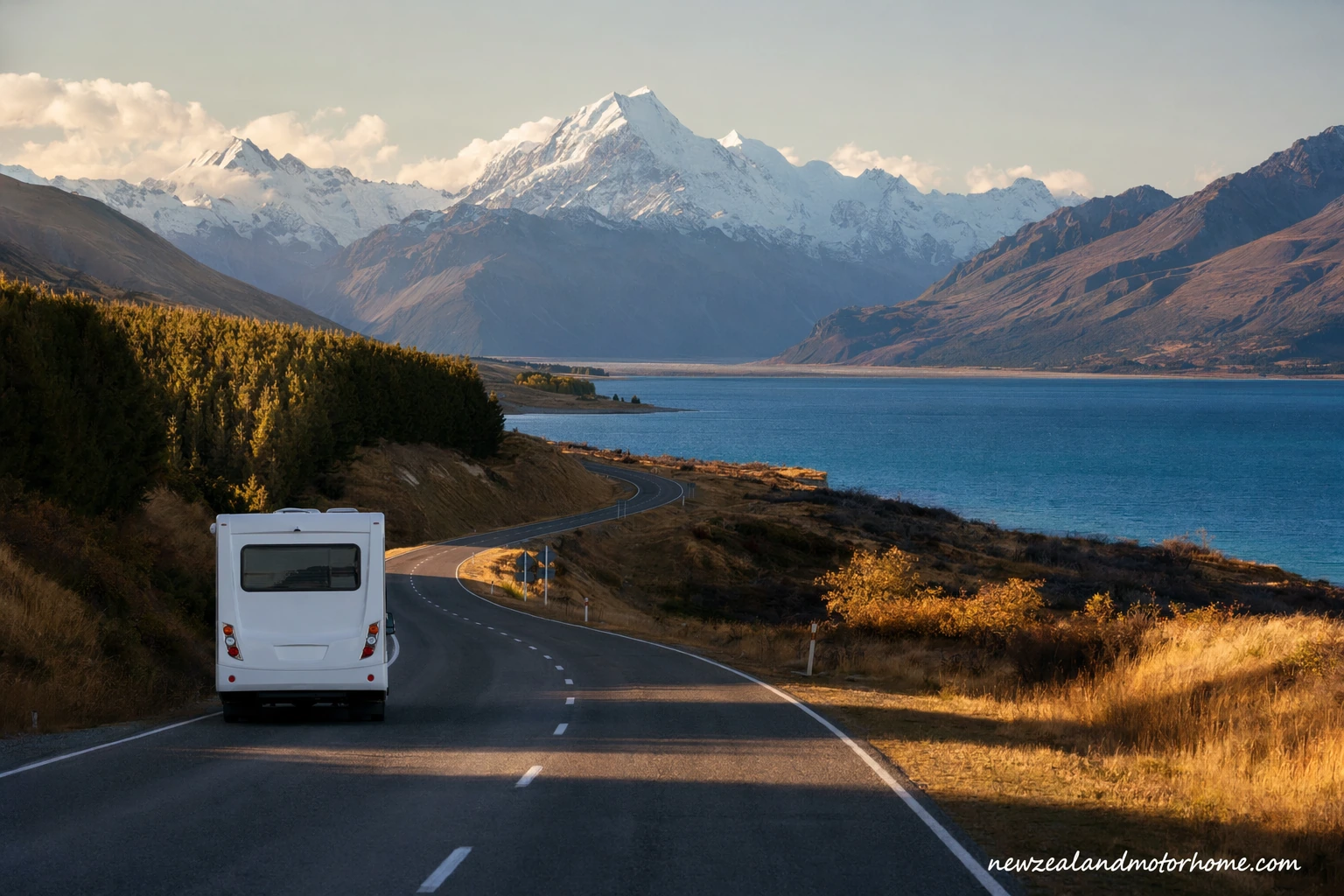
Invercargill to Palmerston North campervan route, planned for vans
- Allow 7–9 days for comfort
- Cook Strait ferry required
- Best for certified self-contained vans
- SH1 is the main van-friendly spine
- Powered nights useful before and after ferry
An invercargill to palmerston north campervan trip is a proper end-to-end New Zealand drive: Southland flats, Otago coast, Canterbury plains, the Kaikōura coast, a Cook Strait ferry crossing and the run up through Kāpiti and Manawatū. It is not a route to rush if you are living in the van as you go; the good bits are often the slower harbour towns, beach walks and early starts before the main traffic builds.
This guide is written for self-drive campervan and motorhome travellers, with realistic legs, where to overnight, how to think about powered versus unpowered sites, and what to check before you park up. You will also find road notes for longer vehicles, ferry reminders, dump station planning, fresh-water and LPG timing, and freedom-camping cautions by district.
How many days to allow for the route
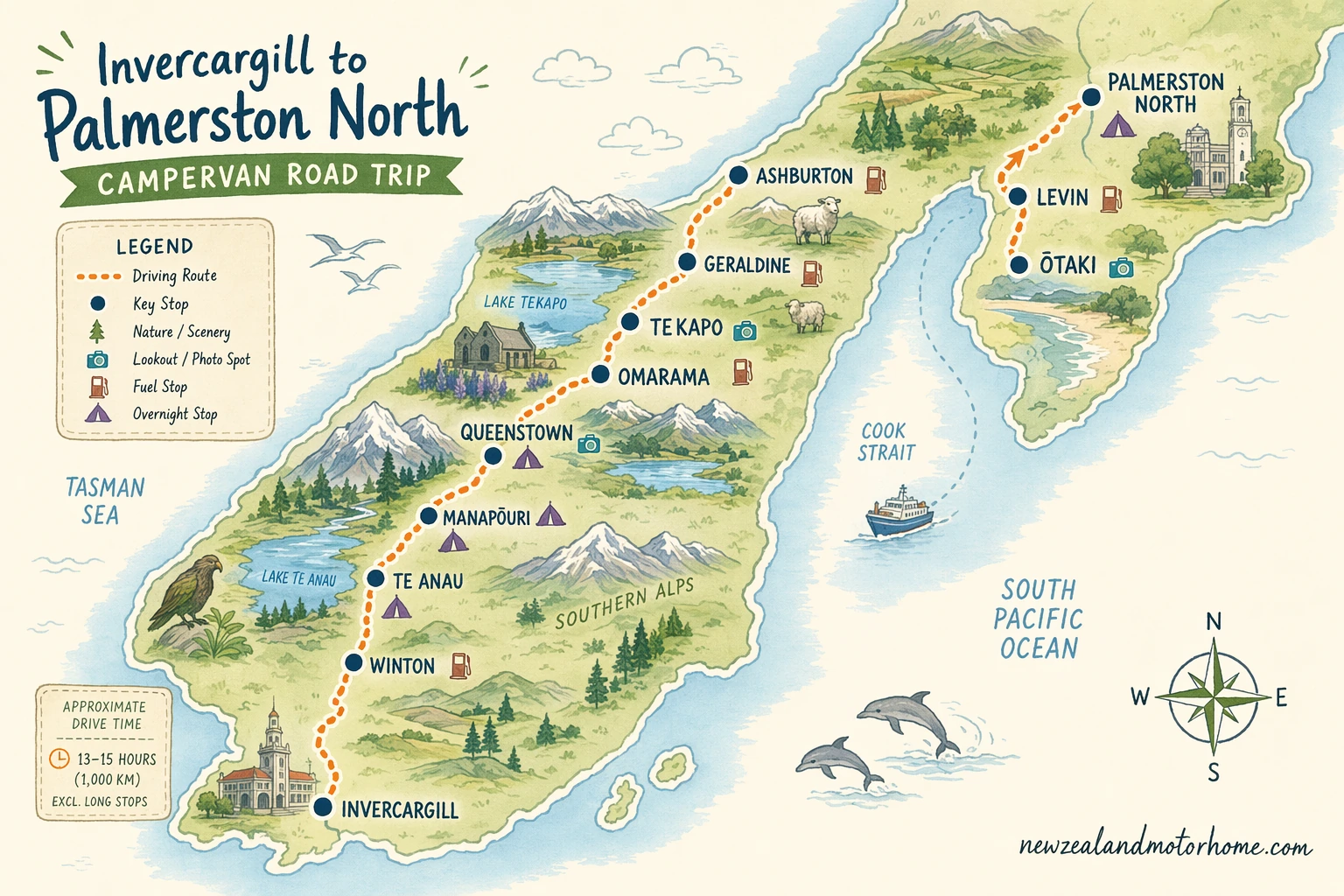
The Invercargill to Palmerston North drive is around 1,100 kilometres before detours, and it includes a ferry crossing, so the calendar matters as much as the odometer. In a campervan, five days is a brisk transit with limited sightseeing; seven to nine days gives you time to service the van properly, wait out rough coastal weather if needed, and enjoy the route without arriving tired.
A sensible invercargill to palmerston north motorhome road trip breaks the South Island into three or four driving days, then treats the ferry as its own logistics day. If you are new to driving a larger van, allow extra daylight for parking, reversing into sites, emptying grey water and finding a supermarket with easy access.
- Fastest comfortable pace: 5 to 6 days, mostly SH1, with booked holiday park nights.
- Better touring pace: 7 to 9 days, adding the Catlins edge, Moeraki, Oamaru, Kaikōura and Kāpiti.
- Long motorhome pace: 10 days or more, useful for larger vans, families, cyclists on the coast roads, or weather holds.
- Planning help: if you want this shaped around your van size, ferry timing and preferred site style, use the soft trip-planning step at /talk-to-us/.
Leg 1: Invercargill to Dunedin, Oamaru or the North Otago coast
From Invercargill, most vans head north-east via SH1 through Gore and Balclutha, then on to Dunedin. It is a straightforward sealed drive with open rural stretches, but crosswinds can be noticeable in a high-roof camper, especially on exposed plains and bridges. Keep your first day modest if you have just collected the van or are still getting used to its width.
Dunedin is worth a night if you want supermarkets, LPG bottle swaps or fills, laundry, dump stations and a powered site before pushing further north. Parking in central Dunedin is tight for longer motorhomes, so aim for edge-of-centre parking, beach suburbs, or a holiday park and use public transport or walking where practical. If you continue to Oamaru, the harbour and Victorian precinct are easier to enjoy once the van is settled for the night.
- Good overnight rhythm: Invercargill to Dunedin for a shorter first leg, or Invercargill to Oamaru if you are already confident in the van.
- Site type: powered holiday park nights are useful here for battery top-ups, showers and laundry after the first long drive.
- Servicing: use Invercargill, Dunedin or Oamaru for dump stations, potable water and LPG rather than leaving it until a small coastal settlement.
- Road note: the direct SH1 route is easier for larger vans than weaving deep through the Catlins, though confident drivers may add a slower scenic night around the coast.
Leg 2: Oamaru to Christchurch and the Kaikōura coast
North of Oamaru, SH1 rolls through Timaru, the Rangitata area and Ashburton before Christchurch. The roads are generally van-friendly, but they are busy freight corridors, so keep left, let faster traffic pass when safe, and avoid pulling a wide motorhome into small gravel lay-bys if the edge looks soft.
Christchurch is the best mid-route reset: dump, fill fresh water, restock food, sort laundry and check the ferry booking before committing to the coast. If you do not want to drive into the central city, use suburban supermarkets and holiday parks with easier turning space. From Christchurch to Kaikōura, the inland and coastal sections both need patience in a heavy vehicle; the coastal highway has rail crossings, tunnels, roadworks at times and photo stops that fill quickly.
- Possible nights: Timaru for a quieter stop, Christchurch for full services, or Kaikōura for whale-watching walks and a coastal camp.
- Powered or unpowered: unpowered is fine if your house battery is healthy, but choose powered in Christchurch or Kaikōura if you have used heating, laptops or the fridge heavily.
- Parking tip: in Kaikōura, use marked large-vehicle or beach-edge parking and avoid squeezing into café-side spaces meant for cars.
- Freedom camping: rules differ between Waitaki, Timaru, Christchurch and Kaikōura districts; even with a current self-containment certificate, check local signs before staying overnight.
Leg 3: Kaikōura to Picton and the Cook Strait ferry
The drive from Kaikōura to Blenheim and Picton is one of the standout parts of the route, but it is also a place to slow down in a campervan. The highway has coastal curves, tunnels, seal-viewing pull-offs, occasional slips or roadworks, and a mix of tourist traffic and trucks. Use proper pull-ins for photos and give yourself more stopping distance than you would in a car.
Picton is the right place to arrive early rather than rushed. Ferry check-in for motorhomes is more relaxed when you have already emptied rubbish, secured loose gear, closed cupboards, and know your vehicle length and height. Gas bottles are usually required to be turned off for the crossing, and you should check the ferry operator’s current instructions before boarding.
- Overnight before sailing: stay in or near Picton if you have a morning ferry, especially in a longer motorhome.
- Servicing: Blenheim and Picton both work well for fuel, groceries, dump stations and fresh water before the North Island leg.
- Ferry booking: book the van by accurate length, height and any bike rack or rear storage box.
- On board: take valuables, medications, warm layers and chargers with you, as access to the vehicle deck is restricted during sailing.
Leg 4: Wellington to Palmerston North in a motorhome
After the ferry, do not underestimate Wellington traffic. If your sailing arrives late or the weather is rough, it is often easier to stay the night around Wellington or the Kāpiti Coast rather than push straight to Palmerston North. Longer vans should avoid hunting for inner-city parking unless they have a clear plan; tight streets, hills and wind make it less pleasant than the map suggests.
The usual route north follows SH1 through the motorway and Transmission Gully to the Kāpiti Coast, then continues towards Levin and either through to Sanson and SH3, or across the Manawatū approach depending on your stop and conditions. The old Manawatū Gorge route is not the through-road it once was, so follow current highway signs and navigation rather than relying on an old paper itinerary.
- Good stop options: Wellington for a post-ferry reset, Kāpiti for beach walks and an easier morning departure, or Levin/Foxton if you want a shorter final hop.
- Road feel: motorway driving near Wellington is smoother but fast; stay in your lane early and avoid last-second exits in a wide van.
- Final services: Palmerston North has supermarkets, fuel, dump station options and holiday park facilities for cleaning down before returning or continuing the trip.
- Wind note: high-sided campervans can feel exposed around Wellington and on open Manawatū roads; slow down and keep both hands on the wheel in gusts.
Overnight stops, dump stations and freedom-camping checks
This route is easiest when you treat servicing as part of the day, not an afterthought at dusk. Dump grey and black water before long rural stretches, refill potable water when you are already near a holiday park, public dump station or larger service town, and keep LPG topped up if you are using the heater or cooking inside during cooler months.
Freedom camping is possible in some places, but it is not a single nationwide permission slip. Councils set local bylaws, and signs can change by beach, reserve or street. A current self-containment certificate is usually the starting point, not a guarantee that you can stay anywhere; if in doubt, book a low-key unpowered site and sleep better.
- Powered nights: plan them after cold-weather driving, several nights off-grid, or before the ferry so the fridge and batteries are settled.
- Unpowered sites: best when you have solar, a healthy house battery and no need for electric heating or long appliance use.
- Dump station spacing: reliable choices are in larger towns such as Invercargill, Dunedin, Oamaru, Timaru, Christchurch, Kaikōura, Blenheim, Picton, Wellington, Levin and Palmerston North.
- Leave no trace: use public toilets where provided, keep sink strainers clean, never drain grey water roadside, and carry rubbish until you find a proper bin.
Keep planning
Holiday parks palmerston north
Read onCampervan supplies palmerston north
Read onCampervan hire palmerston north
Read onWellington to palmerston north campervan
Read onRotorua to palmerston north campervan
Read onQueenstown to palmerston north campervan
Read onCommon questions
How long does the Invercargill to Palmerston North campervan route take?
Allow at least five to six days if you are mainly relocating the van, and seven to nine days for a more enjoyable trip with coastal stops. The ferry crossing can absorb most of a day once check-in, loading, sailing and disembarking are included.
Is SH1 suitable for a large motorhome on this route?
Yes, SH1 is the most straightforward option for most large campervans and motorhomes, but it is still a working freight route with wind, hills, roadworks and busy town approaches. Take proper rest breaks, use slow-vehicle bays where available, and avoid tight scenic detours unless you are comfortable with the van’s length and turning circle.
Should I book holiday parks ahead?
Book ahead in summer, school holidays and around ferry nights in Picton or Wellington. Outside peak periods you may have more flexibility, but powered sites for larger vans can still fill on popular coastal sections such as Kaikōura and Kāpiti.
Can I freedom camp between Invercargill and Palmerston North?
Sometimes, but only where local rules allow it and your vehicle meets the required self-containment standard. Check council signs and current camping apps on the day, because rules can vary between neighbouring beaches, reserves and town streets.
What should I do before taking the campervan on the ferry?
Book with accurate vehicle dimensions, arrive early, secure loose items inside the van and turn off LPG as instructed by the ferry operator. Take warm layers, medications, valuables and anything needed during the crossing, as you usually cannot return to the vehicle deck while sailing.
Where is the best place to reset the van on this trip?
Christchurch is the strongest South Island reset point for groceries, dump stations, fresh water, laundry and LPG. Picton is useful before the ferry, and Palmerston North is a good final service stop before returning the van or continuing further through the North Island.
Have a planner shape this for your dates
Send a short outline — your dates, party size, and the kind of trip you want. A planner replies with a vehicle recommendation, a paced route, and the realistic budget.