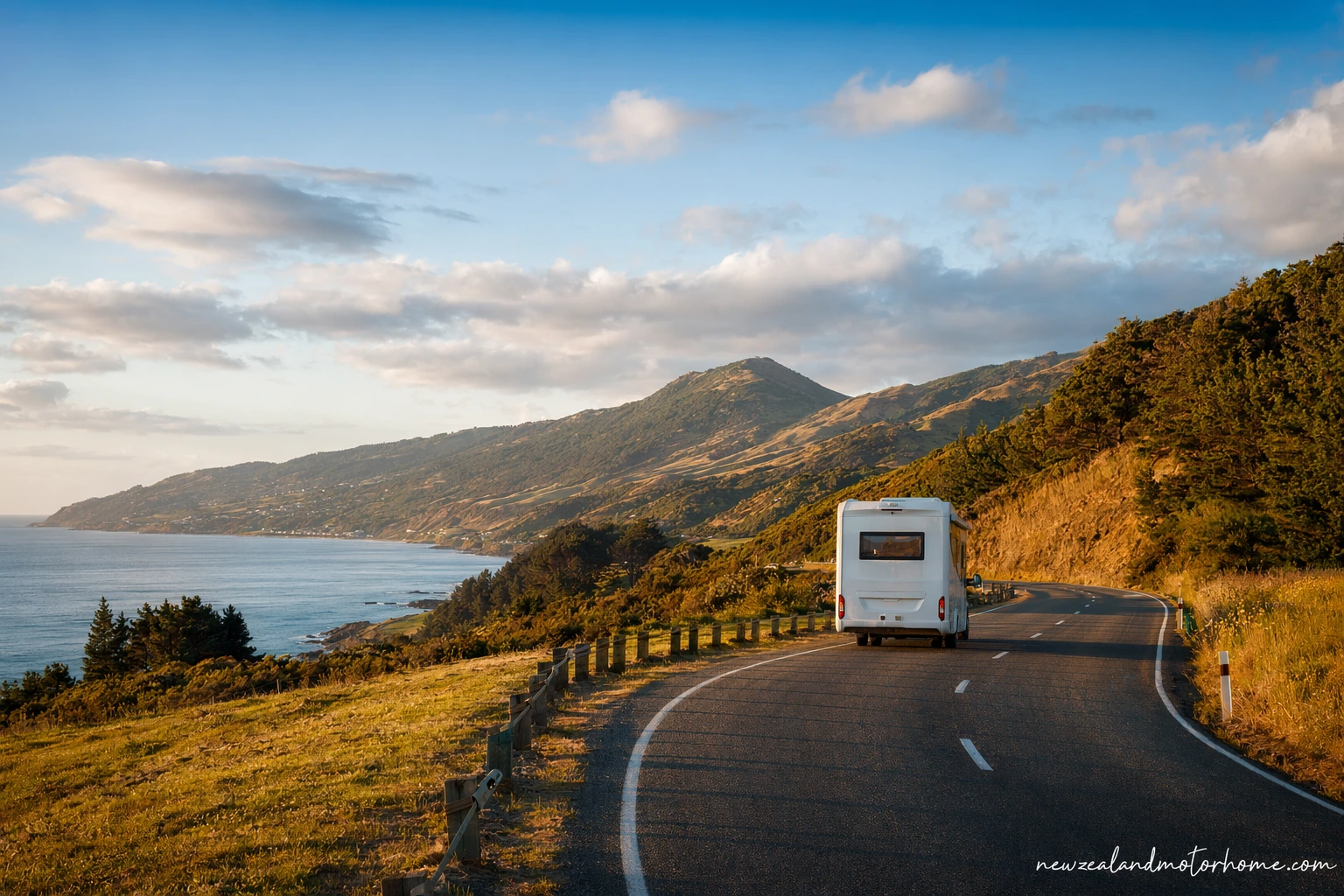
Wellington to Palmerston North campervan route for self-drivers
- 145 km direct route
- Allow 1-3 days
- Main roads suit larger vans
- Powered sites on Kāpiti and in Palmerston North
- Freedom camping only where signed
The Wellington to Palmerston North campervan route is short enough to drive in a day, but it works better when you let the Kāpiti Coast and Horowhenua break it up. You leave the harbour hills, run north on SH1, then turn inland through farm flats and river country before rolling into Palmerston North with the Tararua Range on your right.
This guide is written for travellers driving and sleeping in their hired van: where to pull in without squeezing the mirrors, how to think about powered versus unpowered nights, where to manage water and waste, and which roads are kinder to a motorhome. Use it as a practical base for a one-to-three-day Wellington to Palmerston North motorhome road trip.
Route shape, drive time and how many days to allow
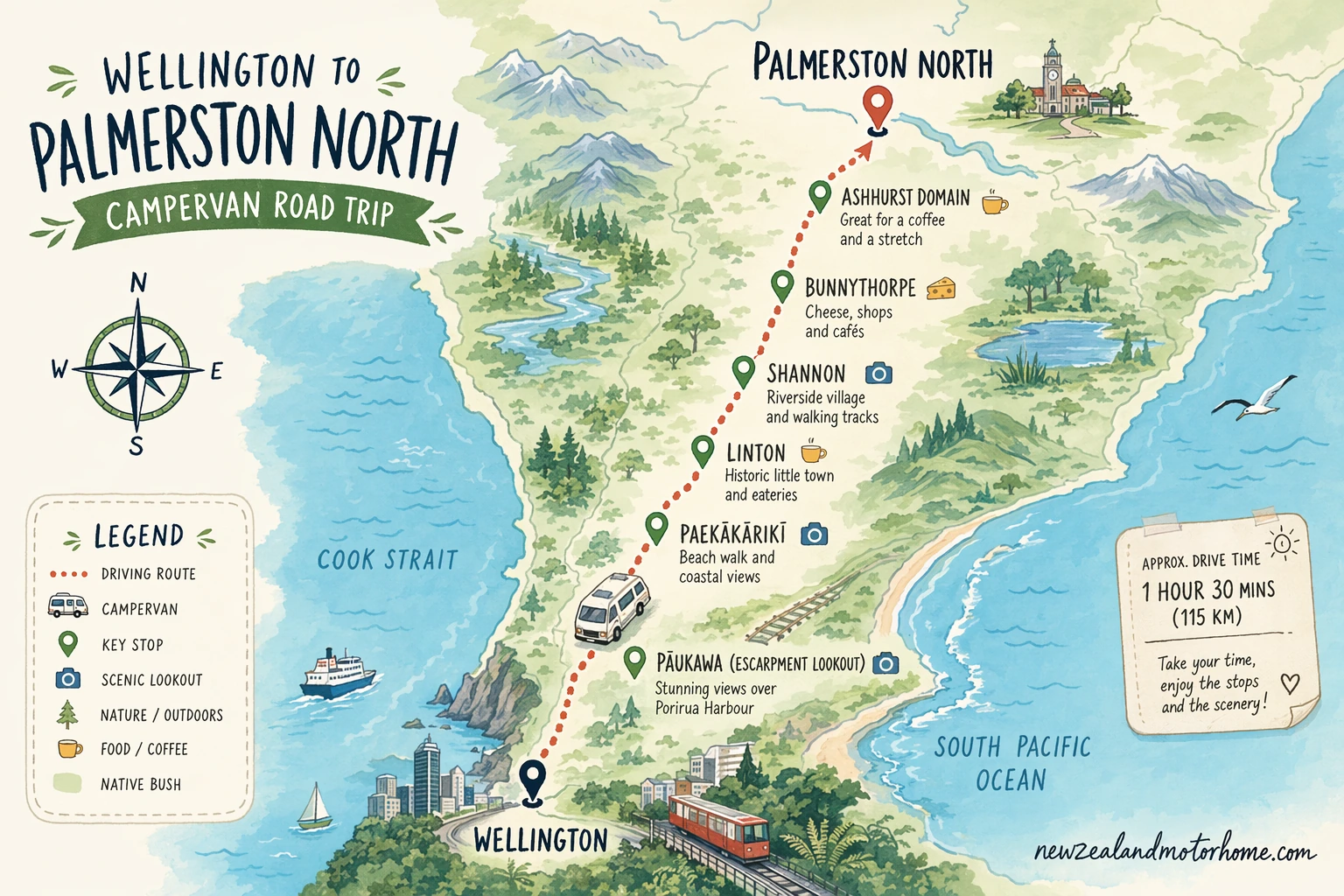
The direct Wellington to Palmerston North drive is around 145 kilometres and usually takes about two to two and a half hours without long stops. In a campervan, allow more time for the Wellington motorway climb, wind exposure, grocery stops, and slower acceleration through the SH1 towns north of the city.
Most vans are happiest following SH1 through Transmission Gully and the Kāpiti expressway, then continuing through Ōtaki and Levin before taking the signed route towards Palmerston North. This is a sealed, main-road run with regular fuel, supermarkets and toilets, so it suits first-time motorhome drivers as well as longer rigs.
- One day: drive Wellington to Palmerston North with a lunch stop at Paekākāriki, Ōtaki or Levin.
- Two days: overnight on the Kāpiti Coast or around Levin, then finish the inland section fresh in the morning.
- Three days: add beach time, short walks, and a quieter farm-country leg via Shannon or Ashhurst.
- Van size note: standard 6-berth motorhomes are fine on the main route; avoid steep scenic detours unless you are confident with width, braking and turning space.
Leaving Wellington: harbour hills, motorway driving and first stops
Wellington starts with city driving, wind, and quick lane decisions, so get your mirrors set before leaving the depot or campground. If your van is tall, avoid inner-city parking buildings and stick to open-air supermarket or waterfront-fringe parking where height barriers are clearly signed.
Transmission Gully is the easiest northbound option for most campervans: modern lanes, gentler corners than the older coastal road, and fewer tight village sections. On very windy days, keep both hands on the wheel on exposed ridges and give yourself extra space around trucks and high-sided vehicles.
- Good early pull-ins: Porirua for groceries and fuel, Plimmerton for a harbour-side breather, and Paekākāriki for beach air if you have time.
- Parking the van: choose open roadside or beach car parks rather than compact town-centre bays; check signs for time limits and overnight restrictions.
- Road to treat carefully: Paekākāriki Hill Road is scenic but narrow and exposed; larger motorhomes are better staying on SH1 unless the driver is very comfortable.
- Before you leave the city: top up LPG or fresh food if needed, as it is easier to do before you are tired at the end of the day.
Kāpiti Coast and Horowhenua overnight options
If you want to turn the route into a relaxed night away, the Kāpiti Coast is the natural first stop. Paraparaumu, Waikanae and Ōtaki have beach access, cafés, supermarkets and open-air parking areas where it is simpler to manoeuvre than in central Wellington.
For a powered night, look for holiday parks around the Kāpiti Coast, Ōtaki Beach, Levin or Foxton Beach. Powered sites are useful if you want to recharge house batteries, run a heater in cooler months, or reset the fridge before heading inland; unpowered sites suit certified self-contained vans when you have enough battery and water onboard.
- Freedom camping: only use council-permitted sites, and only if your van has current certified self-containment. Local rules change, so check signs on arrival rather than relying on old forum posts.
- Dump stations: plan to empty at signposted public dump points or holiday park facilities around the Kāpiti and Levin areas; never discharge grey water into roadside drains.
- Fresh water: refill at approved potable taps only, and keep a separate hose for drinking water if your van supplier provides one.
- Beach parking: sand and wet grass can trap a heavy campervan quickly, so stay on sealed or firm gravel surfaces unless a site is clearly designed for motorhome use.
Levin to Palmerston North: choosing the inland leg
North of Levin, the route turns away from the coast and into flat, productive country. The drive towards Palmerston North is not dramatic, but it is easygoing in a van: straighter roads, fewer steep pulls, and several places to stop for a cup of tea without blocking traffic.
You will generally be choosing between the signed state highway options through Shannon, Opiki or the outskirts of Ashhurst, depending on current roadworks and where you want to stop. Follow live road signage, especially if you are continuing beyond Palmerston North towards the Manawatū Gorge area; the old gorge road is not a through route, so use the current signed highway.
- Shannon: a handy small-town pause with easier kerbside parking than busier centres, but still check for loading zones and time limits.
- Opiki and rural stretches: expect farm vehicles, narrow shoulders and occasional stock movement; let faster traffic pass when safe.
- Ashhurst side trip: good if you want river scenery and a quieter approach, but check road conditions before committing in a larger van.
- Driving style: keep speed conservative through small settlements; a loaded motorhome takes longer to stop, especially in rain.
Arriving in Palmerston North with a campervan
Palmerston North is easier in a motorhome than Wellington, but the central streets still have angle parking, busy crossings and occasional height-restricted car parks. For a stress-free stop, aim for open-air parking near parks, supermarkets or the edge of the CBD, then walk into The Square rather than hunting for the closest bay.
Victoria Esplanade and the Manawatū River Pathway are good places to stretch after the drive, with flat paths and room to slow down. Do not assume daytime parking allows overnight stays: if you are sleeping in the van, use a designated campground, holiday park, or council-approved freedom camping area that matches your self-containment status.
- Powered sites: best after a windy or cold driving day, or before heading into more rural parts of the lower North Island.
- Unpowered sites: practical for one night if your batteries, water and toilet cassette are in good shape.
- Dump and water: use signposted dump stations or campground facilities in Palmerston North before parking up for the night or continuing on.
- LPG: top up in town if your heater, hot water or cooking has been getting regular use.
If you would like this route fitted into a wider lower North Island loop, you can use the talk-to-us step and we will help shape the driving days around your van size, comfort level and overnight style.
Keep planning
Holiday parks palmerston north
Read onCampervan supplies palmerston north
Read onCampervan hire palmerston north
Read onRotorua to palmerston north campervan
Read onQueenstown to palmerston north campervan
Read onPicton to palmerston north campervan
Read onCommon questions
Can I drive from Wellington to Palmerston North in one day in a campervan?
Yes. The route is short enough for one day, but leave extra time for Wellington traffic, wind, food stops and slower van handling. If you are new to driving a motorhome, a Kāpiti or Levin overnight makes it much more relaxed.
Is the road suitable for a large motorhome?
The main SH1 and inland state highway route is suitable for typical hire motorhomes, including larger 6-berth vans. Avoid narrow scenic detours such as Paekākāriki Hill Road unless you are confident with width, hill braking and tight corners.
Where should I overnight between Wellington and Palmerston North?
The easiest overnight areas are the Kāpiti Coast, Ōtaki, Levin and Foxton Beach, where you can usually find holiday park-style sites and town services. For freedom camping, only use signed permitted areas and make sure your van has current certified self-containment.
Are there dump stations on this route?
Yes, but plan them rather than leaving it until the cassette is full. Look for signposted public dump stations or campground facilities around the Kāpiti Coast, Levin and Palmerston North, and confirm access locally when you arrive.
What is the best stop for supplies before Palmerston North?
Porirua, Paraparaumu, Ōtaki and Levin are all practical supply stops with supermarkets, fuel and easier open-air parking than central Wellington. Levin is the last large service town before the inland run to Palmerston North.
Have a planner shape this for your dates
Send a short outline — your dates, party size, and the kind of trip you want. A planner replies with a vehicle recommendation, a paced route, and the realistic budget.