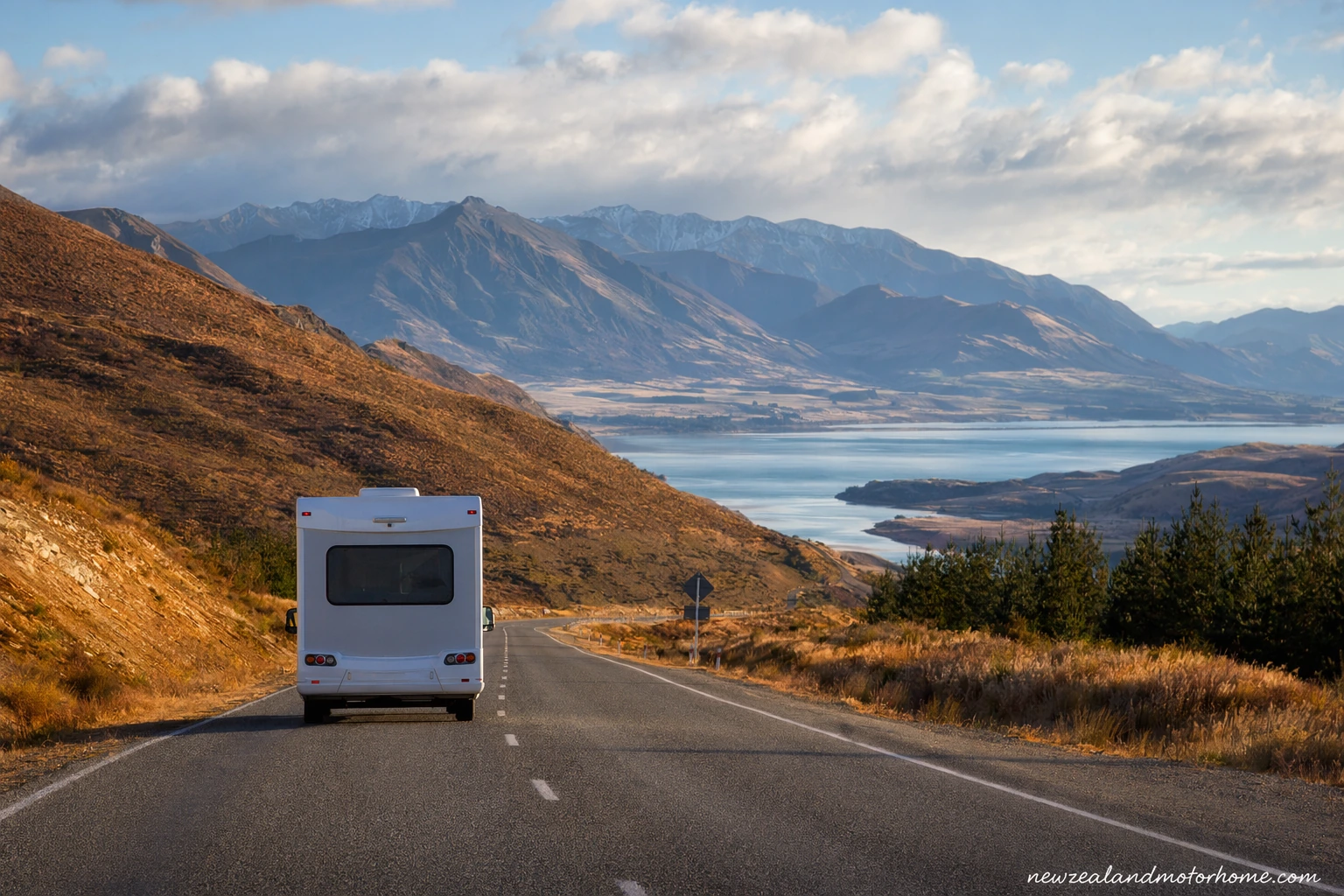
- Best over 5–7 days
- Includes Cook Strait ferry
- Powered sites recommended in winter
- Certified self-contained rules apply
- Watch Lindis Pass and coastal winds
A Queenstown to Palmerston North campervan trip is a proper cross-country run: alpine basins, braided rivers, the Kaikōura coast, a Cook Strait ferry crossing, then the easy roll through Kāpiti and the Manawatū. It is not a route to rush in a big van, especially if you want time for laundry, fresh-water fills, dump stations and the occasional day when the weather tells you to stay put.
This guide is written for self-drive travellers sleeping in their hired campervan or motorhome. You will find sensible driving legs, van-friendly overnight ideas, road notes for longer vehicles, ferry pointers, and places where powered sites or unpowered certified self-contained stops make the Queenstown to Palmerston North drive feel calmer.
How many days to allow for the route
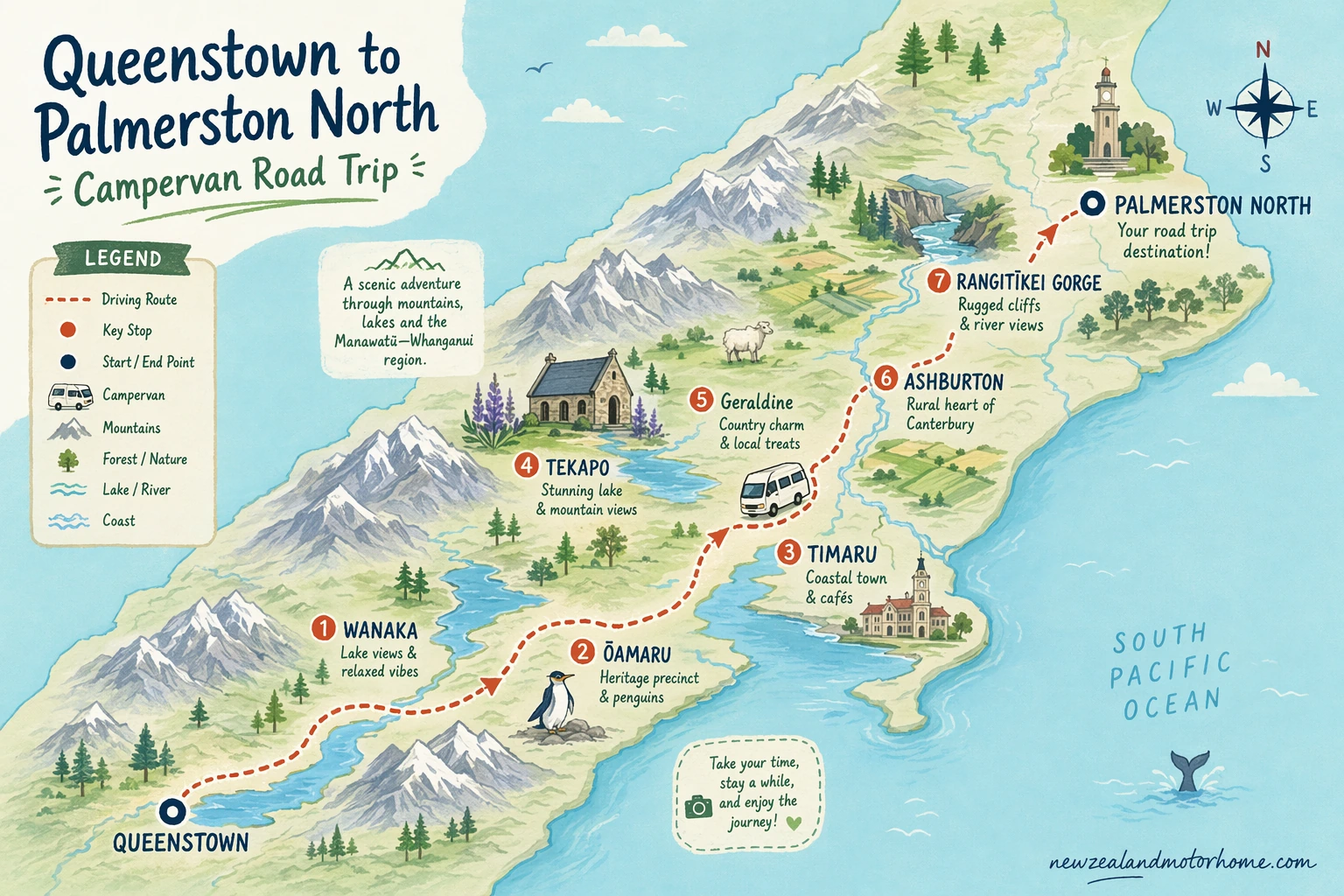
You can drive Queenstown to Palmerston North in three long travel days if the ferry timing lines up, but that is hard work in a motorhome and leaves very little margin for wind, road works, supermarket stops or a late sailing. Most campervan travellers are happier allowing five to seven days, with one South Island rest night before Picton and one North Island buffer night after the ferry.
A steady Queenstown to Palmerston North motorhome road trip usually works best as Queenstown to Mackenzie Country, then Christchurch or Kaikōura, then Picton, ferry to Wellington, and on to Palmerston North via Kāpiti and Levin. If you have a larger six-berth van, treat the listed drive times as moving time only; add stops for fuel, water, dumping and leg-stretching.
- Fast but tiring: 3–4 days, mostly powered holiday park nights, no long side trips.
- Comfortable: 5–7 days, with time for Lake Tekapo or Kaikōura and a ferry buffer.
- Slow travel: 8+ days, adding Wānaka, Aoraki/Mount Cook or extra coastal nights.
Queenstown to Mackenzie Country: getting out of the mountains
Leave Queenstown with full LPG, topped-up fresh water and an empty grey-water tank if you can. Parking a motorhome in central Queenstown is tight, so do your supermarket run in a van-suitable car park before you commit to the open road. Most travellers take SH6 through the Kawarau Gorge to Cromwell, then SH8 over the Lindis Pass to Omarama, Twizel or Lake Tekapo.
The Lindis Pass is sealed and commonly used by campervans, but it is exposed, high and sometimes icy in winter. Use lower gears on descents, keep left where the road narrows, and pull over only in formed lay-bys big enough for your vehicle length. In winter, check conditions before leaving and do not assume a heavy motorhome will handle shaded ice like a small car.
Good first-night stops include holiday parks in Cromwell, Omarama, Twizel or Lake Tekapo, where powered sites make sense if you have been running heating or cooking off-grid. Unpowered DOC-style camping can suit certified self-contained vans in the right places, but always check local signs because lakeside freedom camping rules change between districts.
- Road note: SH8 via Lindis Pass is the standard sealed route for most vans.
- Servicing: Look for dump stations and fresh-water fills around Cromwell, Twizel and holiday parks.
- Parking: Choose formed scenic stops; soft shoulders can be unforgiving after rain.
Mackenzie Country to Christchurch or Kaikōura
From Tekapo or Twizel, the route drops through Fairlie and the Canterbury Plains towards Christchurch. This is a good leg for catching up on practical jobs: groceries, laundry, fresh water, toilet cassette emptying and LPG before the more constrained coastal drive north. If you stay in Christchurch, choose accommodation with clearly marked motorhome bays rather than squeezing into inner-city streets.
Continuing north, SH1 follows a mix of inland road, small towns and coast. Kaikōura is a memorable overnight because you can park up, plug in, and walk to the waterfront without shifting the van again. The coastal sections can be windy and are often busy with freight, so let faster traffic pass at safe pull-off areas and avoid stopping where your rear overhang sits close to the lane.
Powered holiday park sites are the easiest option through Christchurch and Kaikōura, especially if you are charging devices, running a fridge and using onboard heating. Certified self-contained freedom camping may be available in designated areas, but it is closely managed around popular coastal spots; read the signs at the actual car park, not just an old app listing.
- Best practical stop: Christchurch for supermarkets, van supplies and dump stations.
- Scenic stop: Kaikōura, with sea views and compact town access on foot.
- Van tip: Book a site ahead in summer, school holidays and long weekends.
Kaikōura to Picton and the Cook Strait ferry
The run from Kaikōura to Picton is one of the prettiest parts of the Queenstown to Palmerston North drive, but it deserves respect in a motorhome. The road has rail crossings, coastal bends, seal haul-out viewpoints and busy passing traffic. Keep your speed conservative, especially in crosswinds, and do not swing into small gravel pull-offs unless you can see a clear turning space.
Picton is the place to get organised before the ferry: dump the toilet, reduce grey water, secure cupboards, and check your booking matches your campervan length and height. Gas bottles usually need to be turned off for the sailing, and you should know where your LPG shut-off is before you reach the terminal queue. Allow extra time because boarding a motorhome is slower than driving on in a small vehicle.
Many travellers overnight in Picton or Blenheim before the ferry rather than gambling on a same-day arrival from further south. Powered sites are useful here because you can start the North Island leg with full batteries and clean tanks. If you want help lining up ferry timing with overnight stops, you can use the soft planning step at /talk-to-us/ before locking in your dates.
- Before boarding: Turn off LPG, secure loose gear, and know your van height.
- Book correctly: Enter the full vehicle length including bike racks or rear storage.
- Overnight buffer: Picton or Blenheim keeps the ferry day much less stressful.
Wellington to Palmerston North by campervan
After the ferry, resist the urge to push straight through Wellington city traffic if you are tired. Motorhome parking near the waterfront can be limited, and narrow urban streets are not much fun after a Cook Strait crossing. If you want a night nearby, look for established holiday parks or designated campervan sites on the Wellington or Hutt Valley side, then leave for Palmerston North in daylight.
The simplest northbound route uses SH1 through the Kāpiti Coast, then either continues via Levin and SH57 towards Palmerston North or follows the signposted main route depending on current traffic and road works. Kāpiti, Ōtaki, Levin and Foxton are useful places for fuel, food and breaks where you are more likely to find easier van parking than in central Wellington.
Palmerston North is a practical finish point for a campervan route: there are service stations, supermarkets, dump station options in the wider district, and holiday park-style stays if you need one last powered night. Before returning a hired vehicle or carrying on, empty the cassette, dump grey water only at an approved dump station, refill fuel as required, and give yourself time to clean sand, leaves and road dust from the living area.
- Driving style: Expect expressway sections, roundabouts, wind exposure and commuter traffic.
- Good break towns: Kāpiti Coast, Ōtaki, Levin and Foxton.
- Finish jobs: Dump, refill, tidy the van, and check no gear is left in lockers.
Camping style, self-containment and seasonal notes
This route mixes easy holiday-park nights with places where free or low-cost camping is more restricted. A certified self-contained campervan gives you more flexibility, but it does not mean you can sleep anywhere. Queenstown, lakefront areas, Kaikōura, Picton, Wellington and Kāpiti all have local rules that can be specific to one car park, one season or one vehicle type.
In summer, book powered sites around Queenstown, Tekapo, Kaikōura and Picton early, especially if your van is long or you need a drive-through bay. In winter, powered sites become valuable for heating and battery recovery, and you should keep an eye on Lindis Pass conditions, early sunsets and black ice. Spring and autumn are often the most relaxed for a self-drive campervan, but wind can still affect both coastal driving and ferry crossings.
Carry a simple rhythm for the whole trip: dump before you are full, fill fresh water before you are empty, and top up LPG before you head into smaller towns. It keeps the Queenstown to Palmerston North campervan route flexible without leaving you searching for services at the end of a long day.
- Freedom camping: Only where permitted, and only if your vehicle meets the stated self-containment rules.
- Powered sites: Best after cold nights, long fridge use or several unpowered stops.
- Dump stations: Use approved stations only; never drains, toilets or roadside areas.
Keep planning
Holiday parks palmerston north
Read onCampervan supplies palmerston north
Read onCampervan hire palmerston north
Read onWellington to palmerston north campervan
Read onRotorua to palmerston north campervan
Read onPicton to palmerston north campervan
Read onCommon questions
How long does a Queenstown to Palmerston North campervan trip take?
Is the route suitable for a large motorhome?
Do I need to book the ferry in advance with a campervan?
Can I freedom camp on the Queenstown to Palmerston North drive?
Where should I plan dump station and fresh-water stops?
Which season is best for this motorhome road trip?
Have a planner shape this for your dates
Send a short outline — your dates, party size, and the kind of trip you want. A planner replies with a vehicle recommendation, a paced route, and the realistic budget.