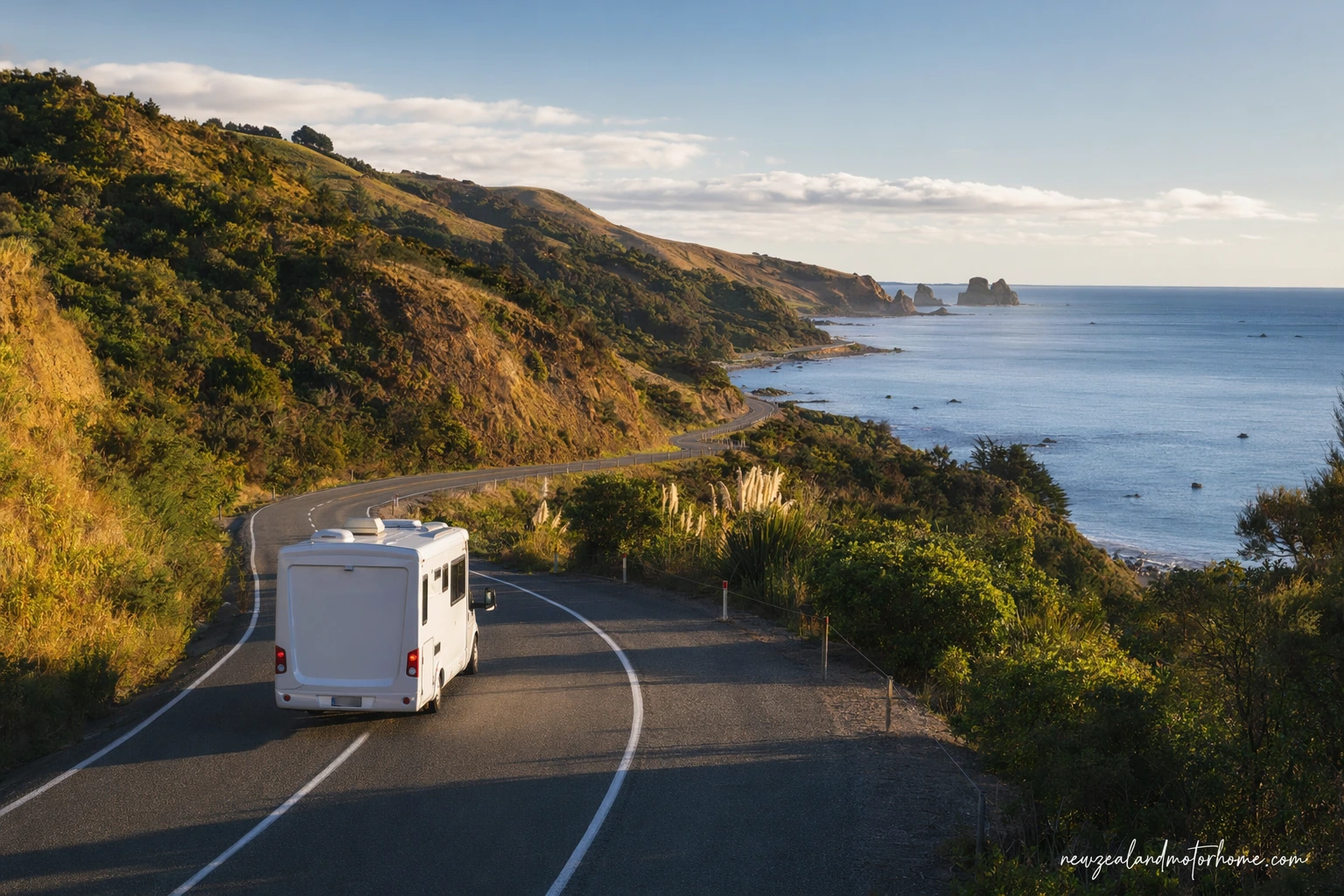
- Best over 3 days
- Includes Cook Strait ferry
- Sealed highways throughout
- Powered sites useful pre-ferry
- Check self-containment rules
The Nelson to Palmerston North campervan route links two very different bits of Aotearoa: Tasman Bay and the upper South Island, then Cook Strait, Wellington, the Kāpiti Coast and the Manawatū plains. It is not just a straight drive — the ferry turns it into a proper self-drive motorhome trip, with timing, gas, water and overnight stops all worth sorting before you leave Nelson.
This guide is written for travellers driving and sleeping in their hired campervan or motorhome. You’ll find a practical breakdown of the Nelson to Palmerston North drive, where to pause with a larger vehicle, how to think about powered versus unpowered nights, and what to check before rolling onto the ferry and heading north.
How many days to allow for the route
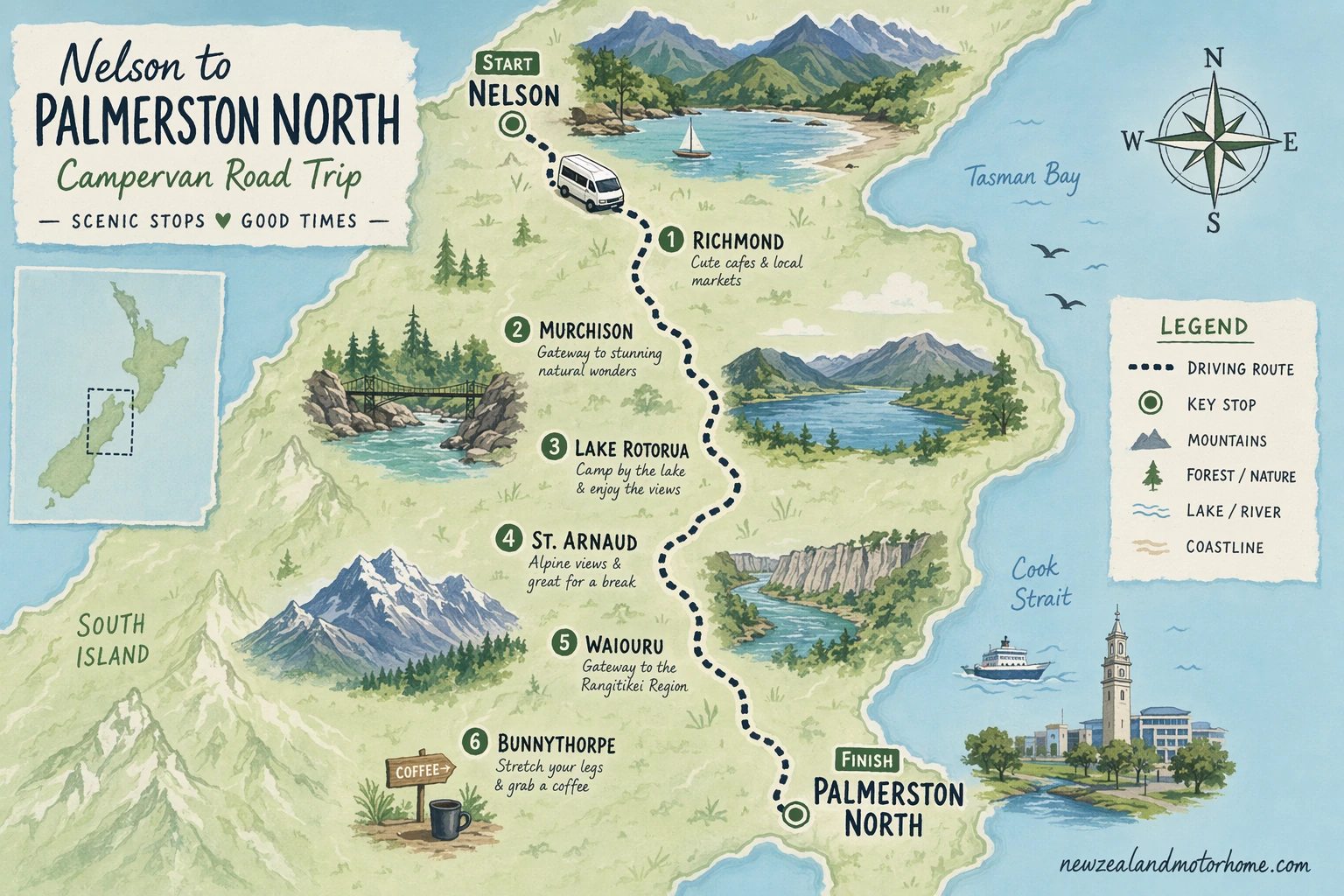
You can drive from Nelson to Palmerston North in two long days if the ferry lines up neatly, but it is a much better campervan trip over three to four days. That gives you time to avoid rushing Queen Charlotte Drive or the Rai Valley roads, board the ferry without stress, and break the North Island stretch with an easy overnight near Wellington or the Kāpiti Coast.
A sensible pace is Nelson to Picton on day one, ferry to Wellington on day two, then Wellington or Kāpiti to Palmerston North on day three. If you want a slower Nelson to Palmerston North motorhome road trip, add a night around Havelock, Picton, Paekākāriki, Waikanae or Foxton and let the van routine settle in.
- Fast but workable: 2 days, with an early start and a booked ferry.
- Comfortable: 3 days, allowing one South Island night and one North Island night.
- Unhurried: 4 days or more, with time for Marlborough Sounds viewpoints and Kāpiti beach stops.
- Best for first-time motorhome drivers: avoid arriving at ferry terminals or holiday parks after dark.
Leg 1: Nelson to Havelock or Picton
From Nelson, most campervans follow State Highway 6 through Rai Valley and on towards Havelock, then continue to Picton via State Highway 1. The road is sealed and regularly used by motorhomes, but it is not a motorway-style run — expect bends, short passing opportunities and slower sections where a fully loaded van will want a patient driver.
Havelock makes a good lunch stop if you want to stretch your legs before the final run to Picton. Park in regular public parking only where your van fits without overhanging footpaths or blocking access; if you are in a longer motorhome, look for edge-of-town or foreshore-style parking rather than squeezing into tight main-street spaces.
Picton is the practical pre-ferry overnight. Staying in a holiday park or approved campground here means you can plug into power, top up fresh water if available on site, empty at a dump station where provided, and reach the ferry terminal without a long morning drive.
- Distance feel: short on the map, slower in a campervan because of bends and traffic.
- Road note: watch speed on descents and pull over safely if traffic builds behind you.
- Overnight style: powered sites in Picton are the easiest pre-ferry option.
- Before boarding: secure cupboards, turn off LPG as required, and know your vehicle height and length.
Cook Strait ferry with a campervan
The ferry is the hinge of this route. Book your campervan or motorhome by vehicle length and height, not just as a standard car, and allow more time than you think for check-in, queuing and loading. If your hire van has bikes, a rear box or anything mounted high, include that in your measurements.
Before you roll into the ferry lanes, tidy the living area and make sure fridge contents are secure. Ferry operators have their own safety instructions for LPG and access to the vehicle deck, so follow the directions given on the day. You usually cannot wander back to the van during the sailing, so take warm layers, medicines, chargers and snacks with you.
On arrival in Wellington, resist the temptation to push straight through the city at peak time if you are tired. A larger motorhome feels much easier once you are clear of the central one-way streets and onto the motorway north, so time your departure with traffic in mind.
Leg 2: Wellington to Kāpiti or Foxton
After the ferry, the route follows State Highway 1 north through Wellington and along the Kāpiti Coast. Transmission Gully has made this section more straightforward for campervans than the older coastal highway, but wind can still be a factor, especially in a high-sided motorhome. Keep both hands on the wheel through exposed sections and leave extra room around trucks.
For a relaxed overnight before Palmerston North, look at established holiday parks, council-approved campgrounds or clearly signed freedom camping areas along the Kāpiti Coast or further north around Foxton. If you plan to freedom camp, your vehicle must meet the current self-containment requirements and you still need to obey local signs — rules can change from one district to the next.
Kāpiti beach settlements are useful for a slower stop because you can park the van, walk the sand, and avoid driving into Wellington late in the day. Foxton is another practical break point, with wide streets and a flatter feel after the city and coastal traffic.
- Powered night: choose this if you have been off-grid in the South Island and need battery recovery.
- Unpowered site: fine for a self-contained van if your house battery, water and toilet capacity are comfortable.
- Freedom camping: only where permitted, and always check local signage on arrival.
- Services: use recognised dump stations and potable water points rather than assuming every car park has facilities.
Leg 3: Kāpiti or Foxton to Palmerston North
The final approach to Palmerston North is an easier drive than the ferry day, with flatter country and more open roads. From the Kāpiti Coast you will usually continue north on State Highway 1 before turning inland toward the Manawatū; from Foxton, the run across to Palmerston North is straightforward in normal weather.
Take care in strong westerlies across open farmland. A high-roof campervan can move around more than a car, so slow down before exposed bridges, passing lanes and open sections where gusts come across the road. If you are driving a longer motorhome, plan fuel and supermarket stops where you can enter and exit without tight reversing.
In Palmerston North, think about where the van will sleep before you think about sightseeing. A powered site is useful at the end of the route for laundry, charging, a proper water refill and a dump-station visit. If you are meeting people in town, check street parking lengths and height clearances carefully — central parking spaces are not always friendly to a tall or long vehicle.
Campervan services, supplies and planning notes
Nelson, Picton, Wellington/Kāpiti and Palmerston North are all sensible places to handle campervan jobs. Do not leave everything until the last hour before the ferry; dumping the toilet cassette, refilling fresh water and checking LPG are much calmer when done the afternoon before.
Use official dump stations for grey water and toilet waste, and only fill fresh water from taps marked as potable. If you are hiring, check your vehicle handover notes for LPG bottle type, electrical lead requirements, toilet chemicals and any rules around gravel roads or insurance exclusions.
If you want this route stitched into a wider itinerary — for example Nelson to Palmerston North, then on to Napier, Taupō or Taranaki — you can use the talk-to-us step and we’ll help shape the overnight rhythm around your van size and travel dates.
- Fresh water: refill before remote or late-arrival nights.
- Dump station: plan one before the ferry and one at the end of the route.
- LPG: check bottle level before cooking-heavy evenings or cold nights.
- Vehicle size: know your length, height and whether mirrors need extra space on narrow streets.
Keep planning
Holiday parks palmerston north
Read onCampervan supplies palmerston north
Read onCampervan hire palmerston north
Read onWellington to palmerston north campervan
Read onRotorua to palmerston north campervan
Read onQueenstown to palmerston north campervan
Read onCommon questions
Can I drive Nelson to Palmerston North in one day in a campervan?
It is not a good plan. The ferry crossing, check-in time, road conditions and fatigue make it too much for most self-drive campervan travellers. Treat it as at least a two-day trip, with three days far more comfortable.
Where should I stay before the Cook Strait ferry?
Picton is the easiest overnight before the ferry because you are close to the terminal and can start the morning without a long drive. A powered site is handy for charging devices, chilling the fridge properly and sorting water or waste before boarding.
Is the road from Nelson to Picton suitable for a motorhome?
Yes, it is a standard sealed route used by campervans and motorhomes, but it has bends, hills and limited passing areas. Drive to the conditions, use slow-vehicle bays where safe, and avoid rushing if you have a ferry deadline.
Can I freedom camp on this route?
Only in places where freedom camping is allowed and only if your vehicle meets the required self-containment rules. Check local council signs on arrival, because permissions differ between Nelson, Marlborough, Wellington, Kāpiti, Horowhenua and Palmerston North areas.
Do I need to book the ferry ahead with a campervan?
Yes, booking ahead is strongly recommended, especially in summer, school holidays and around public holidays. Book with the correct vehicle length and height, including any rear-mounted bikes or roof fittings.
What is the easiest overnight stop after arriving in Wellington?
If you arrive late or tired, stay close to Wellington or continue only as far as a suitable Kāpiti Coast stop. Pushing on to Palmerston North after an afternoon ferry can make the day longer than it looks on the map.
Have a planner shape this for your dates
Send a short outline — your dates, party size, and the kind of trip you want. A planner replies with a vehicle recommendation, a paced route, and the realistic budget.