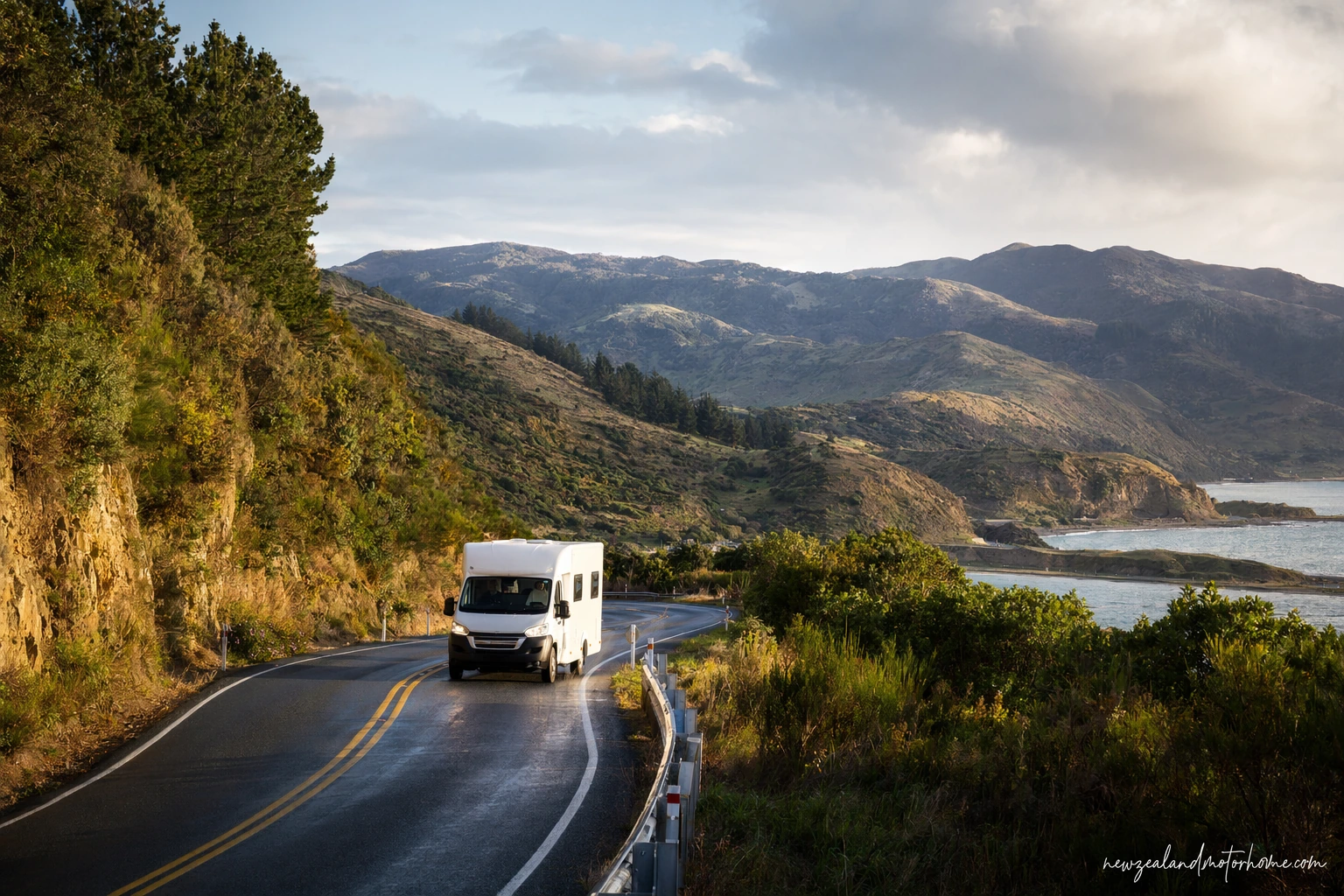
- Best over 2–3 days
- About 400–430 km
- SH2 hill sections need care
- Powered sites easiest in Hawke’s Bay
- Self-contained rules apply
A Palmerston North to Gisborne campervan trip is a proper eastward crossing: from the flat Manawatū, through the rural sweep of Central Hawke’s Bay, then up the wilder SH2 coastline and hill country into Tairāwhiti. It is not a route to rush in a big van, especially once you leave Napier and the road tightens around Wairoa, Morere and the Wharerata hills.
This guide is written for travellers driving and sleeping in their own hired campervan or motorhome. You’ll find practical leg planning, where to break the Palmerston North to Gisborne drive, what to check before choosing freedom camping, and the places to think about fuel, LPG, fresh water and dump stations before the road gets quieter.
How long to allow in a campervan
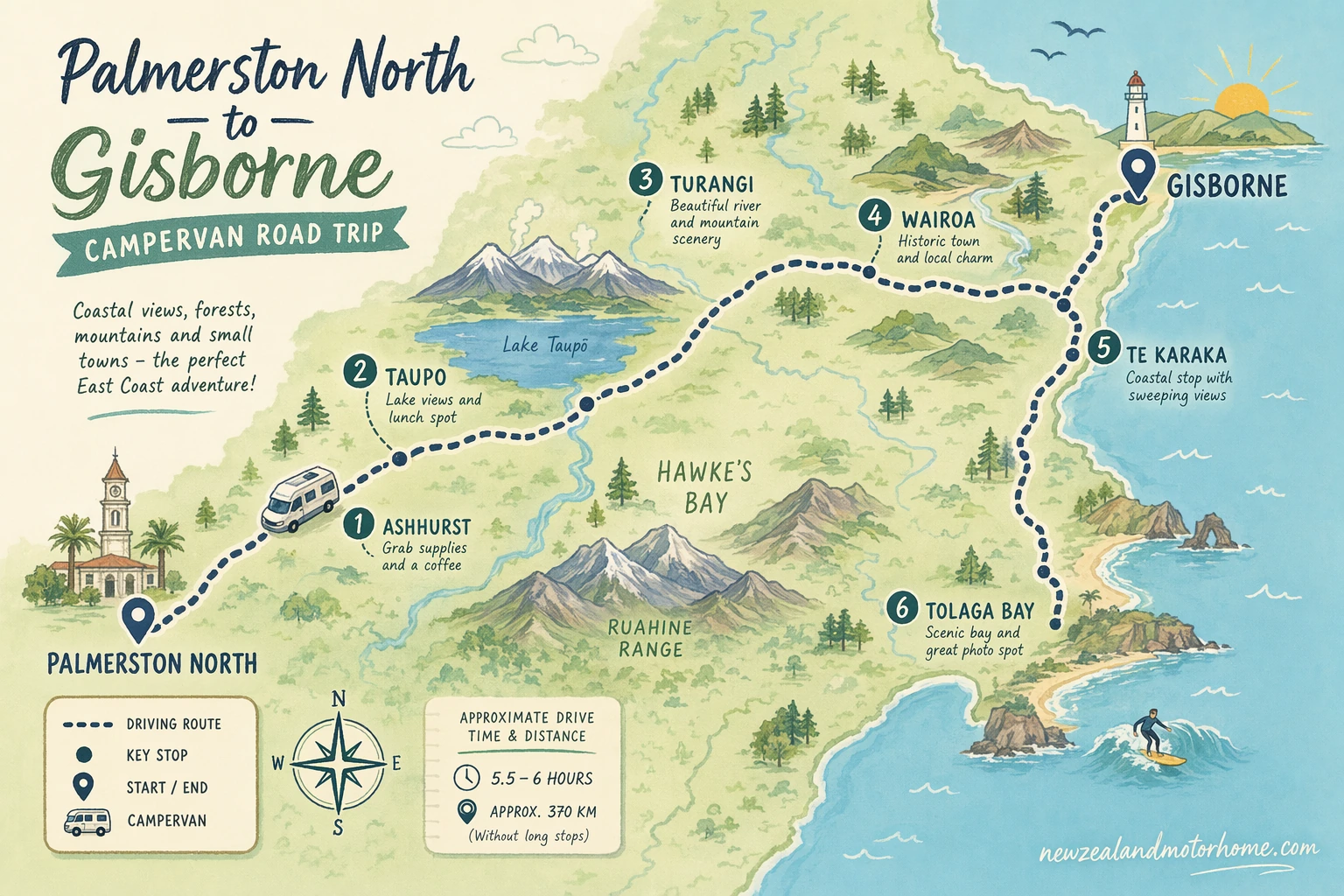
The direct Palmerston North to Gisborne campervan route is usually around 400 to 430 kilometres, depending on whether you detour into Napier, Hastings, Mahia or coastal reserves. In a car it can look like a long single-day drive on the map; in a motorhome, it is far more comfortable as a two or three-day trip.
The easiest rhythm is to use Hawke’s Bay as your first overnight stop, then continue through Wairoa to Gisborne the next day. If you like slower mornings, beach walks and not arriving after dark with a full grey-water tank, add a night around Wairoa or Mahia.
- Fast but tiring: 1 long day, only if the weather is settled and you are confident on winding roads.
- Best balance: 2 days, overnighting in Napier, Hastings, Havelock North or nearby.
- Unhurried: 3 days, with a Wairoa, Mahia or Morere-area stop before Gisborne.
- Van note: plan shorter driving blocks if your motorhome is over 7 metres or if you are new to narrow hill sections.
If you want help matching your hire van, travel dates and overnight style to the route, you can send us the basics through talk to us and we’ll help shape the plan without overloading the days.
Leg 1: Palmerston North to Hawke’s Bay
Leave Palmerston North with fresh water topped up, toilet cassette empty and groceries sorted. The first part of the Palmerston North to Gisborne motorhome road trip takes you through Ashhurst and Woodville, then south-east via Dannevirke and Waipukurau before the country opens towards Hastings and Napier.
Between Ashhurst and Woodville, follow the current signed state highway route and do not rely on old map memory of the Manawatū Gorge road. The road is suitable for campervans, but expect trucks, changing speed limits and exposed wind at times. Take it quietly through the towns; they are useful reset points rather than places to squeeze past with a half-full coffee in hand.
- Good van breaks: Woodville, Dannevirke and Waipukurau all work for stretching legs and checking cupboards before Hawke’s Bay.
- Fuel and LPG: easier in Palmerston North, Dannevirke, Waipukurau, Hastings and Napier than on the quieter northern section.
- Dump stations: look for public or holiday park dump points in Palmerston North, Central Hawke’s Bay and the Napier-Hastings area; confirm access in a current camping app or council listing.
- Parking: in town centres, use longer edge spaces or supermarket-style open car parks where permitted rather than tight angled parks.
For overnighting, Hawke’s Bay gives you the widest choice on the route: powered holiday park sites, unpowered grass sites, and some council-controlled freedom camping areas for certified self-contained vehicles. Always read the local sign at the actual reserve or car park; rules can change by season, vehicle type and time limit.
Hawke’s Bay overnight stops that suit vans
Napier, Hastings and the coastal settlements nearby make the most practical first night. If you want showers, laundry, a dump station and the security of plugging into 230V, choose a holiday park with powered sites. If your batteries are healthy and the weather is mild, an unpowered site can be enough for one night, especially if you have already topped up water.
Freedom camping around Hawke’s Bay is location-specific. A certified self-contained campervan may still be restricted to marked bays, particular reserves or limited nights, and some beachfront areas are patrolled closely. Do not assume an empty seafront car park is legal overnight parking.
- Powered site advantage: recharge house batteries, run appliances safely, use showers and empty waste before the northern hills.
- Unpowered site advantage: quieter and often simpler for one-night stops if you are fully self-contained.
- Freedom camping check: look for council signage, marked bays, time limits and self-containment requirements before settling in.
- Fresh water: fill in Hawke’s Bay rather than leaving it until the Wairoa-Gisborne section, where services are more spread out.
Before rolling north, secure drawers, check the fridge latch and make sure your grey-water tank has room. The next section is beautiful but less forgiving if you need to pull over urgently in a long van.
Leg 2: Napier or Hastings to Wairoa and Morere
North of Napier, SH2 becomes a more serious campervan road. The run to Wairoa has coastal glimpses, river valleys, forestry traffic and sections where the road narrows or bends for long stretches. It is still a standard state highway, but it asks for patience: use slow vehicle bays when safe, let locals pass, and avoid driving it tired.
Wairoa is the key service town between Hawke’s Bay and Gisborne. Treat it as your practical checkpoint for fuel, food, water planning and a toilet stop, even if you are continuing. If you are carrying bikes, surfboards or outdoor gear, re-check straps here before the next hillier section.
- Driving note: expect logging trucks and stock trucks; keep left, brake early and give yourself space on bends.
- Weather note: after heavy rain, check highway conditions before committing to the Napier-Wairoa-Gisborne section.
- Van length: larger motorhomes should avoid late-day driving here, when shadows and fatigue make bends harder to read.
- Services: Wairoa is the sensible place to check fuel range and waste levels before Morere and the Wharerata hills.
If you do not want a long second day, look for a legal Wairoa-area campground, holiday park or designated self-contained stop, then continue to Gisborne fresh in the morning. Morere is also a useful pause for a walk among nikau palms, but check where a high-roof van can park before nosing into smaller roadside areas.
Leg 3: Wairoa to Gisborne via the Wharerata hills
The final approach to Gisborne is one of the most memorable parts of the route. From Wairoa, SH2 passes through Morere, climbs and drops through the Wharerata hills, then finally opens into the vineyards, river flats and wide skies of Tairāwhiti. In a campervan, this is a hands-on drive rather than a cruise-control section.
Use lower gears on descents, especially if your motorhome is heavy with full water tanks, bikes and luggage. Pull over only where there is proper space; soft shoulders and small scenic nooks are not always suitable for a wide rental van. If traffic builds behind you, wait for a safe slow vehicle bay rather than forcing a stop on a blind bend.
- Before leaving Wairoa: check fuel, drinking water, toilet cassette capacity and weather updates.
- On the hills: keep speed modest, use engine braking and avoid crossing the centre line on tight corners.
- Arriving in Gisborne: choose a legal overnight base before sightseeing so you are not hunting for a site after dark.
- Dump and water: Gisborne has more options than the road in, but confirm locations and access hours in a current app or council source.
Once in Gisborne, park the van and slow down. Waikanae Beach, the river mouth, nearby surf beaches and vineyard country are all easier to enjoy when you are not trying to squeeze a long motorhome into a busy kerbside park at lunchtime.
Gisborne arrival: where to base the campervan
Gisborne works well as a two-night stop after the drive because you can reset the van properly: plug into power, do laundry, empty waste, refill fresh water and let the fridge settle. Beachside holiday parks and campgrounds close to town are the simplest choice if you want to walk rather than drive for dinner or a morning swim.
Freedom camping in Gisborne and the wider Tairāwhiti area is controlled by local rules and may be limited to signed places for certified self-contained vehicles. The region is loved by surfers and summer road-trippers, so do not leave your overnight decision until late on a busy weekend.
- Powered sites: best after two days of driving, especially if you have been using lights, fridge, heater or device charging off-grid.
- Unpowered sites: fine for well-set-up vans with good batteries and conservative water use.
- Freedom camping: only where signs and bylaws allow; keep proof of self-containment visible if required.
- Parking in town: use larger public car parks or the edges of beach areas where your length does not overhang footpaths or traffic lanes.
For day trips north or towards the beaches, travel light if you can. Leave awnings packed, water levels sensible and loose items stowed, because Gisborne’s coastal roads can be narrow, sun-glary and busy around surf breaks.
Keep planning
Holiday parks palmerston north
Read onCampervan supplies palmerston north
Read onCampervan hire palmerston north
Read onWellington to palmerston north campervan
Read onRotorua to palmerston north campervan
Read onQueenstown to palmerston north campervan
Read onCommon questions
Can I drive from Palmerston North to Gisborne in one day in a campervan?
Is the Palmerston North to Gisborne drive suitable for a large motorhome?
Where should I empty the toilet cassette on this route?
Can I freedom camp between Palmerston North and Gisborne?
What is the best overnight stop for this route?
Have a planner shape this for your dates
Send a short outline — your dates, party size, and the kind of trip you want. A planner replies with a vehicle recommendation, a paced route, and the realistic budget.