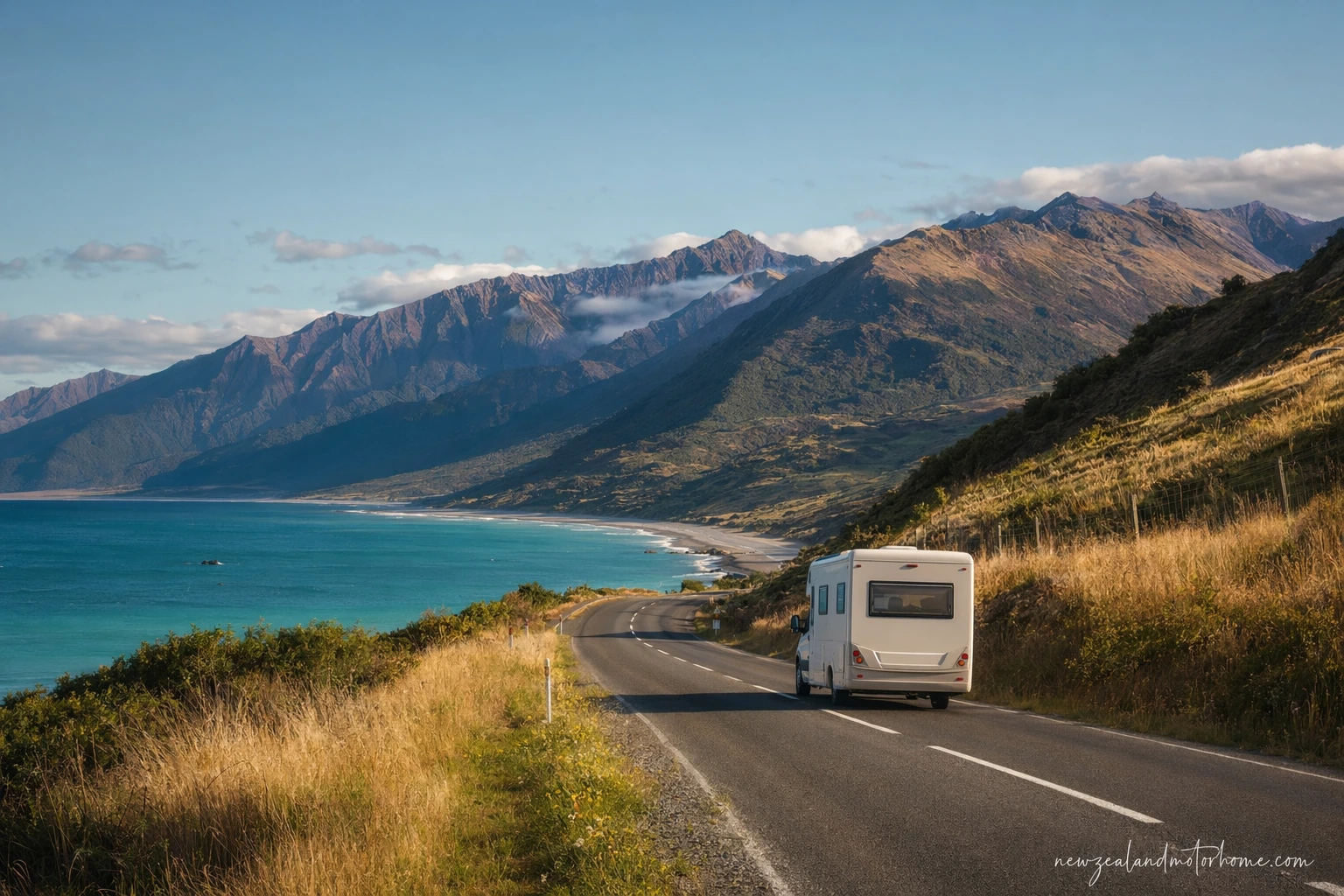
Palmerston North to Timaru campervan route and overnight stops
- Allow 3 to 5 days
- Includes Cook Strait ferry
- SH1 suits most vans
- Book powered sites in peak season
- Self-contained only for freedom camping
The Palmerston North to Timaru campervan run is a proper two-island journey: Manawatū farmland, a Wellington harbour departure, Cook Strait, Marlborough hills, the Kaikōura coast, then the wide Canterbury plains into South Canterbury. It is not a route to rush unless you enjoy arriving tired with half your fresh-water tank sloshed away.
This guide is written for self-drive campervan and motorhome travellers, with practical notes on where to break the drive, how to handle the ferry with a van, which roads suit larger vehicles, and where to think about powered sites, dump stations, LPG and fresh-water fills. Use it as a framework, then adjust for weather, ferry times and how much coast-watching you want between Picton and Timaru.
How many days to allow for the Palmerston North to Timaru drive
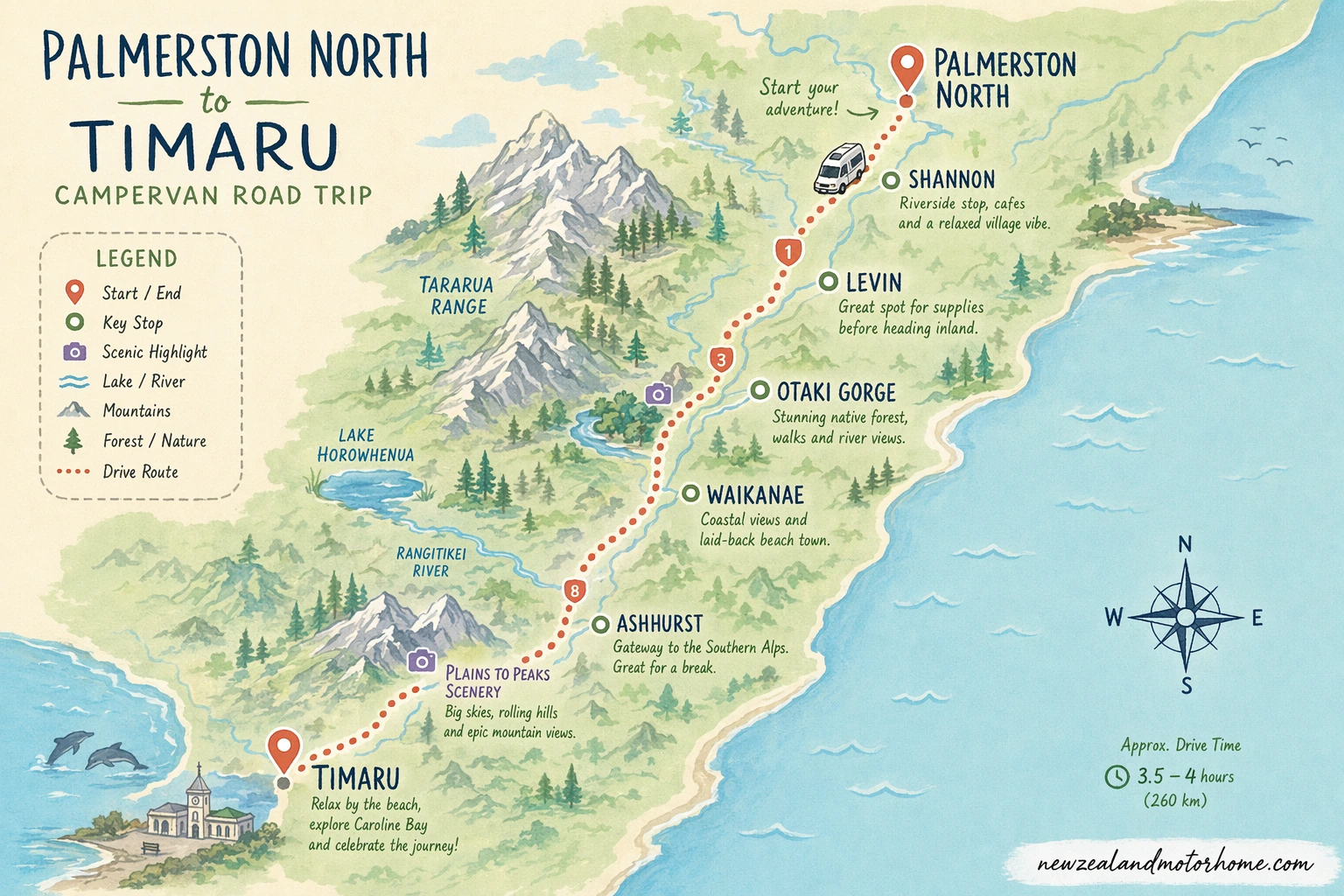
The Palmerston North to Timaru drive is not just a road distance; the Cook Strait ferry becomes part of your day. You can technically push through with one overnight near Wellington or Picton, but it makes for a long, logistics-heavy trip in a campervan. A more comfortable plan is three to five days, especially if you are in a larger motorhome or travelling in winter daylight.
A useful rhythm is to get to Wellington on day one, cross to Picton the next morning or afternoon, then follow State Highway 1 down the east coast and Canterbury. If you want to stop for Kaikōura wildlife walks, a Christchurch resupply, or a slower final approach to Timaru, add another night.
- Fast but tiring: 2 days, with a tight ferry connection and limited sightseeing.
- Comfortable: 3 to 4 days, with nights around Wellington or Picton, Kaikōura, and perhaps North Canterbury.
- Easy touring pace: 5 days or more, adding Marlborough, Christchurch, or Geraldine side trips.
- Best season: spring to autumn for longer daylight; winter is fine but allow for wind, rain and slower coastal driving.
If you want help shaping ferry timing, overnight stops and site availability around your actual van size, add your dates through our plan-your-trip step and keep the route realistic rather than rushed.
Leg 1: Palmerston North to Wellington with a campervan
From Palmerston North, most vans take State Highway 57 or SH56 towards Levin, then join SH1 down the Kāpiti Coast and into Wellington. The roads are sealed and suitable for campervans, but traffic builds near Ōtaki, Paraparaumu and the motorway approaches, so leave yourself more time than the map suggests if you have a ferry booked.
Before leaving Palmerston North, empty the toilet cassette or grey tank if needed and top up fresh water. Larger motorhomes are easier to manoeuvre at service areas on the edge of town than in tighter central streets. Levin, Ōtaki and Kāpiti are sensible breaks for groceries, fuel and a leg-stretch without committing to inner-Wellington parking.
- Van parking: choose supermarket or waterfront parking areas with clear overhang room; avoid squeezing into compact city parks.
- Overnight before ferry: look at holiday parks or designated campervan sites around Kāpiti, Porirua, Lower Hutt or Wellington rather than trying to freedom camp casually near the terminal.
- Services: plan dump station and fresh-water stops before entering central Wellington, where access can be tighter.
- Driving note: Wellington wind can be lively for high-sided motorhomes; slow down on exposed motorway sections and keep both hands on the wheel.
If your ferry is early, staying on the northern side of Wellington can be calmer, but check morning traffic. If your ferry is late, a powered site is worth considering so you can charge devices, run the fridge confidently and start the South Island leg with full batteries.
Cook Strait ferry notes for motorhomes
The ferry crossing is the hinge of this Palmerston North to Timaru motorhome road trip. Book for the full length and height of your vehicle, including bike racks, rear boxes, roof pods or anything else that changes the measured size. Arrive early enough for vehicle marshalling; the ferry terminal is not a place to repack the garage or discover your LPG bottle is loose.
Before boarding, secure cupboards, turn the gas off as instructed, and make sure pets, if travelling, are managed according to ferry rules. You generally cannot access the vehicle deck during the crossing, so take warm layers, medication, chargers and snacks upstairs with you.
- Best pre-ferry habit: fill drinking water and empty waste before reaching the terminal area.
- On board: leave the fridge closed; it will hold temperature better if it has been chilled properly beforehand.
- After arrival in Picton: do not rush off the ramp into town traffic; pull over only where signed and safe.
- Weather buffer: Cook Strait delays happen, so avoid booking a tight campsite arrival on the same evening if you can.
Picton has campervan services nearby and makes a pleasant overnight if your crossing lands late. If you still have daylight, Blenheim is an easy onward drive with more open parking, supermarkets, fuel and LPG options.
Leg 2: Picton to Kaikōura down the Marlborough coast
From Picton, follow SH1 through Blenheim and south towards the coast. The early part is vineyard country and generally easy for vans, with Blenheim a useful resupply point for groceries, fresh water, fuel and LPG before the road becomes more scenic and more constrained.
The coastal section towards Kaikōura is one of the highlights of the route, but it deserves patient driving. Expect curves, tunnels, rail crossings, seal-viewing traffic and places where shoulders are narrow. In a longer motorhome, use proper pull-offs rather than stopping half on the road for photos.
- Good overnight options: Picton for ferry recovery, Blenheim for services, or Kaikōura for coast and wildlife walks.
- Powered sites: useful in Kaikōura if you have been off-grid since the North Island or need a full battery reset.
- Freedom camping: only use clearly permitted areas and only if your vehicle is certified self-contained under current NZ rules.
- Waste and water: do not assume every beach stop has facilities; empty and fill in town service points.
Kaikōura is worth not treating as just a fuel stop. Park the van in signed areas, walk rather than drive around the busiest waterfront pockets, and keep extra space for opening doors in wind. The sea air is lovely; the parking can be tight when everyone has the same idea.
Leg 3: Kaikōura to Timaru via Christchurch and the plains
South of Kaikōura, SH1 carries you through North Canterbury towards Christchurch. The road is suitable for campervans and motorhomes, but it is a working highway with trucks, wind exposure and occasional slow sections. If you are not stopping in Christchurch, use the signed motorway and bypass routes rather than threading a tall van through the central city.
Christchurch is the easiest major resupply point on the South Island leg. This is the place to sort LPG, supermarket supplies, laundry, fresh water, dumping and any van niggles before the final run. South of the city, the route opens out across the Canterbury plains through Ashburton and over long river bridges, where crosswinds can catch high-sided vehicles.
- Christchurch stop: choose large-format shopping areas or holiday parks with clear van access, not small inner-city car parks.
- Canterbury driving: watch following distances; straight roads encourage speed, but a loaded campervan takes longer to stop.
- Possible break points: Amberley, Christchurch, Rakaia, Ashburton and Temuka all work as pauses depending on your day.
- Final approach: Timaru is straightforward from the north on SH1, but choose parking before committing to narrow side streets near Caroline Bay.
If the weather is poor, breaking the Kaikōura to Timaru leg around Christchurch or Ashburton makes the day far more relaxed. A powered site on this stretch is also handy if you have had several nights relying on solar and driving charge.
Where to stay, dump and refill along the route
For this route, think in service clusters rather than single magic stops. Palmerston North, Wellington region, Picton, Blenheim, Kaikōura, Christchurch, Ashburton and Timaru are the main places to manage the practical side of van travel. Check current council information and campsite details before you rely on any dump station, as access and maintenance can change.
Powered holiday park sites are the simplest choice near the ferry, in Kaikōura, and at the end in Timaru if you want showers, laundry and a full battery top-up. Unpowered sites suit milder weather and short stays, provided your house battery, fridge and water use are under control. Freedom camping is possible only where local bylaws allow it, and only in a compliant self-contained vehicle.
- Dump stations: plan to empty before Wellington, again in Marlborough or Kaikōura, and once more around Christchurch or Timaru if needed.
- Fresh water: fill little and often rather than carrying unnecessary weight over the whole trip.
- LPG: top up in larger towns; check forecourt access if your motorhome is long or towing a bike rack.
- Rubbish: use official bins and campground facilities, especially through coastal areas where wildlife is close to the road.
In Timaru, Caroline Bay is the obvious place to stretch your legs, but park with length and height in mind. If you are staying overnight, use a proper campground or a clearly designated legal area rather than assuming a seaside car park allows sleeping in the van.
Keep planning
Holiday parks palmerston north
Read onCampervan supplies palmerston north
Read onCampervan hire palmerston north
Read onWellington to palmerston north campervan
Read onRotorua to palmerston north campervan
Read onQueenstown to palmerston north campervan
Read onCommon questions
Can I drive from Palmerston North to Timaru in one day in a campervan?
It is not a sensible one-day campervan trip because the ferry crossing, check-in time and long driving hours make it exhausting. Plan at least two days, and preferably three or more if you want safe breaks and proper overnight stops.
Where should I stay before the Cook Strait ferry?
Look at holiday parks or designated campervan sites around Kāpiti, Porirua, Lower Hutt or Wellington, depending on your sailing time. For an early ferry, stay close enough to avoid a stressful motorway run, but still choose somewhere legal and suitable for your van size.
Is the Picton to Kaikōura road suitable for large motorhomes?
Yes, SH1 is a main highway and is used by large vehicles, but the coastal section has curves, tunnels, narrow shoulders and tourist traffic. Drive patiently, use proper pull-offs, and avoid stopping on the roadside for photos.
Do I need to book powered sites on this route?
Booking is wise around Wellington, Picton, Kaikōura, Christchurch and Timaru, especially in summer, school holidays and long weekends. Powered sites are particularly useful before or after the ferry and after several off-grid nights.
Can I freedom camp between Palmerston North and Timaru?
Only in places where local rules allow it, and only if your campervan is certified self-contained under current requirements. Bylaws vary between districts, so check signs and council information before settling in for the night.
Where should I plan dump station and water stops?
Use the main service towns: Palmerston North, the Wellington region, Picton or Blenheim, Kaikōura, Christchurch, Ashburton and Timaru. Do not leave waste management until the tank is full, because ferry timing and road delays can remove your options.
Have a planner shape this for your dates
Send a short outline — your dates, party size, and the kind of trip you want. A planner replies with a vehicle recommendation, a paced route, and the realistic budget.