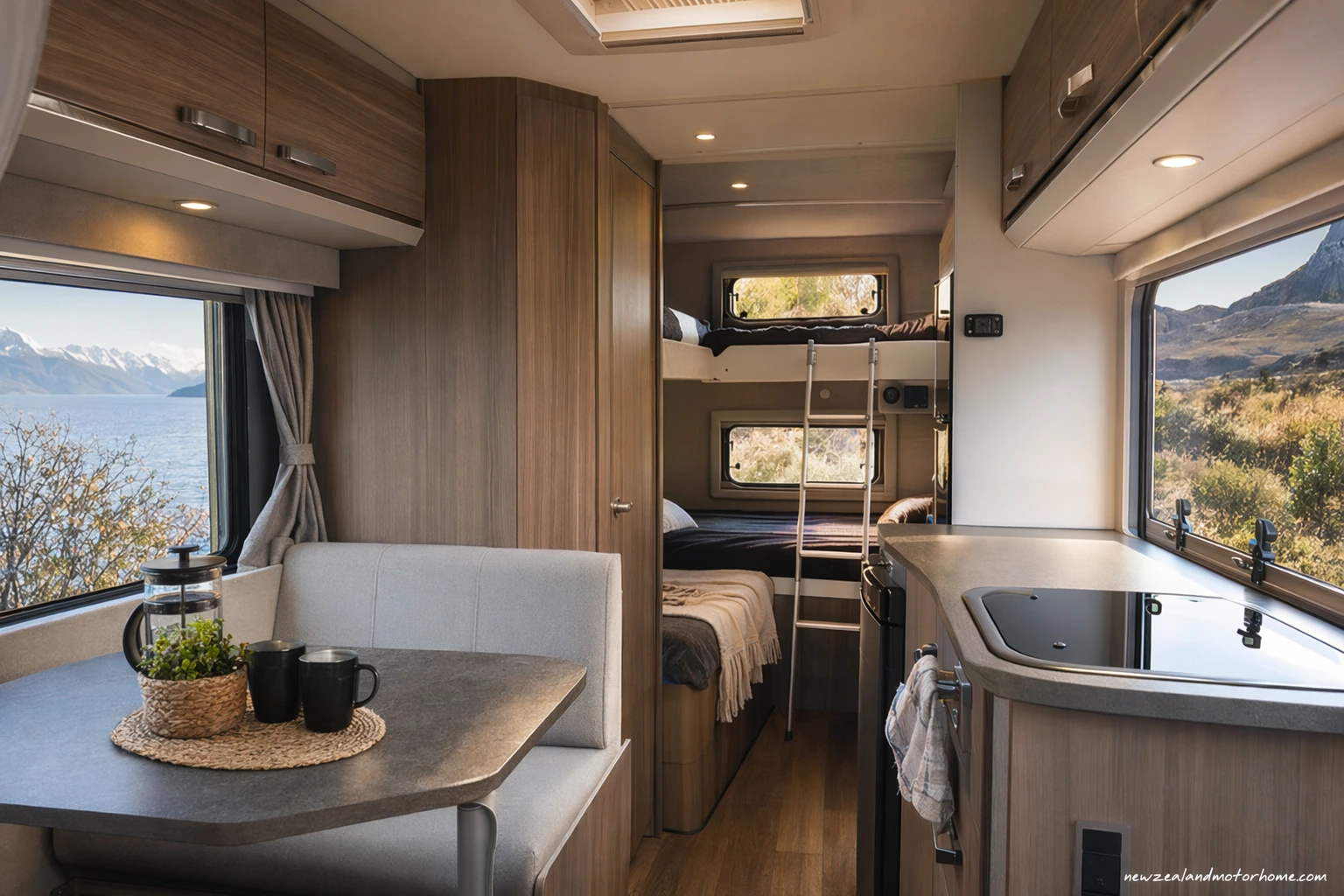
- Sleeps up to 6 people
- Best with powered sites often booked ahead
- Allow extra length for parking
- Self-containment rules still apply
- Plan fuel, LPG, water and dump stops
A 6 berth campervan is the big, practical end of New Zealand motorhome travel: proper beds, an onboard bathroom, a real kitchen, and enough living space for a family or a group of friends to move about without packing the van away every hour.
This guide is written for self-drive travellers who will be parking, sleeping, cooking and managing the van themselves. We’ll cover typical layouts, where a 6 berth motorhome NZ trip feels easy, what to think about with powered sites, dump stations, LPG, fresh water, and how this larger vehicle behaves on local roads.
Who a 6 berth camper suits best
6 berth campervan hire nz usually suits families with children, two couples travelling together, or a small group that wants fixed sleeping zones rather than making every bed from scratch each night. The extra length gives you more storage for soft bags, supermarket food, wet jackets and outdoor chairs, which matters on longer South Island loops or North Island beach-and-lake trips.
A 6 berth camper New Zealand layout is also useful if you are travelling in shoulder seasons, when evenings are cooler and you spend more time inside. You can cook, shower, charge devices and get kids into bed without relying on campground facilities for every little thing.
- Best fit: families, groups of friends, travellers carrying sports or baby gear.
- Less ideal for: couples wanting a nimble van for tight town parking and narrow gravel access roads.
- Plan ahead: book powered campsites early in peak summer, especially in Queenstown, Wānaka, Nelson, Rotorua and coastal holiday parks.
Beds, kitchen and living space inside the van
Most 6 berth motorhomes have three sleeping areas, often a rear bed or dinette conversion, a central dinette that converts, and an over-cab bed. The over-cab bed is handy because it keeps one sleeping space made up while the main table stays available for breakfast, maps, laptops and card games on rainy nights.
The kitchen is normally more usable than in smaller campers, with a fridge, gas hob, sink, fresh-water tank and grey-water tank. You still need to manage space carefully: shop every few days rather than trying to carry a week of groceries, and use campground kitchens when you want a big cook-up without steaming up the van.
- Bathrooms: expect a compact toilet and shower; use dump stations only for waste disposal.
- Storage: soft bags pack far better than hard suitcases in overhead lockers and rear cupboards.
- Power: powered sites help keep the house battery, fridge and devices comfortable on multi-night stays.
Driving and parking a 6 berth motorhome on NZ roads
A 6 berth camper is larger than a city vehicle, so give yourself time. New Zealand distances look short on a map, but rural roads can be winding, exposed and narrow, especially over alpine passes, around Fiordland, the Coromandel, East Cape and parts of the West Coast. Use pull-outs to let traffic pass, take corners wide, and check bridge signs, low branches and campground entrances before committing.
Parking is easiest on the edge of town centres, at supermarkets with larger spaces, lakefront reserves with marked motorhome bays, and holiday parks with drive-through or larger sites. Avoid squeezing into standard angle parks if the rear overhang blocks traffic or the footpath.
- Allow extra length: look for long vehicle parks at supermarkets, i-SITE areas and visitor car parks.
- Check height: watch for trees, motel-style canopies, fuel-station roofs and covered car parks.
- Use a spotter: have one passenger stand outside when reversing into tight powered sites.
- Slow travel works best: two or three hours of driving in a day often feels plenty in a larger van.
Powered sites, freedom camping and overnight stops
A 6 berth campervan can be self-contained, but that does not mean you can sleep anywhere. Check the current local council rules before choosing a freedom camping spot, and look for signs on arrival. Some areas allow certified self-contained vehicles only in marked bays, while others restrict overnight stays altogether.
For a vehicle this size, powered holiday park sites are often the easiest option every second or third night. You can top up fresh water, plug into mains power, empty grey and toilet waste at a dump station, refill laundry bags, and reset the van before heading back to a Department of Conservation-style or unpowered stop.
- Powered sites: best for cold nights, device charging, longer stays and family routines.
- Unpowered sites: fine for short stops if your battery, water and gas levels are healthy.
- Freedom camping: only where permitted, and only if your vehicle meets the required self-containment certification.
- Arrival tip: get into camp before dark so you can level the van and connect power safely.
Fuel, LPG, water and dump station rhythm
In a 6 berth motorhome NZ itinerary, the practical rhythm matters as much as the scenery. Fuel before remote stretches, refill fresh water before heading into quieter coastal or alpine areas, and use dump stations before tanks are close to full. A larger group fills grey water faster through showers, dishes and hand-washing.
LPG commonly runs the hob and may support hot water or heating, depending on the vehicle. Check how your hired van shows gas levels, where the bottle or bay is, and what the handover instructions say about refilling or swapping. If you are travelling in winter or cooking daily, keep a closer eye on gas than you would in summer.
If you would like help matching a 6 berth camper to the route, season and campsites you are considering, use the talk-to-us step and tell us how many people are travelling, how long you have, and whether you prefer holiday parks, freedom camping, or a mix.
- Fuel: top up before long rural drives rather than waiting for the last quarter tank.
- Fresh water: refill at approved taps in holiday parks or marked service points.
- Dump stations: empty toilet and grey water only at authorised dump points.
- LPG: check levels before cold regions, multi-day stays and public holidays.
Common questions
Is a 6 berth campervan hard to drive in New Zealand?
It is manageable if you drive slowly, allow extra stopping distance and plan your parking. The main adjustment is size: narrow rural roads, tight supermarket parks, low branches and campground manoeuvring need more care than a smaller van.
Do I need to book powered sites for a 6 berth camper?
You do not need a powered site every night, but they are very useful for families or groups. Powered sites help recharge the house battery, run appliances comfortably, and give you access to water, rubbish, laundry and dump station facilities.
Can a 6 berth camper freedom camp in NZ?
Only where local rules allow it, and the vehicle must meet the required self-containment certification for that location. Always check signage and council rules, and do not assume a larger van can stay in every scenic car park.
How often should we empty waste water in a 6 berth motorhome?
With four to six people, expect grey water and toilet capacity to become part of your routine. Many travellers plan to use a dump station every couple of days, sooner if everyone is showering in the van.
Is a 6 berth camper better than two smaller vans?
For families and close friends, one 6 berth camper keeps everyone together and can simplify campsite bookings. Two smaller vans may be easier to park and give adults more privacy, but you will manage two fuel tanks, two setups and possibly two powered sites.
Have a planner shape this for your dates
Send a short outline — your dates, party size, and the kind of trip you want. A planner replies with a vehicle recommendation, a paced route, and the realistic budget.