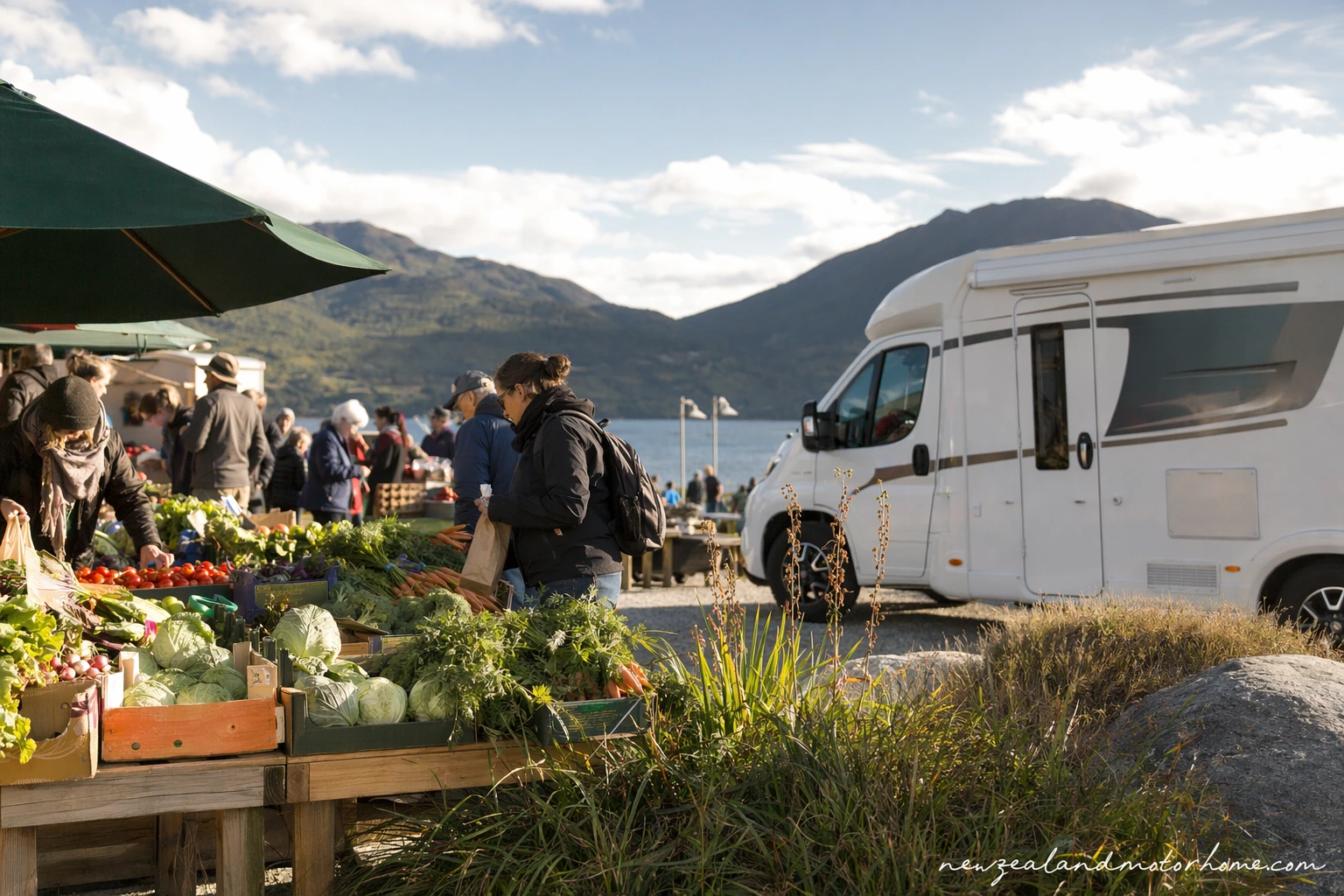
- Best on weekend mornings
- Allow 2-4 days for a Coast food loop
- Long vans park one block back
- Powered sites useful in wet weather
- Check self-contained camping rules
The West Coast is not a place to rush the grocery run. In a campervan, the best food stops often happen between the rain showers: a weekend table of berries and preserves, smoked fish near the harbour, a loaf still warm enough to fog the van window, or a roadside stall with honesty-box vegetables for dinner.
This guide is for self-drive motorhome travellers looking for farmers markets West Coast style: practical, local, and worked around where you can actually park the van. You will find notes on market timing, fresh produce West Coast highlights, town-by-town parking, dump stations, water and LPG planning, plus nearby overnight stops that suit powered and unpowered touring.
How to time West Coast market days in a campervan
West Coast markets are smaller and more weather-dependent than the big city versions, so it pays to treat them as flexible food stops rather than fixed appointments. Most weekend markets West Coast travellers come across are on Saturday or Sunday mornings, with extra pop-ups in summer, school holidays, festival weekends and cruise-ship days.
If you are driving a hired campervan, aim to arrive early enough to get a flat, easy-exit park before the main street fills. A long wheelbase van is much easier to tuck into a town-edge car park than to reverse out of a tight angle park beside a café queue.
- Check the current market day on town noticeboards, visitor information boards or community pages when you arrive.
- Carry cash as a back-up, especially at smaller stalls where mobile coverage can drop in heavy weather.
- Bring your own bags or a foldable crate; it stops tomatoes, eggs and bread sliding around the galley.
- Plan chilled purchases for the end of your wander unless your van fridge is already cold and running well.
North Coast food stops: Westport, Karamea and Reefton
Westport is the easiest northern base for food markets West Coast campervan travellers can work into a Buller loop. The town has wider streets than many Coast settlements, and you will usually have a better time parking a van near the edge of the centre rather than trying to squeeze into the busiest shopfront spaces.
Karamea and Reefton tend to feel more seasonal and community-led, with market days or food stalls appearing around local events, summer weekends and holiday periods. That is part of the charm, but it also means you should not leave your main shop until the last minute if you are heading into more remote country.
- Van parking: look for larger public car parks, recreation-ground edges or town approaches where you can drive through rather than reverse blind.
- Overnights: use holiday parks for powered sites, laundry and showers; check local freedom camping rules if relying on a certified self-contained overnight.
- Services: Westport is a sensible place to empty the cassette, refill fresh water and sort LPG before Karamea or inland detours.
- Road note: the Karamea road is sealed but winding, with slips possible after heavy rain; take it slowly in a tall motorhome.
Greymouth and Hokitika: the easiest central market pairing
Greymouth and Hokitika make the most useful central Coast pairing for van travellers because they sit on the main SH6 flow and have enough services to reset the motorhome. If you are trying to catch fresh produce West Coast style, plan to be in one of these towns on a weekend morning and keep an eye out for community markets, seasonal stalls and bakery tables.
Greymouth is practical for stocking the pantry before Arthur's Pass, Punakaiki or the glaciers. Hokitika has an easy wanderable centre and a good market-stop feel, but the closer you get to the beach and main retail blocks, the more you need to think about van length and swing room.
- Parking the van: choose bigger town car parks or side streets where permitted; avoid taking multiple small angle parks if there is a longer bay nearby.
- Powered sites: both towns have holiday park options if you need to top batteries after a wet, low-solar stretch.
- Dump and water: Greymouth and Hokitika are sensible places to empty waste and fill fresh water before quieter coast sections.
- Food to look for: seasonal fruit, vegetables, local baking, honey, jams, smoked seafood and whitebait when in season and legally available.
South Westland: shop smart before the glaciers and Haast
South of Hokitika, the driving becomes wilder and the regular market scene thins out. You may still find roadside eggs, honey, baking, produce stalls or small event markets around Ross, Franz Josef, Fox Glacier and Haast, but this is not the stretch to assume a full farmers market will be waiting.
For campervan cooking, stock your staples in Hokitika or Greymouth, then use South Westland stalls for the good extras: something fresh for dinner, a treat for the road, or a local jar that will not mind a bumpy cupboard. Glacier village car parks can be tight when tour traffic and day walkers arrive, so park the van once and walk between shops where you can.
- Overnight stops: holiday parks are the easiest option for powered sites, hot showers and drying wet gear after glacier walks.
- Unpowered sites: DOC and low-facility campgrounds can suit self-contained vans, but check access, length limits and current conditions.
- Services: do not pass a dump station or potable water point casually in South Westland; the next convenient one may be a long, wet drive away.
- Road note: SH6 has one-lane bridges, tight corners, forest shade and sudden surface water. Give yourself daylight for market stops and overnights.
What to buy for easy van meals
The best market haul is the one that actually fits your campervan kitchen. A small fridge, two gas rings and a compact sink reward simple food: new potatoes, salad greens, tomatoes, eggs, bread, smoked fish, chutney, berries, apples, honey and local baking for the next wet-road coffee stop.
Think about storage before you buy. Soft fruit needs a lidded container, leafy greens need fridge space, and glass jars need a low cupboard so they do not rattle open on Coast roads. If your van has a three-way fridge, check it is set correctly when you switch between driving, LPG and mains power at a powered site.
- Cook seafood the day you buy it unless you know your fridge is holding temperature well.
- Choose hardy vegetables if you are heading towards DOC-style unpowered nights.
- Buy smaller quantities more often; it keeps weight down and avoids food waste in a compact van.
- Use market bread and produce for lunch before a long drive, rather than cooking in a busy roadside pull-off.
Parking, camping rules and route planning around markets
Market mornings can make small West Coast town centres feel surprisingly full. Before you commit to a street, check for height restrictions, low trees, tight turning bays and whether your rear overhang will block a footpath. If you are in a 7-metre motorhome, the easiest park is often one block away from the stalls.
Freedom camping rules vary by district, and a certified self-contained van does not mean you can sleep anywhere. Use marked sites, respect no-camping areas, and leave market car parks for shopping rather than overnighting unless signs clearly allow it. If you want help shaping markets, dump stations, LPG, fresh-water fills and overnight stops into one tidy loop, send us your dates through /talk-to-us/ and we can sense-check the route.
- Arrive with grey water and toilet capacity spare; market towns are not the place to discover you are full.
- Use powered sites after several rainy days if solar has not kept up with fridge and device charging.
- Refill LPG in larger towns when you can, especially before heading into South Westland.
- Leave room to pull off safely for roadside stalls; never stop where the van narrows SH6 or blocks a farm entrance.
Common questions
What day are farmers markets on the West Coast?
Can I park a large motorhome near West Coast markets?
Is there enough fresh produce on the West Coast to shop as we go?
Can we freedom camp after visiting a market?
Where should we empty waste and refill water on a market loop?
Have a planner shape this for your dates
Send a short outline — your dates, party size, and the kind of trip you want. A planner replies with a vehicle recommendation, a paced route, and the realistic budget.